

A client’s financial desperation is often the defense’s strongest leverage in personal injury litigation. When a plaintiff faces mounting bills and interrupted medical care, they often pressure their legal team to accept lowball settlement offers just to stay afloat. You understand the professional frustration of seeing a high-value case compromised by a client’s immediate need for liquidity. Utilizing pre-settlement funding for attorneys addresses this issue by removing the financial clock that defense teams use to their advantage. It allows you to focus on the legal strategy while your clients receive the support they need to sustain a lengthy negotiation.
This 2026 guide demonstrates how to use funding as a strategic tool to maximize case value and protect your clients’ long-term interests. You will learn how to integrate these financial solutions into your existing medical referral and case management systems to reduce administrative overhead. We provide a clear roadmap to help you streamline workflows and maintain the leverage required to wait for a truly fair settlement. This approach ensures your firm operates with the efficiency and scale needed to dominate in a competitive legal market. You can expect a professional analysis of how to turn financial pressure into a tactical advantage for your practice.
Key Takeaways
- Learn how pre-settlement funding for attorneys acts as a non-recourse strategic asset to neutralize defense delay tactics and protect case value.
- Discover the operational mechanics required to secure funding approvals within 24 to 48 hours using streamlined documentation and case management technology.
- Understand the critical role of funding in maintaining uninterrupted medical care for clients, ensuring they have the financial runway to wait for fair offers.
- Identify the essential criteria for evaluating funding partners, focusing on fee transparency and the long-term impact of simple versus compounding interest models.
- Explore how integrating funding into a broader medical-legal referral network reduces administrative overhead and drives firm-wide scalability.
The Strategic Role of Pre-Settlement Funding in Personal Injury Litigation
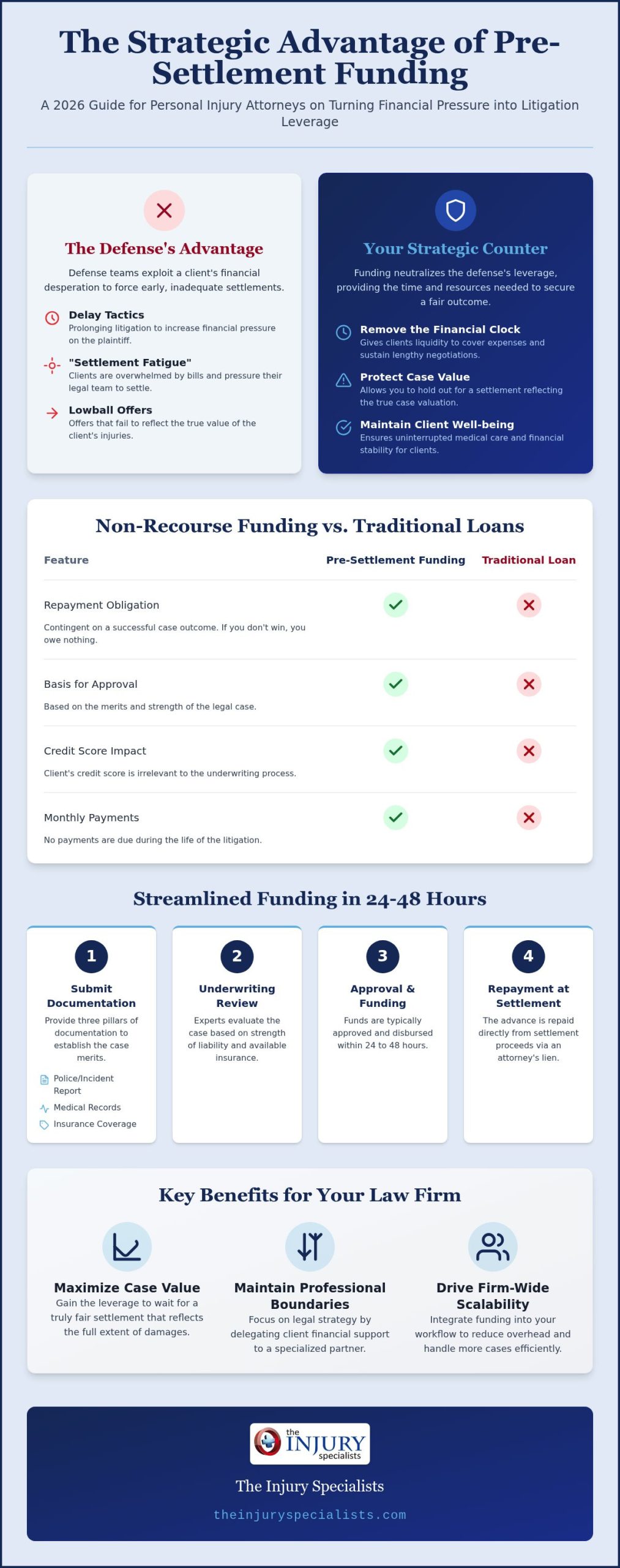
Pre-settlement funding for attorneys is a tactical tool designed to neutralize the defense’s primary advantage: the ability to wait. Unlike traditional debt, this is a non-recourse cash advance against the anticipated proceeds of a legal claim. In 2026, the industry has shifted away from isolated financial transactions toward integrated medical-legal funding ecosystems. These systems ensure that funding is tied directly to the case management process, allowing firms to scale without increasing their administrative burden.
A clear understanding of legal financing is essential for firms to distinguish these advances from “lawsuit loans.” While the term “loan” is frequently used in casual conversation, it’s technically inaccurate in a regulatory context. A loan implies a debt obligation regardless of the case outcome; pre-settlement funding is a contingent purchase of a portion of the future settlement. This distinction is critical for maintaining regulatory clarity and ensuring clients understand their obligations.
Non-Recourse Funding vs. Traditional Loans
The defining feature of pre-settlement funding is its non-recourse nature. If the case doesn’t result in a settlement or verdict, the client owes nothing. This “no-win, no-pay” structure shifts the financial risk away from the individual and onto the funding provider. Because the advance is based solely on the merits of the case, a client’s credit score is irrelevant during the underwriting process.
There are no monthly payments or interest installments required during the life of the litigation. This structure ensures that the client’s financial situation doesn’t deteriorate while the attorney builds the strongest possible case. It provides a level of financial security that traditional bank loans can’t offer, especially for plaintiffs who are unable to work due to their injuries.
Why Attorneys Advocate for Client Funding
Attorneys advocate for this service to combat “settlement fatigue.” This occurs when clients, overwhelmed by mounting living expenses and medical co-pays, pressure their legal team to accept inadequate offers. Utilizing pre-settlement funding for attorneys provides the liquidity needed to sustain long-term litigation. It allows the legal team to hold out for a valuation that reflects the true impact of the client’s injuries.
It also establishes a clear professional boundary between the firm and the client’s personal finances. By delegating financial support to a specialized partner, the legal team focuses on the case’s merits rather than the client’s bank balance. This separation protects the attorney-client relationship and prevents the firm from becoming an informal bank for its clients.
Operational Mechanics: How Funding Integrates with Law Firm Workflows
Efficiency is the benchmark for modern legal operations. Pre-settlement funding for attorneys should not create an administrative bottleneck. Most reputable providers now offer a 24 to 48-hour turnaround for funding approval once the necessary documentation is submitted. This speed is essential for clients facing immediate financial pressure. To facilitate this, firms must provide three primary pillars of documentation: police or incident reports to establish liability, comprehensive medical records to verify damages, and insurance coverage information to confirm the ability to pay.
The funding process relies on an attorney’s lien to secure the provider’s interest. This legal instrument ensures the funder is repaid directly from the settlement proceeds. When managing these agreements, firms should consult ethical guidance on litigation funding to maintain compliance and protect the attorney-client privilege. Modern workflows utilize technology to automate these requests, ensuring that the legal team remains focused on litigation rather than paperwork.
The Underwriting Process from the Firm’s Perspective
Underwriters evaluate cases based on objective risk factors rather than client creditworthiness. They focus on the strength of liability and the depth of available insurance coverage. Accurate medical documentation is the most critical variable in this decision. It allows the funding company to project a realistic settlement value, typically advancing between 10% and 20% of the expected recovery. This objective analysis ensures that the advance remains proportional to the final settlement, protecting the client’s ultimate payout.
Administrative Efficiency and Case Management Technology
Manual processes like “phone tag” and physical paperwork are obsolete in 2026. High-performance firms utilize centralized portals to automate status updates and documentation transfers. This integration reduces the time staff spends on non-billable administrative tasks. Implementing Personal Injury Case Management Technology allows for seamless communication between the firm and the funding provider. These systems create a transparent trail of all funding activity, which simplifies the final accounting process once the case closes. Leveraging a national medical-legal referral network can further simplify these workflows by centralizing care and funding data in one place.
Maximizing Case Value: Funding as a Tool for Litigation Leverage
Litigation is often an endurance test where the party with the most liquid capital holds the advantage. Insurance carriers frequently use time as a strategic weapon, employing delay tactics to exploit a plaintiff’s financial vulnerability. When a client faces mounting personal debt, they’re more likely to pressure their legal team to accept a settlement that doesn’t reflect the case’s true value. Utilizing pre-settlement funding for attorneys transforms this dynamic by removing the “expiration date” on a client’s ability to litigate. It levels the playing field against well-capitalized defense firms by ensuring the plaintiff has the financial runway to see the process through to a fair verdict or settlement.
The psychological impact on defense counsel shouldn’t be underestimated. When the defense realizes a plaintiff isn’t desperate for an immediate check, their negotiation strategy changes. They’re forced to evaluate the case based on its legal merits and the risk of a trial rather than the likelihood of a “fire sale” settlement. This shift protects the firm’s significant investment in experts, depositions, and man-hours, ensuring those costs aren’t wasted on a premature resolution.
Combating Defense Delay Tactics
Defense teams often identify the “stall point” in negotiations, typically during the intensive discovery and deposition phases. This is when the financial pressure on the plaintiff is highest. Pre-settlement funding for attorneys provides the stability needed to navigate these phases without compromise. With their basic needs met, clients can ignore the psychological pressure of a “first and final” lowball offer. This allows the attorney to maintain total control over the negotiation timeline, waiting for the defense to reach a realistic valuation.
Preserving the Attorney-Client Relationship
Administrative friction often stems from a client’s personal financial distress. When a plaintiff is struggling to pay for essential living expenses or medical co-pays, they often flood the firm with hardship calls. This creates a significant drain on staff resources and can strain the professional bond between the attorney and the client. By integrating funding into the case workflow, firms can address these concerns proactively. Benefits include:
- Reduced Administrative Drain: Fewer non-legal calls regarding personal bills and financial crises.
- Strategic Focus: The legal team spends more time on case merits and less on managing client anxiety.
- Increased Trust: Providing a solution for a client’s immediate needs demonstrates a holistic commitment to their recovery and success.
Establishing these boundaries early in the case ensures that the relationship remains focused on the legal objective. It positions the firm as a high-level facilitator that manages every aspect of the case ecosystem, from medical care to financial stability.
Evaluating Funding Partners: What Attorneys Must Look For
Choosing a partner for pre-settlement funding for attorneys is a strategic decision that impacts both firm efficiency and client satisfaction. Speed is a baseline requirement, but true value lies in transparency and operational synergy. Firms must prioritize partners who offer clear fee structures, specifically those utilizing simple interest models over complex compounding rates. Simple interest provides a predictable repayment figure. This simplicity streamlines the final distribution of funds and prevents surprises during the closing process.
The quality of a funder’s support staff is a direct reflection of their reliability. A responsive team ensures that documentation moves quickly and that status updates remain accurate. This reliability is particularly important when evaluating how a funder integrates with existing law firm medical referral programs. A well-integrated system allows for a cohesive flow of information between medical providers, the law firm, and the funding source. It removes the friction that often plagues fragmented medical-legal workflows.
Transparency and Ethical Considerations
Ethical funding practices protect the client’s net recovery. A reputable partner avoids “over-funding,” which occurs when the advanced amount exceeds a safe percentage of the expected settlement. Over-funding can effectively cannibalize the client’s recovery, leaving them with little to no funds after liens and attorney fees are paid. Attorneys should also review a funder’s history of cooperation during final negotiations. A strategic partner understands that cases don’t always reach their maximum projected value. They’re willing to work reasonably with the firm during the final accounting phase to ensure a fair outcome for all parties.
The Importance of a National Network
Scalability is essential for growing firms. Working with a funder that operates on a national scale ensures they understand the jurisdictional nuances and regulatory requirements of different regions. This breadth of experience is especially beneficial when combined with national physician referral services. An integrated network ensures that a client’s medical care and financial needs are managed through a unified system. This connectivity reduces the firm’s administrative burden and ensures consistent service quality across the entire case portfolio. You can access our national funding and referral network to streamline your firm’s medical-legal workflows and maximize case outcomes.
The Injury Specialists: Bridging the Gap Between Medical Care and Funding
The Injury Specialists functions as a high-level facilitator, bridging the critical gap between medical treatment and financial stability. Siloed funding services often operate in a vacuum, leading to administrative delays and gaps in a client’s medical care. By facilitating pre-settlement funding for attorneys within a broader case management ecosystem, we ensure that every case variable is optimized for success. This “power-connector” approach replaces fragmented communication with a streamlined triad of medical, legal, and financial services. It allows firms to maintain the financial runway needed for successful litigation while ensuring clients receive the care they require.
Our Case Management Technology serves as the central nervous system for this integration. It automates the documentation flow between medical providers and funding sources, reducing the manual labor typically associated with PI cases. This level of connectivity ensures that funding decisions are based on real-time medical data, which increases underwriting accuracy and approval speeds. Attorneys who utilize this integrated model experience fewer disruptions and a more predictable path toward settlement.
Integrated Medical Case Management
Cohesive case management requires that funding be utilized as a strategic asset for the client’s recovery and the case’s evidence. When financial barriers are removed, medical care remains uninterrupted. This continuity is vital for establishing the medical evidence necessary to secure high-value settlements. Our platform coordinates between imaging centers, physicians, and funding providers to maintain a seamless flow of care and documentation. For a deeper analysis of these connections, consult The Comprehensive Guide to Personal Injury Referral Networks. This integrated approach ensures that every medical touchpoint is documented and funded, strengthening the overall litigation position.
Joining the National Referral Network
Attorneys leverage our national network to scale their practices without increasing their internal administrative footprint. We provide the infrastructure needed to manage complex personal injury cases across multiple jurisdictions with ease. Our technology handles the heavy lifting of tracking medical referrals and funding status, allowing your legal team to focus exclusively on litigation strategy and case valuation. This system is designed for firms that value efficiency, growth, and professional synergy. Optimize your firm’s medical and financial workflows by joining our national network today to secure the litigation leverage your clients deserve. By utilizing pre-settlement funding for attorneys through an integrated provider, you position your firm as a dominant leader in the personal injury sector.
Scaling Your Practice with Integrated Litigation Support
Mastering the strategic use of pre-settlement funding for attorneys is essential for any firm looking to dominate the personal injury sector in 2026. This guide has detailed how shifting from siloed services to an integrated ecosystem protects case value and streamlines medical-legal workflows. By neutralizing the defense’s ability to exploit client financial weakness, you maintain the necessary leverage to secure maximum settlements. This approach ensures your firm operates with the scale and efficiency required in a competitive market.
Operational success relies on adopting centralized technology that connects medical providers, funding sources, and legal teams. This connectivity reduces administrative friction and ensures that your staff remains focused on high-value litigation tasks rather than manual documentation. Choosing transparent partners who prioritize the client’s net recovery will strengthen your firm’s reputation and foster long-term professional trust. These strategic choices transform financial pressure into a tactical advantage for your practice.
You can gain a competitive edge by accessing the largest PI referral network in the US. Our platform provides the integrated medical case management technology trusted by thousands of medical and legal professionals nationwide. Join the largest personal injury referral and funding network today to optimize your practice. Your firm is ready to turn logistical challenges into a streamlined engine for growth and superior results.
Frequently Asked Questions
How does pre-settlement funding differ from a traditional bank loan for attorneys?
Pre-settlement funding for attorneys is a non-recourse cash advance rather than a traditional loan. Bank loans require monthly payments and personal guarantees regardless of the case outcome. Funding is contingent upon a successful settlement or verdict. If the case is lost, the client owes nothing. This structure prioritizes the merits of the legal claim over the client’s credit history, providing a strategic advantage in personal injury litigation.
What happens to the pre-settlement advance if the personal injury case is lost?
If the personal injury case is lost, the client has no obligation to repay the advance. Pre-settlement funding is non-recourse, meaning the risk of loss lies entirely with the funding provider. The lien on the future settlement proceeds is extinguished if there is no recovery. This protection ensures that plaintiffs can pursue justice without the risk of incurring debt that they don’t have the means to repay after an unsuccessful legal outcome.
Can pre-settlement funding be used to pay for a client’s medical procedures?
Pre-settlement funding is often used to ensure uninterrupted medical care for injured plaintiffs. It provides the liquidity needed to pay for surgical procedures, imaging, and rehabilitation services that insurance might not immediately cover. Consistent medical treatment is critical for the client’s recovery and for building the evidentiary record of the case. Using funding for medical needs prevents gaps in care that defense counsel could use to devalue the claim.
How much administrative work is required from my law firm to facilitate funding?
Administrative overhead is significantly reduced through the use of integrated case management technology. Automated portals handle documentation transfers, status updates, and lien management. Your firm’s staff spends less time on manual data entry and “phone tag” with funding companies. This streamlined approach allows your team to focus on maximizing case value. Leveraging a national referral network ensures that medical and financial workflows are synchronized for maximum efficiency.
Is pre-settlement funding ethical for attorneys to recommend to their clients?
Recommending pre-settlement funding for attorneys is ethical provided that the attorney maintains independent professional judgment. Many state bar associations have issued guidance confirming that lawyers can advise clients on these financial options. It’s essential to ensure the client understands the repayment terms and that the funding doesn’t create a conflict of interest. Partnering with reputable, transparent funders helps maintain high ethical standards while providing clients with the leverage to wait for fair settlements.
What types of personal injury cases are eligible for pre-settlement funding in 2026?
Eligible case types in 2026 span the entire personal injury spectrum, including motor vehicle accidents, slip and fall incidents, and workplace injuries. Funding companies also provide advances for more complex claims like medical malpractice, product liability, and wrongful death cases. The main requirements are established liability and a clear path to recovery through insurance or corporate assets. Each case is evaluated on its individual merits and the projected settlement timeline.
How does the funding company determine the amount of the cash advance?
Funding amounts are determined by a rigorous underwriting process that evaluates the projected settlement value. Companies typically advance between 10% and 20% of the expected recovery. Underwriters analyze police reports, medical records, and insurance policy limits to assess the risk. This conservative calculation protects the client’s net recovery at the end of the case. It ensures that the advance remains a helpful tool rather than a burden that consumes the entire settlement.
Can a client receive multiple rounds of funding during a single case?
Clients can receive multiple rounds of funding as their case progresses and the valuation becomes more certain. Initial advances often cover immediate needs, while subsequent rounds can be approved as more medical evidence or expert testimony is documented. This flexibility allows attorneys to adapt to changing case timelines and defense tactics. Re-evaluating the case at different stages ensures that the client has a consistent financial runway to see the litigation through to its conclusion.
