

The most expensive part of your personal injury practice isn’t your marketing budget. It’s the hidden integration tax paid every time your staff toggles between disconnected software tools. While Filevine has long been a staple in the industry, many high-growth firms now find its clunky interface and steep learning curve are active barriers to scaling. If your team spends more time managing medical liens in spreadsheets than closing cases, it’s time to evaluate Filevine alternatives for personal injury that actually bridge the gap between legal workflows and medical provider networks.
We understand that switching your core operating system feels like a logistical nightmare. You need a platform that reduces administrative overhead through automation rather than adding another layer of complexity. This guide promises to reveal the top legal technology platforms that surpass Filevine in efficiency, medical-legal integration, and referral network growth. We will compare the leading 2026 solutions, analyze their pricing structures, and show you how a unified ecosystem can transform your firm into a streamlined, high-volume powerhouse.
Key Takeaways
- Identify why high-growth firms are moving away from general case management toward specialized ecosystems that eliminate the clutter factor.
- Evaluate the best Filevine alternatives for personal injury by comparing leading specialized platforms against generalist tools.
- Discover how shifting from simple software to a medical-legal ecosystem automates provider referrals and simplifies lien management.
- Learn how integrating medical case management directly into your firm’s process drives referral network growth and reduces administrative overhead.
- Use our 2026 evaluation framework to audit current bottlenecks and ensure a seamless data migration from your existing system.
Why Personal Injury Firms Seek Filevine Alternatives in 2026
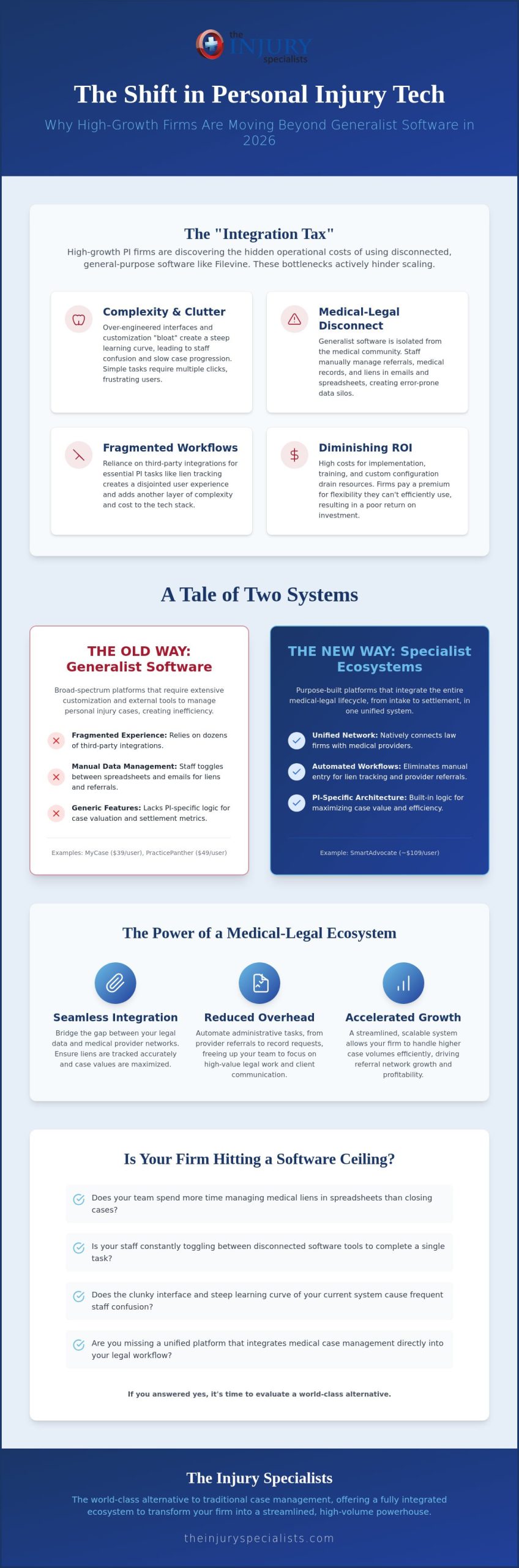
High-growth personal injury firms are moving away from broad-spectrum software. In 2026, the priority has shifted from simple record-keeping to specialized PI ecosystems that facilitate rapid case progression. Many firms initially chose Filevine for its flexibility, but they now face a diminishing return on investment. The search for Filevine alternatives for personal injury is driven by a need for systems that integrate the medical-legal lifecycle directly into the core platform.
Generalist law practice management software often ignores the logistical heavy lifting required for PI cases. This creates an “Integration Tax,” a hidden operational cost where staff must manually manage medical records, provider communications, and lien resolutions outside the primary system. Scalability in the current market requires a power-connector approach that bridges the gap between legal data and medical providers.
The Complexity Trap: When Customization Becomes Clunky
Filevine is built on a foundation of total customization. While this sounds beneficial, it often leads to an over-engineered environment where simple tasks require multiple clicks. The hidden costs of extensive implementation and training can drain a firm’s resources before they even launch their first case. Over-engineered workflows slow down intake and case progression, creating bottlenecks that frustrate both staff and clients.
- Implementation Costs: Firms often spend months and significant capital just to configure basic workflows.
- Staff Confusion: High turnover in law firms means constant retraining on a clunky interface that lacks intuitive logic.
- Workflow Bloat: Custom fields and sections accumulate over time, making it difficult to find critical case data quickly.
Small to mid-sized firms suffer most from this software bloat. They require efficiency and speed, not a platform that requires a full-time administrator to maintain.
The Medical-Legal Connectivity Gap
The most significant failure of traditional software is its isolation from the medical community. Personal injury success depends on the quality and speed of medical care and documentation. Managing physician referral services for personal injury through external emails and phone calls creates a data silo that is prone to error. Standard software fails to bridge the gap between attorneys and medical providers, leaving staff to manage liens and imaging referrals in a vacuum.
Effective Filevine alternatives for personal injury solve this by creating a unified network. Instead of just performing data entry, firms need a platform that facilitates professional networking and real-time connectivity. This approach ensures that medical liens are tracked accurately and case values are maximized through better documentation and faster treatment cycles. Moving beyond simple document storage is the only way to achieve true scalability in 2026.
Top Specialized Personal Injury Case Management Alternatives
High-volume personal injury firms often outgrow generalist software. While many platforms provide excellent billing and document storage, they frequently lack the specialized architecture required for complex litigation. Searching for Filevine alternatives for personal injury usually leads to specialized platforms that focus on case lifecycle management and settlement metrics rather than just time tracking or simple task lists. These tools prioritize the specific data points that drive case value in a PI practice.
The “Generalist vs. Specialist” debate is settled by the specific needs of PI workflows. In 2026, generalist tools like MyCase (starting at $39 per user) or PracticePanther (starting at $49 per user) remain popular for small firms, but they often require dozens of third-party integrations to handle medical records or lien tracking. This creates a fragmented experience for staff. Specialized platforms eliminate this friction by building PI-specific logic directly into the source code, ensuring that every feature serves a purpose in the personal injury ecosystem.
SmartAdvocate and PracticePanther: The PI Powerhouses
These platforms represent reliable options for dedicated personal injury management. SmartAdvocate, which starts at approximately $109 per user per month, caters to large-scale firms needing deep reporting capabilities. It allows partners to mine data for trends in adjuster behavior or provider costs, providing granular insight that basic task managers cannot match. PracticePanther offers a solo-friendly starting point while maintaining a Business Pro tier at $114 per user for firms that need more robust automation. Both platforms handle the specific nuances of PI litigation by emphasizing document automation and deadline tracking.
Litify and Salesforce-Based Solutions
Litify stands out as the enterprise alternative to Filevine. Built on the Salesforce architecture, it offers infinite customization and advanced AI integration. It’s often the choice for firms with over 50 users who need a bespoke operating system tailored to complex organizational structures. However, this power comes with a trade-off. Litify typically starts at $150 per user per month and requires significant setup time and technical expertise. For firms that need immediate utility, the “out-of-the-box” features of specialized PI tools might be preferable to the complex building blocks of a Salesforce-based system.
When evaluating these alternatives, look for features that automate the heavy lifting of a PI practice. Essential 2026 capabilities include auto-demand generation, integrated lien calculators, and real-time medical record tracking. For firms looking to move beyond simple software and into a high-growth ecosystem, integrating your case management with a national referral network is the most efficient way to scale. By choosing a platform that prioritizes medical-legal connectivity, you reduce the administrative burden on your staff and accelerate your firm’s growth.
Beyond Software: The Rise of the Medical-Legal Ecosystem
Personal injury firms often mistake case management software for a complete business solution. While tracking deadlines and storing documents is essential, software alone does not generate new cases or resolve medical liens. The shift toward physician referral services for personal injury signals a broader trend in the industry. High-growth firms now prioritize medical-legal ecosystems that connect them to a broader professional community rather than siloed databases.
Most Filevine alternatives for personal injury focus strictly on internal productivity. A true ecosystem integrates medical case management into the firm’s distinct process. This ensures every client receives cohesive care from the start of their claim. When medical data flows seamlessly between providers and attorneys, settlement values increase because the documentation is comprehensive, accurate, and delivered on time. Moving beyond simple task management allows partners to focus on firm expansion rather than administrative troubleshooting.
Bridging the Silo Between Law and Medicine
The traditional separation between legal workflows and medical treatment creates massive operational drag. Paralegals typically spend hours on manual doctor searches and lien negotiations. This fragmented process is prone to error and slows down case progression. Ecosystem platforms automate these connections, linking attorneys directly with imaging centers and specialized physicians through a unified interface.
Security is a non-negotiable component of this professional exchange. These platforms ensure HIPAA compliance across the entire communication chain, protecting sensitive patient data while maintaining high operational speed. By removing the friction of manual data requests, firms focus on litigation strategy rather than chasing medical records. This connectivity transforms the case lifecycle from a series of hurdles into a streamlined path to resolution.
Facilitating Growth Through Referral Networks
Software-only solutions are static. They help you manage your current caseload, but they don’t help you expand your footprint. A strategic advantage of modern Filevine alternatives for personal injury is the inclusion of built-in marketing and networking tools. Joining a national referral network allows firms to connect with medical partners who are already vetted and familiar with the specific requirements of personal injury cases.
This growth-oriented approach also includes integrated financial tools that benefit both the firm and the client. Leveraging pre-settlement funding within your primary platform provides a critical value-add for injury victims facing immediate financial pressure. It creates a more professional, reliable experience for the client while ensuring the firm has the resources to litigate the case to its full potential. Choosing a platform that acts as a power-connector positions your firm as a dominant, well-connected market leader.
Evaluation Framework: How to Choose Your Next Platform
Selecting a new operating system for your firm requires a strategic assessment of your current throughput. Many firms realize they need Filevine alternatives for personal injury only after identifying critical bottlenecks in their intake or settlement phases. You must determine if your current delays stem from software limitations or manual processes that the software fails to automate. A platform that doesn’t solve your staff’s daily friction is merely a different version of the same problem.
The Migration Audit is the most technical phase of this transition. When interviewing vendors, you must ask specific questions about how they handle your existing Filevine data. Ensure they provide a clear map for moving custom fields, communication logs, and document histories. Data loss during a move can paralyze a high-volume firm for weeks. Prioritize providers who offer a dedicated migration team to manage the technical heavy lifting.
Staff adoption is the final hurdle. Even the most powerful Filevine alternatives for personal injury will fail if the UI/UX is counterintuitive. A clunky interface increases transition downtime and leads to internal resistance. Look for platforms that prioritize a clean, logical layout that mirrors a PI case’s natural lifecycle. This reduces the learning curve and allows your team to maintain momentum during the switch. Firms that take a systematic approach to streamlining personal injury case workflow consistently report faster staff adoption and fewer operational disruptions when transitioning to a new platform.
For high-growth firms like Temecula Valley Injury Attorneys, a streamlined interface also makes it easier to manage third-party experts and property evaluators; to explore how professional inspection services provide the necessary data for premises liability claims, click here.
The ROI of Integrated Case Management
Measuring the success of a new platform goes beyond looking at the monthly subscription cost. You must calculate the time saved per matter when medical records and liens are managed through a systematic, integrated approach. Firms that utilize medical-legal networking often see a direct impact on their average settlement amounts. Comprehensive documentation and faster treatment verification allow for more aggressive demand packages.
Integrated marketing and tracking tools also reduce the volume of “lost” referrals. When your software talks directly to your referral sources, you close the loop on case status updates automatically. This transparency builds trust with your partners and ensures a steady stream of high-quality leads. To maximize these benefits, join the nation’s largest referral network and integrate your workflows with a world-class technology platform.
Security and Compliance Checklist
Data security is a non-negotiable requirement for modern legal operations. Any cloud-based alternative must maintain SOC 2 and HIPAA compliance to protect both firm and client data. Beyond basic security, evaluate the vendor’s policy on data ownership. You must retain the ability to export your entire database at any time to avoid vendor lock-in. Finally, ensure the provider offers 24/7 technical support. High-volume firms cannot afford to wait for business hours to resolve a critical system issue. Firms navigating the May 2026 regulatory updates should review the latest requirements for HIPAA compliant software for law firms to ensure their chosen platform meets mandatory technical safeguards.
- SOC 2 Type II: Verifies that the provider follows strict data security and privacy protocols.
- HIPAA Compliance: Essential for handling sensitive medical records and provider communications.
- Data Portability: Ensures you own your data and can move it if your needs change.
- Uptime Guarantees: Look for 99.9% availability to ensure your firm stays operational around the clock.
The Injury Specialists: The World-Class Alternative to Traditional Case Management
Standalone software is a passive tool. It records data but does not actively drive case value or professional growth. While many Filevine alternatives for personal injury focus on rearranging the same basic features, The Injury Specialists provides a world-class technology platform that functions as a proactive business partner. We combine advanced case management technology with the largest national referral network in the United States to create a system that prioritizes movement and results.
The primary advantage of our platform is the integration of medical case management directly into your firm’s distinct process. This isn’t just a digital filing cabinet. It’s a strategic framework that ensures medical documentation is handled with the same precision as legal filings. By aligning these two critical sectors, firms reduce the administrative friction that typically slows down settlements and increases overhead costs.
A Unified Ecosystem for Attorneys and Providers
Our technology platform streamlines the connection between law firms, physicians, and imaging centers. This unified ecosystem facilitates seamless documentation and communication, ensuring that attorneys have real-time access to the medical data they need to litigate effectively; for example, firms can visit The Orthopaedic & Sports Medicine Institute to see how specialized orthopedic care and documentation are integrated into the case lifecycle. We remove the logistical hurdles that often plague personal injury firms, such as the manual tracking of treatment progress or the negotiation of complex liens.
Our system also addresses the financial realities of high-stakes litigation. We provide integrated solutions for pre-settlement funding and medical lien management, allowing firms to support their clients while maintaining operational liquidity. This approach transforms the case management platform from a simple database into a power-connector that manages every touchpoint of the medical-legal lifecycle.
Ready to Scale Your Firm?
Top-tier firms are moving beyond Filevine because they require more than just document storage. They need an integrated ecosystem that provides immediate access to specialized injury experts and a scalable referral base. Our national network allows you to expand your reach without the typical costs associated with manual networking and marketing. You gain the ability to manage higher case volumes while maintaining the high quality of care and documentation that drives maximum settlement values.
The logical conclusion for a growth-oriented firm is to adopt a platform that bridges the gap between different professional sectors. Standalone software cannot help you grow your referral partner base, but a dedicated medical-legal network can. Experience the future of medical-legal case management with The Injury Specialists.
Scale Your Practice with a Unified Medical-Legal Ecosystem
Transitioning to a new operating system is a strategic investment in your firm’s future. The shift toward Filevine alternatives for personal injury demonstrates a clear industry move away from fragmented tools toward unified ecosystems. You’ve seen how specialized platforms offer deeper functionality, but true scalability requires more than just better software. Success in 2026 depends on your ability to bridge the gap between legal workflows and medical provider networks.
The Injury Specialists offers a world-class alternative by providing the largest PI referral network in the US. Our platform features integrated medical case management and national coverage for physicians and imaging centers. This ensures your staff spends less time on administrative hurdles and more time on high-value litigation. It’s time to move beyond standalone databases and adopt a power-connector model that drives growth. Join the largest personal injury referral network and upgrade your technology today. We look forward to facilitating your firm’s expansion and helping you dominate your market.
Frequently Asked Questions
What is the best Filevine alternative for personal injury firms in 2026?
The Injury Specialists is the premier choice because it combines a national referral network with advanced case management technology. Unlike standalone software, it connects firms directly with medical providers and imaging centers. This ecosystem approach addresses the specific logistical needs of personal injury firms that generalist tools often ignore.
Is it difficult to migrate case data from Filevine to another platform?
Migrating case data from Filevine is a structured process that requires a dedicated technical audit to ensure data integrity. Most modern platforms provide specialized migration teams to map custom fields, communication logs, and document histories. Selecting a vendor with a proven migration framework minimizes downtime and prevents data loss during the transition.
How do specialized PI platforms handle medical lien management differently?
Specialized platforms automate lien tracking by integrating medical provider data directly into the case file. This eliminates the need for manual spreadsheets and separate tracking tools. These systems provide real-time updates on treatment costs and outstanding balances; this allows paralegals to resolve liens faster and more accurately during the settlement phase.
What are the benefits of an integrated medical-legal referral network?
An integrated referral network provides immediate access to vetted medical experts and imaging centers, which accelerates the treatment phase of a case. Firms benefit from streamlined communication and automated status updates from providers. This connectivity reduces administrative overhead and ensures that medical documentation is comprehensive and ready for demand packages.
Are there HIPAA-compliant alternatives to Filevine that offer better medical integration?
The Injury Specialists provides a HIPAA-compliant environment designed specifically for the exchange of medical-legal data. Many Filevine alternatives for personal injury offer basic cloud security, but few provide deep integration with a national network of physicians. Our platform ensures that all medical records and provider communications remain secure while facilitating faster treatment cycles. Firms seeking a comprehensive comparison of platforms that meet the latest regulatory standards can explore our guide to HIPAA compliant software for law firms to evaluate the full range of 2026-ready options.
How much does it typically cost to switch case management software?
Switching costs vary based on firm size and data volume, typically including a one-time migration fee and a monthly per-user subscription. Competitor pricing in 2026 ranges from $39 to $150 per user per month. Firms should also account for the hidden costs of standalone tools, as platforms that include built-in referral networks often provide a higher ROI through increased efficiency.
Can I integrate pre-settlement funding directly into my case management workflow?
Yes, modern ecosystems allow you to manage pre-settlement funding requests within the same interface as your case files. This integration streamlines the application process for clients and provides the firm with better visibility into outstanding advances. Centralizing these financial tools ensures that funding doesn’t become a separate administrative burden for your staff.
Why is medical case management critical for a PI firm’s success?
Medical case management ensures that a client’s treatment and documentation are cohesive, which directly impacts the final settlement value. When a firm manages the medical-legal lifecycle systematically, they avoid gaps in treatment and incomplete records. This professional oversight demonstrates the full extent of the client’s injuries to adjusters, which helps maximize the case outcome.
About the Author: admin
