

In a $63 billion market, most practices still treat referral growth as a game of chance rather than a disciplined science. You understand that inconsistent volume and fragmented communication between medical and legal teams aren’t just daily inconveniences; they’re direct threats to your case value and long-term financial stability. Unreliable documentation and the constant risk of unpaid medical liens often stall the momentum of even the most promising personal injury patient referrals, leaving your practice vulnerable to market fluctuations and administrative bottlenecks.
You deserve a system that replaces guesswork with logistical precision. This guide will help you master the mechanics of high-quality medical-legal referrals and demonstrate how to scale your practice using the nation’s largest integrated network. We’ll explore how to leverage proprietary case management technology and professional synergy to build a predictable stream of high-intent patients. By the end of this article, you’ll know how to achieve better settlement outcomes through cohesive care and a streamlined, technology-first approach to professional growth.
Key Takeaways
- Understand the B2B mechanics of personal injury patient referrals to transform your practice into a high-volume growth engine.
- Utilize a 5-step checklist to identify lien-friendly medical providers who align with your firm’s distinct legal processes.
- Implement centralized technology and medical case management to reduce administrative friction and secure better settlement outcomes.
- Scale your reach by accessing a nationwide network of 1,000+ professionals and integrated pre-settlement funding solutions.
Understanding the Personal Injury Patient Referral Ecosystem
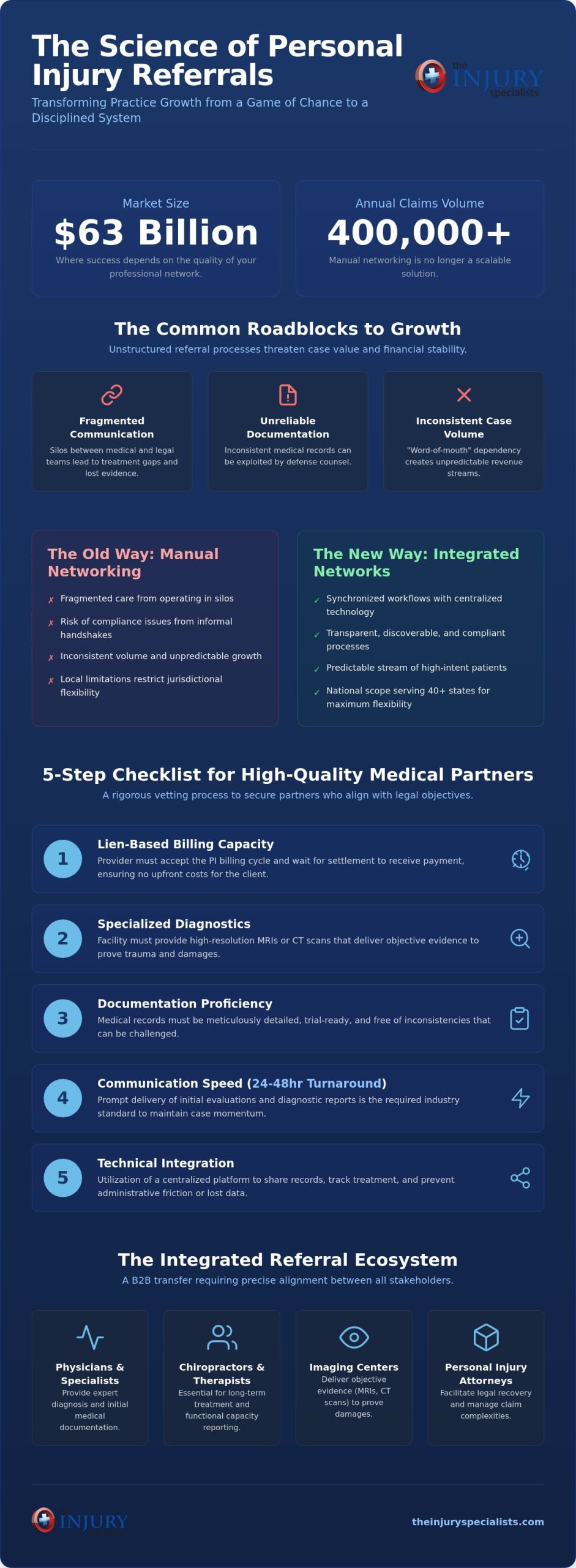
The personal injury sector is a $63 billion industry where success depends on the quality of your professional network. Strategic personal injury patient referrals represent the bridge between a victim’s physical recovery and their legal restitution. This isn’t a casual recommendation; it’s a precise business-to-business transfer that requires alignment between medical and legal objectives. When these two sectors synchronize, they create a high-volume growth engine that benefits the patient, the provider, and the firm.
The ecosystem includes several key stakeholders:
- Physicians and Specialists: They provide the first line of medical documentation and expert diagnosis.
- Chiropractors and Physical Therapists: These professionals are essential for long-term treatment and functional capacity reporting.
- Imaging Centers: They deliver the objective evidence, such as MRIs and CT scans, required to prove damages.
- Personal Injury Attorneys: They facilitate the legal recovery and manage the complexities of personal injury claims.
The 2026 landscape has changed significantly. With approximately 400,000 claims filed annually in the US, manual networking is no longer sufficient for scaling a practice. Evolving regulatory landscapes nationwide increase the need for transparency and discoverability in referral arrangements. Professionals who rely on informal handshakes risk compliance issues and inconsistent volume. To thrive, you must move toward a more structured, technology-driven approach.
The Shift from Manual Networking to Integrated Networks
Traditional “word-of-mouth” referrals often result in fragmented care. When a medical provider and a law firm operate in silos, treatment gaps occur and legal evidence is lost. Modern growth requires integrated networks that use technology to synchronize workflows and eliminate administrative errors. A network with a national scope, serving 40+ states, allows for jurisdictional flexibility that local networks lack. It ensures that regardless of where the accident occurred, the patient receives consistent, documented care that supports the legal case value.
Identifying High-Intent Leads vs. General Inquiries
Not all leads are created equal. High-intent personal injury patient referrals are characterized by clear liability and documented trauma. The foundation of a strong legal case is immediate medical intervention. When a patient is referred quickly to a specialist or an imaging center, the resulting diagnostic data validates the referral quality early in the process. This objective evidence separates a high-value case from a general inquiry. By focusing on patients who receive immediate, documented care, attorneys ensure their resources are allocated to cases with the highest likelihood of a successful settlement.
Criteria for High-Quality Medical Provider Referrals
Securing high-quality personal injury patient referrals requires a rigorous vetting process. You can’t rely on general practitioners who lack experience with the nuances of the legal system. Instead, attorneys must identify partners who understand that their medical role is half of a larger strategic objective. High-quality partners operate on a medical lien basis. This ensures the patient receives care without upfront costs while the firm builds the case without immediate financial drain.
Use the following 5-step checklist to evaluate potential medical referral partners:
- Lien-Based Billing Capacity: Providers must accept the personal injury billing cycle and wait for the case settlement to receive payment.
- Specialized Diagnostics: The facility must provide high-resolution MRIs or CT scans that objectively prove trauma.
- Documentation Proficiency: Medical records must be trial-ready and free of inconsistencies that defense counsel can exploit.
- Communication Speed: A 24 to 48 hour turnaround on initial evaluations and diagnostic reports is the required industry standard.
- Technical Integration: The provider should use a centralized platform to prevent lost records or treatment gaps.
General practitioners often don’t have the administrative infrastructure to handle the specialized billing and reporting needs of a PI case. They may demand health insurance or upfront payments, which complicates the legal strategy. To scale, you need specialists who are accustomed to the “B2B” nature of these transactions. Joining a vetted network like The Injury Specialists provides immediate access to these pre-qualified professionals who prioritize both clinical and legal outcomes.
The Importance of Specialized Chiropractic and Imaging Care
Chiropractors and physical therapists act as the primary front line for PI cases. They often see the patient most frequently, making their notes vital for establishing the duration and intensity of the injury. Attorneys often utilize physician referral services personal injury specialists recommend to ensure they are partnering with lien-friendly experts. Rapid, high-resolution diagnostic data from specialized imaging centers is equally critical. These reports provide the objective evidence needed to validate subjective pain claims early in the litigation process.
Documentation Standards That Support Legal Settlements
The strength of a settlement is directly proportional to the quality of the medical documentation. Detailed SOAP notes that clearly link the accident to the specific injury are non-negotiable. Effective Medical-legal partnerships depend on providers who recognize their clinical findings serve as the foundation for legal recovery. Medical case management is the systematic coordination of a patient’s treatment plan to ensure clinical compliance while simultaneously preserving the integrity of legal evidence. Proactive management prevents gaps in care that insurance adjusters use to devalue claims. Medical groups looking to eliminate these administrative burdens can benefit from reviewing the criteria outlined in the healthcare provider personal injury network 2026 professional buying guide to identify the right strategic partner.
Optimizing Law Firm Workflows for Incoming Referrals
High-volume growth requires more than just lead generation. It demands an intake system that can process personal injury patient referrals with zero latency. When a physician refers a patient, your law firm must act as a sophisticated logistical partner. Friction during this hand-off often leads to patient drop-off or devalued claims. Standardizing your intake protocols ensures that every referral is captured, vetted, and integrated into your firm’s distinct workflow immediately. This transition should feel seamless to both the patient and the referring provider.
To reduce administrative friction, firms should implement the following protocols:
- Standardized Intake Documentation: Use digital forms that capture essential case data directly from the medical provider.
- Automated Confirmations: Send an immediate receipt notification to the referring physician to acknowledge the patient’s entry into your system.
- Rapid Consultation Scheduling: Aim for a same-day or next-day initial legal consultation to maintain the momentum of the referral.
Positioning your firm as a value-add partner means proving you can handle the administrative burden of a PI case. Medical providers want to know their patients are in professional hands and that their liens will be protected. By adopting a technology-first approach, you provide the reliability that physicians expect from a high-level strategic partner. This operational excellence turns a one-time referral into a long-term, high-volume pipeline.
Integrating Medical Case Management into Legal Strategy
Effective medical case management bridges the gap between clinical findings and legal arguments. In 2026, paperless communication is the mandatory standard for professional legal workflows. Using a centralized digital platform allows your team to track patient progress in real-time. This visibility prevents surprise settlement hurdles, such as unexplained gaps in treatment or missing diagnostic reports. By aligning medical treatment with your firm’s specific processes, you ensure the medical evidence is robust enough to support maximum settlement values. It’s about creating a “trial-ready” file from the moment the patient first enters the clinic.
Building Trust with Referring Physicians
Trust is the currency of the referral ecosystem. Physicians need transparency regarding case status without violating attorney-client privilege. Providing high-level updates on case milestones keeps the doctor engaged in the partnership. Prompt lien resolution is equally vital. Ensuring medical providers are paid fairly and quickly upon settlement maintains the health of your referral pipeline. When you treat medical providers as professional peers rather than just evidence sources, you secure your position as the preferred choice for personal injury patient referrals. Physicians who want to maximize their position in this ecosystem should explore a dedicated personal injury marketing for physicians strategy to build compliant, high-volume referral pipelines with top-tier law firms. Marketing your firm as a PI specialist who respects the medical billing cycle—and reinforcing that image with professional branding from KP Innovations—is the most effective way to build a sustainable network.
The Role of Technology and Funding in Referral Success
Scaling a practice requires moving beyond manual processes that are prone to human error. A centralized digital platform is the only way to effectively manage high-volume personal injury patient referrals without losing critical data. Administrative errors, such as misfiled medical records or missed appointments, directly impact case value and professional reputation. By implementing a technology-first approach, you ensure that every referral is tracked from the initial intake through the final settlement. This level of oversight is particularly critical during emergency intakes. Having 24/7 access to a verified provider network allows for immediate medical intervention and evidence preservation, ensuring the case starts on a solid foundation.
Technology also accelerates the legal timeline. Using integrated portals to retrieve medical records on-demand allows firms to compile demand packages weeks faster than traditional methods. This efficiency isn’t just about speed; it’s about cash flow and maintaining a competitive edge. When you can demonstrate a streamlined process for record retrieval, you reinforce your firm’s status as a sophisticated operator in the medical-legal ecosystem.
Leveraging Digital Platforms for Real-Time Case Tracking
The industry has shifted decisively away from the era of faxing paper records. Modern legal-medical portals provide secure, cloud-based environments where providers and attorneys can exchange data instantly. Automation reduces the massive overhead costs typically associated with managing a large referral base. These systems also ensure strict HIPAA compliance by providing encrypted, audit-trailed access to sensitive patient information. To see how these tools can transform your workflow, explore the Case Management Technology offered by our network.
How Pre-Settlement Funding Protects Treatment Continuity
Pre-settlement funding acts as a vital bridge for victims during their physical recovery. Financial stress is the leading cause of treatment dropout, which creates “gaps in care” that insurance adjusters use to devalue claims. When patients have access to non-recourse funding, they can maintain their treatment schedules and follow clinical advice without the pressure of immediate bills. This continuity is essential for documenting the full extent of the injury. There is a powerful synergy between funding and personal injury patient referrals. A healthy ecosystem provides both the care the patient needs and the financial support to ensure they finish that care. This integrated approach protects the patient’s health and the attorney’s case value simultaneously.
Securing Scalable Referrals via The Injury Specialists Network
The final step in mastering high-volume growth is moving from isolated partnerships to a coordinated ecosystem. Joining a nationwide network of over 1,000 professionals allows you to scale your practice with confidence. You aren’t just looking for a single source of personal injury patient referrals; you’re building a sustainable business footprint. By utilizing an all-in-one platform that integrates referrals, medical case management, and pre-settlement funding, you eliminate the fragmentation that devalues cases. This strategic infrastructure provides a significant competitive advantage in a crowded market.
Onboarding with The Injury Specialists is an efficient, “Easy as 1-2-3” process designed for busy professionals. First, you register your practice to join the vetted directory. Second, you integrate with the proprietary digital platform to begin receiving and sending referrals. Third, you leverage the network’s case management tools to ensure every patient receives high-quality, documented care. This streamlined approach allows you to focus on results rather than administrative logistics. It transforms your practice from a reactive participant into a proactive leader in the medical-legal field.
Joining the Largest Nationwide Medical-Legal Network
Operating across 40+ states, this network provides the reach necessary for modern personal injury practices. Whether you need to find a specialized imaging center in a different jurisdiction or secure co-counsel for a complex case, the resources are immediately available. This is the “Power-Connector” advantage. It grants you instant credibility with top-tier PI professionals who value efficiency and results. By joining a personal injury referral network, you position your practice at the center of the industry’s most influential medical-legal bridge. You gain access to a platform built for scale, reliability, and professional synergy.
Requesting a Demo of the Proprietary Referral Technology
Seeing the digital platform in action is the best way to understand its impact on your bottom line. A personalized demo provides a full walkthrough of the secure portal, showing you exactly how to manage cases and track treatment progress in real-time. You’ll explore the networking features that connect you with high-intent personal injury patient referrals and the integrated funding tools that protect treatment continuity. This is your opportunity to see how a technology-first strategy eliminates the overhead of manual case tracking. Request Your Demo and discover the power of the largest injury referral network today.
Scaling Your Practice Through Strategic Connectivity
High-volume growth in the personal injury sector isn’t a result of luck; it’s the product of a disciplined logistical system. You’ve seen how shifting from manual networking to integrated digital platforms eliminates administrative errors and secures treatment continuity. By focusing on lien-friendly providers and trial-ready documentation, you protect the value of every case from the initial intake. These strategies ensure your practice remains resilient against regulatory shifts and administrative bottlenecks.
Mastering personal injury patient referrals requires a strategic bridge between the medical and legal sectors. The Injury Specialists provides this bridge through the nation’s largest injury network, serving over 40 states with more than 1,000 vetted professionals. Our proprietary digital platform and integrated pre-settlement funding ensure that your practice remains efficient, compliant, and positioned for rapid expansion. You don’t have to manage the complexities of case coordination alone when you have access to a proven, technology-first ecosystem.
Request Your Demo and discover the power of the largest injury referral network in the US today. Take the first step toward a more predictable and scalable future for your professional practice.
Frequently Asked Questions
How do personal injury patient referrals differ from standard medical referrals?
Personal injury patient referrals differ from standard medical referrals because they involve a medical-legal partnership based on lien-based billing. Standard referrals typically operate via health insurance or upfront payments. In a PI context, the provider must also produce trial-ready documentation that links the injury directly to the accident. This requires a higher level of administrative coordination and specialized reporting that general medical practices aren’t always equipped to handle.
Can a physician refer a patient to a personal injury attorney?
Physicians can refer patients to personal injury attorneys when they recognize a need for legal protection of the patient’s interests. It’s a common practice when the injuries result from a third party’s negligence. The physician’s primary duty remains the patient’s health, but identifying a legal need helps ensure the patient receives the compensation required for long-term recovery; you can learn more about Car Crash Money Atlanta to see how such connections are professionally facilitated. These referrals must remain ethical and free from prohibited financial compensation.
What are the ethical considerations for attorney-physician referral networks?
Ethical considerations center on transparency and the absence of financial kickbacks. Referral arrangements must comply with the federal Anti-Kickback Statute and state laws like California’s SB 623. Networks should focus on clinical quality and logistical efficiency rather than “pay-to-play” schemes. Professionals should always prioritize the patient’s right to choose their providers and maintain clear boundaries between medical treatment and legal advocacy.
How does a medical lien work in a personal injury referral?
A medical lien is a contractual agreement that allows a provider to treat a patient without immediate payment. The provider secures a right to be paid from the final settlement or judgment. This mechanism is essential for patients who can’t afford upfront costs or lack adequate health insurance. It allows the medical-legal team to proceed with treatment and litigation concurrently without financial interruption.
Why is medical case management necessary for personal injury referrals?
Medical case management is necessary to bridge the gap between clinical treatment and legal evidence requirements. It prevents gaps in care that insurance adjusters use to devalue claims. By coordinating schedules and documentation, case managers ensure that every medical finding is recorded accurately and shared with the legal team. This proactive approach leads to better settlement outcomes and more efficient case resolution.
How can a law firm increase its medical referral volume?
A law firm can increase its volume of personal injury patient referrals by joining a professional, nationwide network that connects them with lien-friendly providers. Demonstrating operational efficiency, such as prompt lien resolution and clear communication protocols, builds long-term trust with medical partners. Using a centralized technology platform also makes your firm a more attractive partner for busy physicians and imaging centers. Medical practices evaluating their options can consult the healthcare provider personal injury network buying guide to understand what criteria define an elite, high-performance referral partnership.
What technology is best for managing personal injury referrals?
Proprietary digital platforms that offer paperless communication and real-time case tracking are the most effective tools. These systems allow for secure, HIPAA-compliant exchange of medical records and case updates. Using a centralized portal reduces the administrative burden on both the law firm and the medical provider. It ensures that no referral is lost and that every case progresses toward settlement without unnecessary delays.
Does the patient have a choice in which doctor they are referred to?
Patients always maintain the final choice in which doctor they see for their treatment. While attorneys and networks can provide a list of vetted, lien-friendly specialists, they can’t mandate a specific provider. Offering a choice of high-quality professionals across 40+ states ensures the patient receives the best care possible. This transparency builds trust and ensures the medical-legal partnership remains focused on the patient’s recovery and rights.
