

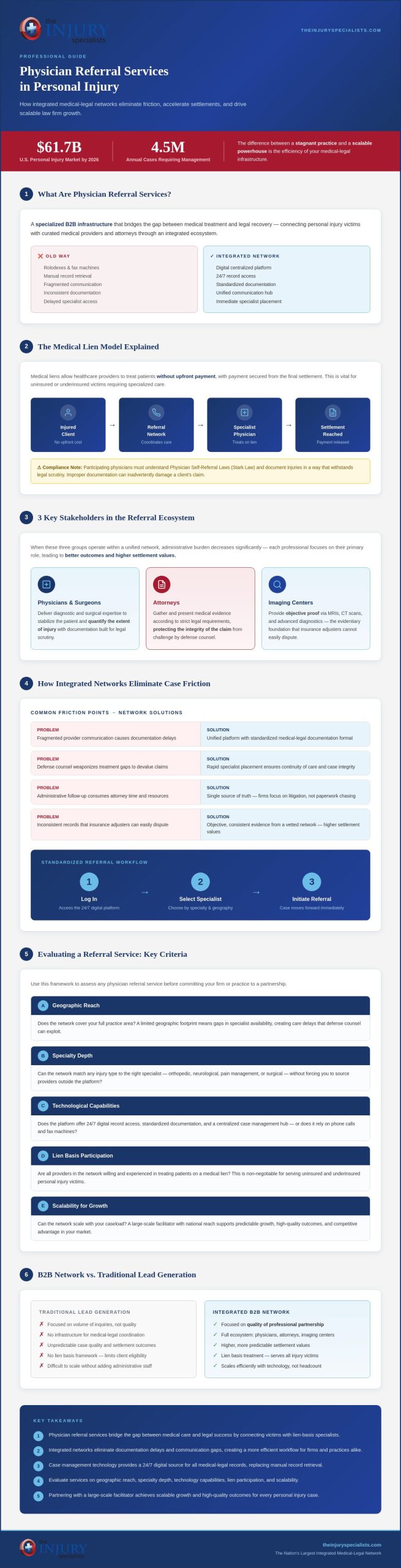
The difference between a stagnant personal injury practice and a scalable powerhouse isn’t the volume of leads; it’s the efficiency of the medical-legal infrastructure. With the U.S. personal injury market projected to reach $61.7 billion by 2026, managing your share of the 4.5 million annual cases requires a sophisticated approach to physician referral services personal injury. You’ve likely felt the friction of manual record retrieval and the difficulty of finding specialists who work on a lien basis. These inefficiencies don’t just waste time; they compromise the quality of medical-legal documentation and stall your firm’s growth.
Utilizing an integrated network is the strategic shift that bridges the gap between medical care and legal success. This professional guide explores how these ecosystems streamline the referral process to ensure high-quality care and optimized case outcomes. You’ll discover how to leverage proprietary technology for 24/7 record access, navigate complex regulations like the Stark Law, and build a scalable practice through a reliable, business-to-business network. We’ll examine the specific benefits of these power-connector systems for both medical providers and legal firms looking to dominate their market.
Key Takeaways
- Learn how physician referral services personal injury bridge the gap between medical care and legal success by connecting victims with specialized providers on a lien basis.
- Discover how integrated networks eliminate documentation delays and communication gaps, creating a more efficient workflow for your firm or practice.
- Explore the impact of case management technology and how digital platforms serve as a reliable, 24/7 source for all medical-legal records.
- Gain a clear framework for evaluating referral services based on their geographic reach, specialty depth, and technological capabilities.
- Understand the benefits of partnering with a large-scale facilitator to achieve scalable growth and high-quality outcomes for every personal injury case.
What are Physician Referral Services in Personal Injury?
The shift from manual networking to digital referral platforms has revolutionized the industry. Relying on Rolodexes and fax machines is no longer viable. In a market where speed and accuracy dictate case outcomes, modern physician referral services personal injury provide a centralized hub for communication. This ensures every stakeholder has access to the data they need to move a case forward. This B2B model outperforms traditional lead generation by focusing on the quality of the professional partnership rather than just the volume of inquiries. It’s about creating a well-oiled machine that supports scalable growth.
The Mechanics of the Medical-Legal Relationship
Referrals in this ecosystem follow a structured flow between law firms, physicians, and imaging centers. This process relies heavily on medical liens. Liens allow healthcare providers to treat patients with the agreement that payment will be secured from the final settlement. This arrangement is vital for uninsured or underinsured victims who require specialized care. However, participating physicians must possess deep knowledge of the personal injury sector. They need to understand how to document injuries in a way that withstands legal scrutiny while adhering to Physician Self-Referral Laws to maintain ethical and legal compliance. Without this specialized knowledge, a doctor’s records might inadvertently damage a client’s legal claim.
Key Stakeholders in a Referral Ecosystem
A high-functioning referral network depends on the synergy of three primary groups:
- Physicians and Surgeons: These professionals deliver the diagnostic and surgical expertise necessary to stabilize the patient and quantify the extent of the damage.
- Attorneys: Legal professionals ensure that medical evidence is gathered and presented according to strict legal requirements, protecting the integrity of the claim.
- Imaging Centers: These facilities provide the objective proof required for successful settlements through MRIs, CT scans, and other advanced diagnostics.
When these stakeholders operate within a unified network, the administrative burden of case management decreases significantly. This allows each professional to focus on their primary role, leading to better medical outcomes and higher settlement values.
How Integrated Referral Networks Eliminate Case Friction
Friction in personal injury cases often stems from fragmented communication. When a law firm uses disparate providers, documentation delays and inconsistent reporting become the norm. An integrated network of physician referral services personal injury eliminates these bottlenecks by providing a unified platform. This centralized approach ensures that medical-legal documentation follows a standardized format. This consistency is essential for establishing the single source of truth required for high-value settlements. By removing the guesswork from data collection, firms can focus on litigation rather than administrative follow-up.
Reducing gaps in care is another critical function of a professional network. Defense counsel often weaponize delays in treatment to devalue a claim. By utilizing a rapid placement system, attorneys can ensure their clients see specialists immediately. This continuity of care doesn’t just improve patient outcomes; it protects the case’s integrity and accelerates settlement timelines. Professional networking directly correlates with higher settlement values. It provides the objective, consistent evidence insurance adjusters cannot easily dispute. Efficient systems lead to faster resolutions and more predictable results.
Standardizing the Referral Workflow
Efficiency depends on a predictable process. A high-level network utilizes a clear 1-2-3 workflow: log in, select the required specialist, and initiate the referral. This structure removes the administrative burden from firm staff by automating referral forms. Beyond speed, these systems ensure strict compliance with HIPAA and legal privacy standards. Following AMA Ethical Guidelines on Referrals ensures that every patient transition is handled with professional integrity. This protects both the physician and the attorney from regulatory scrutiny while maintaining a high standard of patient care.
The Advantage of a Cohesive Care Ecosystem
A truly integrated ecosystem includes more than just primary treating doctors. It must incorporate imaging centers, chiropractors, and physical therapists to provide a complete diagnostic picture. When these entities operate within the same network, evidence loss is virtually eliminated. Coordinating personal injury physical therapy referrals within this unified structure ensures that rehabilitation care aligns seamlessly with the broader medical-legal strategy. This connectivity allows for the seamless integration of pre-settlement funding. This financial bridge ensures patients can complete their treatment plans without financial distress. It allows attorneys to wait for the best possible settlement offer rather than settling early due to a client’s financial needs. To see how a unified system can transform your practice, you might consider exploring the integrated referral tools available to professional partners.
When every stakeholder is connected through a single digital platform, the case moves with precision. Imaging results are uploaded instantly. Chiropractic notes align with surgical recommendations. The entire medical history of the case becomes a cohesive narrative. This level of organization is what separates market leaders from those struggling with administrative overhead.
The Role of Case Management Technology in 2026
The personal injury industry has reached a definitive tipping point where paperless communication is no longer an optional advantage; it’s a professional requirement. Modern physician referral services personal injury now rely on sophisticated case management technology to maintain a single source of truth for every case. This digital transparency ensures that both medical and legal professionals are looking at the same data in real time. For legal teams, this means having instant visibility into a patient’s treatment status. You don’t have to call a clinic to find out if a client showed up for their MRI. The system updates automatically, providing a clear audit trail of patient compliance and medical progress.
On-demand record retrieval is the most significant logistical time-saver in the current market. In previous years, firms waited weeks for medical records to be mailed or faxed. Today’s integrated platforms allow for immediate downloads once the physician signs off on the documentation. This acceleration directly impacts the demand package process. When you can compile a complete medical history in hours rather than weeks, you get your demand out faster. Faster demands lead to faster negotiations and, ultimately, quicker payouts for your clients. It’s about moving cases through the pipeline with maximum velocity and zero data loss.
Innovative Features of Modern PI Platforms
Current technological standards go beyond simple data entry. Leading platforms offer centralized portals where physicians can market their specific surgical or diagnostic expertise directly to high-volume law firms. This creates a transparent marketplace for professional skill sets. Automated notification systems further streamline the day-to-day operations. Staff receive alerts the moment an appointment is completed or when a new record is available for review. Additionally, secure cloud storage now handles high-resolution diagnostic imaging. Attorneys can view MRIs and CT scans directly through the portal without needing specialized local software or waiting for physical discs to arrive by courier.
Why Proprietary Technology Beats Generic Software
Generic medical software or standard legal case management tools often lack the specific logic required for personal injury. Proprietary technology is built specifically for PI workflows, accounting for liens, pre-settlement funding, and the unique documentation requirements of insurance adjusters. For nationwide legal teams, 24/7 accessibility is non-negotiable. Whether your team is in California or Georgia, they need access to the same centralized records at any hour. Digital transparency is the essential catalyst that transforms fragmented communication into a seamless medical-legal synergy in 2026.
Evaluating a Physician Referral Service: A Framework
Selecting a partner for medical-legal coordination requires a systematic evaluation of their operational reach and technical infrastructure. A service that merely provides a list of names is an administrative liability in 2026. To achieve scalable growth, you need a partner that functions as a strategic extension of your professional practice. Evaluating physician referral services personal injury starts with analyzing the scope of their network. A network with national coverage across 40+ states offers a level of reliability and consistency that regional directories cannot match. This scale ensures that no matter where your client is located, they have access to a vetted specialist who understands the nuances of lien-based care.
Specialty depth is the next critical metric. A high-tier service must provide a comprehensive care ecosystem that includes orthopedic surgeons, chiropractors, physical therapists, and imaging centers. To understand how specialized surgical care fits into this model, you may visit Minimally Invasive Neurosurgery of Texas and explore their advanced spinal treatment options. If a network lacks imaging integration, your team will waste hours coordinating between different facilities. Streamlining your personal injury diagnostic imaging referrals through an integrated platform ensures that objective evidence is captured efficiently and delivered directly to your legal team without delay. The technology integration must be seamless. A dedicated portal for managing referrals and records is mandatory for maintaining a high-volume caseload. Additionally, look for integrated support services such as medical case management and pre-settlement funding. These features ensure that financial barriers don’t interrupt the patient’s recovery or the case’s momentum.
Questions Attorneys Should Ask Potential Networks
Vetting a network requires direct inquiry into their operational standards. You should ask how they vet the physicians in their network for specific personal injury experience. A doctor who is excellent at general practice might not understand the documentation requirements needed to survive a deposition. Ask about the average turnaround time for medical record retrieval; in a competitive market, waiting weeks for a signature is unacceptable. Finally, confirm if their platform can integrate with your firm’s existing case management processes to prevent duplicate data entry and manual errors. For a deeper dive into building a disciplined, high-volume referral pipeline, the professional guide to personal injury patient referrals offers a comprehensive framework for scaling your practice with logistical precision.
Criteria for Medical Providers Joining a Network
For medical providers, the evaluation focuses on practice growth and administrative ease. You should determine if the network will actively market your expertise to high-volume law firms in your area. Connectivity is the primary value of a professional network. Inquire about the specific tools provided to manage the documentation needs of PI cases, such as standardized lien forms and secure upload portals. A successful partnership depends on how the network facilitates clear, fast communication with the attorney’s office. Medical groups looking to eliminate manual case management and scale their PI department should review the healthcare provider personal injury network buying guide for a detailed breakdown of what to look for in an elite professional partner. If you’re ready to upgrade your professional infrastructure, you can join the nation’s largest integrated network to start scaling your practice today.
The right choice in a referral partner eliminates the friction that stalls case progress. By applying this framework, you ensure that your practice is supported by a robust, technologically advanced system designed for professional success. Don’t settle for a directory when you can leverage a power-connector ecosystem.
The Injury Specialists: The Nation’s Largest Integrated Network
The Injury Specialists stands as the definitive leader in medical-legal coordination. While other services offer local directories, we provide a national infrastructure that supports over 1,000 professionals across 40+ states. This scale is the result of over a decade of innovation in medical-legal technology. We’ve moved beyond simple lists to create a comprehensive business-to-business ecosystem. Our network is designed for professionals who prioritize efficiency and predictable growth. By choosing the largest integrated network, you’re aligning your practice or firm with a market giant that values professional synergy and logistical ease.
Our proprietary digital platform is the only technology in the industry built specifically for physician referral services personal injury. It serves as a high-level facilitator, connecting attorneys, physicians, and imaging centers through a single, secure portal. This system eliminates the administrative friction that typically stalls case progress. You gain 24/7 access to medical records, real-time treatment updates, and a streamlined referral workflow. This level of connectivity fuels practice and firm growth by allowing you to handle a higher volume of cases with less overhead. It’s a pragmatic solution for a high-stakes industry.
A Complete Ecosystem for Professional Growth
We provide more than just referrals; we offer a complete care ecosystem. Our network integrates physician referrals with world-class medical case management to ensure every patient receives consistent, high-quality care. This integration extends to diagnostic imaging centers and pre-settlement funding, providing a cohesive environment for recovery and litigation. By leveraging these diverse services, you can ensure that financial and logistical barriers never compromise a case. Joining the national leader is a straightforward process. You can request a demo to see our technology in action and discover how our network can support your specific professional goals.
The Future of Medical-Legal Networking
The personal injury sector is constantly evolving, and our commitment to continuous innovation ensures our partners stay ahead of the curve. We are constantly refining our digital tools to provide better data transparency and faster communication. Scaling your business requires a partner that can match your ambition with reliable, large-scale infrastructure. The power of the largest injury network in the US is now at your fingertips. You can discover how to leverage the power of the largest injury referral network today. Start building a more efficient, scalable practice with a partner that understands the mechanics of success.
Scale Your Practice with High-Level Connectivity
Success in the modern personal injury landscape depends on the strength of your professional network and the efficiency of your technology. Moving from fragmented communication to an integrated ecosystem is the most effective way to eliminate administrative friction and protect case values. By prioritizing high-quality documentation and 24/7 record access, you ensure that your firm or practice remains competitive in an increasingly data-driven market. Utilizing advanced physician referral services personal injury allows you to focus on results while a proprietary system handles the logistical complexities of medical-legal coordination.
The Injury Specialists provides the national infrastructure required for sustainable growth. As the largest injury referral network in the US, we serve 40+ states and connect 1,000+ professionals through our proprietary paperless case management technology. This system is designed to facilitate seamless collaboration and immediate accessibility. You can secure a strategic advantage today by joining a network that values professional synergy and logistical ease. Request a Demo of the Nation’s Largest Injury Referral Network to see how we fuel practice and firm growth. It’s time to leverage a system built for professional excellence.
Frequently Asked Questions
What exactly is a physician referral service in the context of personal injury?
A physician referral service is a professional B2B network that connects personal injury attorneys with specialized medical providers. It acts as a high-level facilitator, managing the logistical links between legal firms and healthcare clinics. These services ensure that accident victims receive immediate care while providing attorneys with the consistent, high-quality medical documentation required to build a successful legal claim.
Do physicians in these networks work on a lien basis?
Yes, providers within a specialized personal injury network typically treat patients on a medical lien basis. This arrangement allows injured parties to receive necessary medical treatment without upfront out-of-pocket costs. The physician agrees to accept payment from the final legal settlement. This system is essential for ensuring that uninsured or underinsured plaintiffs can access the specialty care their recovery requires.
How do referral services help attorneys manage client medical care?
These services provide a centralized platform for real-time tracking of a client’s treatment status. Instead of manual follow-ups with multiple clinics, attorneys use a single portal to verify appointments and patient compliance. Utilizing physician referral services personal injury eliminates administrative friction by standardizing the communication between the doctor’s office and the law firm, ensuring a cohesive medical narrative for every case.
Can I find diagnostic imaging centers through these referral networks?
Yes, a comprehensive network includes imaging centers that provide MRIs, CT scans, and other advanced diagnostics. Integrating imaging into the same ecosystem as treating physicians ensures that objective proof of injury is captured early. Because these centers operate on the same digital platform, legal teams can often view high-resolution results immediately after the scan is completed, accelerating the settlement process.
Is there a cost for law firms to join a physician referral network?
Most professional networks, including The Injury Specialists, do not charge law firms a fee to join or utilize the referral platform. The primary goal is to foster professional synergy between medical and legal sectors. By removing financial barriers to entry, these networks encourage law firms to adopt more efficient, technologically advanced workflows that lead to better medical and legal outcomes for their clients.
How does technology improve the medical record retrieval process?
Technology replaces slow, manual retrieval methods with secure, on-demand digital access. Instead of waiting weeks for mailed or faxed records, firms can download signed medical notes and reports directly from a secure cloud portal. This paperless approach ensures that documentation is available the moment the physician signs off, allowing legal teams to compile demand packages with maximum speed and zero data loss.
Are these physician referral services available nationwide or just in specific states?
While many directory services are regionally limited, major networks offer expansive national coverage. For example, The Injury Specialists serves over 40 states with a network of more than 1,000 vetted professionals. This nationwide reach allows law firms to maintain a consistent case management process regardless of where their client is located, providing a scalable solution for firms with a multi-state presence.
What is the difference between a referral network and a medical funding company?
A referral network facilitates the professional connection and management of care, while a funding company provides capital to cover treatment costs or client expenses. However, the most effective ecosystems integrate both functions. An integrated network provides the referral to a specialist and can also facilitate pre-settlement funding, ensuring that financial constraints don’t interrupt a patient’s treatment plan or force an early, undervalued settlement. For professionals seeking to optimize every stage of the recovery process, understanding how to manage personal injury physical therapy referrals within this broader funding and care framework is essential to building a truly cohesive medical-legal strategy.
