

Could the way treatment is funded affect care continuity and what remains from a future settlement? For injured people managing bills while a claim is unresolved, pre-settlement funding for medical treatment may help address financial pressure. But the phrase can describe different arrangements: funds may go to the injured person, or treatment may be arranged with a provider against a potential future recovery.
Look closely at any arrangement before agreeing to it. Its terms can affect repayment, costs, and the portion of a settlement left after obligations are addressed. Funding isn’t guaranteed, and eligibility and repayment depend on the specific agreement and applicable law.
This article explains common treatment-related funding arrangements, the agreement terms and case details to review, and how connections among patients, providers, and attorneys can support coordination. The Injury Specialists facilitates pre-settlement funding connections and links injury victims with medical providers and personal injury attorneys through its referral and case-management network. Understanding each party’s role can help you assess your next steps without confusing funding coordination with medical care or legal representation.
Key Takeaways
- Pre-settlement funding for medical treatment can describe different arrangements, so identify who receives the funds and how they relate to care.
- Compare cash advances, provider billing arrangements, and other payment routes by intended use, recipient, and written terms.
- Review repayment conditions, fees, and possible effects on settlement proceeds in the agreement before signing.
- Account for case details and attorney involvement when assessing an arrangement; approval and terms can vary.
- Clear communication among the injured person, provider, attorney, and funding parties can help define responsibilities and support coordination.
What pre-settlement funding for medical treatment can, and cannot, mean
Care-related expenses can be difficult to manage while an injury claim is unresolved. The phrase pre-settlement funding for medical treatment may sound like one specific service, but it can refer to different arrangements connected to a pending claim. The agreement, the parties involved, and applicable law determine how a particular arrangement works.
In plain language, pre-settlement funding generally refers to money made available before a legal claim resolves, based on the claim and its potential future recovery. It isn’t insurance, a settlement payment, or medical treatment. Insurance coverage is governed by its policy; settlement proceeds are paid as part of resolving a claim; and treatment is provided by a medical professional. Funding may be connected to the claim, but it doesn’t itself provide care or guarantee a case outcome.
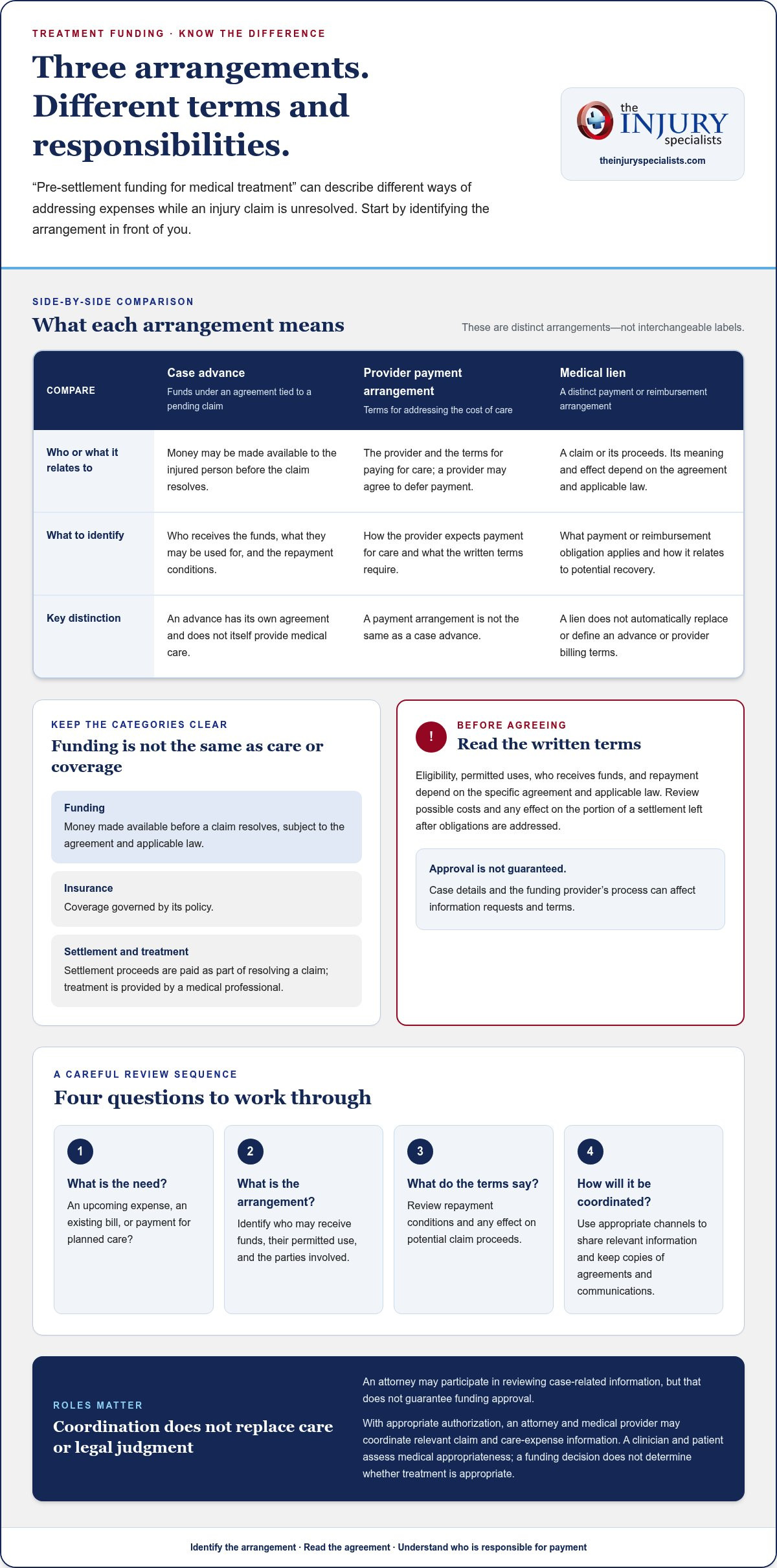
A case advance provides funds under an agreement tied to a pending claim, while a provider payment arrangement sets terms for addressing the cost of care. They are distinct arrangements, not interchangeable labels. Eligibility, permitted uses, who receives funds, and repayment depend on the written agreement and applicable law.
What may count as medical-treatment funding?
Readers may mean money paid to them for personal expenses, funds directed toward medical bills, or an arrangement in which a provider agrees to defer payment. These are different possibilities, not a single standard structure. The contract and parties involved determine who receives the money and what it may be used for. Check those details rather than assuming a general description explains the arrangement.
How is treatment-related funding different from a medical lien?
A lien is a distinct payment or reimbursement arrangement associated with a claim or its proceeds. Its meaning and effect can depend on the agreement and applicable law. A funding advance has its own terms, while provider billing terms describe how a provider expects payment for care. One doesn’t automatically replace or define the other, even if both relate to a potential recovery.
For a broader overview of funding connected to injury claims, read the 2026 guide to pre-settlement funding for injury victims. Identify the specific arrangement in front of you: who pays whom, what the funds may cover, and what obligations may apply if the claim resolves.
How pre-settlement funding for medical treatment may work
The process depends on the arrangement, but a careful review follows a practical sequence. Identify the expense, determine what type of funding or payment arrangement is being considered, examine its written terms, coordinate relevant communication, and keep records. This helps distinguish money intended for personal expenses from funds directed toward a medical bill or terms arranged with a provider.
- Identify the need. Clarify whether the concern is an upcoming expense, an existing bill, or payment for planned care.
- Understand the arrangement. Determine who may receive funds, what they may be used for, and which parties are involved.
- Review the terms. Read the agreement for repayment conditions and any effect on potential claim proceeds.
- Coordinate and document. Share relevant information through appropriate channels and retain copies of agreements and communications.
An attorney may need to participate in reviewing case-related information. That involvement can help clarify how an arrangement relates to the claim, but it doesn’t guarantee funding approval. Eligibility, information requests, and permitted uses depend on the funding provider’s process, the agreement, and applicable law.
What information may be relevant to a funding review?
Depending on the process, a review may consider the claim’s status, anticipated expenses, and available documentation. These are examples, not universal requirements. The funding provider and agreement determine what information is requested. Share case-related or medical information only through appropriate, authorized channels, and understand who will receive it and why.
How can care and case coordination fit together?
With appropriate authorization, an attorney and medical provider may coordinate relevant information about the claim and care-related expenses. Case-management support can help organize communication and records, but it doesn’t replace an attorney’s legal judgment or a clinician’s independent assessment.
A funding decision does not determine whether treatment is medically appropriate. That decision belongs to the clinician and patient, based on their medical circumstances, not on whether a funding request is approved.
For a closer look at how structured workflows can support communication, read the personal injury case management technology guide. The Injury Specialists facilitates connections among injury victims, medical providers, attorneys, and pre-settlement funding parties. Learn more about coordinated injury-claim support and how clear roles can help keep the process organized.
Cash advances, provider arrangements, and other ways to address treatment expenses
Different payment routes can involve different recipients, uses, and obligations. A cash advance may provide money to an injured person, while a provider arrangement may address charges for care directly. Other routes, such as available insurance coverage or payment arrangements, operate under their own terms. Compare the structure: pre-settlement funding for medical treatment does not describe one standard product.
| Payment route | Possible recipient | Possible intended use | Terms and relationship to treatment |
|---|---|---|---|
| Personal cash advance | The injured person | Uses permitted by the agreement, which may or may not include treatment expenses | Agreement-specific. The advance may be connected to a pending claim, but it does not itself provide treatment. |
| Provider billing arrangement | Payment is addressed between the patient and provider under their arrangement | Charges for care | Provider-specific terms explain billing and payment. This is not automatically the same as a cash advance. |
| Other payment routes | Depends on the route and its terms | May address eligible care expenses or bills | Insurance coverage and other payment arrangements have separate rules and agreements; their relationship to a claim varies. |
Is a pre-settlement advance the same as a medical payment?
No. A cash advance and a provider payment arrangement can have different recipients and purposes. An advance paid to a person does not necessarily go to a provider, and a provider arrangement does not necessarily put cash in the patient’s hands. Check the written agreement for permitted uses, payment instructions, and the parties responsible for handling funds.
What trade-offs should readers understand?
Funding may affect the eventual financial picture, depending on the contract. The agreement may describe fees, repayment obligations, triggers, or deductions from claim proceeds. Those terms are not universal, and the effect on net proceeds depends on the specific arrangement and how the claim resolves. Review the complete agreement with your attorney before signing. Pay particular attention to how the amount due may change over time and what happens if the claim does not result in a recovery.
Keep financial arrangements separate from clinical decisions. A patient and clinician determine appropriate care based on medical needs, not on whether a funding option is available. Coordination can help clarify who handles bills, records, and claim-related communication. The guide to personal injury referral networks explains how connections among professionals can support organized communication without deciding medical or legal outcomes. The Injury Specialists facilitates connections among injury victims, medical providers, attorneys, and pre-settlement funding parties.
For case-related coordination, The Injury Specialists’ referral network connects injured people with medical and legal professionals.
How to review a treatment-funding arrangement before agreeing
Before signing, read the specific written agreement from beginning to end. A general description of pre-settlement funding for medical treatment cannot explain your particular obligations. The document should make clear what arrangement is being offered and how it may affect you if the claim resolves in different ways.
Which agreement terms deserve close attention?
Use this checklist to locate key provisions. Terms vary by agreement and applicable law, so the contract is the source for the arrangement’s details.
- Recipient: Who receives the funds, you or a provider?
- Permitted use: Does the agreement limit how the money may be used?
- Repayment trigger: What event, if any, makes repayment due?
- Fees and calculation method: How are charges calculated, and can the amount owed change over time?
- Claim outcomes: What does the document say happens if the claim settles, proceeds to another resolution, or results in no recovery?
- Settlement deductions: Does it describe how repayment may be collected from claim proceeds or affect the net amount you receive?
Look for the actual wording on repayment and settlement effects. If a term is unclear, mark it for discussion rather than filling the gap with an assumption.
What should an injured person discuss with their attorney?
Ask your attorney how the proposed agreement may interact with your specific claim and potential net recovery. Confirm whether it concerns money paid to you, payment directed to a provider, or another arrangement. Funding is not a substitute for legal advice. Your attorney can interpret the agreement in the context of your case; a funding provider’s explanation does not replace that review.
Illustrative example: A person receives an agreement describing payment to a provider for care, but expected the funds to be paid to them. Before signing, they compare the recipient and payment instructions in the document with their understanding, then discuss the mismatch and potential claim impact with their attorney.
Review the complete agreement before you commit, including any sections that explain repayment under different claim outcomes. This helps clarify obligations without assuming every arrangement works the same way.
Explore coordinated pre-settlement funding connections through The Injury Specialists, which facilitates connections among injury victims, medical providers, attorneys, and funding parties.
Connecting medical care, attorneys, and pre-settlement funding
A treatment-related funding arrangement can involve several parties, each with a separate role. The injured person identifies their needs and reviews proposed terms. A medical provider discusses care and billing. An attorney advises on the claim and agreement. Funding parties explain their process and terms. Clear communication can help everyone understand which decisions and responsibilities belong to them.
How can coordinated communication support care continuity?
With appropriate authorization, relevant information can be shared among the people involved, such as details about an expense, a provider payment arrangement, or claim documentation. Clear records and defined communication channels can reduce confusion about who is responsible for the next step. Coordination is an operational aid, not a guarantee of uninterrupted care, payment, funding approval, or claim recovery.
Professional roles remain distinct. A clinician and patient make medical decisions based on the patient’s circumstances. An attorney provides legal advice about the claim and related agreements. A funding party assesses requests under its own process and agreement. A case-management or referral network can help connect participants and organize communication, but it doesn’t make clinical or legal decisions.
What is the next step for injury victims and professionals?
Start with the need, whether it concerns personal expenses, an existing medical bill, or a provider arrangement. Then identify the structure being considered, read the written agreement, and discuss its terms with the appropriate professionals before signing. Confirm who receives any funds, what they may be used for, and how the arrangement may relate to the claim. These steps help clarify logistics without assuming that every pre-settlement funding for medical treatment arrangement works the same way.
The Injury Specialists facilitates connections among injury victims, medical providers, personal injury attorneys, and pre-settlement funding parties through its referral and case-management network. That role supports connection and coordination; it doesn’t determine treatment, provide legal representation, or guarantee a funding or case outcome.
Coordination can clarify logistics, while clinicians and attorneys retain their professional roles. Injury victims and professionals can explore The Injury Specialists network to learn about its connections across the personal injury ecosystem.
Take a Clear Next Step
Before considering pre-settlement funding for medical treatment, identify what type of arrangement is being offered, who receives any funds, and what the written terms say about repayment. A personal advance and a provider payment arrangement can affect expenses differently. Review the agreement with your attorney to understand how it may interact with your claim and potential net recovery.
Coordination also matters. The Injury Specialists facilitates connections among injury victims, medical providers, and law firms nationwide. Its case-management technology supports professional coordination across the personal injury ecosystem, helping participants organize communication while medical and legal decisions remain with the professionals responsible for them.
Careful review and clear communication can help you approach the next steps with a better understanding of the arrangement and each party’s role. Explore coordinated pre-settlement funding connections through The Injury Specialists and learn how its network brings participants together.
Frequently Asked Questions
Can pre-settlement funding be used to pay for medical treatment?
Sometimes, but the agreement determines whether funds may be used for treatment expenses. Pre-settlement funding for medical treatment can refer to money paid to an injured person or to an arrangement involving provider payment terms. Don’t assume funds go directly to a clinic or can cover a specific bill. Review the permitted uses in the written agreement and discuss how the arrangement relates to your claim with your attorney.
Does pre-settlement funding pay the medical provider directly?
Not necessarily. The recipient and payment route depend on the agreement and the parties involved. A personal cash advance, a provider billing arrangement, and a medical lien are distinct structures and aren’t automatically interchangeable. Before relying on funding to address a bill, read the payment instructions and confirm who is responsible for payment. Coordinate questions about the arrangement with your attorney and the relevant provider.
Is pre-settlement funding for medical treatment a loan?
That depends on the specific arrangement, its written terms, and applicable law. A product’s marketing label alone doesn’t establish its legal classification or explain your obligations. Review the contract for repayment terms, fees, and what it says about different case outcomes. Your attorney can help explain how the agreement may apply to your claim. Don’t assume that all treatment-related funding arrangements share the same structure.
What happens if my personal injury case does not settle?
There’s no universal answer; the agreement and applicable law govern. Read the contract for what happens if the case is unsuccessful, dismissed, delayed, or resolved in another way. Look for the provisions that describe repayment obligations under those circumstances, not just the terms that apply to a settlement. Don’t rely only on verbal explanations or broad advertising claims. Ask your attorney to review the specific language before you sign.
Can pre-settlement funding affect my settlement?
It may affect the amount you ultimately receive if the agreement provides for repayment or deductions from claim proceeds. The impact depends on the contract, the case outcome, and applicable law, so a general estimate can’t replace a review of the actual terms. Ask your attorney how the arrangement could affect your potential net recovery before accepting it, including what amount may be owed under different outcomes.
Do I need my attorney involved in treatment-related funding?
Attorney involvement can help clarify how a proposed arrangement relates to your injury claim and potential settlement proceeds. The process varies, but your attorney can review the contract and explain case-specific implications. A medical professional remains responsible for clinical decisions, while the attorney advises on legal matters. Before signing, discuss the agreement with your attorney rather than relying only on a general explanation or an advertising claim.
How quickly can I receive pre-settlement funding for medical treatment?
Timing varies with the arrangement, case information, and review process. Some providers advertise quick decisions, but those claims don’t establish a timeline for every request. Ask about the steps involved and rely on the written agreement for its terms. Don’t assume funding will arrive by a particular date or resolve an urgent care need. Keep medical decisions with you and your clinician, independent of any funding review.

Leave A Comment
You must be logged in to post a comment.