

Referral volume alone doesn’t build dependable chiropractor relationships; patient-centered coordination does. If you’re learning how to build relationships with chiropractors, start with a professional approach that makes collaboration useful for everyone involved. In personal injury care, trust depends on clear roles, accurate documentation, and respectful communication, not a sales pitch or a promise of referrals.
Chiropractic practices and referral partners may have different workflows, expectations, and ways of sharing information. A relationship built on assumptions or one-way requests can create friction instead of making care easier to coordinate.
This guide explains how to build credibility through consistent communication, a clear understanding of a practice’s workflow, and attention to patient needs. You’ll learn how to make a relevant introduction, agree on referral and handoff expectations, support organized documentation, and follow up in a way that makes professional networking useful over time.
Key Takeaways
- Define professional value around patient-centered coordination, clear roles, and useful communication rather than promised referrals.
- Learn how to build relationships with chiropractors by preparing a relevant introduction and choosing a thoughtful follow-up approach.
- Agree on communication preferences and handoff expectations to make collaboration clearer for practices and patients.
- Recognize trust and compliance concerns, and keep networking separate from referral promises or arrangements that could raise ethical concerns.
- Use a simple follow-up cycle to strengthen connections and assess relationship quality through reliable communication and clear workflows.
Why Strong Chiropractor Relationships Start With Patient-Centered Value
A professional relationship is an ongoing connection built on communication and coordination, not a promise to send patients. That distinction matters in personal injury care, where referral quotas or guaranteed case volume can undermine trust. Focus on whether the connection helps patients and makes professional handoffs clearer.
Clear roles help everyone understand who is responsible for each part of the process. Timely, appropriate updates can reduce confusion about next steps and help a patient move between professionals with fewer communication gaps. The goal is an organized workflow, not a promised clinical or legal result.
To understand the profession before reaching out, review a neutral overview of Chiropractic. Then approach each practice as its own organization. Chiropractors may differ in the patients they serve, whether they work with personal injury cases, and how they manage communication. Don’t assume one practice’s process represents them all.
What chiropractors may value in a professional connection
Respectful communication, reliable follow-up, and clear expectations are practical signals of trust. Before proposing collaboration, review how the practice publicly describes its services. Identify one relevant question or shared professional interest for an initial conversation. A focused introduction is more useful than a broad pitch or an immediate request for referrals.
Ask about preferred communication channels and general workflow expectations rather than assuming how the practice operates. After the conversation, record any agreed next step and who owns it. Follow through, even if the next step is simply sharing information or reconnecting later. Consistency shows that the relationship has value beyond a single referral opportunity.
How patient needs keep collaboration on track
Keep patient choice, appropriate care, and accurate communication at the center of every interaction. A professional connection should never pressure a chiropractor to refer, shape clinical judgment, or imply that a particular outcome is assured. Each professional should remain within their role and communicate only through appropriate channels.
For example, if a patient has chosen to receive care from a chiropractor, a coordinator can help clarify the next administrative step and relay an authorized update to the relevant parties. That supports continuity without directing treatment or promising a legal result. In practice, trust, relevance, and follow-through form the foundation for how to build relationships with chiropractors that support coordinated care.
Prepare for Chiropractor Outreach With a Clear, Relevant Introduction
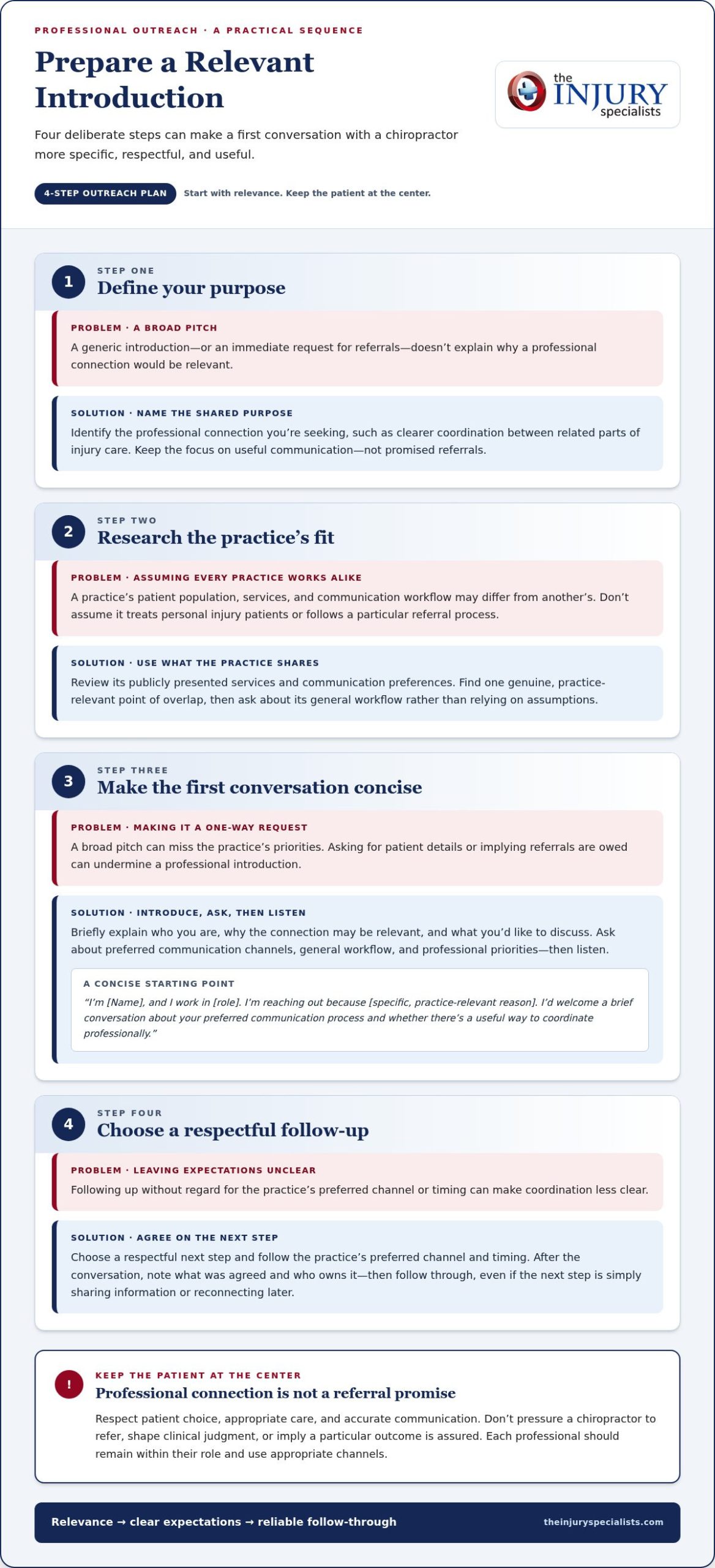
Effective outreach starts before the first email or call. A few minutes of preparation helps you make the conversation specific to the practice, respectful of its time, and clear about what you’re proposing. Use this four-step sequence:
- Define your purpose. Identify the professional connection you’re seeking, such as clearer coordination between related parts of injury care.
- Research fit. Review the practice’s publicly presented services and communication preferences. Don’t assume it treats personal injury patients or follows a particular referral process.
- Prepare a concise introduction. State who you are, why the connection may be relevant, and what you’d like to discuss.
- Choose follow-up. Decide on a respectful next step, then follow the practice’s preferred channel and timing.
Look for a genuine point of overlap. Perhaps your work involves coordinating with professionals who serve related patient needs, or you can discuss ways to make administrative handoffs clearer. Identify one specific reason for contacting the practice rather than relying on a generic pitch. The guidance in Building and Maintaining a Referral Base also emphasizes communication and relationship maintenance as part of professional referral connections.
Identify shared professional interests before making contact
Base your outreach on what the practice has actually shared, not assumptions about its patients, interests, or referral habits. A relevant observation could be that the practice describes services connected to the kind of care coordination you support. Keep the first message focused on whether a professional conversation would be useful. Don’t ask for patient details or imply that referrals are owed.
Make the first conversation concise and useful
Ask about preferred communication channels, general workflow, and professional priorities. Offer a brief, accurate overview of your role and relevant capabilities, then listen. For example, a referral-network or case-management facilitator can explain how coordinated connections may support organized workflows without promising outcomes or overstating reach.
Use this template as a starting point:
“Hello [Name], I’m [Name], and I work in [role]. I’m reaching out because [specific, practice-relevant reason]. I’d welcome a brief conversation about your preferred communication process and whether there’s a useful way to coordinate professionally. Would [proposed next step] suit you, or is there a better time or channel?”
This invitation leaves the decision with the chiropractor. It doesn’t create entitlement to referrals or patient information. If the conversation points toward a potential fit, professional referral and case-management connections can provide a framework for organizing provider relationships.
Build Chiropractor Trust Through Reliable Communication and Clear Workflows
Trust depends on what happens after the introduction. A clear communication routine helps each professional know who handles an update, which channel to use, and what information is appropriate to share. It also reduces avoidable confusion when a patient’s care involves multiple providers or legal professionals.
A dependable professional relationship is built on responsiveness, clarity, and respect for each partner’s role. Those habits make coordination more predictable without blurring professional boundaries.
Agree on communication, documentation, and role boundaries
Set practical expectations for routine coordination. Document who communicates, the agreed channel, and the purpose of each exchange. For example, an administrative contact might coordinate appointment logistics, while the chiropractor retains clinical decisions and legal professionals handle legal matters. Patient information should only be shared through appropriate channels and with proper authorization. Privacy, consent, and applicable legal requirements can vary, so have qualified professionals review the processes that apply to your work.
A simple comparison shows why consistency matters:
| One-off outreach | Consistent, permission-based communication |
|---|---|
| Messages arrive through changing channels. | Partners use agreed channels for defined purposes. |
| Follow-up expectations remain unclear. | Each person knows who will respond and when. |
| Handoffs can lose context or stall. | Concise updates clarify the next administrative step. |
Agreement prevents mismatched expectations. A practice may prefer a particular contact method or a designated staff member for coordination. Respect those preferences, and keep updates limited to what the recipient needs for the agreed purpose. Avoid sending unnecessary patient details, even when a working relationship feels established.
Use follow-through to strengthen credibility
Respond within the timeframe you agreed to, and close the loop on shared administrative tasks. A short update can confirm that a message was received, identify the next step, or explain when you’ll follow up. Keep the wording factual and concise, and use only an appropriate, authorized channel for patient-related information.
If you miss a commitment, address it directly. Acknowledge the delay, provide a realistic revised timeline, and reset expectations rather than leaving the other person to chase an answer. Repeatedly honoring small commitments is a practical way to build relationships with chiropractors through dependable workflows, not just promising conversation.
Handle Referral, Compliance, and Trust Concerns Without Making Promises
Relationship-building should never depend on promised referrals or a specific volume of patients. A credible professional connection is based on appropriate coordination and clear expectations, not pressure to send cases. This distinction is especially important in personal injury care, where clinical, legal, and administrative roles may intersect.
Networking can create opportunities to understand each other’s workflows and improve communication. Referral arrangements, compensation, or incentives may raise separate legal, ethical, or conflict-of-interest questions. Federal and state requirements can vary by circumstance, so treat these questions as matters for current review with qualified counsel, not as issues with one universal answer.
Set ethical expectations for personal injury referrals
Clinical decisions belong with appropriately qualified treating professionals. Don’t promise case volume, reimbursement, settlement outcomes, or a particular course of treatment. If a proposed arrangement involves referral compensation or anything that could influence a referral, pause and seek advice from counsel familiar with the applicable law before proceeding.
Use this comparison to assess whether an approach supports professional trust:
| Transparent coordination | Referral-first or pressure-based outreach |
|---|---|
| Explains each party’s role and the purpose of the connection. | Leads with expected referrals or patient volume. |
| Supports appropriate communication without directing clinical or legal decisions. | Can create pressure to refer or imply a guaranteed outcome. |
| Leaves room to discuss boundaries and applicable requirements. | May obscure potential conflicts or incentive concerns. |
Respond to skepticism with transparency
A chiropractor may want to understand who you represent, what coordination involves, and what information might be shared. Answer directly. Explain your role, the purpose of the proposed connection, and how communication would work. Don’t imply that one referral network fits every practice or disparage other professionals. Give the chiropractor room to decline, ask for clarification, or set boundaries around future contact.
A straightforward response could be: “The purpose is to discuss whether clearer professional coordination would be useful. There’s no expectation of referrals, and your clinical decisions remain yours. We can keep the conversation within the communication boundaries you set.” That kind of clarity helps make how to build relationships with chiropractors a process grounded in trust rather than promises.
Organizations seeking structured connections among providers and legal professionals can learn about personal injury referral and case-management connections through The Injury Specialists, a network and case-management facilitator.
Turn Initial Chiropractor Connections Into Long-Term Professional Collaboration
A first conversation creates an opening. Consistent, useful follow-through is what helps a professional connection develop into a reliable working relationship. Keep the process simple: recap, complete the agreed action, check in, and periodically review how coordination is working.
Create a simple follow-up rhythm
- Recap: Send a brief note after the conversation that reflects agreed responsibilities and next steps. Correct misunderstandings early.
- Act: Complete the task you committed to, such as sharing a workflow resource or making an agreed introduction.
- Check in: Follow up at a mutually appropriate interval. Share relevant professional updates, not routine messages without a clear purpose.
- Review: Ask whether the communication process still works and adjust it with the chiropractor’s input.
Relationship quality isn’t measured only by how often you communicate. Consider whether messages receive timely responses, handoffs have clear owners, and each person understands the next step. If a process repeatedly causes confusion, discuss a practical change, such as using a different agreed channel or clarifying who handles a specific administrative update.
Use a network to support coordinated connections
The Injury Specialists connects chiropractors, injury victims, and legal professionals through provider referrals, medical case management, networking, and case-management technology. These resources support organized professional workflows and facilitate connections. They don’t replace a chiropractor’s clinical judgment or a legal professional’s role.
For broader context, explore the personal injury physician-referral and referral-network guides. Use them to consider how professional connections fit into coordinated injury-care workflows, while keeping each relationship focused on appropriate roles and patient needs.
These steps offer a repeatable approach to how to build relationships with chiropractors: keep communication purposeful, honor agreed next steps, and review the workflow together. The Injury Specialists’ network supports coordinated connections for personal injury care.
Build Stronger Professional Connections Through Consistent Coordination
Lasting chiropractor relationships grow through relevant outreach, clear expectations, and dependable follow-through. Keep patient needs at the center, respect each professional’s role, and make communication useful rather than treating referrals as a target. A simple cycle of recap, agreed action, check-in, and periodic review can help turn an introduction into a more reliable working connection.
That’s the practical foundation for how to build relationships with chiropractors: focus on trust and workflow clarity, not promises of referrals or outcomes. The Injury Specialists connects chiropractors, injury victims, and legal professionals, with medical case management, networking, and case-management technology supporting organized professional workflows.
Explore The Injury Specialists’ professional network to learn how coordinated connections can support personal injury care. With a patient-centered approach and consistent communication, you can build professional relationships that are useful, credible, and ready to grow.
Frequently Asked Questions
How do you build a professional relationship with a chiropractor?
Build the relationship through relevant communication, clear expectations, and reliable follow-through. Start by learning about the practice’s publicly presented services, then explain why a professional connection may be useful. Ask about communication preferences and general workflow rather than assuming every chiropractor handles personal injury cases the same way. Focus on patient-centered coordination, respect the chiropractor’s role, and follow through on each agreed next step.
What should I say when reaching out to a chiropractor?
Introduce yourself, state your role, explain one specific reason for connecting, and suggest a low-pressure next step. For example: “I’m [Name], and I work in [role]. I’m reaching out because [relevant reason]. I’d welcome a brief conversation about your preferred communication process and whether professional coordination could be useful. Would [suggested next step] work for you?” Keep the message concise, avoid a generic sales pitch, and don’t imply that referrals or patient information are expected.
How can a personal injury professional work with chiropractors ethically?
Keep patient needs, appropriate care, and each professional’s role central to the relationship. Clinical decisions should remain with qualified treating professionals, and legal decisions with legal professionals. Don’t promise referrals, case volume, reimbursement, treatment, or settlement outcomes. Share patient information only through appropriate channels and with proper authorization. Referral compensation or incentives may raise legal, ethical, or conflict concerns, so have qualified counsel review proposed arrangements under applicable federal and state requirements.
Can chiropractors receive personal injury patient referrals?
Yes. Chiropractors can receive referrals for personal injury patients, but a referral should not guarantee treatment, payment, or a legal result. The patient’s choice and the chiropractor’s independent clinical judgment remain important. Referral processes and any related compensation or incentives can raise legal and ethical questions that depend on the circumstances. Professionals should have qualified counsel review applicable requirements and keep referral communications transparent, accurately documented, and free of pressure.
How do you maintain a relationship with a chiropractor after the first meeting?
Maintain the connection by following a simple cycle: send a brief recap, complete agreed actions, check in at a mutually appropriate time, and periodically review the workflow. Keep updates relevant and respect the chiropractor’s preferred communication channel. For example, if you promised to share an administrative resource, send it and confirm any next step. If you miss a commitment, acknowledge the delay and reset expectations directly rather than leaving the other person waiting.
What should you avoid when building relationships with chiropractors?
Avoid treating a professional connection as a promise of referrals or a source of guaranteed patient volume. Don’t pressure a chiropractor to refer, assume the practice treats personal injury patients, or suggest that clinical judgment should serve business goals. Avoid sharing patient information without appropriate authorization, making claims about outcomes, and sending repeated messages after someone sets a boundary. Keep your outreach accurate, respectful, and focused on whether coordination is genuinely relevant.
How can a referral network help chiropractors build professional relationships?
A referral network can create connections among chiropractors, injury victims, and legal professionals, while helping organize professional workflows. The Injury Specialists supports these connections through provider referrals, medical case management, networking, and case-management technology. A network can facilitate communication and coordination, but it doesn’t replace a chiropractor’s clinical judgment or create an obligation to accept a referral. Each connection should remain appropriate to the patient’s needs and the professionals’ roles.

Leave A Comment
You must be logged in to post a comment.