

A provider list can point to a clinician, but it can’t coordinate what happens next. A personal injury medical network connects injured people with relevant providers and helps medical and legal professionals organize referrals, communication, and documentation through connected workflows.
A directory is useful for finding names and contact details. Coordination goes further by supporting handoffs between a patient, treating providers, attorneys, and case-management teams. For example, a clear process can show who receives a referral request, which information needs to move with it, and who owns the next step. Without that structure, updates and records can become fragmented across separate processes.
This article explains how a coordinated network works and how it differs from a basic provider directory. You’ll learn what providers, attorneys, and case-management support contribute, how referral programs and technology can fit into professional workflows, and what to assess when choosing a network for your organization. The Injury Specialists connects injury victims, providers, and law firms through referral services, case-management support, and technology designed to align with partner workflows.
Key Takeaways
- A personal injury medical network links injury victims and professionals through referral and coordination pathways. It is not a clinic, law firm, or treatment plan.
- Follow the workflow from identifying a need to connecting with a provider and tracking next steps. Treating clinicians determine appropriate evaluation and care.
- Compare a practice, directory, referral network, and coordinated system by their purpose, connection pathways, ongoing coordination, and workflow support.
- Assess workflow fit by reviewing referral pathways, communication expectations, documentation processes, and technology alignment for each professional role.
- The Injury Specialists connects injury victims, providers, and law firms through physician, chiropractic, physical therapy, and imaging-center referrals.
What Is a Personal Injury Medical Network, and What Does It Connect?
A personal injury medical network connects people who have been injured with relevant professionals through organized referral and coordination pathways. It can help link someone seeking care with independent providers and support communication between medical and legal participants when appropriate. Its purpose is to facilitate connections and support workflows, not to replace the professionals responsible for care or legal advice.
A personal injury medical network is a connection-and-coordination structure, not a treatment provider. A clinic delivers care through its own practice. A law firm provides legal representation. A public directory helps users search for contacts. A clinician creates a treatment plan for a patient. A network connects these separate roles without taking on their responsibilities.
Which professionals and services can a medical network connect?
Different professionals contribute distinct expertise. A referral pathway can help connect an injured person with a provider whose services relate to the stated need. The clinician, not the network or attorney, determines whether an evaluation or treatment is appropriate.
- Physicians evaluate health concerns and make clinical decisions within their professional scope.
- Chiropractors and physical therapists provide care within their respective disciplines when clinically appropriate.
- Diagnostic imaging centers perform imaging services when ordered or otherwise clinically indicated by a qualified provider.
- Attorneys advise and represent clients in legal matters. A personal injury lawyer may coordinate case-related communications, but does not direct a clinician’s independent medical judgment.
Keep the functions distinct. Referral services facilitate connections, providers deliver medical care, attorneys provide legal representation, and funding services address a separate financial need. A network can support handoffs among participants, but that does not make it a clinic or law firm, or turn a referral into a clinical recommendation.
How does a network differ from a provider directory?
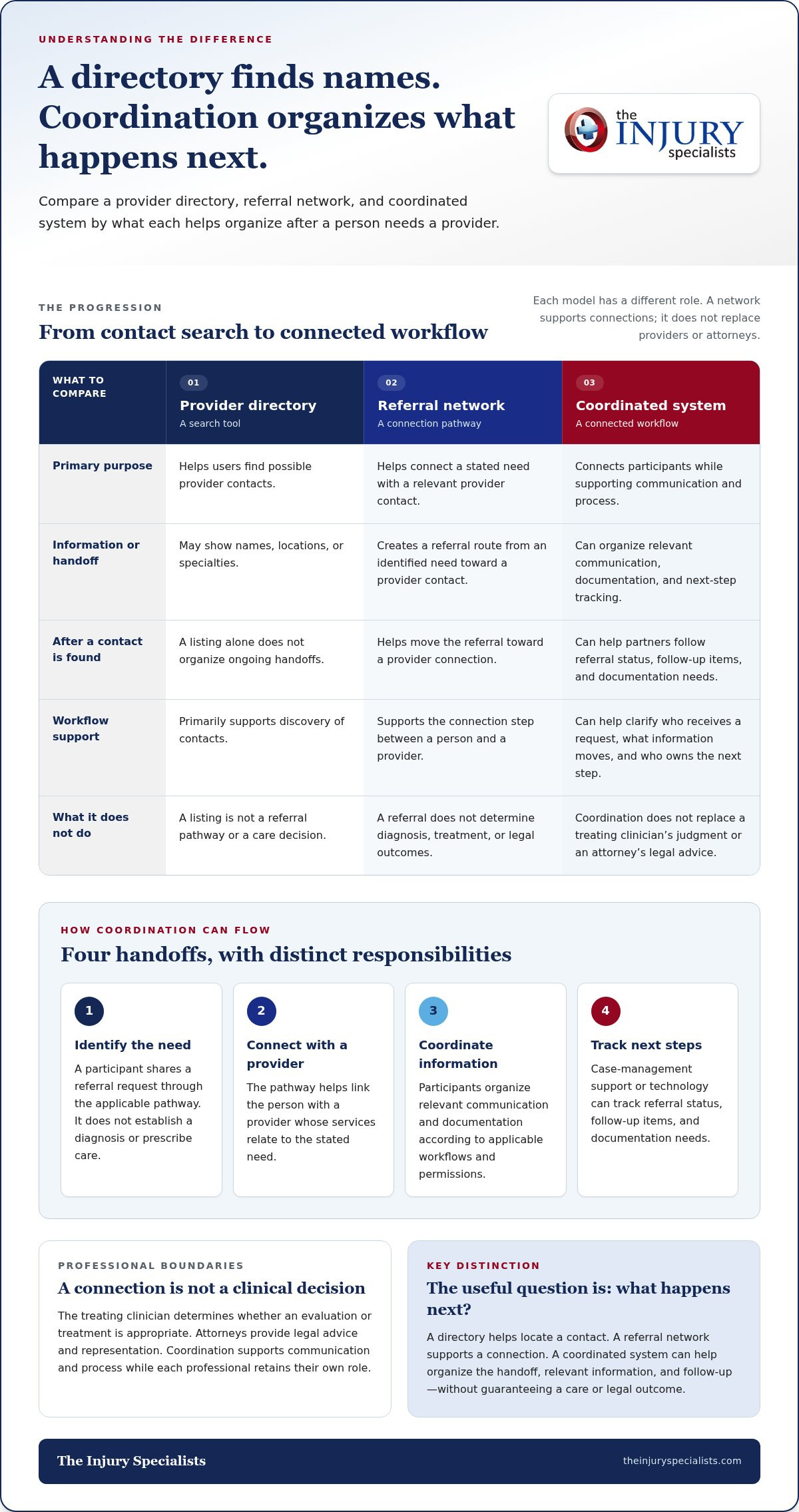
A directory is primarily a search tool. It may show provider names, locations, or specialties so users can identify possible contacts. That can solve the initial discovery problem, but a listing alone does not create a referral pathway or organize ongoing handoffs between participants.
A referral network adds a connection process: a referral can move from an identified need toward an appropriate provider contact. A coordinated system can also support relevant communication, documentation, and next-step tracking. For a broader look at how these connections are organized, explore this personal injury referral network guide.
The practical distinction is what happens after someone finds a name. A directory helps locate a contact; a coordinated structure can help organize the handoff. Neither model guarantees a particular care or legal outcome, and network participation does not replace a patient’s clinician or attorney. The value is a clearer way to make professional connections and organize workflows while preserving each participant’s separate role.
How Personal Injury Medical Networks Coordinate Care and Case Workflows
Coordination works best as a defined sequence, with clear handoffs and each professional responsible for their own decisions. A personal injury medical network can help organize that sequence from an initial request through provider connection and follow-up, while leaving clinical care in the treating clinician’s hands.
- Identify the need. An injured person, attorney, or other participant shares a referral request through the applicable pathway. The request helps establish what type of provider connection may be relevant, without determining a diagnosis or prescribing care.
- Connect with a provider. The referral pathway helps link the person with a provider whose services relate to the stated need. The provider’s practice handles scheduling and determines whether an evaluation is appropriate.
- Coordinate relevant information. Participants organize necessary communications and documentation according to the workflow and permissions that apply to them. Clear handoffs help each person understand who needs to act next.
- Track next steps. Case-management support or technology helps partners keep track of referral status, follow-up items, and documentation needs. Tracking supports the process; it does not determine care or case outcomes.
Coordination support organizes the workflow; it does not make clinical decisions. The treating clinician determines appropriate evaluation and care. The attorney handles legal advice and representation, while case-management support focuses on communication and process. Separating these responsibilities helps participants work together without confusing their roles.
What happens from an initial connection to ongoing coordination?
At a high level, referral intake captures the request and routes it through an appropriate connection pathway. If the referral leads to a provider connection, the practice manages scheduling and clinical interactions. Ongoing coordination helps participants organize relevant updates and follow-up tasks within their respective workflows. The patient, provider, attorney, and support team each retain responsibility for their own decisions and actions.
Where does medical case management fit into the network?
Medical case management supports the operational side of coordination. Depending on the partner workflow, it can include organizing communications, tracking documentation needs, and keeping referral-related next steps visible. It does not dictate treatment, establish legal strategy, or guarantee results. The Injury Specialists provides medical case management for attorneys, designed to support law firms’ distinct processes, alongside technology intended to align with partner workflows.
For law firms and providers, the practical value is a more organized handoff, not a transfer of professional authority. A firm may need visibility into referral progress; a provider may need a clear channel for relevant case-related communication. A coordinated workflow helps each partner understand which tasks belong to them and what information is needed to move the process forward. It can also keep documentation organized in ways that fit the partner’s established process.
Teams assessing their coordination approach can review The Injury Specialists’ network and workflow support to see how referral connections, case-management support, and technology fit together.
Directory, Referral Network, or Coordinated System: What Is the Difference?
These models solve different operational needs. A provider practice delivers services through its own organization. A directory supports discovery. A referral network creates pathways between participants, while a coordinated system can also support follow-through and partner workflows. The right fit depends on the task, not simply on the number of names in a contact list.
Scale alone doesn’t establish coordination quality. A longer provider list may expand discovery options, but it doesn’t show whether referrals are routed, handoffs are clear, or relevant documentation can move through a usable process. When assessing a personal injury medical network, focus on what it enables participants to do, not just how many contacts it includes.
When is a directory enough, and when might coordination matter?
A directory can be a practical starting point when someone needs to find a provider or compare basic contact information. A straightforward need may not require additional coordination. Cases involving multiple providers can create more communication and documentation touchpoints. A structured handoff helps partners keep track of those tasks, though not every case needs a network or case-management support.
How can a network support transparency and professional independence?
Clear processes help participants understand what a referral pathway does and where each role begins and ends. Useful operational practices include:
- Defined roles: Separate referral coordination from clinical, legal, and funding decisions.
- Documented workflows: Make handoffs and follow-up responsibilities understandable to participating professionals.
- Appropriate information handling: Share and manage information through processes suited to its purpose and permissions.
Referral relationships should preserve clinicians’ independent judgment and attorneys’ independent legal advice. A network does not decide diagnosis, treatment, representation, or case value. Privacy and professional-conduct requirements can depend on the circumstances, so organizations should verify applicable guidance using current, authoritative sources and build their processes accordingly.
How to Assess a Personal Injury Medical Network for Workflow Fit
Assess the connection process, not just the size of the provider list. A personal injury medical network is a stronger workflow fit when its referral pathways, communication practices, documentation support, and technology work with the processes your team already uses. Clear role boundaries matter too. No network should replace a clinician’s judgment or an attorney’s independent legal advice.
Start with the handoffs: how does a referral move from request to provider connection, and how are relevant updates or follow-up tasks organized? Consider national reach in practical terms, including whether the network supports the professional connections your operations need across the areas you serve. Reach alone doesn’t establish fit; consistent processes and clear expectations matter.
What should medical providers assess before joining a network?
Compare referral pathways with your practice’s capacity and patient-care processes. Consider whether communication and documentation expectations fit your existing procedures without disrupting clinical responsibilities. Also assess how professional networking, referral activity, and case-management support fit your operations. The objective is a workable connection process, not a promise of patient volume or clinical outcomes.
- Referral alignment: Check that the referral process supports your practice’s services and intake workflow.
- Operational fit: Review how coordination and networking tasks interact with staff roles and existing processes.
- Documentation: Understand what information is organized, how it moves through the workflow, and who handles each step.
What should law firms assess in a medical network?
Law firms should look for coordination that aligns with their distinct case-management workflow. Map how a provider connection is initiated, how imaging referrals are handled when relevant, and how documentation needs fit into existing case processes. A workflow that complements the firm’s systems makes responsibilities easier to track without directing medical decisions or legal strategy.
- Referral pathways: Identify how physician, therapy, and imaging connections fit into the firm’s case process.
- Communication: Clarify who handles referral updates and how those updates fit into the team’s established workflow.
- Technology: Assess whether the tools support documentation needs and align with the firm’s approach to case management.
For a deeper look at how technology can support these processes, review this guide to personal injury case-management technology.
Practice leaders should bring both perspectives together. Document who owns each handoff, which systems hold relevant information, and how teams manage communication. Then compare those requirements with the network’s workflow. This makes it easier to identify operational gaps before they affect day-to-day coordination.
Prioritize transparent processes and role clarity over unsupported guarantees about care, legal outcomes, or case results. To explore referral connections and workflow support for your organization, connect with The Injury Specialists.
How The Injury Specialists Connects Personal Injury Medical Networks
The Injury Specialists connects injury victims, medical providers, and law firms. Its referral programs create professional pathways to physicians, chiropractors, physical therapists, and imaging centers. The company facilitates these connections and supports partner workflows; it does not deliver medical treatment or provide direct legal representation.
That distinction matters in a personal injury medical network. A referral can connect a person to a provider, while the provider independently determines appropriate evaluation and care. Attorneys retain responsibility for legal advice and representation. The network helps organize connections and related workflows across these separate professional functions.
- Physician referrals connect people and professional partners with physician practices.
- Chiropractic and physical therapy referrals support connections to providers in those disciplines.
- Imaging-center referrals help establish a connection to diagnostic imaging services when relevant to the referral process.
- Attorney referral programs and professional networking help connect legal professionals with medical and case-management support tailored to partner workflows.
The Injury Specialists serves a national audience and operates the largest personal injury referral network in the United States. Its scale is part of its connector model, while the practical value for a partner depends on how referral pathways and coordination fit that organization’s needs. Network participation does not dictate clinical judgment, legal strategy, or case outcomes.
How do referral programs and technology work together?
Professional connections are supported by referral programs, marketing, and networking. Case-management technology adds workflow support by helping partners organize communication and documentation in ways designed to align with their processes. For example, a firm may need referral-related information to fit its case workflow, while a provider’s process centers on practice operations. Technology supports those workflows; it doesn’t decide what care a patient receives or how a legal matter proceeds. Providers can learn more in the physician referral services guide.
Coordination is most useful when partners understand what happens at each handoff: who initiates a referral, where relevant documentation fits, and which professional owns each next step. The Injury Specialists’ case-management support and technology are designed to work with partner processes rather than replace them. That structure gives participating teams operational context beyond a standalone listing, without promising a particular treatment, legal, or settlement result.
What is a practical next step for medical and legal professionals?
Start with your role and workflow priorities. Providers can consider how referral connections fit their practice and documentation processes. Law firms can assess how medical case-management support and technology align with their distinct workflows. Both can focus on communication expectations, referral pathways, and clear responsibilities when exploring a professional network.
A connected pathway adds context to an introduction by supporting coordination around the referral. Explore The Injury Specialists’ network programs to learn how its referral services, case-management support, and technology connect medical and legal professionals.
Build Your Next Workflow Around Clear Connections
Turn network evaluation into an operational plan. Identify one recurring handoff your team wants to clarify, then define who owns each action, what information is needed, and how progress will be tracked. This gives providers and legal professionals a practical starting point for assessing whether a personal injury medical network fits their day-to-day work.
Strong coordination depends on deliberate design, not assumptions about what a network will deliver. Keep clinical and legal decisions with the professionals responsible for them, and focus on building a process partners can understand and use. The Injury Specialists operates the largest personal injury referral network in the United States, connecting injury victims with medical and legal professionals.
Explore how referral programs and workflow support can align with your organization’s priorities. Explore The Injury Specialists’ network programs and take a practical next step toward more connected professional workflows.
Frequently Asked Questions
What is a personal injury medical network?
A personal injury medical network connects people dealing with injury-related care needs to medical and legal professionals through organized referral relationships. For example, someone who needs an imaging referral can be connected with an imaging center, while their attorney manages legal questions separately. The network supports professional connections and related processes; it doesn’t diagnose injuries, provide treatment, or replace advice from a qualified clinician or attorney.
How is a personal injury medical network different from a directory?
A directory helps someone search for contact information. A network provides established referral pathways and operational support beyond that initial search. For instance, a directory entry alone may not clarify where a referral request goes or how partners organize related documentation. These models serve different purposes, so compare whether the process supports the task at hand rather than assuming one format is universally better.
Can a personal injury medical network choose a patient’s treatment?
No. A network can facilitate a connection, but the treating clinician evaluates the patient and makes clinical decisions. A referral for physical therapy, for example, doesn’t determine that therapy is appropriate or prescribe a course of care. Patients should discuss evaluation and treatment questions with their provider. Attorneys handle legal advice, and network or case-management support doesn’t replace either professional’s judgment.
Who can participate in a personal injury medical network?
Participants can include injured people seeking provider connections, physicians, chiropractors, physical therapists, imaging centers, and attorneys. Each contributes a distinct function. A provider delivers care through their practice, while an attorney handles legal representation. Referral programs and networking create connections among these participants. Funding is a separate function; The Injury Specialists facilitates pre-settlement funding services rather than providing medical care or legal representation.
How does medical case management fit into a personal injury network?
Medical case management helps partners organize case-related communication and documentation around their workflows. For example, a law firm may need to track whether a referral-related document has been received, while a provider follows its own clinical and recordkeeping processes. Case-management support helps organize those operational tasks, but it doesn’t set treatment plans, direct legal strategy, or promise a particular case result.
Are personal injury medical networks available nationwide?
Some networks operate nationally. The Injury Specialists serves a national audience and connects injury victims with medical and legal professionals through its referral programs. National reach describes the scope of the network, not a guarantee that every provider or service is available in every location. For professionals assessing reach, consider whether the network’s connections and workflows suit the people and partner organizations they serve.
How can a medical provider or law firm evaluate a personal injury network?
Start by mapping a routine referral from the first request through the next internal task. Providers can compare referral intake and documentation expectations with practice procedures. Law firms can assess whether coordination fits their case-management process, including how they organize provider connections and records. Both should look for clear responsibilities, practical communication pathways, and technology that supports existing workflows rather than relying on unsupported outcome promises.

Leave A Comment
You must be logged in to post a comment.