

More cases don’t create scale; repeatable systems do. Learning how to manage a high-volume PI practice means building workflows that keep deadlines, records, follow-ups, and client communication moving as caseloads grow. Without clear ownership, handoffs stall, workloads become uneven, and important next steps are harder to track.
That pressure is familiar to firms handling a steady flow of personal injury matters. Adding staff or adopting new technology can help, but neither replaces a consistent operating model. Teams need shared processes, visible case milestones, and reliable ways to coordinate with medical and legal professionals.
This article covers practical ways to build that structure: assign ownership at each stage, standardize routine work, monitor bottlenecks, and keep communication consistent. It also explains how case management technology and coordinated referral relationships can complement existing firm processes and help keep case progress organized as capacity grows.
Key Takeaways
- Define high volume by workload and operational complexity, then identify where growing intake strains ownership, handoffs, and follow-up.
- Map a repeatable case workflow from intake through closure, with clear stage owners, completion criteria, and next steps.
- Diagnose whether capacity, process, technology, or coordination is the constraint before choosing an operational fix.
- Use a consistent review cycle and focused scorecard to spot stalled matters, uneven workloads, and recurring process exceptions.
- Learn how to manage a high-volume PI practice by integrating medical-legal coordination with the firm’s established workflows.
How to Manage a High-Volume PI Practice Without Losing Control
High-volume PI practice management is the disciplined coordination of cases, people, and next steps so increased intake doesn’t disrupt case progress. There is no universal case-count threshold for a high-volume practice. The practical test is whether the firm can advance matters, track follow-ups, and communicate consistently with its current workload.
Personal injury matters can involve different injuries, records, treatment paths, and legal questions. A general overview of personal injury law provides context for the breadth of the practice area, but each firm must assess the demands of its own caseload. A file count alone can obscure how much coordination each matter requires.
Growth and capacity are not the same. More signed files increase intake, but they add value only when the team has the ownership, time, and processes to advance both new and existing matters. When files arrive faster than staff can organize next steps, the backlog grows even as the firm appears to be expanding.
Where caseload growth puts pressure on firm operations
Friction often starts at the handoffs. Intake details may be captured inconsistently, tasks may lack a clear owner, or records requests may wait between teams. Each delay adds follow-up work, makes workloads harder to balance, and can lead to inconsistent client updates depending on who last touched the file.
Illustrative example: A new matter is opened, but no one is assigned to confirm that the initial records request was sent. A case manager assumes intake handled it; intake assumes the case team owns it. The request goes out late, staff have to reconstruct what happened, and the client receives an update only after asking. The core problem is an unclear handoff, not simply a busy team.
Set a practical definition of manageable volume
Assess workload by what each case needs next, not just by the number of files on a dashboard. Group active matters by stage, complexity, and required follow-up. Compare those demands with available staff capacity, then flag work that is waiting, repeatedly reassigned, or dependent on one person.
- Separate intake from progress. Track new matters entering the firm separately from active matters advancing through their next steps.
- Make ownership visible. For every open task, record who owns it and what completion looks like.
- Look for pressure points. Review delayed records requests, overdue follow-ups, and cases without a defined next action.
A manageable caseload is one the firm can advance with consistent ownership and follow-up. The threshold varies with case complexity, staffing, and workflow design. Use recurring operational signals to assess capacity, then address the source of strain before treating additional intake as proof the practice can absorb more.
Build a Repeatable PI Case Workflow From Intake to Resolution
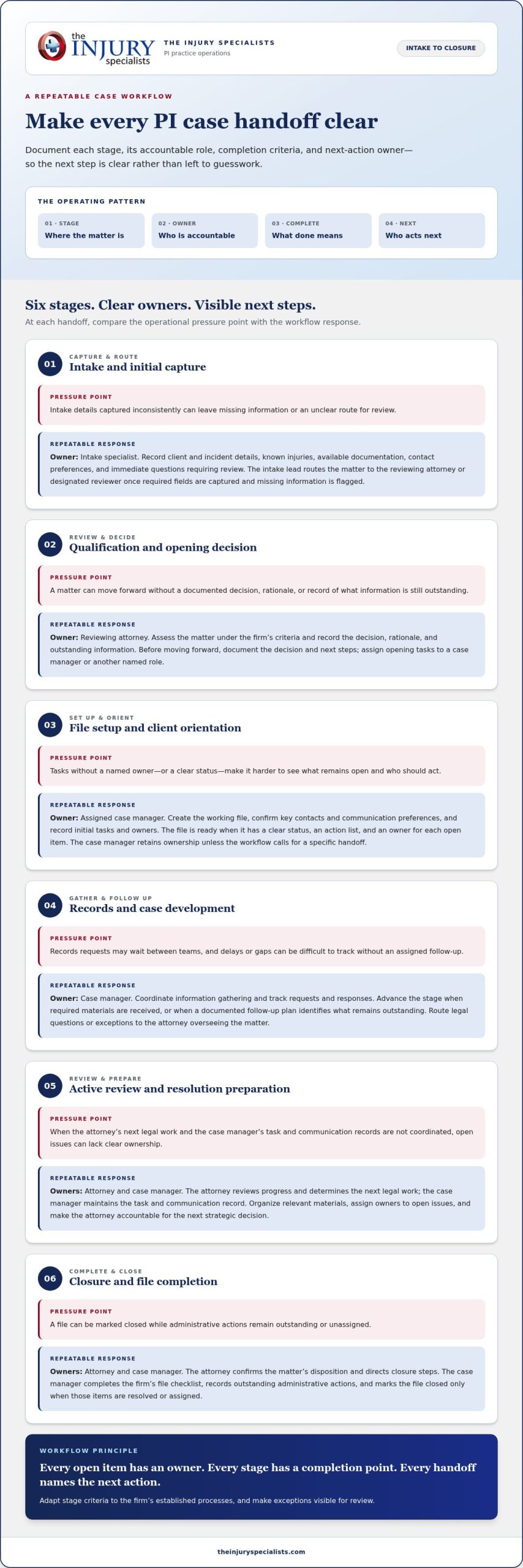
A repeatable workflow makes each case transition a clear handoff rather than a guess about who should act next. For firms considering how to manage a high-volume PI practice, document each stage, its accountable role, completion criteria, and next-action owner. The workflow should guide routine matters while making exceptions visible for review.
Use the sequence below as a working model. Assign each responsibility to a role in your firm, then adapt the stage criteria to your established processes.
- Intake and initial capture. The intake specialist records client and incident details, known injuries, available documentation, contact preferences, and immediate questions requiring review. This stage is complete when required fields are captured, missing information is flagged, and the matter is routed for qualification. The intake lead owns the handoff to the reviewing attorney or designated reviewer.
- Qualification and opening decision. The reviewing attorney assesses the matter under the firm’s criteria and records the decision, rationale, and outstanding information. Before the matter moves forward, document the decision and next steps. The attorney assigns opening tasks to a case manager or another named role.
- File setup and client orientation. The assigned case manager creates the working file, confirms key contacts and communication preferences, and records initial tasks and owners. The file is ready when it has a clear status, an action list, and an owner for each open item. The case manager retains ownership unless the workflow calls for a specific handoff.
- Records and case development. The case manager coordinates information gathering, tracks requests and responses, and flags gaps or delays for review. The stage advances when required materials are received or a documented follow-up plan identifies what remains outstanding. The case manager routes legal questions or exceptions to the attorney overseeing the matter.
- Active review and resolution preparation. The attorney reviews case progress and determines the next legal work, while the case manager maintains the task and communication record. Completion criteria should reflect the firm’s process, such as confirming that relevant materials are organized and open issues have owners. The attorney owns the next strategic decision.
- Closure and file completion. The attorney confirms the matter’s disposition and directs closure steps. The case manager completes the firm’s file checklist, records outstanding administrative actions, and marks the file closed only when those items are resolved or assigned. This creates a consistent endpoint and reduces lingering, ownerless tasks.
At every transition, require a concise handoff: current status, completed work, outstanding items, relevant documents, and the next owner. If information is incomplete, route the file through a defined exception path, such as attorney review or assigned follow-up, rather than advancing by assumption. Set internal review intervals that fit the firm’s workflow, and keep them separate from legal deadlines.
A shared status view helps staff see the stage, task owner, pending requests, and blocked work without relying on scattered messages. Personal injury case management technology can support that structure when it aligns with the firm’s process. The Injury Specialists provides structured referral and case-management support to complement a firm’s own workflow.
Choose the Right Fix: Staffing, Technology, or Better Coordination
When cases slow down, the first proposed solution is often another hire or a new system. But a visible delay may be a symptom, not the cause. To determine how to manage a high-volume PI practice effectively, trace where work waits, repeats, or returns because information is missing. Match the fix to the constraint, then assess whether it improves that point in the workflow.
Diagnose the bottleneck before adding resources
Review a sample of recent files and map where progress paused or work had to be repeated. Note how often each issue occurs, which role owns the task, and what information or decision was missing. A temporary intake spike may call for short-term task redistribution; a recurring backlog at the same stage points to an ongoing capacity or process problem.
Staffing constraint
Symptoms: Tasks are clearly defined, but assigned staff cannot complete them on time and queues keep growing.
Likely cause: Available capacity does not match recurring workload.
Response: Review workload distribution and role coverage. Test reassignment or added capacity against the affected tasks.
Workflow constraint
Symptoms: Files bounce between teams, tasks are duplicated, or staff repeatedly seek missing details.
Likely cause: Unclear ownership, handoff requirements, or stage criteria.
Response: Clarify who owns each action and what information must accompany a handoff before changing headcount or tools.
Technology constraint
Symptoms: Staff rely on separate records or manual status checks to see what is pending.
Likely cause: The current system does not support the firm’s documented workflow, or staff use it inconsistently.
Response: Compare technology with actual process needs and define how staff will use it.
Coordination constraint
Symptoms: Progress depends on repeated outreach across the firm and external medical-legal relationships.
Likely cause: Responsibilities and communication paths across parties are not structured.
Response: Define the coordination steps and owners. The Injury Specialists’ attorney referral program provides a structured external coordination model that complements the firm’s own process.
Use technology to support an established process
Software won’t resolve unclear ownership or inconsistent procedures by itself. First document the tasks, roles, and handoffs the system must support. Then assess whether it makes case status, outstanding requests, and next actions easier to track. Plan adoption with role-specific training, clear accountability, and consistent expectations for use.
Make each improvement testable. For example, if files stall because records requests lack a follow-up owner, assign that role and review request status at a defined internal check. If the queue still grows, investigate whether workload or external coordination is the deeper constraint. The Injury Specialists’ referral and case-management support complements established firm processes when medical-legal coordination is part of the bottleneck.
Improve Capacity With a PI Practice Management Review Cycle
A review cycle turns operational signals into deliberate adjustments. Rather than waiting for a missed handoff or growing backlog to prompt a reaction, set recurring time to examine workload, stalled matters, internal actions, and exceptions. The goal isn’t to measure the firm against an unsupported industry average. It’s to see whether its own processes are becoming more reliable as volume changes.
Keep the review practical: use a small scorecard, define each measure, and assign someone to lead the discussion. Review trends over time instead of treating one busy period as proof a process has failed. This gives the team a consistent basis for deciding where to focus.
Track indicators that reveal operational friction
Choose measures the team can define and update consistently. For example, track internal tasks still open past their planned review point, handoffs awaiting acceptance, files missing information needed for the next step, and workload by role or case stage. Agree on exactly what qualifies for each measure so successive reviews can be compared fairly.
Numbers show where to look, but staff can explain why a queue is forming. Ask which steps generate repeated follow-ups, unclear requests, or avoidable rework. Record recurring obstacles alongside the scorecard, then distinguish isolated exceptions from patterns that call for a process change.
- Aging tasks: Track open internal actions beyond their planned review point.
- Unresolved handoffs: Record transitions that have no confirmed receiving owner.
- Missing documentation: Note files blocked because information needed for the next step is absent.
- Workload distribution: Compare assigned work by role and stage to identify uneven pressure.
Turn review findings into controlled improvements
Choose one issue with a clear operational impact, such as repeated delays routing a particular request. Document the current process, select a defined team or case segment for a pilot, and name the person responsible for the change. Set an evaluation period that gives the team time to use the revised process, then compare the same measure before and during the pilot.
Decide in advance what success means. It might be fewer unresolved handoffs, more complete requests at a transition, or clearer task ownership, rather than an invented productivity benchmark. Gather staff feedback alongside scorecard results. Keep the change if it addresses the cause without creating new friction; revise it if execution is inconsistent, or stop it if the intended improvement doesn’t appear. Expand only after the pilot produces a useful, repeatable approach.
A steady review rhythm is one practical part of how to manage a high-volume PI practice. As the firm refines its operating model, The Injury Specialists provides personal injury referral network resources and case-management support. Explore The Injury Specialists’ professional network to discuss how this support can fit your firm’s processes.
Connect Your PI Practice With Coordinated Medical-Legal Support
Some case delays begin outside the firm’s own workflow. A file may depend on communication between legal staff and medical professionals, such as coordinating a referral, tracking a request, or routing relevant information to the appropriate person. When these steps rely on scattered messages or unclear responsibility, adding software alone won’t resolve the coordination gap.
For firms considering how to manage a high-volume PI practice, external coordination is one operational component, not a replacement for internal case ownership. The firm still defines its legal workflow, client communication practices, and decisions. A referral or case-management program can support professional coordination around those processes, with clear boundaries and handoffs.
Coordinate medical and legal work around clear handoffs
Identify where communication with medical professionals intersects with case progression. At each point, define what information is needed, who requests or routes it, and how the firm records its status. Document what happens when information is delayed or a request needs follow-up, so staff know who should act next.
Consistent status updates help teams distinguish completed actions from pending ones. The aim is not to control another professional’s work or imply a particular treatment or case result. It’s to make coordination visible: what was requested, what has been received, who owns the next step, and whether the matter needs internal review.
Choose a partnership that fits the firm’s operating model
A useful program fits the firm’s established process rather than forcing staff to work around a separate system. The Injury Specialists’ attorney referral program integrates medical case management based on a firm’s distinct processes. Firms can align support with their coordination needs, including referral access, networking with medical professionals, and case management.
Before implementation, align on practical priorities: which case stages need external coordination, which firm role owns each handoff, what status information staff need, and how exceptions return to the firm for review. Referral access, networking, and technology supporting case management can contribute to a coordinated operating model, but they work best when responsibilities and communication paths are defined. Focus on workflow fit and implementation priorities, without replacing the firm’s own systems or judgment.
Structured medical-legal coordination helps firms manage connections across professional partners while keeping internal ownership clear. Explore The Injury Specialists’ professional network to learn how an attorney referral and case-management program can align with your firm’s processes.
Put Your Next Growth Step Into Motion
Scaling well is an ongoing operating decision, not a finish line. Choose one pressure point your team can address now, then make the improvement visible in daily work. This keeps growth tied to the firm’s ability to serve clients and move matters forward.
For firms considering how to manage a high-volume PI practice, the next step may include strengthening professional relationships around case progression. The Injury Specialists connects injury victims with medical and legal professionals through a national network, and its attorney referral program integrates medical case management around a firm’s distinct processes.
Explore how coordinated support can fit your firm’s operating model. Explore The Injury Specialists’ professional network and identify a practical next step for your team.
Frequently Asked Questions
How many cases can a personal injury lawyer manage at once?
There’s no universal case limit for every lawyer or firm. A workable number depends on case complexity, stage, support staff, and the attention each matter requires. A lawyer handling several trial-preparation files may have less capacity than one overseeing matters with fewer active demands. Assess workload by reviewing upcoming decisions, attorney-owned tasks, and files waiting for legal review, then adjust assignments before delays become routine.
What is the first step in scaling a personal injury practice?
Start by establishing a baseline of how work moves through the firm today. Review a sample of open and recently closed files to find where cases pause, where staff repeat work, and which tasks depend on one person. This gives leaders a practical view of current capacity before they add staff, technology, or intake targets. Choose one specific friction point to address first rather than changing several processes at once.
Can a PI firm handle more cases without hiring more staff?
Yes, if avoidable rework, duplicate data entry, or unclear task routing is consuming available capacity. For example, standardizing the information collected before a file moves to the next team may reduce repeated clarification. Track whether the change frees time without creating delays or weakening client service. If work queues remain beyond the team’s capacity after process improvements, additional staffing or external support may be necessary.
Which metrics should a high-volume personal injury firm track?
Track measures that explain movement and workload, not just total files. Useful indicators include open tasks by owner, time since the last documented case action, files awaiting records or decisions, client contacts completed according to firm policy, and matters returned for missing information. Define each measure before tracking it. A trend can point to a specific process issue; a number without context may not guide a useful decision.
How often should a PI firm review its case workflows?
A practical starting point is a short weekly review of blocked matters and overdue internal actions, paired with a monthly look at recurring patterns. The weekly check supports timely reassignment or escalation; the monthly review helps leaders determine whether a bottleneck is persistent or temporary. Adjust the cadence to the firm’s workload and operating needs. Review workflows sooner after a major staffing, technology, or process change to catch unintended effects.
How can a firm maintain consistent client communication as caseloads grow?
Set a firm-wide communication standard that identifies who owns updates, which events trigger contact, and where each interaction is recorded. For example, decide how staff will communicate after a meaningful case development and what they’ll do when there’s no material change to report. Record the client’s preferred contact method and agreed expectations in the file. Clear ownership makes communication less dependent on which staff member happens to notice the case.
When should a PI firm consider outside medical-legal coordination support?
Consider it when staff repeatedly spend time coordinating medical-provider connections or tracking information across professional relationships, and the issue persists despite clear internal ownership. Identify which coordination tasks need support and how updates should flow back to the firm. The Injury Specialists’ attorney referral program integrates medical case management around a firm’s distinct processes, complementing the firm’s workflow without replacing its case decisions or client relationships.

Leave A Comment
You must be logged in to post a comment.