

If your case doesn’t result in a recovery, non-recourse lawsuit funding generally means you won’t have to repay the advance. But the agreement still matters. It defines what counts as a recovery, how the amount owed is calculated, and whether any circumstances affect repayment. “Non-recourse” describes how repayment is tied to the case outcome, not every detail of the contract.
It’s reasonable to want clarity before accepting funds, especially when the amount owed could reduce what you ultimately receive. This guide explains how non-recourse funding typically works, what repayment may depend on, and which agreement terms to review closely. You’ll also learn the general steps involved in exploring funding, from discussing the case with your attorney to understanding the proposed terms. The Injury Specialists facilitates connections to pre-settlement funding as part of a broader network supporting injury cases.
Key Takeaways
- Understand how non-recourse lawsuit funding ties repayment to the outcome of the underlying claim, and how that differs from conventional debt.
- Review each stage of the funding process, from the initial request through case review, agreement decisions, and disbursement.
- Look beyond the “non-recourse” label: charges may still affect the proceeds left after a recovery.
- Check how the agreement calculates the total payoff, when it’s due, and what repayment conditions apply.
- Learn how The Injury Specialists facilitates connections between injury victims and professional partners as part of a broader support network.
What Does Non-Recourse Lawsuit Funding Mean?
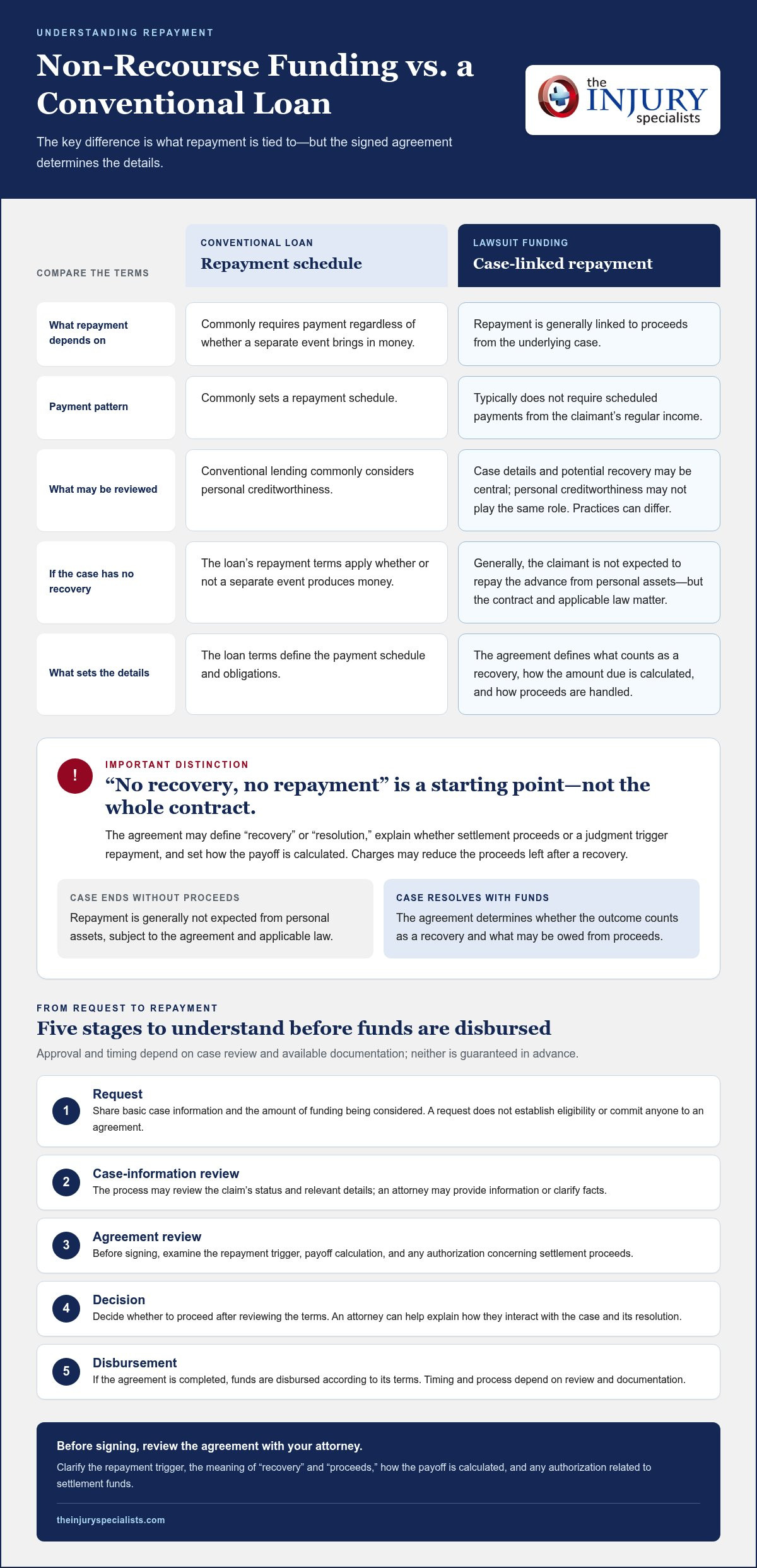
Non-recourse lawsuit funding is an advance connected to a pending legal claim. Repayment is generally expected from proceeds if the claim produces a recovery. Unlike conventional debt, it typically doesn’t require scheduled payments from the claimant’s regular income. The exact obligation depends on the signed agreement, how the case resolves, and applicable law.
In practical terms, non-recourse funding ties repayment to a case recovery, but the agreement determines how that principle applies. An agreement may define which outcomes count as a recovery, how the amount due is calculated, and what happens if proceeds are unavailable or handled in a particular way. The label alone doesn’t answer every repayment question.
The broader concept of nonrecourse debt generally limits repayment to specified collateral rather than making a person personally responsible for an unpaid balance. Lawsuit funding applies a related idea to a legal claim, but agreements and legal treatment can vary. Don’t assume every arrangement has identical terms or protections.
How non-recourse differs from a conventional loan
A conventional loan commonly sets a repayment schedule and requires payment regardless of whether the borrower receives money from a separate event. With non-recourse lawsuit funding, repayment is generally linked to proceeds from the underlying case instead. That makes the case outcome central to understanding the repayment obligation.
Review how the funding request is evaluated, too. Case details and the potential recovery may be central considerations, while personal creditworthiness may not play the same role it does in conventional lending. Practices can differ, so don’t treat this as a universal underwriting rule. “Lawsuit loan” is a common search phrase, but it doesn’t necessarily describe the legal structure of a particular agreement.
What “no recovery, no repayment” does and doesn’t tell you
The phrase usually describes the basic risk allocation: if the claim produces no recovery, the claimant generally isn’t expected to repay the advance from personal assets. But it isn’t a substitute for reading the contract. The agreement may define what counts as a “recovery” or “resolution” and how settlement proceeds must be handled. Applicable law may also affect the arrangement.
Consider two possible outcomes: a claim ends without proceeds, or it resolves with funds paid through a settlement. The agreement’s wording determines how those situations are treated and whether repayment is limited to available proceeds. Check whether “recovery” includes only a settlement or judgment, or also refers to other case-related payments. These definitions can shape what is owed even when the case doesn’t end as expected.
Before signing, review the agreement with your attorney. Ask them to explain the repayment trigger, the meaning of recovery and proceeds, and any authorization related to settlement funds. Clear answers help distinguish the general non-recourse principle from the specific obligations in your contract.
How Non-Recourse Lawsuit Funding Moves From Request to Repayment
Exploring non-recourse lawsuit funding usually involves more than submitting a request. The process connects the claimant, the legal team, and the funding review, while the agreement sets the terms for any later repayment. Each stage is an opportunity to understand what information is being considered and how the arrangement fits the case.
Approval and timing depend on the case review and available documentation, so neither is guaranteed in advance. A typical process may include these steps:
- Request: The claimant shares basic information about the case and the amount of funding being considered. This begins the review, but it doesn’t establish eligibility or commit anyone to an agreement.
- Case-information review: The funding process may involve reviewing the claim’s status and relevant case details. Depending on the process, the attorney may provide information or help clarify facts about the case.
- Agreement review: If terms are offered, read the proposed agreement before signing. Focus on the repayment trigger, how the amount due is calculated, and any authorization concerning settlement proceeds.
- Decision: The claimant decides whether to proceed after reviewing the terms. The attorney can help explain how the agreement interacts with the case and its resolution.
- Disbursement: If the agreement is completed, funds are disbursed according to its terms. The timing and process depend on review and documentation, so don’t rely on an assumed schedule.
What information may be reviewed during an application
A review may consider the general status of the claim, whether the claimant has legal representation, and information that helps describe the underlying case. The specific materials and process can vary. Attorney coordination can help put case details in context, but it doesn’t guarantee a particular decision. Don’t assume that a specific document or credit review is always required.
Keep your attorney involved as the request moves forward. They may be asked to provide relevant case information, clarify the status of negotiations, or review proposed terms with you. Their input is especially useful when a detail in the funding paperwork depends on how the case is being handled.
How case resolution can affect repayment
If a covered recovery occurs, the agreement may provide for repayment from the proceeds. A settlement and a judgment are different ways a claim may result in recovery, and the contract’s wording determines how each is treated. A resolution without recovery may trigger a different result under a non-recourse arrangement, but the phrase alone doesn’t settle every contractual question.
Before signing, identify what the agreement calls a recovery and how it defines proceeds. Then ask your attorney to explain how repayment would work for the possible outcomes of your case. Legal outcomes and contract terms vary, so the agreement, rather than a general process description, governs the specific obligation.
The Injury Specialists facilitates pre-settlement funding connections within a broader network linking injury victims with legal and medical professionals. Learn more about pre-settlement funding connections.
Non-Recourse Funding Risks: What ‘Risk-Free’ Claims Leave Out
“Non-recourse” describes a repayment structure, not a promise that funding has no cost or consequence. If a covered recovery occurs, the amount payable under the agreement may reduce the proceeds left for you. If no recovery occurs, repayment may generally not be required, but the contract’s definitions and conditions matter. Treat claims such as “risk-free” as marketing language, not a replacement for the signed terms or applicable law.
The trade-off is practical: funding can provide cash while a claim is unresolved, but accepting it may leave less from a later recovery. That can affect the amount available after other case-related obligations are addressed. The decision depends on your immediate needs and the agreement’s total payoff, not just the amount advanced or the absence of scheduled payments.
How funding charges can affect net proceeds
The payoff may change over time depending on the agreement’s calculation method and when repayment occurs. A longer case timeline could matter if charges accrue. Compounding terms, caps, fees, or payoff provisions can also affect the total. Not every agreement uses the same approach, so don’t assume a quoted starting amount will equal the final payoff.
Before signing, ask your attorney to help identify how the contract answers these questions:
- Does the amount due accrue over time, and how is that calculated?
- Does the agreement apply compounding, and if so, how often?
- Are any fees added to the balance, and when do they apply?
- Is there a cap or another limit on the total payoff?
- How is the amount calculated if repayment occurs at different stages of the case?
Use the agreement’s actual terms to understand the potential effect on net proceeds. A clear payoff explanation helps you compare the immediate cash-flow benefit with what may remain if the case resolves with a recovery.
Why the case outcome and contract wording matter
Terms such as “recovery,” “proceeds,” and “case resolution” can determine when repayment is triggered and what funds are covered. The agreement may describe settlements, judgments, or other outcomes differently. Don’t infer how an unsuccessful resolution or partial recovery will be treated from a promotional summary alone.
Have your attorney review exceptions, special conditions, and any authorization involving settlement proceeds. Ask how the wording applies to possible outcomes of your case, including a resolution that produces less than expected. This is a contract-specific review, not a prediction of how your claim will end.
Rules and legal treatment can vary by jurisdiction and may change. Confirm current requirements with qualified legal counsel rather than relying on a general description or a provider’s marketing statement. Consider the obligation in the agreement as interpreted under applicable law, alongside its practical effect on your potential net recovery.
How to Review a Non-Recourse Funding Agreement
A careful agreement review turns broad promises into specific obligations you can assess. Before accepting non-recourse lawsuit funding, identify how the amount due will be calculated, when it may be collected, and what happens under different case outcomes. The goal is to understand the potential effect on your net proceeds, not just the amount available upfront.
Read the full agreement, including definitions, authorizations, and any attached disclosures. If a clause is unclear, ask your attorney to explain how it could apply to your case. This checklist can help organize that conversation, but it isn’t legal advice or a substitute for reviewing your specific contract with counsel.
Terms to locate and understand before signing
Start with the financial terms and repayment language. Find the amount advanced, how charges are calculated, when they begin accruing, and how the payoff is determined. Then check whether the agreement describes a cap, additional fees, or different treatment for an early payoff.
- Calculation: Is the amount owed fixed, or can it grow over time? What method does the agreement use?
- Timing: When do charges begin, and how does the payoff change if the case takes longer?
- Outcome: How does the contract address a settlement, judgment, unsuccessful claim, or material change in the case?
- Proceeds authorization: Does the agreement authorize anyone to receive, hold, or disburse funds from a settlement? Identify who is responsible and what the authorization permits.
- Limits and fees: Are caps, fees, or early-payoff terms clearly stated, and how do they affect the final amount due?
Don’t rely on a verbal summary if the written terms say something different. Ask for unclear terms to be explained before you sign, and make sure you understand any document incorporated by reference.
Questions to discuss with your attorney
Your attorney can help connect the agreement’s wording to the case. Discuss how repayment could affect your estimated net proceeds under different outcomes, including a settlement that differs from expectations. Ask whether the funding terms could interact with settlement decisions or case strategy, and clarify any role the agreement assigns to your attorney or law firm.
Also review what the agreement means by “recovery” and “proceeds,” and how it handles a case that ends without a payment. The answers should come from the actual contract and applicable law, not assumptions based on a general description.
For broader context on evaluating funding, read this pre-settlement funding guide. Learn how funding connections fit into a broader injury-support network by exploring pre-settlement funding support.
Exploring Non-Recourse Lawsuit Funding Through a Coordinated Support Network
Funding is one part of a personal injury claim, not a substitute for legal representation or medical care. A claimant may be managing case decisions, treatment, and immediate financial needs at the same time. Coordination among the people and services involved can help keep those roles clear as the case progresses. Access to funding is not guaranteed, and any arrangement remains subject to its review and agreement.
The Injury Specialists facilitates connections between injury victims, attorneys, and medical providers, as well as pre-settlement funding services within that broader network. It supports connections and coordination, rather than acting as the claimant’s attorney or providing medical treatment. The attorney remains the appropriate person for legal advice and case strategy; medical professionals guide care decisions.
How funding connects to the wider personal injury process
A claimant considering non-recourse lawsuit funding may need to coordinate several separate conversations. The funding process can involve case information and attorney participation, while medical providers focus on care and documentation relevant to treatment. These connections can help you understand how each part fits without confusing a funding agreement with a legal or medical decision.
Coordination also matters for professional partners. Clear communication can help attorneys, providers, and funding services understand their respective roles and the information needed for the process. It doesn’t determine legal strategy, guarantee a funding decision, or replace the claimant’s review of the agreement. The personal injury case management technology guide offers more context on how connected systems can support coordination across case-related services.
A practical next step for claimants and professional partners
Use a deliberate sequence before moving forward:
- Understand the need: Identify what the funds would help address and whether an advance fits your circumstances.
- Consult counsel: Discuss the case, the request process, and any attorney involvement with your lawyer.
- Review the terms: Understand the payoff calculation, repayment conditions, and any authorization involving proceeds before signing.
- Make an informed decision: Consider the potential cash-flow support alongside its possible effect on proceeds if the case results in a covered recovery.
For professional partners, the same principle applies: keep responsibilities distinct, coordinate relevant case information, and make sure the claimant understands the proposed terms. The Injury Specialists brings injury victims and professional partners together as part of a broader personal injury support network. To learn about that connected support, Explore The Injury Specialists’ network.
Make Your Next Step an Informed One
Before moving forward with non-recourse lawsuit funding, treat the decision as part of your broader case planning. Consider how a funding agreement fits your financial priorities, and keep your attorney involved in questions about case strategy and settlement proceeds. A deliberate decision can help you move forward with a clearer understanding of your options.
The Injury Specialists connects injury victims with legal and medical professionals through a national network and facilitates pre-settlement funding as one element of broader case support. Its case-management technology helps professional partners coordinate across the personal injury process. These connections support a more joined-up approach while leaving legal decisions to attorneys and treatment decisions to medical professionals.
Explore how connected support can fit into your next steps through The Injury Specialists’ personal injury network. The Injury Specialists facilitates connections to pre-settlement funding and professional support as part of its broader network.
Frequently Asked Questions
Is non-recourse lawsuit funding really non-repayable if I lose?
Generally, repayment is tied to a recovery, so a claim that ends without one may not require repayment. The signed agreement and applicable law control, however, and the phrase alone can’t confirm how every situation is treated. Before signing, ask your attorney how the contract addresses a dismissal, withdrawal, or other case ending without proceeds. Pay particular attention to provisions defining a covered recovery or setting conditions for the repayment obligation.
Can non-recourse lawsuit funding affect my settlement?
Yes. If the agreement requires repayment from settlement proceeds, the amount due can reduce what remains for you after the case resolves. For example, a settlement may need to cover several obligations, so ask your attorney to explain how the funding payoff fits into the expected distribution. Funding doesn’t determine whether you should accept a settlement. That decision belongs to you, with legal advice from your attorney.
How much does non-recourse lawsuit funding cost?
There isn’t one standard cost for every agreement. The amount due may depend on how charges accrue, whether they compound, what fees apply, and how long the case remains open. Request a written payoff explanation that shows how the balance is calculated over time, including any cap or early-payoff provision. Compare the likely repayment obligation with the funds you’d receive, and have your attorney clarify terms that are difficult to interpret.
What happens if my personal injury case takes longer than expected?
A longer case may affect the payoff if the agreement adds charges over time. Check whether the balance continues to accrue during delays, how the agreement measures that period, and whether any limit applies. You can ask for an updated payoff estimate as the case progresses, then discuss its effect on potential net proceeds with your attorney. Don’t assume the amount due stays fixed unless the written terms say so.
Does non-recourse lawsuit funding require a credit check?
Requirements can differ by funding process, so don’t assume a credit check is either mandatory or excluded. Case status and information about the claim may be important to review, but that doesn’t establish what a specific process requires. Before submitting an application, ask what information will be considered and why. Review any authorization carefully, and discuss questions about sharing case details with your attorney.
Can I get non-recourse lawsuit funding without an attorney?
Many pre-settlement funding processes involve an attorney because case information and settlement coordination may require the law firm’s participation. Whether an application can proceed without representation depends on the process and applicable rules. If you don’t have an attorney, first get advice about your legal options and the status of your claim. Don’t sign an agreement that assigns responsibilities to a lawyer or law firm before you understand who can fulfill them.
Is non-recourse lawsuit funding available in every state?
No. Availability and legal requirements vary by state, and rules can change. As of 2026, North Carolina prohibits certain third-party litigation funding arrangements, while other states have adopted consumer-funding requirements. Those differences can affect whether an arrangement is allowed and what disclosures apply. Ask your attorney to verify the current rules for your situation before signing. A general online explanation can’t determine whether a particular agreement is valid or available where you live.

Leave A Comment
You must be logged in to post a comment.