

A mass tort firm doesn’t need a second legal case-management system to coordinate claimant care. It needs a medical workflow that connects claimant-level treatment and records with portfolio-level oversight. Medical case management for personal injury attorneys can support that connection without replacing legal matter management: the legal team tracks claims, deadlines, and strategy, while medical coordination helps organize provider communication, care milestones, and records.
As claimant groups grow, disconnected updates make it harder to see where coordination stands across individual cases. Firms need a clear operating model, whether staff manage coordination internally, software supports the workflow, or an external network connects the firm with medical providers. Each approach affects workflow ownership, staff responsibilities, provider communication, and reporting.
This article distinguishes medical coordination from legal matter management, compares practical operating models, and outlines a framework for aligning claimant care with firm workflows. It also explains how a connected referral network and technology platform can complement a firm’s existing processes, including through medical case management tailored to those processes.
Key Takeaways
- Separate medical coordination from legal matter management so care-related workflows complement, rather than duplicate, the firm’s legal systems.
- Use medical case management for personal injury attorneys to connect claimant-level coordination with firm-wide visibility while keeping medical and legal decisions with the appropriate professionals.
- Compare in-house, software-led, and networked models by workflow ownership, provider connectivity, claimant visibility, and reporting responsibilities.
- Build a scalable framework by mapping needs, assigning decision owners, setting update routines, and reviewing workflows as the portfolio evolves.
- The Injury Specialists connects law firms, injury victims, and medical professionals, with coordination tailored to a firm’s distinct processes.
Why Medical Case Management Matters in Mass Tort Litigation
Mass tort litigation brings together a large group of claims, but each claimant still has an individual care history, provider relationships, and documentation needs. Medical case management coordinates access to care, communication among relevant parties, and visibility into care-related status. For a law firm, it creates an operational layer between claimant needs and the broader demands of managing a docket.
Medical case management broadly concerns coordinating healthcare services around an individual’s needs. In a personal injury setting, that coordination may include helping organize provider connections, tracking relevant care milestones, and supporting the flow of medical information. It does not determine treatment or legal strategy. Those decisions remain with treating clinicians and the attorneys responsible for the claim.
Medical coordination versus legal case management
Legal matter management organizes the firm’s work: deadlines, filings, documents, tasks, and case progression. Medical coordination focuses on care-related workflows, such as whether a claimant has connected with a provider or whether requested records have arrived. The functions intersect, but they answer different operational questions.
Medical case management coordinates care-related activity; legal case-management software organizes the firm’s legal work. A firm can keep its legal platform as the system for matter records and legal tasks, while a separate coordination process supports provider communication and claimant-level care updates. Clear handoffs let the two processes complement each other without requiring attorneys to manage every medical logistics task or suggesting that coordinators replace legal or clinical professionals.
Why mass tort workflows add coordination demands
Scale makes consistency essential. Claimants may have different treatment timelines, providers, and outstanding record requests. Without a defined way to capture those differences, teams can struggle to distinguish an individual follow-up need from a broader operational issue. Medical case management for personal injury attorneys establishes a repeatable way to organize care-related information alongside the firm’s legal workflow.
Consider a hypothetical product-liability docket. One claimant may be waiting for an appointment, another may have completed care but still have records outstanding, and a third may have new provider information for the case team. These are coordination statuses, not conclusions about diagnosis, causation, eligibility, or case value. A consistent process makes each claimant’s next care-related step easier to identify while keeping the appropriate decision-makers accountable.
Two views matter:
- Individual claimant visibility: The team can identify care-related status and outstanding coordination needs for a specific person.
- Portfolio-level reporting: Firm leaders can review patterns across the docket, such as recurring delays or workflow bottlenecks, without treating claimants as interchangeable.
Keeping those views distinct helps firms coordinate at scale while preserving the individual context each claim requires. It also gives legal teams a clearer basis for operational follow-up without confusing medical activity with legal progress.
How Medical Case Management Connects Claimant Care and Firm Workflows
A dependable workflow starts with the firm’s operating requirements, not a one-size-fits-all checklist. The legal team defines what information it needs, how updates should reach case staff, and where those updates fit into existing matter processes. Coordination supports the claimant’s care-related needs, provider connections, and follow-up, then passes relevant status information back to the team.
A practical coordination sequence for claimant care
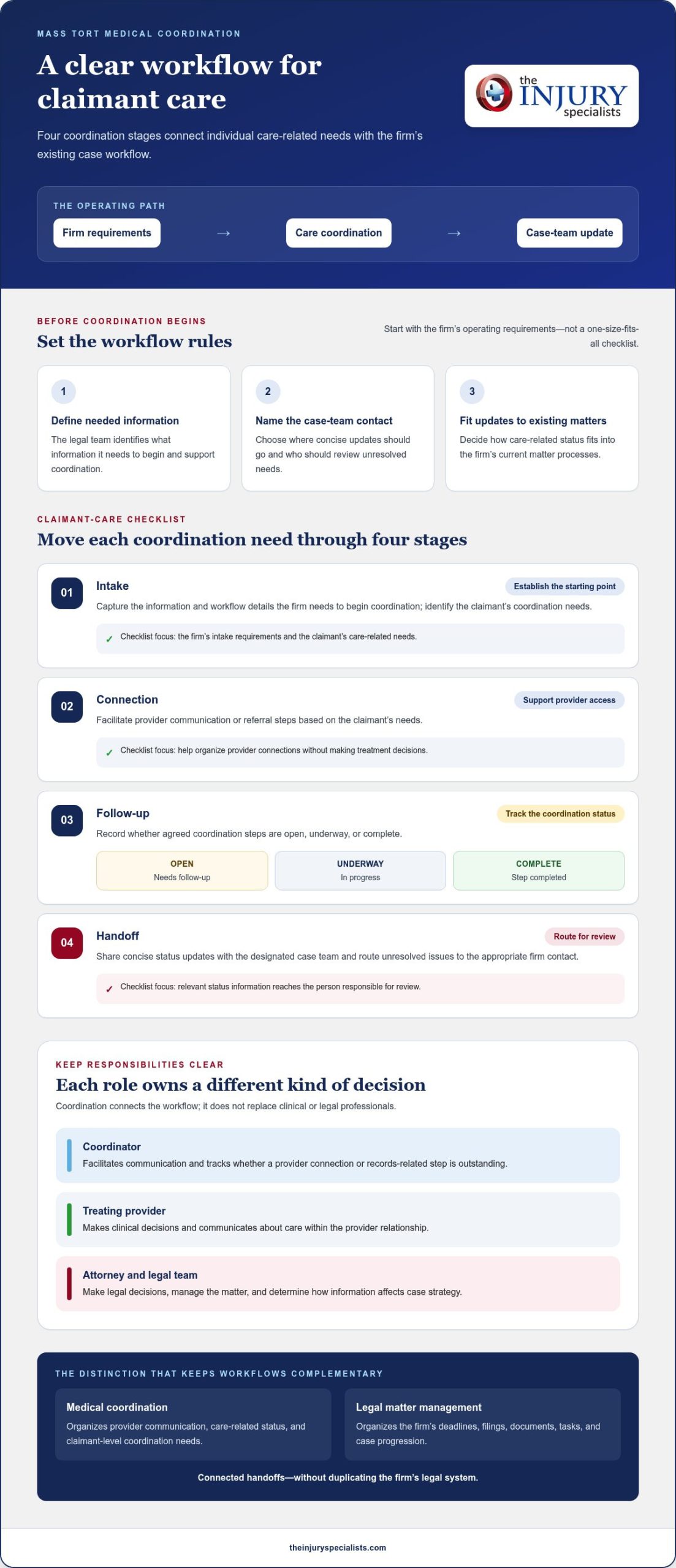
Build the handoff in clear stages. First, establish the firm’s intake requirements and identify the claimant’s coordination needs. Next, support appropriate provider connections and track agreed follow-up steps. Then share concise status updates with the designated case team so unresolved coordination needs can be routed to the right person.
- Intake: Capture the information and workflow details the firm needs to begin coordination.
- Connection: Facilitate provider communication or referral steps based on the claimant’s needs.
- Follow-up: Record whether coordination steps are open, underway, or complete.
- Handoff: Route updates or unresolved issues to the appropriate firm contact for review.
These stages clarify responsibility. A coordinator can facilitate communication and track whether a connection or records-related step is outstanding. A provider makes clinical decisions and communicates about care within the provider relationship. The attorney and legal team make legal decisions, manage the matter, and determine how information affects case strategy. The Case Management Society of America (CMSA) describes case management as a collaborative process, a useful basis for defining the coordinator’s role without extending it into clinical or legal authority.
The handoff is simple: medical coordination supplies relevant care-status updates, and the firm’s legal workflow determines how those updates are used to manage the matter.
Keeping individual files visible within a larger portfolio
Consistent stages make updates easier to interpret across a docket, but they shouldn’t make claimant files interchangeable. One claimant may be awaiting a provider connection; another may have completed an appointment but still have a records request in progress. Those distinct statuses guide individual follow-up. Portfolio-level reporting can summarize operational patterns, such as open connections or recurring delays, without replacing claimant-specific review.
Useful status categories describe coordination without implying a medical conclusion. A firm might distinguish “connection requested,” “follow-up pending,” “records outstanding,” and “coordination step complete.” Staff can use those labels to identify the next owner and action. Avoid language that suggests a diagnosis, treatment recommendation, or legal determination unless the information comes from the appropriate professional and is handled through the firm’s process.
For firms aligning these handoffs with existing systems, the personal injury case management technology guide offers related context on how technology can support legal workflows. Medical case management for personal injury attorneys is most effective when coordination fits the firm’s established processes. The Injury Specialists connects law firms, injury victims, and medical professionals through referral services and medical case management tailored to a firm’s distinct workflow.
Compare In-House, Software-Led, and Networked Medical Coordination
These models assign coordination work differently. In-house teams keep it within the firm, software-led workflows use technology to organize tasks and status, and networked models add provider connections and coordination support. A firm can combine elements, using its legal platform for matter administration while coordinating provider connections through a network.
Legal software may organize matter data, deadlines, and tasks without carrying out medical coordination or provider communication. The comparison is not simply about which tool has more features. Consider who owns each workflow, how claimant updates reach the legal team, and who reports open coordination steps.
| Model | Workflow ownership | Provider connectivity | Claimant visibility | Reporting responsibility |
|---|---|---|---|---|
| In-house coordination | Firm staff manage the process. | Staff communicate with providers and handle connection steps. | Depends on how the firm records and shares updates. | Firm teams define and produce reports. |
| Software-led tracking | Firm staff own the process; software organizes tasks and information. | Depends on the firm’s communication process and available system capabilities. | Can reflect entered data, with staff responsible for keeping it current. | Firm teams set reporting practices and interpret the information. |
| Networked coordination | Coordination is supported by an external network, with firm-specific roles and handoffs defined. | Provider connections are facilitated through the network. | Depends on agreed updates and how they reach the firm’s case team. | Responsibilities are established between the firm and coordination partner. |
When firms manage coordination internally
In-house coordination gives the firm direct control and draws on staff knowledge of its procedures, terminology, and case-team preferences. It also requires capacity for consistent follow-up, provider communication, and status entry. Clarify ownership by assigning who logs an update, who addresses a stalled connection, and how information moves from support staff to the responsible legal team.
When networked coordination may fit the workflow
A networked approach can add provider connections and coordination support while allowing the firm to define how updates fit its existing process. Start with a clear operating agreement: identify the coordination partner’s scope, the firm’s decision owners, update channels, and escalation paths. Medical case management for personal injury attorneys should fit the firm’s workflows, not create a parallel system with unclear accountability.
Assess fit with practical questions: Who owns claimant follow-up? Where is each status recorded? Who receives updates, and what triggers escalation? Which reports belong to firm staff, and which coordination details should be shared? The answers help reveal whether internal, software-led, networked, or combined operations best match the firm’s capacity and provider needs.
For additional context on how referral relationships can support provider connections, the law firm medical referral program guide explores referral-program considerations. The Injury Specialists’ firm-aligned medical case management can be tailored to a law firm’s processes.
Build a Medical Case Management Framework for Mass Tort Cases
A workable framework turns coordination into a defined operating process, not an informal set of reminders. For medical case management for personal injury attorneys, the firm should establish who owns each decision, what information moves between people, and how the team identifies unresolved steps. The framework can scale across a docket while keeping claimant-specific needs visible.
Set responsibilities, information flows, and review points
Start with five implementation steps. Assign owners by function, then document the handoffs so each participant knows what to do and when to route an issue. The firm retains control of its legal workflow, providers retain clinical judgment, and coordinators facilitate communication and administrative follow-up.
- Map needs. Identify the claimant and firm information needed to initiate coordination, recurring care-related steps, and points where updates must reach the case team.
- Assign roles. Name the legal workflow owner, claimant communication owner, provider coordination contact, and operational reporting owner. One person may hold multiple roles, but the responsibilities should remain distinct.
- Define updates. Set what counts as a useful status update, where it should be recorded, who receives it, and how unresolved steps are escalated. Use consistent labels while preserving individual claimant context.
- Establish review. Set a process for reviewing open handoffs, overdue follow-ups, and recurring friction points. Keep operational review separate from decisions about treatment or legal strategy.
- Refine workflows. Use review findings to adjust responsibilities, communication paths, and stages as the firm’s needs change.
Information-sharing procedures should be explicit. Use firm-approved processes to establish consent, appropriate access, and handling of sensitive information. Define which details the coordination team may communicate, which channel the firm uses to receive them, and who can resolve access questions. These are workflow controls, not a substitute for the firm’s own privacy and legal guidance.
Referral pathways also need clear ownership. If a claimant’s coordination needs involve diagnostic imaging, define how a referral request is initiated, how the provider connection is communicated, and how status returns to the designated team member. The personal injury diagnostic imaging referral guide provides related context for organizing that pathway.
Measure workflow performance without promising case outcomes
Track whether the process is functioning, not whether it guarantees a medical or legal result. Useful measures include the share of files with a current coordination status, the number of unresolved handoffs, and completion of assigned follow-up steps. Review these indicators both by claimant file and across the portfolio. A recurring backlog may point to an unclear owner or communication gap, prompting a workflow adjustment rather than an assumption about an individual claim.
To connect medical coordination with your firm’s established processes, explore firm-aligned medical case management.
How The Injury Specialists Supports Attorney Medical Case Management
The Injury Specialists connects law firms, injury victims, and medical professionals through a referral network, medical case management, and a technology platform. For firms coordinating a large claimant group, these elements work together: the network facilitates provider connections, while coordination and technology support communication within the firm’s operating process. The Injury Specialists facilitates these connections; medical decisions remain with treating professionals, and legal decisions remain with the law firm.
Connect firm workflows with medical and provider coordination
The attorney program aligns medical case management with a firm’s distinct processes. Coordination steps can be organized around the firm’s preferred intake, update, and handoff practices rather than requiring legal teams to adopt a generic workflow. Clear boundaries help each participant understand what information to provide, who receives it, and when the firm takes over for legal review.
Provider referrals are one part of this connection. The network facilitates connections to medical professionals and imaging centers, while the firm maintains its legal workflow and the provider retains responsibility for clinical decisions. For additional context on how referral networks connect professionals, the personal injury referral network guide examines their role in personal injury coordination.
The technology platform and referral network serve complementary purposes. The network supports connections among firms and medical professionals; the platform supports case management, marketing, and professional networking. Together, they provide an operational structure for coordinating information and relationships without positioning legal software as a substitute for provider communication or medical coordination.
Take the next step toward a coordinated operating model
Connected referral and medical case-management support can help a firm coordinate provider connections, organize care-related updates, and fit these activities into established legal processes. It can also clarify the division of work between firm staff and external coordination, so each claimant’s status moves through an agreed workflow. The model supports operations; it does not promise treatment access or a particular legal result.
For firms assessing medical case management for personal injury attorneys, the practical starting point is a workflow that reflects the firm’s needs and keeps professional responsibilities clear. The Injury Specialists’ attorney program connects medical coordination with firm-specific processes. Explore attorney medical case management to see how this connected operating model can fit your firm.
Make Coordination Part of Your Firm’s Next Growth Stage
As a mass tort portfolio expands, make coordination a deliberate part of how the firm operates. Set a clear owner for each handoff, decide what information helps the legal team act, and review whether the process still fits as claimant volume and workflows change. This creates room to scale without losing sight of the individual files behind portfolio-level reporting.
Medical case management for personal injury attorneys should strengthen the firm’s operating model, not force a choice between legal workflow control and connected medical coordination. The Injury Specialists’ attorney program is tailored to a firm’s processes, with its referral network and technology platform supporting connections among legal and medical professionals.
Build a coordination model that fits your team and gives each professional a clear role. Explore attorney medical case management and take the next step toward a more connected workflow.
Frequently Asked Questions
Can medical case management support claimants involved in mass tort litigation?
Yes. It can help coordinate provider connections and care-related communication for claimants in mass tort matters while preserving each person’s distinct needs. For example, if a claimant joins a firm’s docket after an initial intake period, the team can use its established process to capture relevant coordination information and route it to the appropriate contact. This support organizes operational follow-up; it doesn’t determine legal eligibility or predict a claim’s outcome.
Is medical case management the same as personal injury case-management software?
No. Software can help a firm organize legal matters, documents, tasks, and deadlines. Medical case management for personal injury attorneys focuses on coordination around claimant care and provider-related communication. A useful setup defines which system holds legal matter information, where care-related updates are recorded, and how those updates reach the case team. That clarity helps staff avoid duplicate entries and identify who owns each follow-up.
Can a medical case manager make treatment decisions for a claimant?
No. Treatment decisions belong to the claimant and treating medical professional, not a case manager coordinating logistics. A coordinator may help relay an appointment detail or route a claimant’s question to the appropriate provider, but shouldn’t recommend a diagnosis, treatment, or change in care. For instance, if a claimant asks whether to stop a prescribed therapy, the coordinator should direct that clinical question to the treating provider.
What information should a law firm share for medical case coordination?
Share only the information needed to carry out the agreed coordination task through the firm’s approved process. This may include a claimant’s identifying and contact details, relevant referral context, the firm’s designated point of contact, and instructions for routing updates. The firm should define how consent and access are handled, who may receive information, and which communication channel to use. Avoid sending unrelated case materials by default.
Can medical case management work with a law firm’s existing case platform?
Yes. Coordination can complement a firm’s existing platform by establishing what status information staff need and how updates are transferred into their workflow. Before launch, identify who enters or reviews each update, how the team flags missing information, and where the authoritative legal record remains. This planning supports a consistent handoff without assuming that a separate coordination service automatically integrates with a firm’s software.
Does medical case management guarantee faster treatment or a better settlement?
No. Coordination can help organize referrals, communications, and administrative follow-up, but it can’t guarantee appointment timing, a particular treatment, or a settlement result. Provider availability and clinical judgment affect care, while legal outcomes depend on the facts and handling of each claim. Firms can assess whether their process is working by reviewing coordination measures, such as unresolved requests and completed follow-ups, without treating those measures as predictors of case value.

Leave A Comment
You must be logged in to post a comment.