

More leads won’t solve a conversion problem caused by unanswered inquiries and inconsistent follow-up. For firms focused on converting more personal injury leads, the opportunity often starts with improving what happens after someone makes contact. A clear intake process helps your team respond consistently, assess fit, and keep qualified inquiries moving without relying on lead volume alone.
Building that process takes more than a fast first response. Your team needs defined screening criteria, coordinated follow-up, and a way to connect marketing sources with intake outcomes. This guide explains how to strengthen each step, identify which channels bring appropriate opportunities, and organize case-related information across your workflow. It also shows how referral coordination and case-handling technology can complement your firm’s intake process. The Injury Specialists connects legal and medical professionals through a nationwide referral network, supporting coordination alongside the systems your firm uses to qualify and follow up with leads.
Key Takeaways
- Separate inquiries, qualified opportunities, and signed clients into distinct funnel stages so conversion performance is easier to assess.
- Build a measurable workflow with a clear owner and consistent status for every lead, from source through final disposition.
- Compare referral, organic, paid, and direct inquiries using the same quality and progression criteria before adjusting your marketing mix.
- For converting more personal injury leads, use a repeatable follow-up process with response expectations that fit your staffing and professional obligations.
- Organized medical-legal coordination can complement intake workflows. The Injury Specialists’ network includes 1,100+ professionals across 40+ states, and the company was founded in 2006.
Converting More Personal Injury Leads Starts with Fixing the Intake Gap
More inquiries do not automatically mean more suitable cases. A firm can increase advertising or referral activity and still lose potential opportunities if calls go unanswered, intake details vary from one staff member to another, or nobody owns the next follow-up. Converting more personal injury leads starts with mapping the path from first contact to a clear outcome, then finding where inquiries stall.
Lead generation brings inquiries to the firm; lead conversion moves each inquiry through a consistent process to a qualified opportunity and, where appropriate, a retained client.
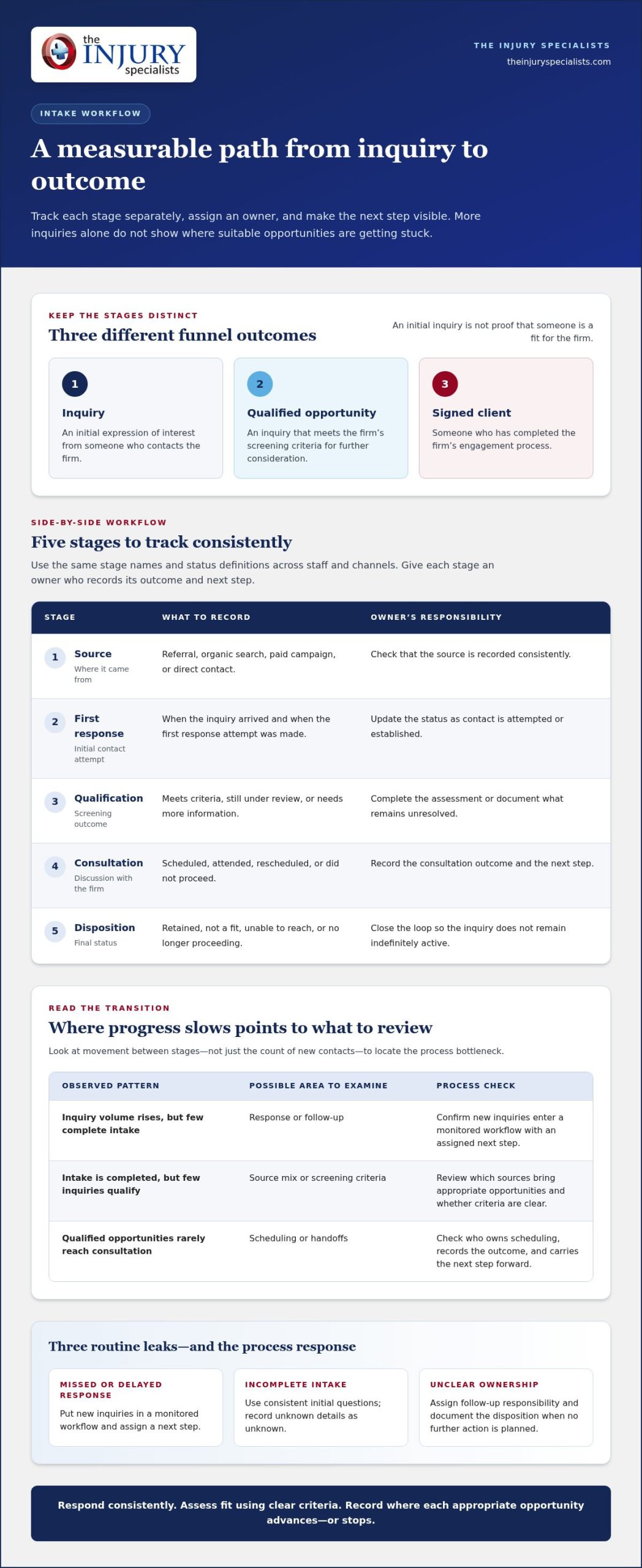
These stages matter because an inquiry is an initial expression of interest, not proof that the person is a fit for the firm. A qualified opportunity is an inquiry that meets the firm’s screening criteria for further consideration. A signed client is someone who has completed the firm’s engagement process. Tracking these stages separately helps teams evaluate performance without treating every person who reaches out as a suitable case.
Where personal injury inquiries commonly stall
Leakage often happens during routine handoffs. A missed call may not be returned, or an email may sit in an inbox without an assigned owner. Even when someone responds, inconsistent questions can leave important details unclear or make inquiries difficult to compare. For example, one intake specialist may record the incident type and contact preference, while another captures only a name and callback number.
Make ownership explicit. If the person who first receives an inquiry assumes another team member will follow up, the next step can disappear between roles. A shared process should show who is responsible, what information has been collected, and what action remains. Because inquiries can involve different circumstances under personal injury law, consistent intake helps the firm assess each one based on its information rather than on assumptions.
Separate inquiry volume from conversion quality
Track movement through the funnel, not just the number of new contacts. Lead volume counts incoming inquiries. Qualification records which inquiries meet the firm’s criteria for further review. Consultation tracks those that progress to a discussion with the firm. The retained-client stage records which consultations result in an engagement. Each stage answers a different operational question and can reveal a different bottleneck.
Review the transitions between stages. If inquiry volume rises but few contacts complete intake, the immediate issue may be response or follow-up. If intake is completed but few inquiries qualify, review the source mix or screening criteria. If qualified opportunities rarely reach a consultation, examine scheduling and handoffs. These patterns direct attention to the process instead of prompting a reflexive push for more leads.
- Missed or delayed response: Confirm that new inquiries enter a monitored workflow and have an assigned next step.
- Incomplete intake: Use a consistent set of initial questions and record unknown details as unknown.
- Unclear ownership: Assign responsibility for follow-up and document the disposition when no further action is planned.
A sound funnel supports better decisions, not automatic acceptance. Some inquiries will be outside the firm’s focus or otherwise unsuitable. The objective is to respond consistently, assess fit with clear criteria, and understand where appropriate opportunities advance or stop.
Build a Personal Injury Lead Conversion Funnel You Can Measure
A useful funnel turns inquiry handling into a sequence the team can review. Keep it within the firm’s existing workflow, and assign one owner and a consistent status to each stage. This makes handoffs visible without requiring every firm to adopt a new system. It also helps pinpoint whether a problem starts with source tracking, response, screening, consultation, or final disposition.
- Source: Record where the inquiry came from, such as a referral, organic search, paid campaign, or direct contact. Assign an owner to check that the source is recorded consistently.
- First response: Track when the inquiry arrived and when the first response attempt was made. The assigned owner updates the status as contact is attempted or established.
- Qualification: Record whether the inquiry meets the firm’s screening criteria, is still under review, or needs more information. Keep the qualification owner responsible for completing or documenting that assessment.
- Consultation: Track whether a consultation is scheduled, attended, rescheduled, or did not proceed. Assign responsibility for recording the outcome and next step.
- Disposition: Record the final status, such as retained, not a fit, unable to reach, or no longer proceeding. The owner closes the loop so the inquiry doesn’t remain indefinitely in an active stage.
Use the same stage names and status definitions across staff and channels. A short written guide can clarify what “contacted,” “qualified,” and “closed” mean, reducing inconsistent reporting. For a deeper discussion of how technology can support organized case workflows, see this personal injury case management technology guide.
Choose practical lead conversion measures
Measure each transition using a defined time period and denominator. Response time is the elapsed time from receipt to the first response attempt. Contact rate is inquiries successfully contacted divided by all inquiries received in the selected cohort. Qualification rate is qualified inquiries divided by inquiries with a completed screening. Consultation attendance is consultations attended divided by consultations scheduled to occur in that period. Keep the definitions stable before comparing results.
Pair those measures with a review of intake notes and dispositions. A rate can show where movement slows, but notes may reveal that key details were missing, a handoff was unclear, or an inquiry didn’t meet the firm’s criteria. Use one inquiry-date cohort and allow the same follow-up window before comparing periods, so newer leads aren’t judged against older ones.
Make lead-source reporting useful
Source labels only help when staff apply them consistently. Define how to record referrals, organic search, paid campaigns, and direct inquiries, including how to handle an unknown source. Compare each channel by qualification and progression through later stages, not by raw inquiry count alone. A channel with fewer inquiries may produce a stronger fit, while another may need better intake or clearer attribution.
Review the funnel regularly with intake and marketing staff. Use the findings to adjust handoffs, questions, or reporting before assuming the firm needs more volume. A case-management technology platform can complement that internal process. Firms exploring that role can learn more about The Injury Specialists’ case-management technology. No channel or measurement method guarantees signed cases, but consistent tracking gives the team a clearer basis for decisions and for converting more personal injury leads.
Assess Personal Injury Lead Quality Before Changing Your Marketing Mix
A channel’s inquiry count doesn’t show whether it’s reaching the right people or whether the firm’s process is moving suitable inquiries forward. Compare sources using the same criteria, then review what happens at each funnel stage. This separates source quality from handling issues, such as delayed contact or incomplete intake, before you shift marketing resources.
Use the table as a diagnostic framework, not as a set of assumptions about how every channel performs. Assess inquiries over the same period and apply the same firm-specific criteria.
| Source | Relevance | Intake completeness | Response expectations | Downstream progression |
|---|---|---|---|---|
| Referral | Does the inquiry match the firm’s focus? | What relevant context arrived with it? | Was a preferred contact method shared? | Does it advance through qualification and consultation? |
| Organic | Does the inquiry align with the information or service sought? | Are the incident and contact details usable? | Did the person request a particular next step? | Where does it pause or exit the funnel? |
| Paid | Does the inquiry match the campaign’s intended audience? | Are key screening details present? | Was the inquiry submitted with a clear contact preference? | Does it progress beyond initial contact? |
| Direct | Can the firm identify the reason for contact? | Are the source and relevant details recorded? | Is a callback or other follow-up expected? | What disposition follows intake? |
For referral pathways, context can clarify how an inquiry reached the firm and what coordination may follow. The personal injury referral network guide offers a deeper look at referral networks.
Distinguish a poor-fit inquiry from a process failure
Set fit criteria that reflect the firm’s practice focus, then apply them consistently. Record incomplete inquiries, duplicates, unreachable contacts, and out-of-scope matters as separate dispositions. These outcomes point to different issues: a duplicate may reflect tracking, while an incomplete record may need follow-up. Don’t combine them under a vague “unqualified” label. Keep records accurate; never alter or fabricate details to improve a source’s reported results.
Evaluate sources beyond the first contact
Review whether each source produces complete inquiries that progress through qualification, consultation, and final disposition. Interpret results alongside staffing capacity and follow-up consistency. If one channel appears to stall, check whether its inquiries received the same opportunity for timely, complete handling as others before concluding that the source is weak.
Look at comparable periods and allow enough time for follow-up to understand what happened after the first contact. A short-term rise in inquiries may not show sustained fit or progression. Use intake notes and dispositions to identify whether the constraint is the source, the information collected, or the firm’s process. That distinction helps firms make measured marketing decisions while converting more personal injury leads.
Use a Repeatable Follow-Up Process to Convert More PI Leads
A reliable follow-up process gives every inquiry a clear next step, an accountable owner, and an accurate record. Set response expectations around the firm’s staffing, operating hours, and applicable professional obligations. The goal isn’t to contact every person in the same way or to turn every inquiry into a client. It’s to make sure each inquiry receives consistent handling and a documented outcome.
- Receive and assign: Record the inquiry’s arrival time, source, contact details, and preferred contact method in the firm’s established system. Assign an owner and make the next action visible.
- Make the first contact attempt: Follow the firm’s response expectations and use an appropriate channel. Record the time, method, and outcome, including an unanswered call or undelivered message.
- Complete initial intake: Use concise, consistent prompts to understand the person’s reason for contacting the firm and gather information relevant to its screening criteria. Don’t pressure the caller or fill gaps with assumptions.
- Set the next step: If more information or a consultation is appropriate, identify who will follow up and when, in line with the firm’s process and obligations. If the inquiry isn’t a fit, document the disposition accurately.
- Review unresolved inquiries: Flag records without a completed contact or disposition for follow-up by the assigned owner or supervisor. Close the loop with a clear status.
Standardize the first response and intake handoff
Consistency depends on more than a shared question list. Each handoff should show what has happened, what remains outstanding, and who owns the next action. Use neutral prompts, such as “What would you like the firm to know about your inquiry?” and “What’s the best way to reach you?” Record the person’s answers in their own terms where practical. Staff should document contact attempts and outcomes promptly in the firm’s established system so the next team member can act on a dependable record.
Review unanswered and unresolved inquiries
Set a recurring review for inquiries with no completed contact, pending information, or no recorded disposition. A supervisor can check whether the assigned owner took the next step, whether the status reflects what happened, and whether the file should remain open. Use the review to identify process gaps, not to encourage repeated contact after a person has opted out.
Keep outreach lawful and ethical, follow applicable opt-out requests, and don’t present consent to text or email as a condition of receiving services. A text should state: “Message and data rates may apply. Reply STOP to opt out.” An email should include unsubscribe instructions. The law firm medical referral program guide provides additional context on referral pathways that may connect with a firm’s follow-up process.
Clear ownership and documented handoffs can make intake more consistent without adding unnecessary steps. Explore case-management technology and referral coordination to see how these tools can complement a firm’s workflow.
Connect Lead Conversion with Medical-Legal Coordination
A qualified inquiry may lead to questions about provider connections, records, or coordination between a law firm and medical professionals. Those needs sit beyond initial intake, but a clear handoff can keep them connected to the firm’s broader case-handling workflow. Referral management and technology can support that coordination while the firm maintains its own screening, communication, and decision-making processes.
The Injury Specialists connects attorneys, physicians, chiropractors, physical therapy providers, and imaging centers through a nationwide network of 1,100+ professionals across 40+ states. Founded in 2006, the network supports professional connections and referral coordination. It complements a firm’s intake process; it doesn’t determine whether an inquiry is suitable or guarantee that it will become a client.
Use referral management to support organized handoffs
Through the Networking Portal, users can find doctors or attorneys and submit referral forms. The platform also provides 24/7 access to medical facilities for referrals. This is an access feature, not a guarantee of uninterrupted platform service. Firms can incorporate referral-related steps into their own workflows by recording the need, assigning responsibility for the next action, and tracking relevant information through their established process.
The Injury Specialists facilitates connections rather than providing direct legal representation or medical treatment. Referrals are not guarantees of accuracy, a particular provider or service, or a case outcome.
- Identify the coordination need: Note whether the inquiry raises a need for a provider connection, medical records, or another case-related handoff.
- Assign responsibility: Make clear which team member will manage the next step and document its status in the firm’s workflow.
- Use the appropriate connection: Portal users can search for doctors or attorneys and submit referral forms as relevant to the matter.
- Track follow-through: Record updates accurately and keep intake and case-related information organized for the appropriate professionals.
Apply technology without overstating results
On-demand medical record retrieval and paperless communication between providers and attorneys can support information exchange within professional workflows. Used alongside clear ownership and accurate records, these tools can help teams coordinate follow-up after an inquiry moves beyond intake. They don’t replace a firm’s own review or establish that a referral is appropriate.
The platform is for legal and ethical purposes only. Referral accuracy, service continuity, medical treatment, legal action, and outcomes aren’t guaranteed. Technical issues may interrupt service, and responsibility for decisions and outcomes remains with the appropriate parties. Treat technology as workflow support, not as a promise of conversion or case results.
For firms focused on converting more personal injury leads, coordinated referral and case-handling workflows can complement a consistent intake process. Explore The Injury Specialists or request a platform demo to see how the available tools may fit your professional workflow.
Make Your Next Intake Improvement Count
Use your current workflow as a starting point. Choose one handoff or stage where inquiries tend to stall, then review the records with the people responsible for intake and follow-up. A focused adjustment, such as clarifying ownership or improving how referral needs are documented, gives your team a practical way to strengthen its process and assess the results.
Converting more personal injury leads is an ongoing operational effort, not a single marketing fix. As your intake process develops, coordinated referral management and digital case-handling tools can help connect the firm’s workflow with its broader professional network.
Explore The Injury Specialists network and request a platform demo to see how its referral and case-handling tools may fit your firm’s coordination needs. Take the next step by reviewing your workflow and identifying where professional collaboration could support it.
Frequently Asked Questions
How do you calculate a personal injury lead conversion rate?
Divide the number of leads that become signed clients by the number of leads in the same defined group, then multiply by 100. For example, if 12 of 150 inquiries received in April sign within your chosen follow-up window, the conversion rate is 8%. Keep the cohort, time window, and definition of “lead” consistent. That makes comparisons between reporting periods more meaningful.
Is a personal injury lead the same as a signed client?
No. A lead is an inquiry from someone who has contacted the firm or been referred to it. A signed client has completed the firm’s engagement process. Between those points, the person may not meet the firm’s criteria, may choose not to proceed, or may need more information before deciding. Tracking these statuses separately helps prevent inquiry totals from being mistaken for retained-client counts.
Can law firms improve lead conversion without increasing lead volume?
Yes. Converting more personal injury leads can start with improving how existing inquiries are handled, rather than increasing advertising or referral activity. For example, a firm might find that qualified inquiries are not consistently offered a consultation because scheduling responsibility is unclear. Fixing that handoff can improve visibility into the process and help suitable prospects move forward, though no workflow change guarantees that an inquiry will become a client.
What information should a law firm track for each lead source?
Record the source using a consistent label, along with the date received, campaign or referral details when available, and the inquiry’s progress through the firm’s stages. For example, distinguish a referral from a provider from an organic website inquiry instead of grouping both as “online.” Also capture the final disposition and any missing source information. These details help explain differences in fit and progression, not just volume.
How can a firm distinguish an unqualified inquiry from a missed follow-up?
Review the record for evidence that the firm completed its planned contact and screening steps. An inquiry should be marked unqualified only when the available information was assessed against the firm’s criteria. If contact attempts weren’t completed or the screening details are missing, classify the outcome as unresolved or unable to reach instead. Clear categories help supervisors identify whether the issue was fit, incomplete information, or a process gap.
Does faster follow-up guarantee more signed personal injury cases?
No. A prompt response can help a firm connect with an inquiry while the person is still seeking information, but it can’t guarantee a signed case. Fit, the person’s decisions, the information available, and other circumstances all affect what happens next. Measure response performance separately from qualification and signed-client outcomes. That distinction shows whether faster handling is improving contact without overstating its effect on retention.
Can medical-legal referral coordination replace a law firm’s intake process?
No. Referral coordination can support connections and information flow after an inquiry, but the firm still needs its own intake process to assess fit, decide next steps, and document its decisions. Treat the workflows as complementary: intake manages the firm’s evaluation of the inquiry, while coordination can support relevant professional handoffs. Keeping those roles clear helps prevent a referral connection from being mistaken for legal review or client engagement.

Leave A Comment
You must be logged in to post a comment.