

A referral arrangement can look like routine coordination and still raise legal and ethical issues. Compliance for medical legal referrals depends on who participates, how compensation and ownership are structured, what services are involved, and which jurisdictions’ rules apply. A process that works in one state may need a different review elsewhere, particularly when providers, attorneys, records, and communications cross state lines.
Federal rules provide a baseline, but state laws and professional duties can change the analysis. This practical guide explains how to identify issues that call for jurisdiction-specific review and build documented processes for referrals, compensation, privacy, and oversight.
You’ll learn how to assess potential incentives, keep medical and legal roles distinct, and coordinate communications and records through responsible workflows. Founded in 2006, The Injury Specialists connects a network of 1,100+ professionals across 40+ states. That reach makes tailored review essential. Digital coordination can help organize referral and case-handling workflows, but it doesn’t replace legal review or your organization’s compliance oversight.
Key Takeaways
- Compliance for medical legal referrals depends on the arrangement, participants, compensation, and jurisdictions involved, not simply on whether a referral occurs.
- Assess federal self-referral and anti-kickback questions separately, considering the services, parties, payment sources, and financial relationships involved.
- Build a jurisdiction comparison that records referral activity, participant roles, compensation, and the current rules counsel needs to review.
- Use a documented workflow to assign responsibility for legal review, clinical decisions, referral administration, information handling, and platform access.
- Treat referral technology as workflow support, not a compliance guarantee. The Injury Specialists’ platform is for legal and ethical purposes only.
Compliance for Medical-Legal Referrals: Why the Arrangement Matters
A medical-legal referral relationship connects or coordinates an injured person with healthcare and legal professionals. It might involve a simple introduction, a referral form, help coordinating care, or access to a professional network. Separate business arrangements may also be involved, such as compensation, shared ownership, marketing, or technology access. Assess each part separately. A referral isn’t automatically lawful or unlawful based on its label. The participants, structure, services, payment sources, and jurisdictions can all affect the analysis.
That distinction matters for compliance for medical legal referrals. A workflow that organizes introductions raises different questions from an arrangement where financial benefits depend on referrals or influence which professionals receive access. Describe what actually happens, not just what an agreement calls it.
What counts as a medical-legal referral relationship?
Start by mapping each activity and each participant’s responsibility. A patient makes personal decisions about seeking care and legal representation. A provider evaluates the patient and makes clinical decisions. An attorney advises on legal matters and case strategy. A referral administrator or platform may facilitate connections, collect referral forms, or support coordination. Keep these roles distinct.
- Introductions connect a patient or professional with another participant. They don’t establish a treatment plan or attorney-client relationship by themselves.
- Referral forms capture information used to route or manage a request. Their use doesn’t determine whether a provider should treat someone or how an attorney should handle a case.
- Care coordination supports communication and logistics, while clinical decisions remain with the treating professional.
- Network access helps users identify professionals. Access alone doesn’t establish that a participant is suitable for a particular patient or case.
An introduction doesn’t dictate treatment, legal strategy, or case outcome. Referral management organizes and supports these connections. It isn’t legal advice, and it doesn’t guarantee that an arrangement complies with law or professional rules.
Why one national rulebook is not enough
Federal requirements may address particular financial relationships, services, or payment sources, while state laws may govern other aspects of the same arrangement. Professional licensing requirements and bar rules can add obligations for healthcare and legal professionals. A national workflow therefore needs a way to identify where each participant operates and which rules may apply to each activity.
For example, the Stark Law concerns physician self-referrals in specified circumstances. It is one reference point, not a complete analysis of every medical-legal connection. State requirements and the facts of the particular arrangement still matter.
The Injury Specialists connects providers across 40+ states through a network of 1,100+ professionals. That reach makes jurisdiction-specific review a practical workflow step, not a one-time formality. Identify the relevant states, document the activity and relationships, then have qualified counsel assess current laws and professional rules in those jurisdictions. Referral technology can support administration, but The Injury Specialists’ platform is for legal and ethical purposes only. It doesn’t replace counsel or an organization’s compliance review.
Federal Referral Rules: Examine Financial Relationships and Incentives
Federal healthcare referral laws don’t apply to every connection in the same way. The analysis can turn on who refers, what services are involved, how those services are paid for, and whether a financial relationship exists. Separate the referral activity from any payment, ownership, marketing, or benefit connected to it. That distinction helps counsel identify which rules may apply instead of treating every referral as the same legal question.
Assess self-referral and financial-interest questions
The federal physician self-referral framework, commonly called the Stark Law, is a screening issue when a physician refers a patient for designated health services to an entity with which the physician or an immediate family member has a financial relationship. The law is generally treated as a strict-liability civil statute, so intent isn’t required to establish a violation. Its scope and potential exceptions depend on the facts. Counsel should assess the parties, services, and relationship rather than assume the framework applies to every medical-legal introduction.
Map direct and indirect financial ties between referring professionals and entities receiving referrals. These may include ownership interests, investments, compensation, or other arrangements. Separately, the federal Anti-Kickback Statute addresses offering, paying, soliciting, or receiving remuneration to induce or reward referrals involving items or services paid for by federal healthcare programs. It has a different scope and intent standard from Stark. Don’t use one law as shorthand for the other.
Review incentives, fees, and mixed referral activities
Compensation, ownership, marketing payments, and benefits are reasons for legal review, not automatic proof of a violation. Document what each party actually provides and receives, including the work performed, payment method, and any technology or administrative support. A fee for defined services may require a different analysis from a payment that changes with referral activity. Contract labels don’t replace a review of how the arrangement operates.
Payment linked to referral volume or value merits prompt legal review because it may raise questions about whether remuneration is intended to induce or reward referrals, particularly when the referred services may be paid for by a federal healthcare program. Counsel can evaluate the arrangement’s purpose and terms, and whether an applicable exception or safe harbor may be available. Don’t assume that calling a payment a marketing or platform fee resolves the issue.
- Record the service performed, the party receiving it, and how compensation is calculated.
- Identify whether payment, benefits, or access changes based on referral volume or value.
- Keep attorney referral-service rules separate from healthcare fraud-and-abuse analysis. Each may require its own legal review.
For organizations coordinating referrals, case handling, and professional connections, medical-legal referral coordination can support an organized workflow. The Injury Specialists’ platform is for legal and ethical purposes only. Platform use doesn’t replace qualified counsel’s review of financial relationships or applicable federal rules.
State Laws and Professional Rules: Compare the Risks Before Launch
Federal review is only one layer. State statutes, regulations, licensing rules, and bar requirements may address different participants and activities in the same referral workflow. A lawyer referral-service rule, for example, isn’t interchangeable with a medical self-referral restriction or a healthcare payment rule. Don’t assume that a conclusion reached in one state applies nationwide.
Build a state-by-state comparison before launching or expanding an arrangement. Use it to identify questions for qualified counsel, not to draw unsupported conclusions about what a state permits.
Map the rules that may apply in each jurisdiction
Track where the patient receives care, where the referring and receiving professionals practice, and where referral activity and related services take place. Then assign counsel to verify current provisions, exceptions, and effective dates. Past reporting by the Florida Bar is a reminder that lawyer referral-service rules and mixed legal and nonlegal referrals may be subject to change. It doesn’t establish current Florida requirements or serve as a national standard.
A comparison table can make the review repeatable:
| Jurisdiction | Participant type | Referral activity | Compensation | Rule sources for counsel to review |
|---|---|---|---|---|
| State where patient receives care | Patient and receiving provider | Introduction, routing, or care coordination | Payment or benefit involving the provider or entity | State healthcare statutes, regulations, and licensing rules |
| State where referring professional practices | Referring clinician or other professional | Referral, marketing, or network participation | Ownership, compensation, or other financial interest | State referral restrictions and professional rules |
| State where attorney practices | Attorney and referral administrator | Attorney introduction or mixed legal/nonlegal referral | Referral-service, marketing, or administrative payment | State bar rules and applicable referral-service requirements |
Test the arrangement against the actual workflow
Review the real process, not just its written description. Trace how a referral is initiated, routed, accepted, documented, and followed up. Note which person or system performs each action and whether the patient, provider, or attorney makes the relevant decision.
Then compare referral-only activity with bundled services such as marketing, case management, or technology access. A combined offering may raise different questions from a basic introduction, particularly if compensation or access varies with referral activity. Record what remains unresolved, who owns the review, and what must be verified before launch or a material change.
- Separate rule sets: Review attorney referral-service requirements independently from healthcare self-referral and payment restrictions.
- Track scope: Note the jurisdiction, participant, activity, compensation, source reviewed, and date counsel verified it.
- Revisit changes: Reopen the analysis when the workflow, services, participants, or payment structure changes.
This jurisdiction-based method turns compliance for medical legal referrals into a documented review process while leaving legal conclusions to qualified counsel familiar with current state requirements.
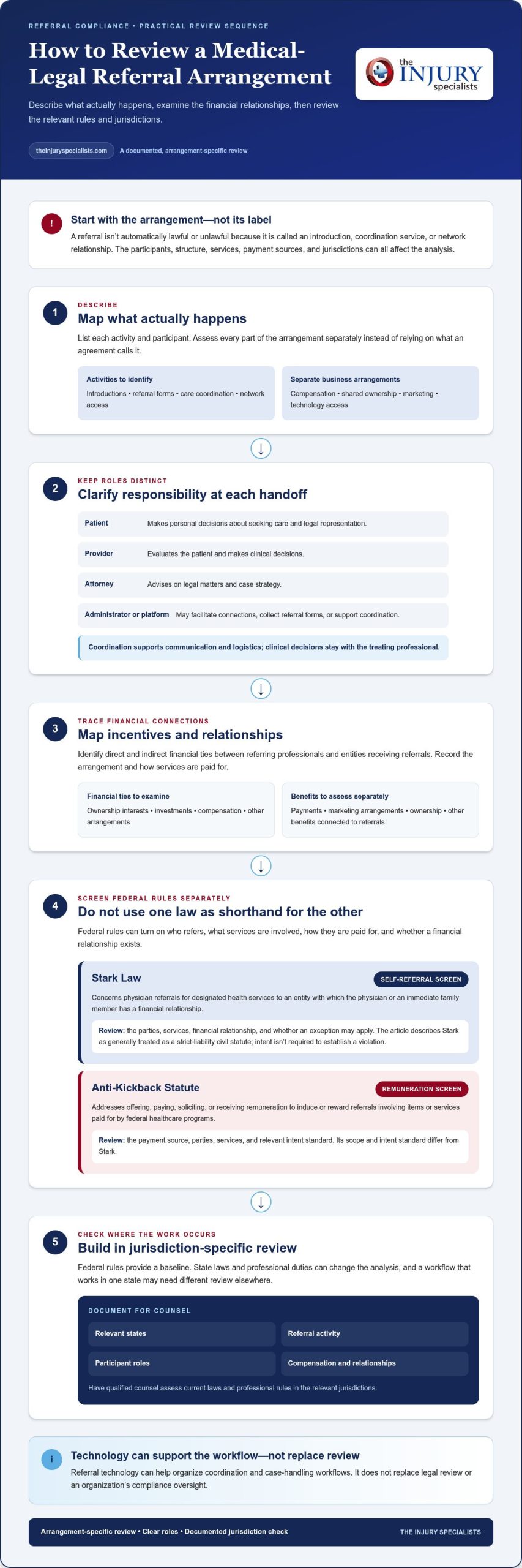
Build a Medical-Legal Referral Compliance Workflow
A written workflow turns compliance for medical legal referrals into repeatable steps rather than informal decisions. Assign an owner to each task, define when review is required, and preserve a record of the decision. Keep legal review, clinical judgment, referral administration, and platform access distinct. A platform can support case handling and coordination, but it can’t determine whether an arrangement meets applicable laws or professional rules.
Document referral criteria, roles, and decisions
Use a consistent intake and review path. Define who may submit, receive, review, and act on a referral, and identify which decisions belong to a clinician or attorney. Record the referral basis, relevant permissions or other applicable authority, routing steps, and any legal-review decision. Restrict platform access to authorized users and prohibit false information, unauthorized access, or interference with platform services.
- Map jurisdictions. Record where the patient, referring professional, receiving professional, and relevant services operate. Route new or changed arrangements for jurisdiction-specific legal review.
- Define roles. Document who handles intake, clinical decisions, legal advice, referral administration, records, and platform access. Don’t let an administrative process substitute for professional judgment.
- Review compensation. Inventory payments, ownership interests, marketing arrangements, benefits, and technology or administrative support. Send changes to payment terms or referral-linked compensation to qualified counsel before implementation.
- Protect information. Limit access to records based on role and applicable privacy requirements. Establish procedures for retrieval, sharing, retention, and correction with privacy counsel.
- Document decisions. Maintain the referral basis, routing history, relevant permissions, reviewer, unresolved questions, and decision rationale in the appropriate record. Set an escalation path for incomplete information, unusual compensation, or a potential privacy incident.
- Monitor changes. Set a review schedule suited to the organization’s workflow, and trigger an additional review when jurisdictions, participants, services, technology, or compensation change. Assign an owner to track updates and record when counsel reviews them.
Protect records and manage communications responsibly
Make information handling operational. Specify which users can retrieve or share records, how requests are documented, and how corrections or retention questions are escalated. Have privacy counsel assess the procedures against the organization’s obligations. Digital access or paperless communication alone doesn’t establish compliance.
If the workflow includes text or email communications, explain that message and data rates may apply. Users may opt out at any time by replying “STOP” to text messages or using unsubscribe instructions in emails. Keep communication preferences and access controls distinct from decisions about referral administration.
For a structured operational layer, The Injury Specialists’ medical-legal platform supports digital communication and case handling. It is for legal and ethical purposes only, not a substitute for counsel or organizational oversight. Explore referral management support for coordinating referral workflows.
Use Referral Technology Responsibly and Review Compliance Continuously
Technology can make referral administration more organized, but it can’t decide whether an arrangement complies with law, replace professional judgment, or guarantee a compliant outcome. Treat a platform as workflow support. Keep legal review with qualified counsel, clinical decisions with providers, and legal strategy with attorneys. Set a regular review process so the workflow can keep pace with changes to rules, participants, services, and compensation.
Founded in 2006, The Injury Specialists connects a network of 1,100+ professionals across 40+ states. Its medical-legal services include referral management, access to a Networking Portal to find professionals and submit referral forms, on-demand medical record retrieval, and paperless communication between providers and attorneys. These tools can support coordination, but they don’t guarantee referral accuracy, treatment, legal action, or case outcomes.
Where a dedicated medical-legal platform fits
Use the Networking Portal to find a doctor or attorney and submit a referral form. Digital case handling can help organize workflow, while record retrieval and paperless communication support information exchange between participants. Define who may access records and take action at each step, and maintain the organization’s own review and documentation procedures. The platform is for legal and ethical purposes only, not a compliance certification or substitute for counsel.
Keep platform boundaries clear. Third-party content and linked websites aren’t guaranteed or controlled by the platform. Users and organizations remain responsible for their own decisions, information, and compliance review. Technology can make a process visible, but it can’t establish that every referral, payment, or professional relationship is permissible.
Set review and escalation expectations
Assign internal owners to track policy changes, complaints, user access, documentation quality, and referral patterns. Establish a clear escalation route for unusual referral activity, access concerns, incomplete records, or potential conflicts. Review what the workflow shows, then involve counsel when a change could affect the legal analysis.
- Reassess on change: Review the process when jurisdictions, participants, services, technology, or compensation arrangements change.
- Check routine controls: Confirm that access remains role-appropriate, required records are maintained, and staff follow the documented workflow.
- Record follow-up: Log the concern, assigned reviewer, decision, and any process update so the organization can track resolution.
For compliance for medical legal referrals, continuous oversight matters as much as the initial review. A clear division of responsibilities, documented escalation path, and periodic reassessment help keep referral operations organized without confusing technology support with legal approval.
Make Compliance a Foundation for Responsible Growth
Use your review process as a checkpoint before expanding a referral relationship, adding a service, or entering a new jurisdiction. This gives decision-makers a clear moment to pause, involve the right reviewers, and update procedures before the change becomes part of daily operations. Strong compliance for medical legal referrals isn’t a one-time sign-off. It’s an operating discipline that can evolve as your organization grows.
Next, align your referral workflow with the tools your team uses to coordinate professionals and manage cases. A platform demonstration can help your organization understand the available workflow and assess how it fits alongside your own policies, counsel’s guidance, and professional responsibilities.
Request a demo of The Injury Specialists Networking Portal to explore a more coordinated way to support your referral operations. With a clear review process and practical tools in place, your team can move forward with greater confidence.
Frequently Asked Questions
Are medical-legal referral arrangements illegal?
No, not automatically. The arrangement’s legality depends on its participants, services, compensation, patient circumstances, and jurisdictions. For example, a process limited to routing an inquiry may raise different questions from one that combines referrals with payments or other benefits. Don’t treat the referral itself as proof that the arrangement is lawful. Before launch or a material change, give qualified counsel a clear description of the actual workflow and current rules.
Can a medical provider pay for personal injury referrals?
A provider payment connected to referrals needs careful review. Describing it as marketing or administration doesn’t settle the question. Document the specific work performed, who receives payment, how the amount is calculated, and whether it changes with referral activity. Then have counsel assess the arrangement under applicable healthcare and state rules. Review attorney referral-service requirements separately, since they may apply to different participants and activities.
Does HIPAA apply when medical information is shared with an attorney?
HIPAA may apply depending on who holds or shares the information, that party’s role, and the circumstances. A referral or case-management relationship alone doesn’t necessarily authorize access to medical records. Before sending records to an attorney, identify the source of the information, the purpose of disclosure, and the applicable permission or legal basis. Ask privacy counsel to review the specific process, including how the organization limits, tracks, and safeguards disclosures.
Do lawyer referral services have to follow state bar rules?
Some referral or matching arrangements may be covered by state bar rules, but definitions and requirements vary and can change. Past Florida Bar reporting describes a historical development, not current nationwide guidance. Before operating or joining an arrangement, identify the states where the relevant attorneys and referral activity are based. Have counsel verify current rules with the appropriate state authority and assess how the arrangement works in practice.
What records should an organization keep for medical-legal referrals?
Keep records that show how the process operated, such as the referral request, routing history, permissions, access activity, compensation review, and decisions sent to counsel. For example, if a request was held for review, note who reviewed it and how it was resolved. Don’t collect information without a defined operational or legal purpose. Work with counsel and the privacy lead to set access controls, retention periods, and secure disposal procedures.
Can a referral platform guarantee compliant medical or legal referrals?
No. A platform can support administrative workflows, but it can’t guarantee that each referral complies with applicable law, professional rules, or case-specific duties. The Injury Specialists doesn’t guarantee referral accuracy, uninterrupted service, treatment results, or legal outcomes. Organizations remain responsible for their own review and use of the platform. Use it only for legal and ethical purposes, and direct questions about a specific arrangement to qualified counsel.
How often should a medical-legal referral process be reviewed?
Set a review cadence that fits the arrangement’s risk and counsel’s advice, then revisit the process whenever a material change occurs. Examples include adding a jurisdiction, changing who can submit or receive referrals, introducing a service, or revising payment terms. Also establish a route for timely review of complaints or suspected misuse. Record the review date, issues identified, responsible owner, and any corrective steps so follow-up is clear.

Leave A Comment
You must be logged in to post a comment.