

A personal injury firm can sign more cases and still outgrow its cash flow, staffing, or case-management capacity. A practical business plan for a personal injury practice connects case economics with the people, processes, and resources needed to move matters forward.
Planning can be challenging because revenue and case expenses may fall on different timelines. Intake, documentation, and referral coordination also affect how much work a firm can handle. Generic law-firm templates rarely account for these demands.
This 2026 guide explains how to build a practice-specific plan with measurable goals and regular review points. You’ll learn to model revenue and costs using your firm’s own assumptions, match staffing and technology to operating capacity, and set a sustainable approach to growth and professional relationships. The sections cover core plan components, from defining your market and forecasting finances to improving workflows and tracking performance.
Key Takeaways
- Use a business plan for a personal injury practice as a working decision tool, tying financial assumptions to case mix and the firm’s capacity.
- Connect each plan component, from market focus to finances, to the services you intend to deliver and the client experience you want to create.
- Compare growth channels by fit and sustainability. Referral volume alone doesn’t show whether a strategy supports the firm’s goals.
- Turn priorities into a 90-day roadmap with clear owners, deadlines, and review points.
- Translate workflow needs into practical requirements for referral coordination, communication, and record retrieval, then assess technology against those needs.
Why a Personal Injury Practice Needs a Business Plan Beyond a Startup Checklist
A launch checklist helps a firm open its doors. It doesn’t show whether the practice can sustain its case mix, manage files as they progress, or support growth without overloading staff and systems. A business plan for a personal injury practice should be a decision-making document that connects goals to the financial and operational assumptions behind them.
A business plan is a working guide to what the firm will pursue, how it will deliver the work, and what resources those choices require. A launch checklist records what must happen to open; a business plan tests whether the practice can operate and adapt.
General business plans often cover goals, operations, management, marketing, and finances. Those elements of a business plan provide a useful foundation, but a personal injury firm also needs to connect them to the movement of cases through its workflow. Document how target clients, services, intake, case handling, staffing, and financial assumptions fit together.
Timing matters in case-based work. A firm may face operating and case-related expenses well before a matter produces revenue. If more files arrive than the team can process, intake, documentation, communication, and follow-up can become bottlenecks. Compare expected workload with available capacity before deciding whether to hire, improve systems, or adjust the pace of expansion. Record assumptions about case mix, workload, and revenue timing, then revise them when actual experience or business conditions change.
What does a personal injury practice business plan do?
It turns direction into decisions. A goal such as “grow the practice” needs measurable operating objectives, such as improving intake follow-through, setting a case-capacity target, or choosing a date to review a new workflow. Select measures the firm can track, assign an owner, and set a review date. The plan can then guide resource decisions: whether the current team can take on more matters, whether a process needs support, and whether a growth initiative fits the firm’s service model.
Who should use the plan, and when should they build it?
New founders can use a launch plan to test the relationship between intended services, the operating model, and financial assumptions before committing resources. Solo practitioners can use one to identify capacity limits and prioritize systems that reduce avoidable friction. Established firms can refresh their plan when changing their case focus, staffing, intake approach, or growth direction. The purpose may differ, but the discipline is the same: document assumptions, clarify responsibilities, and revisit the plan on set dates.
A plan also aligns the people involved in running the practice. Internally, it gives attorneys and staff a shared view of priorities and how progress will be assessed. It can also support focused discussions with lenders or professional partners by explaining the firm’s direction and operating logic. Make sure it reflects current conditions rather than simply repeating a generic template. Review it at planned intervals and whenever a material change makes its assumptions less useful.
What to Include in a Personal Injury Practice Business Plan
A business plan for a personal injury practice should connect strategic choices to the work the firm expects to handle. Each section should explain how the planned case mix affects the client experience, the team’s workload, and the resources required to deliver the firm’s services. The New York City Bar Association’s guidance on writing a law firm business plan offers a general framework. Tailor it to the practice’s workflows and documented assumptions.
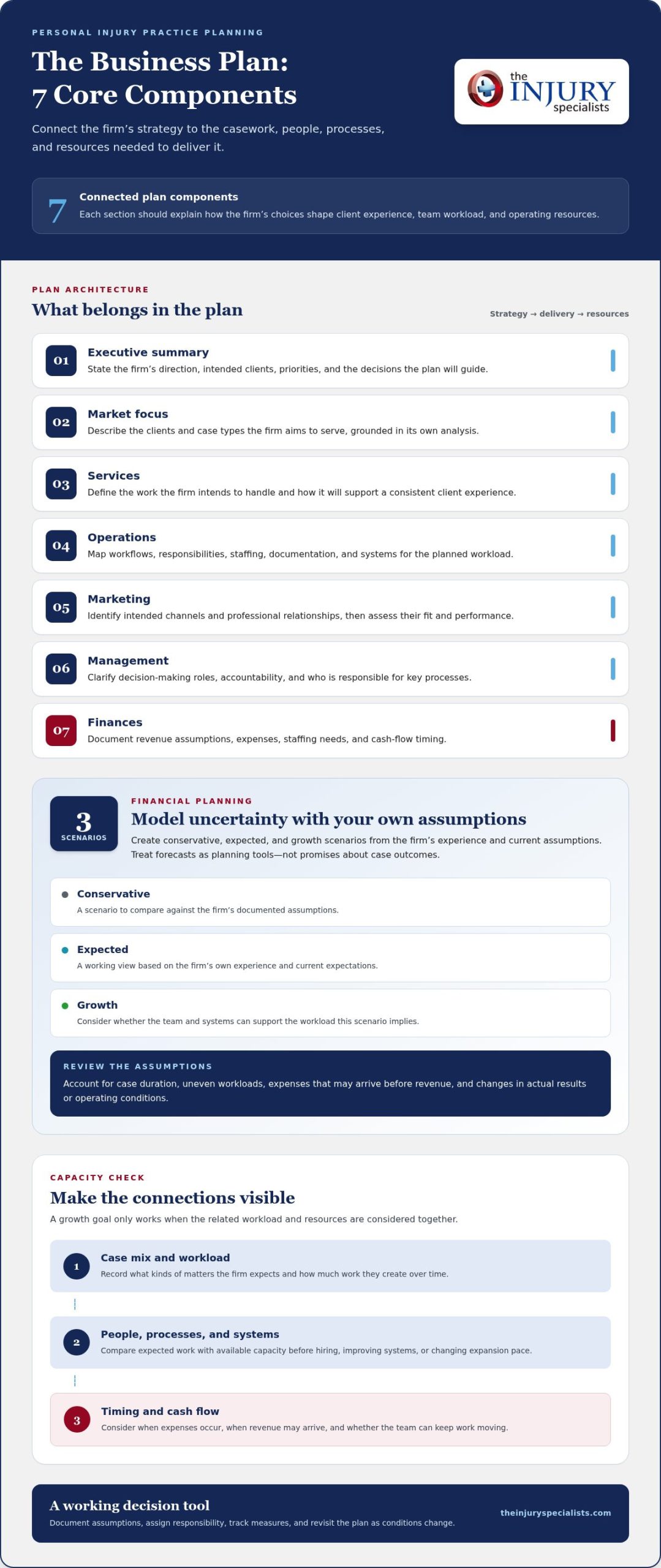
Organize the plan around these components:
- Executive summary: State the firm’s direction, intended clients, priorities, and the decisions the plan will guide.
- Market focus: Describe the clients and case types the firm aims to serve, based on its own analysis rather than unsupported market averages.
- Services: Define the work the firm intends to handle and how it will support a consistent client experience.
- Operations: Map workflows, responsibilities, staffing, documentation, and systems needed to manage the planned workload.
- Marketing: Identify the channels and professional relationships the firm intends to develop, and explain how it will assess their fit and performance.
- Management: Clarify decision-making roles, accountability, and the people responsible for key processes.
- Finances: Document revenue assumptions, expenses, staffing needs, and cash-flow timing.
Keep the sections connected. If the firm plans to accept more matters, explain how intake, case documentation, and team capacity will support that workload. Label assumptions clearly and distinguish them from verified results. A forecast is a planning tool, not a promise about case outcomes.
Build financial assumptions around case timing and capacity
Separate expected revenue from operating expenses, staffing, and cash-flow timing. Create conservative, expected, and growth scenarios using the firm’s own experience and current assumptions. Consider how case duration and uneven workloads could affect when revenue arrives and how much work the team must manage at different points. Revisit the scenarios when actual results or operating conditions change.
Describe operations from intake through documentation
Map who handles each handoff, from initial inquiry and intake through follow-up, record collection, and case documentation. Define workflow ownership, staffing requirements, secure record-handling procedures, and consistent documentation practices. Match technology to a specific need, such as organizing referrals or retrieving records, instead of adding systems without a clear purpose.
Make the plan actionable by attaching an owner, a measure, and a review date to each objective. For example:
- Intake workflow: Owner, intake lead. Measure, completion of the planned process review. Review date, set by the firm.
- Documentation process: Owner, operations lead. Measure, adoption of the documented procedure. Review date, set by the firm.
- Growth channel: Owner, marketing lead. Measure, progress against the firm’s defined objective. Review date, set by the firm.
If the plan identifies a need for connected referral and case-handling tools, explore case management technology as one operational resource. The Injury Specialists platform supports referral management, paperless communication, and on-demand medical record retrieval. Use the platform only for legal and ethical purposes. Assess its features against the firm’s documented workflow, and retain professional judgment over firm decisions.
Choose a Personal Injury Growth Strategy That Fits Your Practice
A growth channel is useful only when it fits the firm’s target clients and the team can manage the work it generates. A business plan for a personal injury practice should compare relationship-based growth, educational marketing, networking, and structured referral management against intake capacity and follow-up processes. More referrals alone don’t create sustainable growth. If inquiries aren’t handled promptly and consistently, added volume can strain operations without advancing the firm’s objectives.
Use the comparison below to consider each channel’s potential contribution, operational demands, and a measure the firm can track. Set targets from your own baseline rather than assuming a channel will produce a particular conversion rate or case value.
| Growth channel | Potential benefit | Operational demand | Useful measure |
|---|---|---|---|
| Existing relationships | Builds on established professional connections and familiarity. | Consistent communication and clear follow-through. | Qualified inquiries and response time. |
| Educational marketing | Explains the firm’s focus and helps intended clients understand its services. | Planning, content review, and a process for responding to inquiries. | Relevant inquiries and intake completion. |
| Professional networking | Creates opportunities to develop and maintain professional connections. | Dedicated relationship-building time and clear boundaries. | Meaningful follow-ups and qualified inquiries. |
| Structured referral management | Organizes referral communication and coordination. | Defined responsibilities, accurate information, and consistent tracking. | Referral status and follow-up completion. |
Assess referral relationships as one part of a growth system
Networking can create a connection, but it doesn’t replace the firm’s intake and case-management process. Define who receives an inquiry, who follows up, what information is recorded, and how updates are handled. Set expectations for timely communication and accurate information. Before implementing a referral arrangement or related marketing activity, verify the professional conduct and referral rules that apply in each relevant jurisdiction.
The Injury Specialists connects legal and medical professionals through a network of 1,100+ professionals across 40+ states. Its digital platform supports referral management and case handling. Firms can assess whether those capabilities fit their documented workflows and growth goals. Referral connections don’t replace the firm’s judgment or its responsibility for its own processes.
Match growth channels to measurable firm objectives
Start with the outcome the firm wants to improve, such as more qualified inquiries, faster follow-up, or a better fit between incoming work and available capacity. Assign an owner to each channel and review the same measures consistently. If inquiry volume rises while response times worsen, the plan may need stronger intake coverage before additional promotion. This keeps growth tied to operational readiness rather than volume alone.
Turn the Plan into a 90-Day Operating Roadmap
A plan becomes useful when it changes what the firm does next. Convert its priorities into a 90-day roadmap with four stages: baseline, priorities, implementation, and review. Each action needs one accountable owner, a completion date, and a measure that shows whether the work is progressing.
Milestones make a business plan actionable by turning strategic goals into owned tasks with deadlines and evidence of progress. Track leading operational measures, such as completed intake steps, response time, or documentation progress. These measures can reveal bottlenecks, but they don’t guarantee revenue, case outcomes, or growth.
Set the first 30 days of planning priorities
Use the first month to establish a reliable baseline before changing processes. Document current workflows, capacity limits, target clients, and tools in use. Choose a small number of priorities based on gaps the firm can describe and address, rather than trying to overhaul every function at once. For each measure, record its data source and who maintains it.
- Baseline, days 1-15: Assign an operations owner to map intake, communication, and documentation workflows. Set a completion date within this period, and record current measures with their data sources.
- Priorities, days 16-30: Have firm leadership select a focused set of actions based on the documented gaps. Name an accountable owner and target date for each action, and define what evidence will demonstrate completion.
Use days 31 through 90 to implement and review
From day 31, move from diagnosis to execution. Assign clear owners for intake, communication, records, and financial review. Schedule recurring check-ins so the team can surface handoff delays, workload pressure, or assumptions that no longer match actual operations. At each review, compare the agreed measure with its baseline, identify the cause of any gap, and decide on a specific adjustment.
- Implementation, days 31-75: Each action owner completes the assigned process or system change by its target date. Track operational indicators, such as whether the defined intake steps are completed and whether record procedures are followed.
- Review, days 76-90: Leadership reviews progress, unresolved bottlenecks, and the assumptions behind the plan. Update targets or sequencing when the evidence supports a change, and carry unfinished work into the next planning cycle with a new owner or date.
For example, if the firm identifies inconsistent intake handoffs, the intake owner can document the steps, establish a completion measure, and review it at scheduled check-ins. If that process reveals a need for better referral coordination or record retrieval, compare the need with the firm’s existing workflow before choosing an operational resource.
Use the roadmap as a management tool, not a promise of financial results. Clear ownership and dated reviews help the firm see whether a change is being implemented and whether it fits the practice’s capacity. If the roadmap identifies a need to evaluate connected case-handling technology, request a platform demonstration to assess how the available tools align with the firm’s documented workflow.
Connect Your Personal Injury Business Plan to the Right Operating Infrastructure
A firm’s plan should describe both the work it intends to handle and the infrastructure that will support it. Turn documented workflow gaps into practical requirements for referral coordination, communication, and medical record retrieval. This keeps technology decisions tied to operating needs rather than feature lists.
For example, if staff spend time tracking referral status across separate processes, define what information needs to be recorded, who owns follow-up, and how the firm will monitor progress. If obtaining records creates workflow friction, document the handoffs and retrieval steps the practice needs to manage. These requirements give the firm a consistent basis for evaluating tools. The personal injury case management technology guide can provide further context when mapping technology to case workflows.
Evaluate referral management and digital coordination against your plan
The Injury Specialists connects legal and medical professionals through a network of 1,100+ professionals across 40+ states. Founded in 2006, the company offers a digital platform with a Networking Portal for finding professionals and submitting referral forms. The platform also supports paperless communication and on-demand medical record retrieval. These features can be assessed against the coordination and record-handling needs the firm has documented.
Use a fit assessment to connect a platform feature to an operational requirement. For example, identify who will submit and track referral forms, how staff will coordinate follow-up, and where record retrieval fits into the firm’s process. The law firm medical referral program guide offers related planning context for firms examining professional connections and referral workflows.
Technology can support coordination, but it doesn’t replace firm judgment or responsibility for the firm’s processes. Referrals aren’t guaranteed to be accurate, and the platform doesn’t guarantee legal, medical, or financial outcomes. Use the platform only for legal and ethical purposes. For platform text messages, message and data rates may apply, and users can opt out at any time by replying “STOP.” For emails, users can opt out using the unsubscribe instructions.
Choose next steps that preserve ethical, practical use
Before evaluating an operational resource, write down the requirements it needs to meet. Be specific about the handoffs to support, the records staff need to retrieve, the roles involved, and how activity will be reviewed. Then compare those needs with the platform’s stated features and decide how the firm will use them responsibly within its established workflows.
This makes implementation more deliberate and helps the firm distinguish a genuine operational need from a feature that doesn’t address a current priority. After documenting your requirements, request a platform demonstration to assess how the platform’s referral management and case-handling capabilities align with your plan.
Put Your Next Practice Decision into Motion
Your plan earns its value through the decisions it helps the firm make next. Choose one priority, identify the operational need behind it, and define how you’ll assess progress. Keep that discipline in place as the practice evolves. A business plan for a personal injury practice is most useful when it stays connected to real workflows and guides practical choices, rather than sitting untouched after approval.
If referral coordination or case handling is part of your next step, evaluate tools against the needs you’ve documented. Founded in 2006, The Injury Specialists has a network of 1,100+ professionals across 40+ states. Its platform supports paperless communication and on-demand medical record retrieval. These resources can inform infrastructure planning while your firm retains responsibility for its own decisions and processes.
See how the platform may fit your documented requirements. Request a demonstration of The Injury Specialists platform, then use what you learn to shape your next operational decision.
Frequently Asked Questions
What should a business plan for a personal injury practice include?
A business plan for a personal injury practice should connect the firm’s mission, intended clients, services, market approach, workflows, management roles, and financial assumptions. Make each element useful for a decision. If the firm plans to handle a different mix of matters, for instance, explain how that affects intake questions, staff responsibilities, and the resources needed to document cases. Assign an owner and review date to key objectives so the plan stays in use.
How do you write a business plan for a personal injury law firm?
Start with the firm’s objectives and the clients it intends to serve, then describe the services and processes needed to support them. Build financial projections from firm-specific inputs and explain the assumptions behind them. Add responsibilities and measurable milestones, such as who will review a revised intake process and when. Before finalizing the plan, discuss it with the people expected to carry it out, then revise it as operational experience provides new evidence.
Can a solo personal injury lawyer benefit from a business plan?
Yes. A solo lawyer can use a concise plan to set priorities and protect time for casework and practice management. Identify the matter types the firm intends to accept, the workload it can manage, and which intake or documentation tasks need a repeatable process. The plan doesn’t need a large firm’s hierarchy. Keep it proportionate, with practical measures the lawyer can review and adjust as capacity changes.
How should a personal injury practice plan for cash flow?
Use documented assumptions, not generic industry averages. Separate anticipated receipts from operating expenses, staffing commitments, and other cash demands, and model conservative and expected scenarios. Because matters may progress on different timelines, don’t treat projected receipts as certain or assume files will resolve on a uniform schedule. Compare actual cash flow with the forecast during financial reviews. If expenses, workload, or case mix shift, update the assumptions and consider what decisions the change requires.
How often should a law firm update its business plan?
Set a recurring review schedule that fits the firm, and revisit the plan sooner after a meaningful change, such as a staffing shift, a new practice focus, or a workflow problem. At each review, compare actual activity with the plan’s assumptions and milestones. Record what changed, who owns any follow-up, and when it’s due. A review is useful only if it informs a decision, so revise outdated priorities rather than preserving targets that no longer fit.
What metrics should a personal injury practice track in its business plan?
Track measures that answer a specific management question and can be collected consistently. A firm might define inquiry response time as the period between initial contact and the first documented reply, or track intake completion by checking whether required internal steps were recorded. It can also monitor workload by team and operating expenses. Specify each metric’s source, owner, and review method before setting a target. Use results to investigate process issues, not to promise revenue or case outcomes.
Should a personal injury practice include referral strategy in its business plan?
Yes, if professional relationships support the firm’s growth objectives. Describe how the practice will handle incoming connections, communications, intake decisions, and follow-up, including who is responsible at each step. Referral activity should fit available capacity and the firm’s established processes, not become a substitute for them. Before adopting a referral arrangement or related marketing activity, verify the professional conduct rules that apply in the relevant jurisdiction. Referral volume alone doesn’t establish sustainable growth.
Can a business plan change after a personal injury firm launches?
Yes. Treat the plan as a working management document and revise it as the firm learns from its operations. If a new process creates delays or responsibilities shift between team members, document the change and update the relevant objectives, assumptions, and ownership. Keep a record of significant revisions so leadership can see why priorities changed. This lets the firm adapt without losing sight of its objectives or relying on startup assumptions that no longer fit.

Leave A Comment
You must be logged in to post a comment.