

Accepting a personal injury lien shouldn’t feel like a high-stakes gamble with your practice’s cash flow. Many medical groups treat patients for months, or even years, only to have the final settlement check disappear due to administrative errors or attorney oversight. It’s a systemic failure that leaves high-quality providers holding the bill for essential care. This guide provides a clear roadmap for medical lien protection for providers, moving beyond simple paperwork to a comprehensive operational strategy.
You already know that high accounts receivable aging is the primary threat to your practice’s growth. You’re likely frustrated by the manual labor required to track case statuses and the risk of being forgotten during the settlement phase. We’ll show you how to implement a reliable system for tracking liens and securing higher payout rates. This article previews the specific networking and technology tools that turn personal injury cases into a predictable, high-yield revenue stream rather than a financial liability.
Key Takeaways
- Identify the legal and operational differences between statutory liens and Letters of Protection to safeguard your practice’s revenue.
- Standardize your intake and documentation processes to ensure your medical records accurately reflect the full value of the patient’s care.
- Establish robust medical lien protection for providers by vetting the insurance coverage and liability of every personal injury case before treatment begins.
- Leverage proprietary case management technology to automate status tracking and eliminate the administrative burden of manual follow-ups.
- Connect with a national network of vetted law firms to secure faster payment cycles and a more reliable stream of personal injury referrals.
Understanding Medical Liens: Financial Opportunity vs. Practice Risk
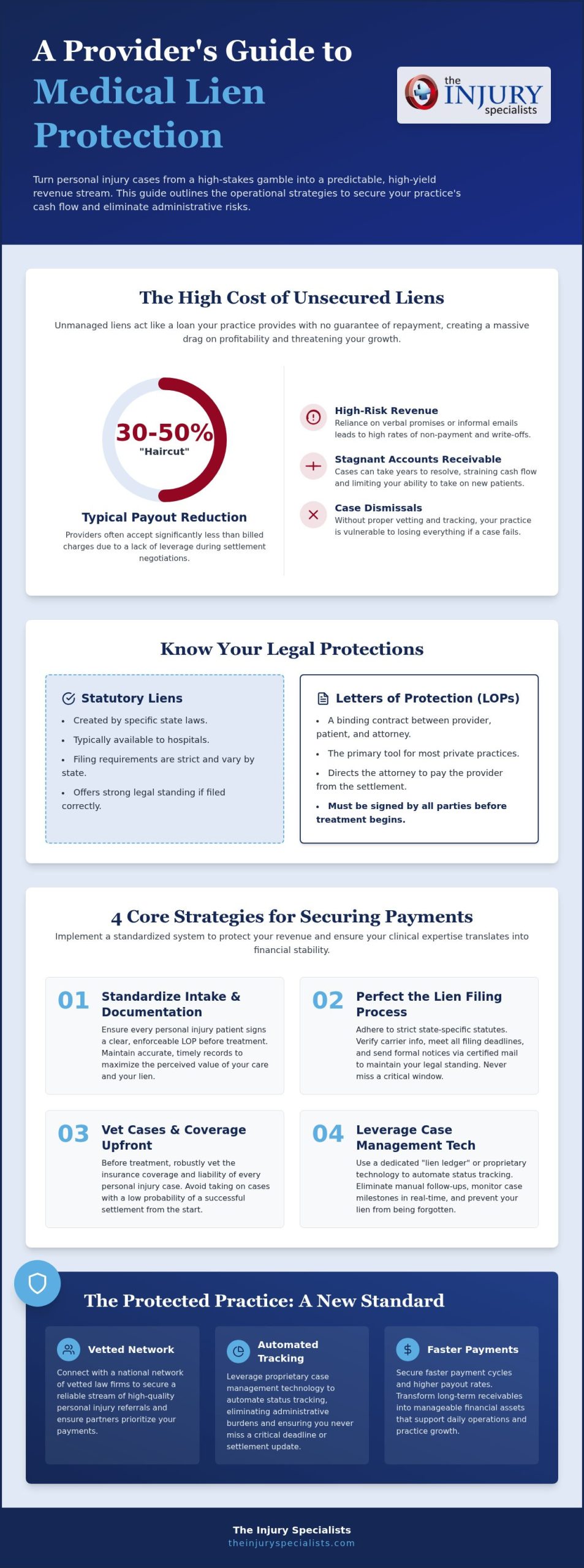
A medical lien is a legal claim placed on a future personal injury settlement to ensure a healthcare provider receives payment for services rendered. It allows patients to access necessary care without paying out of pocket, which is critical for treating uninsured or underinsured accident victims. While statutory liens are created by specific state laws, usually for hospitals, most private practices rely on a Letter of Protection (LOP). Accepting these cases opens significant revenue streams, but it also introduces operational risks. Without robust medical lien protection for providers, your practice faces the possibility of case dismissals, insufficient settlement amounts, or attorneys who prioritize their own fees over your outstanding balance.
The Mechanics of a Letter of Protection
An LOP functions as a binding contract between the medical provider, the patient, and the patient’s attorney. It directs the attorney to pay the provider directly from the settlement proceeds before the patient receives their portion. To secure your revenue, you must ensure the LOP contains specific clauses regarding payment priority and non-revocability. Effective medical case management is essential here; you must verify that every LOP is valid, signed, and properly filed. Relying on verbal promises or informal emails creates a vulnerability that can lead to zero recovery on a high-value case.
Financial Impact of Unsecured Liens
Unmanaged liens create a massive drag on practice profitability and overall valuation. When you treat patients on a lien basis, you’re essentially acting as a lender. If the case fails or the attorney negotiates poorly, that “loan” goes unpaid. Providers without proper medical lien protection for providers often accept a 30% to 50% “haircut” on their billed charges during settlement negotiations simply because they lack the leverage to demand full payment. This high rate of write-offs disrupts your revenue cycle management (RCM) and makes the practice less attractive to potential buyers or investors. Protecting these assets requires moving beyond passive waiting and adopting a system that tracks case milestones in real time.
Core Strategies for Securing Medical Lien Payments
Implementing a standardized intake process is the first step toward effective medical lien protection for providers. Every personal injury patient must sign a clear, enforceable Letter of Protection (LOP) before treatment begins. This prevents administrative confusion and ensures the legal foundation for your claim is established early. Accurate and timely medical documentation also plays a vital role in maximizing lien value. Insurance adjusters and defense attorneys scrutinize clinical records to find inconsistencies that justify lower settlement offers. If your records are incomplete or delayed, the perceived value of your lien drops significantly.
A dedicated “lien ledger” is another essential tool for practice stability. You can’t rely on memory or scattered spreadsheets to track hundreds of outstanding cases. Real-time tracking allows your billing team to identify stagnant cases and follow up with law firms before they reach a settlement. Relying on a system that prioritizes medical lien protection for providers ensures that your clinical expertise translates into actual revenue rather than uncollectible debt.
Perfecting the Lien Filing Process
Filing a lien correctly requires strict adherence to state-specific statutes. Many providers lose their legal standing because they miss filing deadlines or fail to send notices via certified mail. For example, some jurisdictions require liens to be filed within 30 days of the first treatment to remain valid. Your process should include:
- Verifying the correct insurance carrier and claim number immediately.
- Filing the lien document with the appropriate county recorder or state agency within the required timeframe.
- Sending formal notice to the patient’s attorney and the liability insurance carrier.
Case management technology can automate these deadlines. It ensures your staff never misses a critical filing window, which is the most common reason liens are invalidated by the court.
The Role of Pre-Settlement Funding
Pre-settlement funding is a strategic tool that provides immediate liquidity for your practice. Personal injury cases often take years to resolve. This delay strains your cash flow and limits your ability to take on new patients. Funding bridges this gap by providing an advance on the expected settlement proceeds. It transforms a long-term receivable into a manageable financial asset that supports daily operations.
Integrating funding options into your workflow reduces the financial risk of treating patients on a lien basis. It allows you to maintain care continuity without worrying about the practice’s immediate overhead. By utilizing integrated pre-settlement funding solutions, you can secure practice revenue while the legal process unfolds. This proactive approach protects your bottom line from the unpredictability of the litigation cycle.
Vetting Law Firms and Case Quality for Better Lien Security
Your choice of legal partner is the most critical variable in the lien recovery equation. Even the best documentation won’t save a lien if the attorney lacks the competence to win the case or the integrity to honor the LOP. Vetting law firms is a proactive form of medical lien protection for providers that reduces the risk of non-payment before the first appointment is scheduled. You aren’t just treating a patient; you’re entering a business arrangement with a law firm that holds the keys to your reimbursement.
The Attorney Reliability Checklist
A reliable firm treats medical providers as strategic partners rather than secondary creditors. You should evaluate firms based on their historical settlement values and their internal communication protocols. Watch for red flags like unreturned phone calls, vague status updates, or a refusal to provide liability insurance details. High-performing firms prioritize transparency and often utilize a standardized attorney physician referral system to streamline information exchange. This level of organization ensures that case milestones are shared and that your billing department isn’t left in the dark for months at a time.
Case Merit Assessment for Providers
Not every accident claim is a viable lien case. You must evaluate case quality based on clear liability and sufficient insurance policy limits. If a defendant has a minimum policy and the patient’s injuries require extensive surgery, your lien is at risk of being drastically reduced or “cut” to accommodate other costs. Basic criteria for a “safe” lien include a clear police report, a defendant with verifiable coverage, and a patient who is compliant with treatment. Some practices utilize medical legal consulting services to vet complex cases, ensuring they only commit resources to high-probability recoveries. This objective analysis prevents your practice from becoming a de facto bank for meritless litigation.
Working within an established referral network, like The Injury Specialists, removes the guesswork from this vetting process. We pre-vet law firms to ensure they have the financial stability and professional reputation required to protect your practice’s interests. This network-based approach provides a layer of medical lien protection for providers that independent practices simply can’t achieve on their own. By connecting with high-volume, vetted firms, you secure a more predictable stream of personal injury revenue and minimize the administrative burden of manual case vetting.
Leveraging Case Management Technology for Lien Tracking
Relying on manual spreadsheets for personal injury case tracking is an operational liability. Static documents fail to capture the dynamic nature of litigation, which often leads to missed deadlines and unpaid invoices. Implementing robust medical lien protection for providers requires a digital infrastructure that bridges the gap between the clinic and the law firm. A centralized platform ensures that every Letter of Protection (LOP) and medical record is accessible, searchable, and secure. This prevents the common “lost record” excuse that attorneys or adjusters use to delay settlement negotiations and final payouts.
Features of Modern PI Case Management Technology
Modern platforms integrate medical records management directly with legal portals, allowing for seamless document exchange. Instead of making dozens of phone calls for status updates, your billing team can view real-time case milestones through a secure dashboard. This transparency builds trust between professional partners and ensures that your practice remains a priority during the distribution of funds. By utilizing personal injury case management technology, medical practices can significantly reduce administrative overhead while maintaining complete oversight of their accounts receivable. Automated reminders for settlement dates and case filings further eliminate the risk of human error in the lien tracking process.
Data-Driven Lien Management
Technology also enables a shift from reactive billing to proactive financial strategy. Analytics tools within these platforms help predict settlement timelines based on historical data from specific law firms or insurance carriers. This allows for more accurate financial forecasting and helps the practice manage its cash flow more effectively. You can track the performance of your referral partners, identifying which firms settle cases efficiently and which ones require more frequent follow-ups. This data-driven approach transforms your lien portfolio from a list of uncertain payments into a predictable asset class.
Efficiency is the hallmark of a successful personal injury practice. If you’re still manually tracking case statuses, you’re leaving your revenue to chance. You can streamline your lien tracking today by adopting the proprietary tools used by the nation’s leading medical providers.
Strategic Networking: How The Injury Specialists Protect Your Practice
The Injury Specialists operates the largest personal injury referral network in the United States, providing a massive scale advantage to medical practices. By joining this network, you move beyond individual case management into a streamlined ecosystem where medical lien protection for providers is a standard operational feature. We remove the significant burden of vetting legal partners by connecting you with pre-vetted firms that have a proven track record of honoring liens and securing high-value settlements. This professional synergy ensures that your practice focus remains on patient care while our infrastructure protects your revenue. It’s not just a directory; it’s an active management layer that facilitates professional growth and financial security.
The Power-Connector Advantage
Traditional business development in the personal injury sector often relies on inefficient cold calling or unverified word-of-mouth recommendations. A professional personal injury referral network eliminates this uncertainty. By accessing a curated ecosystem of legal and medical professionals, you build trust through established performance data rather than empty promises. This connectivity allows you to scale your practice nationwide, tapping into high-quality referral partners who understand the clinical and financial requirements of treating accident victims on a lien basis.
Integrated medical case management within the network ensures that documentation is consistent across all providers involved in a patient’s care. When a patient sees a chiropractor, an imaging center, and a pain management specialist, the network synchronizes the records. This cohesion prevents “gaps in care” arguments from insurance adjusters that frequently devalue liens. By maintaining a unified documentation trail, the network strengthens the legal standing of every provider involved in the case.
Getting Started with Secure Lien Management
Onboarding your practice into our network is a direct investment in your long-term financial stability. We provide the comprehensive tools required to manage physician referral services through a proprietary technology platform that automates documentation and communication. This integrated approach ensures that no case milestone is missed and no lien is left unprotected during the settlement phase. You’ll gain immediate access to standardized intake protocols and a support system designed to handle the complexities of multi-provider cases.
To secure your practice’s cash flow in 2026, you must replace fragmented workflows with a unified system. Medical lien protection for providers is most effective when it’s backed by the logistical power of a market leader. By leveraging our network and technology, you can minimize financial risk, reduce administrative friction, and maximize the profitability of every personal injury case you accept.
Securing Your Practice’s Financial Future in 2026
Transitioning your personal injury workflow from manual spreadsheets to a tech-driven ecosystem is no longer optional; it’s a strategic necessity for any practice looking to scale. By implementing standardized intake protocols and vetting your legal partners, you establish the foundation for reliable medical lien protection for providers. This proactive approach ensures that your clinical expertise is met with guaranteed reimbursement rather than indefinite delays or administrative oversight. You’ve learned that the right combination of technology and networking transforms medical liens from a financial gamble into a predictable asset class.
The Injury Specialists provides the professional infrastructure you need to eliminate these recurring financial risks. Our world-class technology platform, expert medical case management, and nationwide network of vetted attorneys offer a level of security that independent practices simply can’t achieve alone. You can stop chasing payments and start focusing on delivering high-quality patient care to accident victims. Join the largest personal injury referral network and secure your medical liens today. Taking this step positions your practice for streamlined success and logistical ease in an increasingly competitive market.
Frequently Asked Questions
What is the best way to protect a medical lien from being ignored by an attorney?
The most effective way to prevent an attorney from ignoring your claim is to work within a vetted referral network. Standardized Letters of Protection (LOP) coupled with persistent case tracking ensure your practice remains a priority during settlement. The Injury Specialists pre-vets every law firm in its national network, establishing a professional standard that minimizes the risk of forgotten liens. This system creates a level of accountability that independent billing departments often struggle to maintain alone.
Can a medical provider file a lien without an attorney involved?
Medical providers can file statutory liens independently if their state laws allow it, typically requiring filing with a county recorder or state agency. However, for most private practices, the process involves a Letter of Protection (LOP) which is a three-party contract between the provider, the patient, and the attorney. While you can treat a patient without an attorney involved, securing medical lien protection for providers is significantly more difficult without a legal representative to guarantee payment.
How long does a medical lien remain valid in a personal injury case?
A medical lien typically remains valid until the personal injury case reaches a final settlement or judgment. However, the exact duration depends on state-specific statutes of limitations and filing requirements. Some states require liens to be renewed or refiled if the litigation extends over several years. Utilizing a digital case management platform allows your team to track these legal timelines automatically, ensuring that no lien expires due to an administrative oversight during a long litigation process.
What happens to a medical lien if the personal injury case is lost?
If a personal injury case is lost or dismissed, the medical lien generally becomes an unsecured debt. The patient remains legally responsible for the cost of care, but the direct claim against settlement proceeds is extinguished. This financial risk is why vetting case liability and insurance coverage is essential before accepting a patient on a lien basis. By using a professional referral network, you can focus on cases with higher probabilities of successful recovery and documented insurance limits.
Is a Letter of Protection (LOP) as legally binding as a statutory lien?
A Letter of Protection (LOP) is a legally binding contract, whereas a statutory lien is a right granted by state law. Statutory liens often take higher priority in the line of creditors, but they are frequently limited to hospitals or specific trauma centers. For most specialists and imaging centers, a well-drafted LOP is the primary tool for securing payment. Ensuring your LOP contains non-revocable clauses is a critical component of medical lien protection for providers in the private sector.
How much do medical providers typically lose on uncollected liens?
Without a managed system, medical providers often lose 30% to 50% of their billed charges through uncollected liens or forced settlement reductions. These losses stem from poor case vetting, administrative errors, or attorneys who prioritize their own fees over medical bills. Implementing a structured tracking system and working with vetted legal partners reduces these write-offs significantly. This transformation of accounts receivable into predictable revenue is a core benefit of joining a professional medical-legal networking ecosystem.
Can pre-settlement funding be used to pay off a medical lien early?
Pre-settlement funding is specifically designed to provide immediate liquidity by advancing a portion of the expected settlement to the medical provider. This process effectively pays off the lien balance early, removing the financial strain of waiting years for a case to resolve. It bridges the gap between treatment and payment, allowing the practice to maintain care continuity and cover operational overhead without being tied to the unpredictable timeline of the legal system.
What is the role of case management software in lien protection?
Case management software acts as the central hub for documentation, communication, and milestone tracking. It replaces manual spreadsheets with automated alerts for filing deadlines and real-time status updates from law firms. This technology ensures that every medical record and LOP is centrally located, preventing the loss of critical evidence during settlement negotiations. Centralized data also allows your practice to analyze the performance of various referral partners and predict future payout timelines with greater accuracy.

Leave A Comment
You must be logged in to post a comment.