

In the personal injury sector, a clinical record is not just a history of patient care; it is the primary financial engine of a legal claim. If your chiropractor documentation for personal injury lacks objective proof, even the most effective treatment plan will fail to survive rigorous insurance scrutiny. You likely already know the frustration of seeing valid claims denied due to perceived gaps in treatment or receiving feedback from law firms that your records lack the defensible data they need to win. These administrative roadblocks do more than stall individual cases; they damage your reputation as a reliable medical partner and slow your practice’s growth.
This guide provides the professional framework to transform your documentation from a time-consuming chore into a strategic asset that satisfies adjusters and builds high-value attorney partnerships. We will examine the specific standards required for defensible records, the impact of objective findings on case value, and how proprietary technology streamlines these workflows. By mastering these documentation protocols, you ensure faster settlement approvals and position your practice as a sophisticated, results-oriented leader in the medical-legal landscape.
Key Takeaways
- Understand how insurance software evaluates records and why shifting from subjective reports to objective evidence is essential for settlement value.
- Master the specific requirements for chiropractor documentation for personal injury, including establishing the mechanism of injury and tracking measurable functional gains.
- Identify and eliminate common documentation gaps, such as treatment inconsistencies or unaddressed patient non-compliance, that lead to claim denials.
- Discover how integrated case management technology bridges the communication gap between your practice and law firms to reduce administrative burdens.
- Position your practice for growth by using clinical excellence as a calling card to attract high-volume referral partners within a national network.
Why Chiropractic Documentation is the Backbone of Personal Injury Settlements
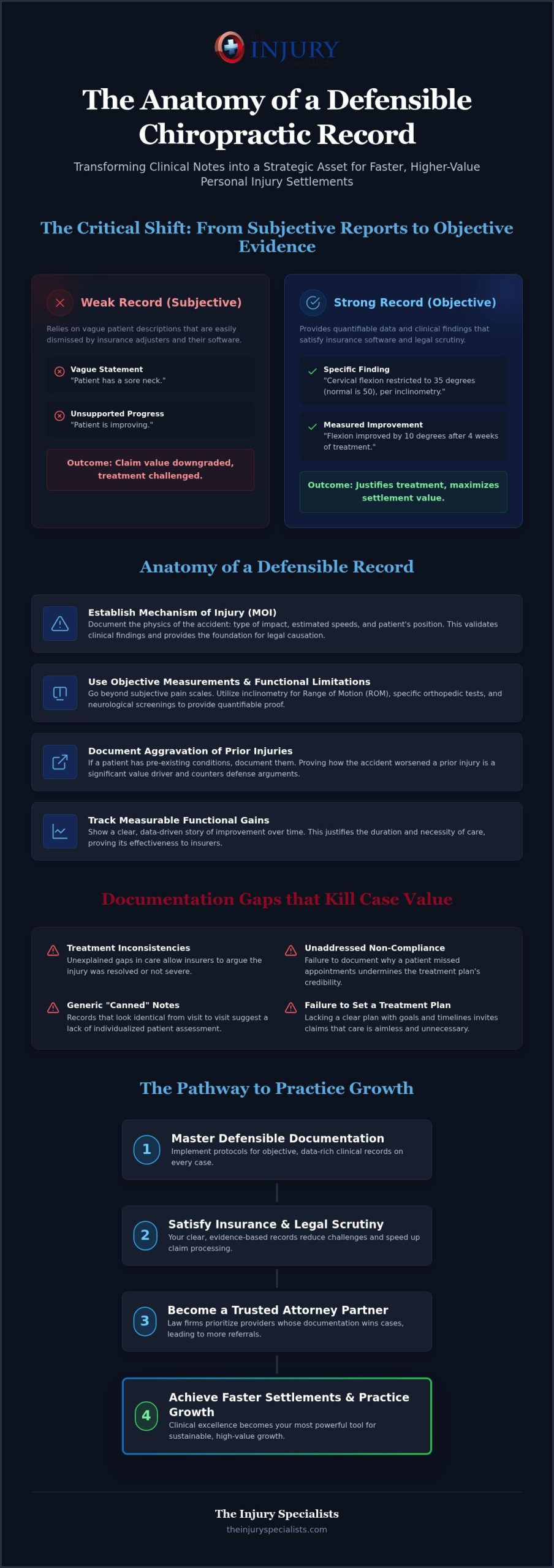
Clinical notes serve as the objective bridge between medical care and legal compensation. In previous decades, subjective pain reports carried significant weight, but the current insurance landscape demands quantifiable data. High-quality chiropractor documentation for personal injury shifts the focus from how a patient feels to how they function. This transition is vital. Adjusters cannot assign a dollar value to a “sore neck” without clinical proof of restricted range of motion or neurological deficit. Your records must provide the evidence required to transform a patient’s narrative into a defensible legal claim.
Insurance carriers use sophisticated software like Colossus to evaluate claims. These systems act as digital auditors, scanning medical records for specific “value drivers.” If your records lack precise diagnostic codes or functional assessments, the software automatically downgrades the claim’s value. There’s a direct, measurable correlation between the granularity of your notes and the settlement multipliers an attorney can negotiate. Detailed records provide the leverage needed to substantiate higher settlement demands; vague notes do the opposite.
The Insurance Adjuster Perspective
Adjusters operate on the principle of the “burden of proof.” If a treatment isn’t documented with precision, it didn’t happen in the eyes of the insurer. Vague notes such as “patient is improving” often lead to challenges regarding “reasonable and necessary” care. In a personal injury context, medical necessity is defined as treatment that is clinically indicated, consistent with the diagnosis, and required to return the patient to their pre-accident functional status. Without this clarity, adjusters will aggressively slash treatment costs and deny reimbursement for future care.
Documentation as a Practice Growth Strategy
Excellence in reporting is your most effective marketing tool. Attorneys prioritize working with providers who understand the medical-legal interface because it protects their clients’ cases. Defensible records significantly reduce the time spent in depositions, as the notes are comprehensive enough to speak for themselves. This level of professionalism is a strict requirement for any provider looking to scale through a personal injury referral network. Chiropractic practices that master these documentation standards see more consistent referrals, higher-quality cases, and faster resolutions. It’s a logistical necessity for a well-oiled practice.
The Anatomy of a Defensible Chiropractic Record: Key Requirements
A defensible record is built on clinical specificity. Standard chiropractor documentation for personal injury must go beyond basic observations to provide a forensic level account of the patient’s condition. This process begins with the Initial Assessment. You must establish the Mechanism of Injury (MOI) by documenting the physics of the accident. Records should specify the type of impact, estimated vehicle speeds, and the patient’s position during the event. These details validate the clinical findings and provide the foundation for legal causation.
Establishing Causation and Mechanism of Injury
Precise documentation bridges the gap between the traumatic event and the patient’s physical symptoms. You need to connect immediate post-accident symptoms directly to the trauma described. If a patient has pre-existing conditions, don’t omit them. Documenting the aggravation of a prior injury is a significant value driver in personal injury cases. It demonstrates exactly how the accident altered the patient’s functional baseline, making the records more resilient against insurance defense arguments.
Objective Measurements and Functional Limitations
Subjective pain scales are insufficient to justify ongoing treatment in a pre-litigation environment. You must utilize objective findings like inclinometry for range of motion (ROM) data and specific orthopedic or neurological screenings. The National Center for Complementary and Integrative Health notes that practitioners use these physical examinations to evaluate the spine and develop appropriate care plans. In a personal injury context, you should standardize this data using the AMA Guides to the Evaluation of Permanent Impairment, 6th Edition, to provide the objective proof adjusters demand.
Documentation must also focus on Activities of Daily Living (ADL) disruptions. It’s not enough to note that a patient is “sore.” You must document how that soreness prevents them from performing specific tasks, such as lifting objects or sitting at a desk. Daily SOAP notes should track these functional gains over time. When your records show a measurable transition from total disability to improved functional capacity, you’re providing the evidence needed for settlement approvals.
The treatment cycle concludes with a comprehensive Final Report that summarizes the care provided, the patient’s prognosis, and any future medical needs. This document serves as the closing argument for the medical portion of the claim. Managing these complex requirements consistently is more efficient when you utilize integrated case management technology to track every clinical data point from intake to discharge.
Avoiding the Documentation Gaps That Kill Personal Injury Cases
Gaps in care are the primary targets for insurance adjusters looking to minimize claim values. If a patient waits weeks to seek treatment or misses multiple appointments without a documented explanation, the adjuster will argue the injury wasn’t severe or resulted from an intervening event. Adhering to the “72-hour rule” for initial post-accident documentation is a baseline requirement. Establishing a clinical record within three days of the trauma creates a direct, defensible link between the accident and the physical findings. When chiropractor documentation for personal injury is delayed, the burden of proof becomes significantly harder to meet.
Managing Gaps and Delays in Care
When treatment delays or pauses occur, you must provide specific clinical justifications in the record. Whether the patient was ill, traveling, or had unavoidable work conflicts, these reasons must be documented to prevent the “gap” from being used against the claim. Documenting patient non-compliance is just as vital. If a patient ignores home exercise protocols or misses scheduled visits, your notes should reflect your attempts to re-engage them. This transparency protects the provider’s integrity and explains why functional gains might have plateaued despite appropriate clinical intervention.
Repetitive, “cloned” notes represent another significant risk. Using identical text across multiple visits suggests a lack of individual assessment and frequently triggers insurance audits. While templates offer efficiency, each entry must reflect the patient’s specific clinical state during that session. Aligning your records with Medicare Chiropractic Documentation Guidelines ensures your notes meet a high standard of medical necessity. This level of detail makes it difficult for adjusters to dismiss care as “routine” or “unnecessary.”
Ensuring Inter-Provider Consistency
Inconsistencies between different medical providers can derail a settlement. If an emergency room record mentions “no back pain” but your initial exam three days later identifies significant lumbar restriction, you must clinically address and reconcile this discrepancy. This is where aligning your findings with personal injury diagnostic imaging referrals becomes critical. Objective imaging provides the physical evidence that bridges the gap between different medical observations and confirms the underlying pathology.
Effective chiropractor documentation for personal injury requires a bird’s-eye view of the entire case. Professional case management helps maintain record harmony across various specialties, ensuring that the chiropractor, the imaging center, and any other specialists are on the same page. When the clinical narrative remains consistent throughout the entire treatment cycle, the case’s legal and financial value remains protected from defense challenges.
How Modern Case Management Technology Streamlines Chiropractic Records
Medical-legal technology is the strategic bridge between clinical Electronic Medical Records (EMR) and the attorney’s case file. While standard EMRs focus on patient care, integrated case management systems prioritize the accessibility and defensibility of those records. This technology automates the delivery of chiropractor documentation for personal injury, ensuring that every SOAP note and diagnostic report is available to legal partners the moment it is finalized. This real-time visibility eliminates the administrative friction that typically delays personal injury settlements.
The Efficiency of Integrated Platforms
Manual record requests represent a significant drain on practice resources. Utilizing personal injury case management technology allows chiropractic staff to bypass the cycle of phone calls and emails. These platforms centralize diagnostic imaging, final billings, and clinical notes in a single secure location. By standardizing report formats, you provide attorneys with documents that are easy to review and submit to insurance adjusters. This logistical ease directly translates to faster case resolutions and higher staff productivity.
Data Security and Professional Synergy
Maintaining a strict chain of custody for medical evidence is a legal necessity. Integrated technology ensures that every record update is time-stamped and logged, providing an audit trail that withstands court challenges. These systems compile settlement-ready packages of chiropractor documentation for personal injury that include everything an attorney needs to substantiate a claim. This level of organization is a key differentiator for practices participating in a law firm medical referral program. When you provide high-quality data through a streamlined interface, you strengthen the professional synergy between your clinic and your legal partners.
HIPAA compliance remains the foundation of these digital interactions. Modern platforms facilitate legal discovery through encrypted portals that protect patient privacy while allowing authorized access to necessary records. Automated notifications for treatment milestones ensure that attorneys are never left wondering about a patient’s status. This proactive communication builds trust and positions your practice as a sophisticated medical-legal partner. To see how these systems can modernize your workflow, request a demo of our proprietary technology platform.
Scaling Your Practice with a National Personal Injury Referral Network
High-quality chiropractor documentation for personal injury is your most effective professional calling card. In a competitive medical-legal landscape, law firms prioritize providers who deliver defensible, objective records without requiring constant administrative follow-up. When your clinical notes consistently meet rigorous standards, you position your practice as a reliable asset in high-volume litigation. Clinical excellence builds the foundation, but administrative efficiency is the mechanism that allows a practice to scale. Joining a structured network ensures that your documentation reaches the right partners at the right time.
The Injury Specialists operates the largest national personal injury referral network in the United States, acting as the primary bridge between top-tier clinicians and leading law firms. This ecosystem values providers who understand that a clinical record is a strategic legal asset. By integrating your practice into this national framework, you shift from manual networking to a system-driven growth model. The focus remains on clinical outcomes while the network manages the logistical connectivity required to sustain a high-volume personal injury department.
The Competitive Advantage of Network Membership
Membership in a national network removes the overhead and inconsistency of individual firm marketing. You gain immediate access to a steady stream of personal injury physical therapy referrals and chiropractic cases. The network handles the heavy lifting of case placement and tracking, allowing your staff to focus on patient care rather than administrative chasing. Additionally, the availability of pre-settlement funding ensures uninterrupted treatment plans. This financial stability allows you to maintain the necessary frequency of care to achieve measurable functional gains, which further strengthens your documentation.
Next Steps for Growth-Oriented Chiropractors
Practice expansion requires a commitment to standardized excellence. Your first step should be an internal audit of your current records against national standards, specifically the AMA Guides 6th Edition. Ensure your SOAP notes move beyond subjective pain reports to track quantifiable ADL disruptions. If your records are already defensible and settlement-ready, applying to join a national referral network is the most logical path forward. The Injury Specialists facilitates B2B growth for medical partners by providing a proprietary technology platform that automates case management and streamlines communication with law firms. This integration transforms your practice into a sophisticated, results-oriented operator capable of handling large-scale referral volume with logistical ease.
Elevating Your Practice Through Documentation Excellence
Mastering chiropractor documentation for personal injury is the most direct path to securing faster settlement approvals and strengthening attorney partnerships. By replacing subjective pain reports with objective functional data and utilizing integrated technology to eliminate administrative gaps, you protect the financial value of every claim. These standards aren’t just clinical requirements; they’re the engine of a scalable, professional personal injury department.
The Injury Specialists facilitates connections for thousands of medical and legal professionals nationwide. Our network provides access to world-class case management technology and specialized medical case management to ensure your practice remains at the forefront of the industry. This logistics-first approach allows you to focus on clinical results while we manage the complexities of case tracking and referral growth.
Join the Largest Personal Injury Referral Network and Scale Your Practice
Your commitment to defensible records today builds the foundation for long-term professional success and sustainable practice growth.
Frequently Asked Questions
What are the most common chiropractic documentation mistakes in PI cases?
Cloned notes and failing to document ADL disruptions are the most frequent errors. When chiropractor documentation for personal injury uses repetitive templates, it triggers insurance audits. Other mistakes include failing to establish a clear mechanism of injury or neglecting to reconcile findings with diagnostic imaging. These errors create vulnerabilities that adjusters use to slash claim values. Precise, individualized notes are the only way to defend the medical necessity of the treatment provided.
How often should a chiropractor perform a re-evaluation for an injury case?
Clinical re-evaluations should typically occur every 30 days or every 12 visits, depending on the patient’s progress. These milestones allow the provider to document measurable functional gains or justify changes to the treatment plan. Regular re-assessments provide the objective data needed to prove that care remains reasonable and necessary. If a patient plateaus, the re-evaluation helps determine if they’ve reached Maximum Medical Improvement or require a referral to a specialist.
Does every personal injury record need an impairment rating?
Not every case requires an impairment rating, but it’s essential when a patient reaches Maximum Medical Improvement with residual deficits. Ratings should follow the AMA Guides to the Evaluation of Permanent Impairment, 6th Edition. Providing an accurate rating gives attorneys a quantifiable figure to use during settlement negotiations. Without this data, it’s difficult to substantiate claims for permanent loss of function or future medical expenses in a personal injury context.
How does thorough documentation affect the attorney-chiropractor relationship?
High-quality documentation transforms the chiropractor from a service provider into a strategic partner. Attorneys rely on clinical records to build their legal arguments; therefore, clear and defensible notes reduce the need for time-consuming depositions. When a practice consistently delivers settlement-ready records, it earns a reputation for professionalism. This trust leads to higher-quality referrals and more cohesive collaboration within a national personal injury referral network, benefiting both the practice and the law firm.
What is the “Colossus” system and how does it read chiropractic notes?
Colossus is a software program used by insurance carriers to calculate settlement ranges by scanning medical records for specific value drivers. It looks for clinical data such as restricted range of motion, muscle spasms, and disruptions to activities of daily living. If your notes are purely subjective or lack specific diagnostic codes, the system will assign a lower value to the claim. Mastering chiropractor documentation for personal injury requires understanding these digital auditing standards to ensure maximum case value.
Can technology help reduce the time spent on personal injury charting?
Proprietary technology platforms significantly reduce the time spent on manual charting and administrative tasks. These systems use standardized templates that prompt providers for objective data, ensuring no critical value drivers are missed. By integrating clinical records with attorney portals, technology allows for real-time record sharing and automated milestone notifications. This streamlined workflow reduces the burden on chiropractic staff while maintaining the high documentation standards required for successful personal injury settlements.
What should be included in a final discharge summary for a PI patient?
A final discharge summary must include the patient’s status at Maximum Medical Improvement, a comparison of initial versus final functional outcomes, and a detailed prognosis. It should also outline any anticipated future medical care and the associated costs. This report serves as the closing evidence for the medical portion of the legal claim. Clear documentation of the patient’s final recovery status ensures that the attorney can accurately represent the total impact of the injury.
How do I ensure my documentation supports medical necessity for long-term care?
Supporting long-term care requires documenting a clear clinical rationale for extended treatment. You must show that the patient continues to make measurable functional improvements or that care is necessary to prevent significant regression. Using objective tests, such as inclinometry or orthopedic screenings, provides the proof adjusters demand. Detailed notes must explain why the patient’s specific injuries require a longer recovery period than typical industry averages might suggest, maintaining the defensibility of the care plan.

Leave A Comment
You must be logged in to post a comment.