

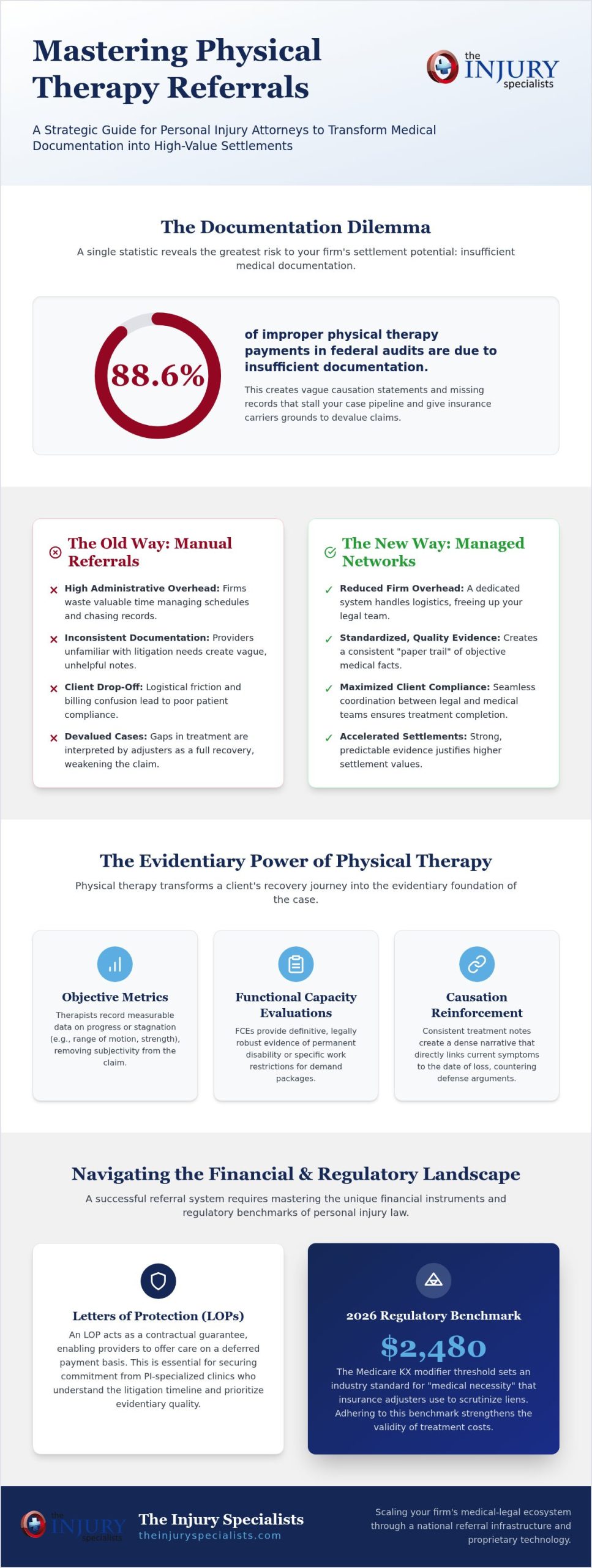
Insufficient documentation accounted for 88.6% of improper physical therapy payments in recent federal audits, a statistic that underscores a massive risk for your firm’s settlement potential. You understand that a personal injury case is only as strong as its medical evidence, yet most attorneys still struggle with administrative delays and providers who don’t grasp the litigation process. This disconnect often results in vague causation statements and missing records that stall your pipeline.
This 2026 strategic guide provides a blueprint to master physical therapy referrals for personal injury attorneys, focusing on logistical precision and evidentiary quality. You’ll learn how to build a streamlined referral system that produces predictable documentation and improves client recovery. We’ll examine the latest 2026 regulatory updates, including the $2,480 KX modifier threshold and new remote monitoring codes, to ensure your medical evidence stands up to the highest level of insurance scrutiny and maximizes every case settlement.
Key Takeaways
- Understand how consistent medical documentation creates an objective “paper trail” that strengthens the evidentiary foundation of every personal injury case.
- Master the logistics of physical therapy referrals for personal injury attorneys to eliminate administrative delays and secure high-quality medical records.
- Identify the critical differences between manual referral methods and managed networks to reduce firm overhead and accelerate the settlement timeline.
- Learn to navigate the 2026 financial landscape of medical liens and Letters of Protection to ensure seamless cooperation between legal and medical professionals.
- Discover how to leverage national referral infrastructure and proprietary technology to scale your firm’s medical-legal operations with minimal friction.
The Strategic Impact of Physical Therapy Referrals on Case Value
In the 2026 legal market, physical therapy referrals for personal injury attorneys are no longer just medical recommendations. They are strategic assets. Insurance carriers now utilize advanced algorithmic tools to scan medical records for inconsistencies or “soft” data. To counter this, firms must treat physical therapy as the evidentiary foundation of the case. Comprehensive rehabilitation does more than heal the client; it builds a “paper trail” of objective medical evidence that justifies higher settlement outcomes. When you view a provider as a strategic partner rather than a vendor, the quality of documentation improves significantly.
A successful personal injury case relies on the correlation between treatment duration and injury severity. If a client stops attending sessions, adjusters assume the injury has resolved. Managed referrals prevent these gaps by establishing a professional rhythm of care. This ensures that the medical record reflects the true extent of the client’s suffering and functional loss over time. High-value settlements are won through the accumulation of these documented facts.
Beyond Clinical Care: The Evidentiary Role of PT
Physical therapists provide the most granular view of a client’s recovery. Unlike a brief physician visit, PT sessions happen multiple times per week, creating a dense narrative of functional limitations. Standardizing physical therapy referrals for personal injury attorneys ensures that every therapist note serves the litigation strategy. These notes document the “daily impact” of an accident, recording specific restrictions in range of motion and weight-bearing capacity. This bridges the gap between the initial emergency room diagnosis and the long-term prognosis required for a demand package.
- Objective Metrics: Therapists record measurable progress or stagnation, removing subjectivity from the claim.
- Functional Capacity Evaluations (FCE): These evaluations provide definitive evidence of permanent disability or work restrictions.
- Causation Reinforcement: Regular treatment notes consistently link current symptoms to the original date of loss, preventing defense arguments about intervening causes.
Maximizing Client Compliance and Retention
A fragmented referral process leads to client drop-off, which immediately devalues the file. Utilizing a specialized referral network ensures the patient receives immediate, coordinated care. When a client sees a professional, unified front between their legal and medical teams, their compliance rates increase. They’re more likely to finish the prescribed course of treatment when the logistical friction of scheduling and billing is removed. This consistency is what transforms a standard claim into a high-value settlement based on comprehensive medical evidence. Predictable treatment leads to predictable case outcomes.
Navigating the Mechanics of Medical Liens and LOPs
Securing physical therapy referrals for personal injury attorneys involves managing a complex financial lifecycle that differs significantly from traditional healthcare models. In a standard clinical setting, providers rely on immediate insurance reimbursement; however, the personal injury sector operates on a deferred payment structure. This requires a robust Letter of Protection (LOP) to act as a contractual guarantee between the firm and the provider. Without a clear LOP, clinics may hesitate to provide the intensive care necessary to document a high-value claim. Specialized PI providers are essential because they understand the litigation timeline and prioritize evidentiary quality over immediate cash flow. They accept the financial risk of the case in exchange for the reliability and volume your firm provides.
The Legal Framework of Personal Injury Liens
Attorneys must distinguish between statutory liens and contractual LOPs to protect their clients’ net recovery. While medical liens for chiropractors and physical therapists serve the same purpose, the billing structures often differ based on the complexity of the treatment plan. In 2026, the Medicare KX modifier threshold for combined PT and speech-language pathology services rose to $2,480. While this is a federal benchmark, it sets an industry standard for “medical necessity” that insurance adjusters use to challenge private liens. Standardizing your lien agreements ensures that providers adhere to these benchmarks, preventing “lien stacking” that can consume a settlement.
- Standardized Agreements: Use uniform LOP templates to ensure all medical partners operate under the same legal and financial expectations.
- Reduction Strategies: Establish pre-negotiated reduction percentages based on the final settlement amount to avoid post-case friction during accounting.
- Statutory Compliance: Ensure all liens comply with evolving mandates across various jurisdictions, such as requirements to bill available health insurance before establishing a lien.
Administrative Efficiency in Billing Workflows
Administrative friction is the primary cause of settlement delays. When firms utilize unmanaged clinics, they often face “billing surprises” during the final accounting phase that can derail a closing. A streamlined system utilizes upfront fee schedules and real-time ledger updates, allowing case managers to track the exact value of the medical specials at any moment. This level of transparency eliminates the burden of “balance billing” disputes after the case closes. By utilizing a specialized pipeline for physical therapy referrals for personal injury attorneys, firms can ensure that medical billing remains a predictable component of the case rather than a last-minute obstacle. This predictability allows for faster demand drafting and more accurate settlement projections for the client.
Direct Access vs. Managed Referral Networks: A Comparative Analysis
Managing physical therapy referrals for personal injury attorneys through a manual, direct-to-provider model is a scalability bottleneck. While all 50 states now allow some form of direct access to physical therapy, relying on a fragmented list of local clinics creates significant administrative friction. Every new provider introduces a different billing method, a different reporting format, and a different level of responsiveness. A managed system centralizes these variables, allowing your firm to scale without increasing its administrative headcount. This shift from manual coordination to a structured network is the difference between a struggling practice and a high-growth firm.
The Limitations of the Direct Referral Model
The traditional method of manual referrals is deceptively expensive. Paralegals spend hours each week chasing medical records and clarifying vague treatment notes. This manual approach often leads to inconsistent reporting that confuses insurance adjusters. When adjusters see varying formats and missing data points, they use those discrepancies to devalue the claim. Additionally, many local clinics are not “litigation-ready.” They might provide excellent clinical care but fail to document causation or functional loss in a way that survives a defense deposition. Using unmanaged providers carries specific operational risks:
- Record Retrieval Delays: Manually requesting records from multiple independent clinics can take weeks, stalling the demand package.
- Non-Standardized Documentation: Adjusters prefer uniform data; fragmented reports from different clinics make the case harder to settle.
- Lack of Case Management: Without integrated oversight, there’s no way to ensure the provider is following the firm’s specific evidentiary needs.
Strategic Advantages of a National Ecosystem
Transitioning to a personal injury referral network transforms your medical-legal pipeline into a high-performance engine. A national infrastructure provides a level of uniformity that local clinics simply cannot match. Whether your client is treated at one location or five, the documentation remains consistent and professional. This centralized approach acts as a force multiplier for your firm, as medical case management is handled externally by specialists who understand the litigation lifecycle. It removes the administrative burden from your staff, allowing them to focus on high-value legal work.
This ecosystem also offers logistical benefits that local providers lack. Access to pre-settlement funding ensures that clients can continue their treatment even if they face financial hardship. This prevents treatment gaps that insurance companies often interpret as a sign of recovery. By utilizing a managed network, you ensure that every physical therapy referral contributes directly to a higher case value through superior documentation and uninterrupted care. Consistency across all providers ensures that your demand packages are predictable, authoritative, and difficult for adjusters to ignore.
Establishing Standardized Documentation and Communication Workflows
High-quality physical therapy referrals for personal injury attorneys require a shift from passive observation to active management. The “Perfect Medical Record” isn’t a clinical ideal; it’s a litigation tool designed to withstand insurance scrutiny. It must contain objective, quantifiable data that an adjuster cannot dismiss as subjective. This includes standardized Range of Motion (ROM) measurements and Muscle Testing scores. If a therapist fails to explicitly link the treatment to the traumatic event in every progress report, the defense will argue the care is unrelated to the original accident.
The 5-Step Referral Excellence Workflow
Efficiency depends on a repeatable sequence. Implementing a standardized 5-step workflow for physical therapy referrals for personal injury attorneys ensures that no case stalls due to administrative oversight. This structure creates a predictable pipeline for evidence gathering and client management.
- Step 1: Immediate intake and electronic referral transmission to prevent treatment gaps.
- Step 2: Verification of LOP and insurance/lien status to confirm financial logistics upfront.
- Step 3: Bi-weekly status updates on client compliance to identify drop-off risks early.
- Step 4: Automated record retrieval upon discharge or Maximum Medical Improvement (MMI).
- Step 5: Final document audit to ensure all clinical notes support the legal theory of causation.
Auditing Medical Reports for Legal Strength
Reports must be audited for legal viability. Federal analysis published in February 2026 revealed that insufficient documentation accounted for 88.6% of improper payments in physical therapy clinics. This highlights a critical vulnerability for law firms; if a record doesn’t satisfy a federal auditor, it won’t satisfy a savvy insurance adjuster. Adjusters look for “canned” or repetitive notes as a “red flag” to devalue claims. Every progress report must show a clear progression of care and specific functional improvements. It’s essential that ICD-10 codes align perfectly with the traumatic event described in the initial intake. Utilizing medical case management for attorneys provides an expert layer of review that catches these inconsistencies before the demand package is sent.
A well-oiled documentation pipeline reduces the time your staff spends on record retrieval and increases the evidentiary weight of your files. To optimize your firm’s medical evidence, partner with a managed network that prioritizes litigation-ready reporting and standardized communication.
Scaling Your Firm’s Medical-Legal Ecosystem with The Injury Specialists
Scaling a high-volume law firm requires more than just an increase in lead volume; it requires a superior operational infrastructure. The Injury Specialists operates the largest national personal injury referral network in the United States, providing a ready-made ecosystem for growth. This platform allows attorneys to offload the logistical burden of medical coordination while maintaining absolute control over the evidentiary chain. By centralizing physical therapy referrals for personal injury attorneys through a single, authoritative source, firms can manage a higher caseload with fewer administrative staff. This is not just a referral list; it’s a strategic partnership designed to maximize case value through logistical precision.
A World-Class Technology Platform for Attorneys
The core of this ecosystem is proprietary personal injury case management technology that integrates directly into your firm’s existing processes. This platform eliminates the manual paperwork cycles and endless follow-up calls that traditionally slow down case progression. You gain real-time visibility into client treatment status and immediate notification of record availability. This ensures your demand packages are never delayed by missing medical notes or unverified treatment dates. The system acts as a digital hub, providing marketing and networking tools that help you grow your firm’s referral base while ensuring all clinical documentation remains litigation-ready and compliant with 2026 standards.
- Digital Transparency: Track every client’s rehabilitation progress through a centralized dashboard.
- Administrative Relief: Automated record retrieval workflows free your paralegals for higher-value legal tasks.
- Growth Tools: Access networking resources designed to connect your firm with elite medical providers across the country.
The Future of Professional Medical-Legal Networking
Top-tier firms are moving away from fragmented local referrals in favor of a unified national network. A strategic partnership with a “power-connector” provides a level of reliability and logistical ease that independent clinics cannot replicate. This model prioritizes your firm’s growth by bridging the gap between medical care and legal success through standardized, high-quality evidence. You don’t need to spend years building a network from scratch when you can leverage an established infrastructure designed specifically for high-stakes litigation. Integrating your firm into the national network is a straightforward process that yields immediate dividends in efficiency and settlement outcomes. Success in 2026 belongs to the firms that prioritize professional synergy and technological integration.
Optimizing Your Firm’s Medical-Legal Infrastructure for 2026
Mastering the logistical and evidentiary requirements of modern litigation requires a shift from manual coordination to a structured, technology-driven ecosystem. You’ve seen how precise documentation and standardized workflows transform routine medical records into powerful evidentiary tools that withstand insurance scrutiny. By navigating the financial mechanics of liens and leveraging managed networks, your firm eliminates administrative friction and secures higher settlement outcomes. Implementing a professional system for physical therapy referrals for personal injury attorneys is the most effective way to scale your operations without increasing your firm’s administrative overhead.
The Injury Specialists facilitates the largest personal injury referral network in the United States. We provide proprietary case management technology designed specifically for attorneys and integrated medical case management for seamless care coordination. This national infrastructure allows your team to focus on high-value legal work while we handle the complexities of the medical-legal bridge. It’s time to move beyond fragmented local referrals and embrace a unified system built for growth. Join the largest national personal injury referral network today and position your firm for predictable, scalable success in the 2026 legal market.
Frequently Asked Questions
How do physical therapy referrals affect the total settlement value of a PI case?
Consistent treatment creates a detailed paper trail of objective medical evidence. This documentation justifies higher medical specials in the demand package. Insurance adjusters frequently use treatment gaps to devalue claims, so a full course of therapy proves the severity of the injury. Utilizing physical therapy referrals for personal injury attorneys ensures that every functional limitation is recorded, providing the leverage needed to maximize the final settlement amount.
What is the difference between a medical lien and a Letter of Protection (LOP)?
A medical lien is a legal claim against the proceeds of a settlement, often established by state statute. In contrast, a Letter of Protection (LOP) is a contractual agreement where the attorney guarantees payment from the settlement funds. While both secure the provider’s interest, an LOP is a direct promise from the firm. Attorneys must understand this distinction to manage the financial lifecycle of the case and negotiate final reductions effectively.
Do physical therapists in a referral network provide expert witness testimony?
Many physical therapists within specialized referral networks are prepared to provide expert witness testimony or depositions. They serve as fact witnesses regarding the client’s functional limitations and progress. Because they treat the patient multiple times per week, their testimony often carries significant weight regarding the daily impact of the injury. Firms should verify a provider’s litigation experience during the initial intake process to ensure they are litigation-ready.
How quickly should a client start physical therapy after a motor vehicle accident?
Clients should ideally begin physical therapy within 24 to 72 hours following a motor vehicle accident. Immediate treatment prevents the gap in care defense that insurance adjusters use to deny claims. Early intervention also allows for the immediate documentation of acute symptoms and range of motion restrictions. Rapid physical therapy referrals for personal injury attorneys establish a clear timeline from the date of loss to the start of rehabilitation, strengthening the evidentiary chain.
What happens to the physical therapy lien if the case does not settle?
If a case does not settle or results in a defense verdict, the client remains personally responsible for the medical bills. The LOP or lien does not waive the debt; it merely defers payment until the case concludes. However, specialized providers often work with firms to reach a secondary agreement or payment plan for the client. Clear communication regarding this risk is essential during the intake phase to manage client expectations and firm liability.
How can technology reduce the administrative burden of medical record retrieval?
Case management technology centralizes medical record retrieval through automated workflows and digital portals. Instead of paralegals manually calling clinics, a proprietary platform provides real-time visibility into treatment status and record availability. This reduces the administrative burden by eliminating paperwork cycles and ensuring that all necessary documentation is ready for the demand package. Streamlined technology ensures that firms can scale their caseload without increasing their internal administrative headcount.
Why should attorneys avoid referring clients to their primary care physician for PI injuries?
Primary care physicians often lack the administrative infrastructure to manage personal injury billing and documentation. Many PCPs refuse to treat patients on a lien or LOP basis, requiring immediate payment or health insurance. Additionally, PCPs may not provide the detailed, causation-focused notes required for litigation. Specialized physical therapy and chiropractic providers understand the legal requirements and focus on documenting the functional deficits necessary to prove the value of a claim.
What specific documentation should I look for in a physical therapist’s report to prove causation?
Look for progress reports that explicitly link clinical findings to the traumatic event. The report should include objective metrics such as Range of Motion (ROM) and Muscle Testing scores. Therapists must document how the injury prevents the client from performing specific daily activities or work duties. Standardized reports that utilize consistent ICD-10 codes and functional measurements provide the strongest evidence for proving causation and justifying the necessity of the treatment plan.
