

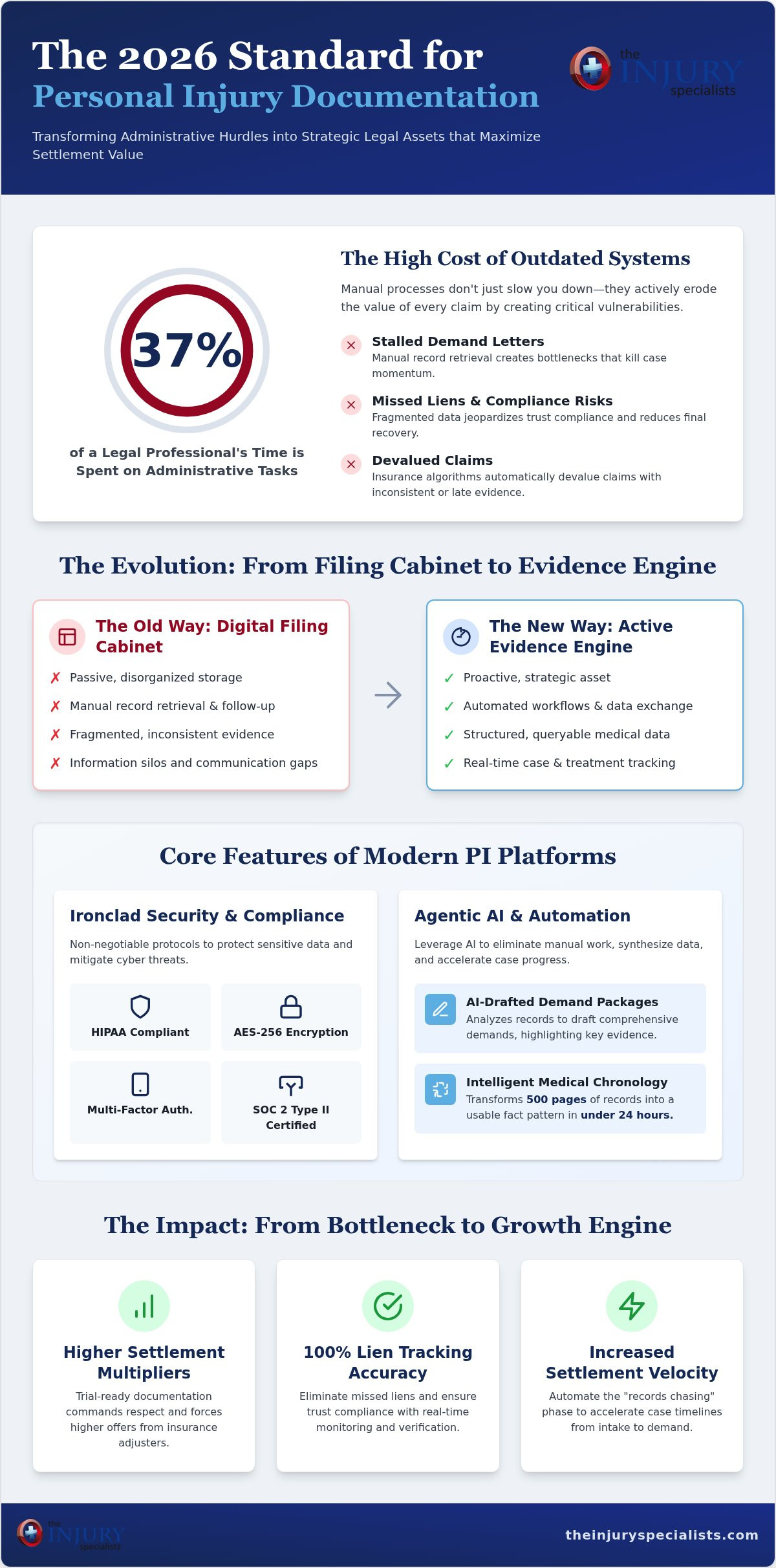
In 2026, documentation is no longer just storage; it is the strategic bridge between medical evidence and settlement value. Legal professionals currently spend nearly 37% of their time on administrative tasks, often bogged down by manual medical record retrieval that stalls demand letters. You’ve likely seen how disconnected communication between providers and your firm leads to missed liens and trust compliance risks. Relying on outdated systems doesn’t just slow you down. It actively erodes the potential value of every claim. Integrating advanced personal injury documentation software is the standard for firms that prioritize scale and precision.
This strategic guide will show you how to master the technology that bridges the gap between raw medical evidence and maximum settlement value. We’ll explore how to achieve 100% accuracy in lien tracking and establish a seamless medical-legal data exchange. You’ll learn to use Case Management Technology to eliminate bottlenecks and increase settlement velocity. By the end of this article, you’ll have a clear roadmap to transform your documentation process from a logistical hurdle into a powerful engine for firm growth and professional synergy.
Key Takeaways
- Understand how high-fidelity documentation directly correlates with higher settlement multipliers by transforming medical evidence into a strategic legal asset.
- Identify the critical features of personal injury documentation software that automate medical record retrieval and ensure 100% accuracy in lien tracking.
- Discover why specialized evidence management platforms outperform generic legal CRMs in high-volume, contingency-fee litigation environments.
- Learn a two-step implementation process to map your documentation pipeline and automate the “records chasing” phase for maximum efficiency.
- Leverage proprietary Case Management Technology to create a seamless data exchange between medical providers and law firms, accelerating settlement velocity.
The Strategic Role of Documentation in Personal Injury Litigation
Personal injury documentation software has evolved into a specialized ecosystem for evidence management. It is a strategic asset, not a passive storage tool. While traditional legal case management focuses on general administrative task lists, PI-specific systems prioritize the collection, verification, and analysis of medical data. This technology acts as a central hub where medical records, billing statements, and legal strategies converge to build a bulletproof case.
High-fidelity documentation directly correlates with higher settlement multipliers. Insurance adjusters utilize sophisticated algorithmic tools to evaluate claims. If evidence is fragmented, inconsistent, or submitted late, these algorithms automatically devalue the case. Firms using specialized personal injury documentation software provide comprehensive, well-organized records that demonstrate a level of trial-readiness. Consistent documentation transforms a standard claim into a high-value asset that commands respect from defense counsel.
In 2026, the industry has moved away from “digital filing cabinets” toward “active evidence engines.” These systems don’t just hold files; they proactively identify documentation gaps in medical liens and treatment cycles. Missing a single lien or failing to track a treatment gap can jeopardize trust compliance and reduce the final recovery. Utilizing advanced Case Management Technology allows firms to monitor these variables in real time, ensuring no detail is overlooked during the demand phase.
Bridging the Medical-Legal Evidence Gap
Fragmented data between medical providers and law firms is the leading cause of stalled demand letters. When a firm relies on manual record retrieval, case momentum frequently dies. Real-time treatment tracking ensures the legal team understands the client’s progress without constant phone tag. This connectivity allows for immediate updates when a client misses an appointment or completes a phase of care. Centralized technology ensures that medical necessity is clearly documented for adjusters by linking imaging results directly to clinical recommendations, removing the guesswork for the carrier.
The 2026 Standard for “Settlement-Ready” Documentation
Basic PDFs are no longer the benchmark for high-stakes litigation. The current standard requires structured, queryable medical data that allows for instant chronology generation and deep-dive analysis. Time-stamped evidence provides essential Statute of Limitations (SOL) protection by creating an immutable record of all case activity and communication. This level of precision prevents defense counsel from challenging the timeline of events. Settlement-ready documentation is the synthesis of medical facts and legal strategy.
Essential Features of Modern PI Documentation Platforms
Modern personal injury documentation software must act as an active participant in case development rather than a passive storage site. By 2026, security standards have reached a critical threshold. HIPAA compliance now requires mandatory multi-factor authentication (MFA) and AES-256 encryption at rest to mitigate increasing cyber threats. SOC 2 Type II certification is a non-negotiable requirement for firms handling high volumes of sensitive medical data. These protocols ensure that your firm remains protected against data breaches that could derail litigation or lead to severe regulatory penalties.
The introduction of agentic AI has revolutionized the demand phase. Unlike basic automation, agentic AI analyzes raw medical records to draft comprehensive demand packages that highlight specific treatment gaps and injury severity. This technology mirrors the rigor found in government systems like OSHA’s Injury Tracking Application, where standardized data entry is essential for legal and regulatory clarity. By synthesizing thousands of data points into a cohesive narrative, these platforms allow attorneys to focus on high-level strategy rather than administrative assembly.
Intelligent Medical Chronology and Record Management
AI-driven chronology tools can now transform 500 pages of raw medical records into a structured, usable fact pattern in under 24 hours. This speed is essential for maintaining case momentum. High-performance platforms utilize per-provider status tracking to eliminate the need for manual faxes and phone calls to medical offices. These systems automatically flag missing records or significant gaps in the treatment timeline. This proactive approach ensures that the legal team is never surprised by undocumented gaps during negotiations or trial preparation.
Advanced Lien and Disbursement Automation
Structured lien ledgers are vital for maintaining trust compliance and preventing disbursement errors. Modern platforms provide real-time visibility into outstanding medical bills across all referral partners, ensuring that every dollar is accounted for before a case settles. Seamless integration with pre-settlement funding data allows for instant, accurate net-to-client calculations. This level of financial precision reduces the risk of malpractice claims related to improper fund distribution. Implementing a world-class Case Management Technology platform allows firms to align these financial workflows with their clinical evidence, ensuring 100% accuracy in every disbursement.
Specialized PI Software vs. Generic Legal Management Tools
Generic CRM systems and all-in-one legal tools are designed for the broad legal market, typically prioritizing billable hours and general task management. In a contingency-fee environment, these platforms often fail because they lack the specialized infrastructure required for high-stakes evidence management. While generic tools focus on “Matter Tracking,” high-growth firms require “Evidence Management.” This distinction is critical. Managing a personal injury case involves tracking clinical progress, imaging results, and complex lien ledgers; tasks that generic software simply isn’t built to handle without expensive, time-consuming customization.
The complexity of litigation technology has led to a rise in highly specialized tools, similar to the precision seen in government-funded legal technology designed for forensic and justice applications. Adopting personal injury documentation software that is purpose-built for the industry ensures that every data field reflects the reality of a PI case. This specialization directly impacts settlement velocity. When your software understands the relationship between an MRI report and a surgical recommendation, it accelerates the demand process and increases the overall ROI of your technology stack.
Why Generic Platforms Create Documentation Bottlenecks
Generic platforms often lack structured fields for essential incident details, such as impact velocity, weather conditions, or specific injury classifications. Without these built-in fields, staff must rely on messy “notes” sections, making data retrieval nearly impossible during the demand phase. These tools also struggle with complex medical lien math and subrogation tracking. The hidden cost of “customizing” a generic CRM to fit a PI workflow often exceeds the price of a premium, specialized platform. These bottlenecks don’t just waste time; they create opportunities for human error in trust compliance and disbursement math.
The Advantage of a Connected Referral Ecosystem
Specialized platforms act as a growth engine by facilitating strategic networking between medical and legal sectors. Unlike generic tools, these systems offer built-in medical case management that aligns with your firm’s distinct processes. This connectivity allows for seamless communication with chiropractic, physical therapy, and imaging referral partners. By using Case Management Technology that bridges the gap between different professional sectors, your firm becomes a “power-connector.” This integrated approach ensures that victims receive cohesive care while your firm maximizes its referral partner base through professional synergy and logistical ease.
Implementing Documentation Workflows for Maximum Efficiency
Transitioning to high-performance personal injury documentation software requires a methodical approach to workflow integration. Firms that succeed don’t just install software; they re-engineer internal processes to eliminate manual intervention. “Efficiency in documentation is the primary driver of firm liquidity.” By structuring data from the first point of contact, firms ensure every subsequent phase of the case moves with precision and speed. Firms that successfully deploy personal injury documentation software report significant reductions in administrative overhead and faster case turnaround times.
The implementation process follows a logical four-step sequence:
- Step 1: Map the Intake-to-Retainer Pipeline. Identify every touchpoint where data is collected. Standardizing intake documentation prevents “garbage in, garbage out” scenarios that delay later stages.
- Step 2: Automate the “Records Chasing” Phase. Use integrated technology to trigger record requests automatically upon retainer. This removes the administrative burden from paralegals and reduces the time spent waiting for medical evidence.
- Step 3: Utilize AI for Demand Generation. Once records arrive, AI tools should immediately synthesize facts into a draft demand package. This ensures the legal team reviews a high-quality starting point rather than starting from zero.
- Step 4: Monitor Settlement Velocity. Use executive analytics to track how long each phase takes. Identifying bottlenecks through Case Management Technology allows for continuous process improvement and higher throughput.
Optimizing the Intake and Lead Management Phase
Securing high-value cases requires immediate action. Automated follow-up and conversion tracking allow firms to capture leads before they contact a competitor. This phase must utilize HIPAA-compliant data capture to protect sensitive information from the very first interaction. When intake documentation integrates directly with the broader case management workflow, the transition from lead to active matter is instantaneous. This eliminates duplicate data entry and ensures the file is ready for medical case management immediately.
Accelerating the Demand-to-Settlement Timeline
Firm success is measured by the speed at which a file moves from “records received” to “settlement reached.” High-performance firms benchmark demand generation to occur within 7 to 10 days of the final medical record arriving. Document automation reduces manual drafting errors that often lead to pushback from insurance adjusters. By standardizing the demand package, you present a trial-ready image that encourages faster carrier response times. To see how these workflows can scale your firm, explore our integrated Case Management Technology today.
Leveraging The Injury Specialists’ Case Management Technology
The Injury Specialists provides a world-class technology platform that serves as the ultimate solution for modern personal injury litigation. While other platforms offer basic storage, our Case Management Technology is a proprietary ecosystem designed to align medical and legal workflows from inception to settlement. This system is not just a tool; it’s a strategic partner that connects your firm to the largest personal injury referral network in the United States. By centralizing medical case management and legal documentation, firms ensure victims receive cohesive care while simultaneously maximizing administrative efficiency.
Integrating pre-settlement funding directly within the platform provides a distinct strategic advantage. It allows for real-time visibility into the financial variables that impact a case’s final value. This level of connectivity ensures that the net-to-client calculations discussed in earlier sections are handled with 100% accuracy. When you utilize personal injury documentation software that bridges these professional sectors, you eliminate the friction that typically slows down case progression. The result is a streamlined path toward growth and logistical ease.
A Unified Ecosystem for Medical and Legal Professionals
The technology facilitates a seamless referral process for physicians, chiropractors, and imaging centers. This unified approach removes the logistical hurdles often associated with coordinating care and gathering evidence. Professional medical case management plays a vital role in this ecosystem, ensuring that every phase of treatment is documented according to your firm’s distinct processes. For a deeper understanding of these connections, consult our Physician Referral Services for Personal Injury. This integration ensures that medical necessity is clearly established, providing the high-fidelity evidence required for maximum settlement multipliers.
Scaling Your Practice through Strategic Networking
Growth in the personal injury sector depends on the strength of your professional relationships. Our platform includes advanced marketing and networking tools specifically designed to help firms grow their referral partner bases. The technology is flexible enough to align with your specific firm processes, allowing for custom case management that reflects your unique legal strategy. This capability transforms the software into a growth engine rather than just an administrative expense. To see how this system can drive results for your firm, book a demo of our Case Management Technology. By leveraging a national network and a sophisticated evidence engine, your firm can achieve the professional synergy required for long-term success.
Future-Proofing Your Personal Injury Practice
Mastering personal injury documentation software is the most direct path to increasing settlement multipliers and firm liquidity. Moving from generic matter tracking to a specialized evidence engine ensures that every medical detail is leveraged for maximum recovery. The integration of medical case management and real-time treatment tracking eliminates the administrative bottlenecks that stall high-value demands. This transition allows your team to focus on high-level strategy rather than manual record retrieval. The Injury Specialists offers the world-class technology platform needed for seamless medical-legal coordination and professional synergy.
As the largest personal injury referral network in the United States, we provide the scale and reliability your practice requires for sustained growth. Our specialized medical case management integrates directly into your firm’s workflow, ensuring precision and trust compliance in every file. Now is the time to optimize your documentation pipeline and secure your firm’s competitive advantage. Streamline your PI practice with our Case Management Technology and position your firm as a dominant market leader today. Success in 2026 belongs to the firms that prioritize technological integration and professional connectivity.
Frequently Asked Questions
What is the difference between generic legal software and personal injury documentation software?
Generic legal software focuses on billable hours and general task management across various practice areas. In contrast, personal injury documentation software is a specialized evidence engine built for contingency-fee environments. It includes dedicated fields for medical case management, imaging results, and lien tracking. These platforms prioritize the synthesis of medical data into legal strategy. Choosing a purpose-built system like our Case Management Technology ensures your firm avoids the documentation bottlenecks common in generic platforms.
How does documentation software improve personal injury settlement values?
Documentation software increases settlement values by producing high-fidelity, trial-ready demand packages. Insurance adjusters use algorithms that devalue claims with treatment gaps or missing records. By providing structured medical data and clear chronologies, the software demonstrates medical necessity and injury severity. This level of precision forces carriers to offer higher settlement multipliers. It transforms raw medical evidence into a strategic legal asset that commands respect from defense counsel and insurance adjusters alike.
Can PI documentation software help with medical lien management?
Modern platforms include integrated lien ledgers that track all medical bills and subrogation interests in real time. This functionality is essential for maintaining trust compliance and preventing disbursement errors. The software provides visibility into outstanding balances from chiropractors, imaging centers, and other medical providers. By automating the net-to-client math, firms ensure every dollar is accounted for before settlement. This reduces the risk of malpractice claims related to improper fund distribution or missed liens.
Is personal injury case management technology HIPAA compliant?
Professional platforms are built with HIPAA and SOC 2 Type II security as the baseline standard. By 2026, this includes mandatory multi-factor authentication and AES-256 encryption for data at rest and in transit. These protocols protect sensitive medical records from data breaches and regulatory penalties. Security is a non-negotiable feature for any firm handling high volumes of victim data. Utilizing a secure Case Management Technology platform ensures your firm remains compliant with evolving federal privacy rules.
How long does it take to migrate data to a new PI documentation platform?
Data migration typically requires 30 to 90 days for a complete transition. The timeline depends on the complexity of your current database and the volume of historical medical records. A successful migration involves mapping your intake-to-retainer pipeline and ensuring all evidence transfers without loss. Professional providers assist with this transition to maintain case momentum. It’s a strategic investment that pays off through increased settlement velocity and long-term administrative efficiency once the new system is live.
Does documentation software integrate with medical record retrieval services?
Most advanced personal injury documentation software offers direct integration with medical record retrieval services. This connectivity automates the “records chasing” phase, which is traditionally a significant bottleneck in PI cases. Instead of manual faxes or phone calls, the system triggers requests and tracks status automatically. This ensures that demand letters are generated within 7 to 10 days of the final record arrival. Integrated retrieval is a core component of a well-oiled, evidence-driven legal practice.
How does AI help in personal injury documentation and demand drafting?
Agentic AI transforms raw medical records into structured fact patterns and medical chronologies in under 24 hours. It identifies specific treatment gaps and highlights the clinical necessity of procedures like imaging or physical therapy. Once records arrive, AI drafts comprehensive demand packages by synthesizing medical facts with your firm’s legal strategy. This technology reduces the 37% of time attorneys typically spend on administrative tasks. It allows the legal team to focus on high-level negotiation and growth.
What should I look for in a personal injury case management technology provider?
You should prioritize a provider that offers more than just a digital filing cabinet. Look for a platform that connects you to a national referral network and integrates medical case management into your firm’s workflow. The technology should be flexible enough to match your distinct processes while facilitating professional synergy with medical providers. A world-class provider like The Injury Specialists acts as a strategic partner, offering the connectivity and scale required to dominate the PI market.
