

What if the biggest case-management bottleneck isn’t the volume of medical information, but the lack of a consistent process for coordinating it? A medical case manager for lawyers can help organize appointment details, record follow-up, and updates among clients, providers, and the legal team. The role is administrative and coordinative, leaving medical care and legal decisions to the appropriate professionals.
Medical appointments, records, and status updates often require repeated follow-up. When responsibilities are unclear, staff may duplicate work or lose track of open tasks, while questions about client experience, privacy, and case oversight can arise. The answer isn’t to hand over control. It’s to define which tasks need coordination and how they fit the firm’s existing workflow.
This article explains the role’s practical scope, where coordination can fit into a law firm’s process, and what to assess when evaluating providers and technology. Use it to identify workflow gaps, set boundaries, and compare support against your firm’s needs.
Key Takeaways
- A medical case manager for lawyers can coordinate appointments, provider communication, status updates, and documentation follow-up without taking over medical care or legal decisions.
- A defined workflow helps firms assign tasks, track updates, and identify issues that need attorney attention.
- Compare support by scope, communication, provider connections, documentation, technology, and escalation processes.
- Written boundaries, firm-approved communications, named contacts, and access controls help preserve client relationships and case oversight.
- Map your workflow and identify recurring gaps before choosing support that fits your firm’s processes.
What a Medical Case Manager for Lawyers Coordinates
A medical case manager for lawyers supports the logistics and communication around a client’s care. Depending on the agreed scope, tasks may include confirming appointment details, following up on records, tracking open requests, and sharing updates among the client, providers, and law firm. The role does not include providing medical treatment, directing clinical decisions, or representing the client legally. Responsibilities should be defined in advance, with client consent and applicable professional requirements in mind.
A medical case manager coordinates care-related information and logistics for a law firm, while medical providers make care decisions and attorneys retain legal authority over the case. The broader practice of Medical case management can help explain the coordination concept, but firms should document the specific duties and boundaries of their own arrangements.
How the Role Differs From a Law Firm Case Manager
A law firm case manager may handle legal deadlines, organize pleadings, maintain case files, and support attorney-directed case processes. Medical coordination focuses on appointment logistics, provider communication, status tracking, and documentation follow-up. The roles may intersect when a coordinator shares a care-status update through a firm-approved process. Since titles and duties vary, confirm who owns each task rather than relying on job titles alone.
Which Personal Injury Matters May Need Coordination
Coordination may be worth considering when a client is working with multiple providers, appointments are difficult to sequence, or staff repeatedly follow up on records and status updates. These are operational signals to review, not proof that every matter needs a dedicated coordinator. A firm can compare its referral and coordination needs with this law firm medical referral program guide when considering how provider connections fit its process.
Before assigning work, specify what the coordinator may do, what information they may handle, and which issues must go back to the attorney or provider. For example, a coordinator might confirm an appointment detail under an approved protocol, then route a client’s question about legal strategy to the responsible attorney. A change in symptoms or a request for medical advice should be directed to an appropriate healthcare professional, not answered as an administrative or legal decision.
Clear boundaries help staff know who owns each follow-up, keep communications consistent, and preserve the distinction between coordinating care-related tasks and making clinical or legal decisions.
How Medical Case Management Fits a Law Firm’s Case Workflow
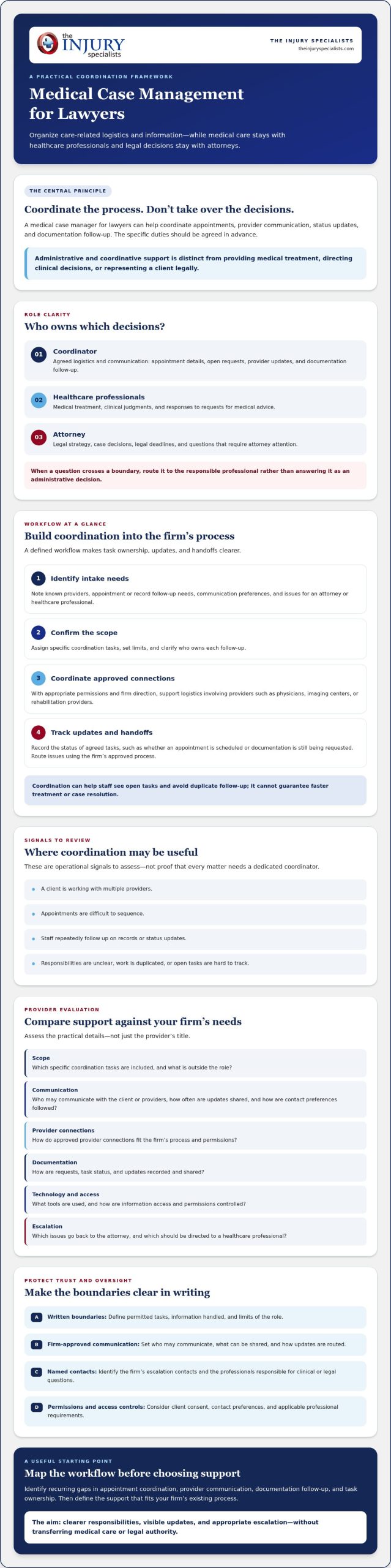
A defined workflow gives coordination support a clear role and keeps legal and clinical decisions with the professionals responsible for them. A medical case manager for lawyers can handle agreed logistical tasks, while attorneys retain control of legal strategy, deadlines, and case decisions. Firm-approved handoffs can help staff avoid duplicate follow-up and see which tasks remain open, but they can’t guarantee faster treatment or case resolution.
Set Expectations at Intake and During Handoffs
Before assigning coordination responsibilities, establish what the firm needs tracked, who may communicate with the client or providers, and what information can be shared. Document the client’s contact preferences and permissions, the firm’s escalation contacts, and how often updates should be shared. Keep clinical judgments with healthcare professionals and legal strategy with attorneys. For background on legal nurse consulting as a related but distinct field, consult the American Association of Legal Nurse Consultants.
- Identify intake needs. Note known providers, appointment or record follow-up requirements, communication preferences, and any immediate issue that belongs with an attorney or healthcare professional.
- Confirm the scope. Assign specific coordination tasks and set limits. For example, support staff may track whether a requested record has arrived, while an attorney decides how that record affects the claim.
- Coordinate approved connections. With the appropriate permissions and firm direction, support can assist with logistics involving physicians, imaging centers, or rehabilitation providers. It should not select treatment or make clinical recommendations.
- Track updates. Record the status of agreed tasks, such as an appointment being scheduled or documentation still being requested. Use the firm’s chosen process so attorneys and staff can see what remains open.
- Escalate issues. Route legal questions to the attorney and medical concerns to the relevant healthcare professional. Flag missed handoffs or unresolved administrative tasks to the designated firm contact.
Coordinate Providers, Records, and Status Updates
Separate logistical updates from interpretation. A coordinator may relay that an appointment is scheduled or that records have not yet been received, following the firm’s approved process. Reviewing medical findings, advising on claims, and setting legal priorities remain outside that task. The medical case management technology guide offers another lens for considering how a firm can organize case-related workflows.
A reliable workflow moves from intake needs to defined scope, approved coordination, documented updates, and clear escalation, with each handoff approved by the firm. Firms assessing support can also review how The Injury Specialists connects law firms with medical and legal professionals through case-management and referral services.
How Lawyers Can Evaluate Medical Case Management Support
Evaluate a medical case manager for lawyers against the work your firm needs done, not broad claims about efficiency. Start by listing recurring coordination gaps, then compare internal processes, outsourced support, and network-enabled support. The right fit depends on whether your main need is consistent task tracking, connections with medical professionals, technology, or a combination.
| Area | What to assess |
|---|---|
| Scope | Which tasks are included, excluded, assigned to your firm, or escalated? |
| Communication | Who contacts clients and providers, through which approved channels, and how are updates shared? |
| Provider access | What connections are available, and how does the firm approve or request them? |
| Documentation | How are requests, responses, permissions, and outstanding tasks recorded and made available to the firm? |
| Technology | Does the process fit the firm’s existing tools and reporting needs? Clarify what the platform supports. |
| Escalation | Who receives unresolved logistics, client concerns, and questions requiring attorney or provider judgment? |
Questions to Ask Before Choosing a Case-Management Partner
Ask for a clear task list, including what the provider will not do and which decisions stay with the firm or healthcare professionals. Confirm how client permissions, information access, documentation, and communications are handled. Ask how the service can adapt to your procedures and reporting needs, then walk through a typical matter to identify handoffs and gaps. The federal definition of case management services describes services in a Medicaid program context. It may offer a reference for task categories, but it is not a universal definition of law-firm support.
Match Support to Firm Size and Matter Complexity
Compare how often coordination is needed, how many matters require follow-up, and how many professionals are involved. A firm with occasional administrative gaps may first refine internal processes. Recurring coordination demands may warrant evaluating outside support. Firms seeking provider connections alongside workflow support can also assess a network-enabled model. Review the physician referral services guide when considering how provider access could fit your process.
Test options against a representative workflow. Check whether responsibilities are clear, updates reach the right people, and open tasks are visible. Use those observations to compare fit rather than relying on unverified performance benchmarks or promises.
Addressing Control, Confidentiality, and Role-Boundary Concerns
Coordination support should fit the firm’s process, not take over its client relationships or case decisions. A medical case manager for lawyers can work within defined instructions, but the firm should establish who communicates with the client, what information may be shared, and which issues return to the attorney. Resolve control and privacy questions before work begins by making these responsibilities part of the agreed process.
Define Permissions and Information-Sharing Practices
Before coordination starts, confirm the client’s authorization and which information each participant is permitted to receive. Ask how information is transferred, who can access it, how long it is retained, and how actions or communications are documented. Don’t assume one privacy rule applies identically to every participant or situation. Have qualified legal and compliance professionals assess whether HIPAA or other applicable requirements apply to the specific arrangement.
Keep Medical and Legal Responsibilities Distinct
Coordination doesn’t replace clinical judgment, legal advice, or attorney oversight. Establish a route for concerns outside the agreed role: medical questions go to the appropriate healthcare professional, legal questions to the attorney, and process or client concerns to the designated firm contact. Put these handoffs in written procedures so staff know what to do without asking a coordinator to make decisions beyond their scope.
Adapt this pre-engagement checklist with counsel and compliance professionals:
- Scope: List included and excluded tasks, decision boundaries, and responsibilities that remain with the firm or providers.
- Contacts: Name the firm lead, coordination contact, and escalation contacts. Define how and when updates are shared.
- Permissions: Confirm client authorization and specify what information may be shared, with whom, and for what purpose.
- Access and handling: Review transfer methods, access limits, retention practices, and documentation procedures.
- Communications: Set approved channels and clarify who may contact the client or providers, and when firm review is needed.
- Escalation: Document how to route medical concerns, legal questions, privacy issues, and unresolved coordination tasks.
Review the process as the firm’s needs change, and update responsibilities or access arrangements when appropriate. A provider should be able to explain how its support can align with the firm’s distinct procedures without displacing attorney oversight. To discuss medical case management aligned with your firm’s process, explore support from The Injury Specialists.
Building a Medical Case Management Model Around Your Firm
A workable model starts with the firm’s actual workflow, not a preset package. Map where provider connections, appointment coordination, and record follow-up fit. Then identify what your team wants to manage internally and where outside support may help. Define boundaries before implementation. Technology can support visibility and consistent processes, but it doesn’t replace professional judgment, attorney oversight, or direct legal representation.
A Practical Launch Plan for Law Firms
Start with one recurring workflow, such as following up on outstanding records or coordinating approved provider connections. Review the process with the staff who handle it, then document responsibilities at each handoff.
- Map the current process: Record who handles each step, where communication slows, which tasks are repeated, and what information staff need to see.
- Identify the gap: Decide whether the main need is clearer internal ownership, medical case-management support, provider connections, technology, or a combination.
- Set boundaries and measures: Define assigned tasks, permissions, escalation routes, and practical indicators to review, such as open follow-ups, task ownership, and whether updates reach the intended team members.
- Start with a limited workflow: Test the agreed process before expanding it. Gather feedback from the people using it and adjust unclear handoffs.
- Review and refine: Set a regular review cadence that fits the firm. Use documented operational feedback to update procedures as needs change.
Explore a Connected Support Model
Once the firm has defined its requirements, it can assess whether a connected model fits. The Injury Specialists connects personal injury law firms with medical and legal professionals through a referral network, professional medical case management, and technology designed to support case-management, marketing, and networking workflows. Its attorney program can be aligned with a firm’s distinct processes. Confirm the current scope and availability of support, technology, or connections directly before selecting them.
These services facilitate professional connections and coordination. They don’t mean The Injury Specialists provides medical treatment or legal representation. Keep the firm’s defined role boundaries in place, and evaluate technology as a way to support agreed workflows, not to make clinical or legal decisions. Avoid relying on network-size comparisons unless the claim and its supporting evidence have been verified and approved.
A medical case manager for lawyers should fit the firm’s operating model, with clear responsibilities and review points. If your firm is defining a coordinated approach, discuss your distinct processes and case-management needs with The Injury Specialists before deciding what support fits.
Build a Coordination Model That Fits Your Firm
A medical case manager for lawyers can support care-related logistics, but the role works best when responsibilities, communications, and escalation paths are clearly defined. Start by mapping your current workflow, identifying recurring coordination gaps, and setting boundaries that preserve attorney oversight and client relationships.
Evaluate support against your firm’s actual needs, including provider connections, documentation practices, communication, and technology. The Injury Specialists connects law firms with medical and legal professionals through a personal injury referral network, and its attorney program can be adapted to a firm’s distinct processes. Any comparative claim about network size should be substantiated before use.
With a defined process, your firm can assess coordination support without giving up control of the case. Discuss a case-management approach built around your firm’s workflow and identify what fits your team’s needs.
Frequently Asked Questions
What does a medical case manager do for a lawyer?
A medical case manager for lawyers coordinates agreed care-related logistics, such as appointment details, provider communications, status tracking, and documentation follow-up. The role can help keep open tasks visible to the firm, but its scope should be defined in advance. A coordinator doesn’t provide medical treatment, make clinical decisions, give legal advice, or determine case strategy. Those responsibilities remain with the appropriate healthcare professionals and attorneys.
Is a medical case manager the same as a law firm case manager?
No. The roles can differ, although titles and responsibilities vary by organization. A law firm case manager may organize case files, monitor legal deadlines, and support attorney-directed case processes. A medical case manager generally focuses on care-related coordination, such as provider communication or appointment and record follow-up. Some tasks may overlap, so document who owns each responsibility and how status updates are shared.
How can a medical case manager help a personal injury law firm?
A medical case manager can help organize recurring coordination tasks across a matter, including tracking appointment logistics, following up on documentation, and routing updates through agreed channels. This can give staff a clearer view of outstanding tasks and make follow-up ownership easier to identify. The value depends on the firm’s workflow and defined scope. Coordination support doesn’t guarantee treatment, settlement, or case outcomes.
Can a medical case manager communicate with a client’s doctors?
Communication may be part of the role if it fits the agreed scope and the necessary client authorization and information-sharing permissions are in place. Firms should specify who may contact providers, what information can be shared, and which communications need attorney review. A coordinator can handle approved logistical updates, but should not interpret medical findings or provide clinical advice. Confirm applicable privacy requirements with qualified reviewers.
How do lawyers choose a medical case management provider?
Compare providers against your actual workflow. Ask which tasks are included, excluded, and escalated; how communications and documentation are handled; what provider connections are available; and how support can align with your firm’s procedures. Review technology, information access, and reporting needs as well. Walk through a representative matter to test handoffs and responsibilities instead of relying on broad efficiency claims or unsupported performance promises.
Does medical case management guarantee better settlements or faster treatment?
No. Medical case management does not guarantee a settlement result, a particular case outcome, or faster treatment. Coordination can help organize approved communications and follow-up, but healthcare providers control clinical decisions and attorneys control legal strategy. Evaluate support based on whether it fits your processes, clarifies task ownership, and keeps updates organized, not on promises about outcomes outside the coordinator’s control.
What privacy issues should law firms review before using medical case management?
Before coordination begins, confirm client authorization, permissible information sharing, and who can access records or updates. Ask how information is transferred, documented, retained, and restricted, and establish approved communication channels and escalation contacts. HIPAA and other privacy requirements may depend on the specific parties and arrangement, so don’t assume one rule applies identically in every situation. Have qualified legal and compliance professionals review the facts.
Does The Injury Specialists provide legal representation or medical treatment?
No. The Injury Specialists doesn’t provide direct legal representation or medical treatment. The organization connects personal injury law firms with medical and legal professionals through a referral network and offers medical case management and case-management technology. Its attorney program can be aligned with a firm’s distinct processes. Firms should confirm the current scope of support and connections directly and retain their own legal and clinical decision-makers.
