

A strong injury claim needs more than a reported accident. Knowing how to screen potential personal injury cases means assessing the available evidence, whether a party’s conduct caused the harm, the injury’s impact and the deadlines that apply. A firm’s initial screening is an accept-or-decline review, and it should surface weak links before they shape the case.
That review is systematic, not a snap judgment. Firms weigh records and witness accounts against the liability theory, consider current and future losses, and identify possible defendants and available coverage. This article explains how these factors work together, which screening criteria help distinguish stronger cases, and why deadline checks must account for the claim and defendant. It also covers how firms organize case management and professional referrals to support consistent evaluations.
Key Takeaways
- Organize records, photos, and witness accounts to build a clearer timeline and connect the incident to the claimed harm.
- Evaluate liability, injury impact, potential damages, and available coverage together rather than relying on a single case factor.
- Track the earliest applicable filing or notice deadline for each possible defendant, then set an internal decision date ahead of it.
- Use consistent screening criteria to identify cases that need further attorney review and spot issues that may affect their prospects.
How evidence establishes incident facts and liability
Evidence helps reconstruct the accident, connect a defendant’s conduct to the injury, and test the client’s account. Firms compare records and observations instead of treating any single document as the whole story.
Reviewing Accident Facts
An accident review brings accounts, records, and scene details together in a timeline. A lawyer can compare a witness statement with a police report and photographs to identify agreement or conflict. The sequence can show where each person was, what they saw, and whether a defendant’s conduct contributed to the incident. Conflicting accounts may also reveal which evidence needs closer review.
Physical Evidence and Documentation
Physical evidence and documents record the incident and its effects in ways that can be compared. In California, examples include photos of the scene or injuries, witness statements, police reports, medical bills, and doctor reports. A photo may show vehicle damage or a visible injury, while a medical record documents treatment. Together, these materials can connect the circumstances of the accident to the claimed harm and clarify disputed details.
Collecting and Preserving Evidence
After an accident, preserve photos and videos showing the scene, damage, or injuries. Keep records of hospital visits, medical bills, and missed work or lost wages. Where possible, note each item’s date and source so it can be placed in the incident timeline. A missing report or unclear date can leave a gap, so firms should record what each item establishes.
Explaining Psychological Evidence in Court
Psychological evidence may address trauma-related conditions, depression, anxiety, PTSD, or cognitive difficulties associated with a concussion or TBI. A forensic psychologist can explain how trauma affects memory, concentration, and emotional regulation, helping fact-finders interpret testimony in context. Reviewing records, interviews, and testing can help distinguish new symptoms from pre-existing or unrelated conditions. This analysis connects psychological findings to legally relevant questions about causation and the injury’s effects.
How Do Personal Injury Firms Screen and Evaluate Cases?
Firms assess whether the evidence supports liability, whether the injury is connected to the incident, and whether damages warrant further work. A thorough review also identifies credibility concerns, the need for experts, and possible defense arguments, including a summary-judgment motion.
Assessing Case Prospects
Case screening weighs the strength of liability evidence against the injury’s impact, recoverable damages, and likely costs. This matters because contingency-fee firms commit resources before receiving a fee. An attorney considers whether records support the claim, whether a defendant can be identified, and whether an expert is needed to explain a disputed issue. The early assessment should also consider the possibility of a defense summary-judgment motion.
A psychological evaluation differs from an Independent Medical Evaluation (IME). An IME is a neutral, non-treating medico-legal examination, often retained by defense counsel or an insurer. A plaintiff-retained psychological assessment is not technically an IME.
Questions for the Initial Consultation
An initial consultation establishes the incident timeline, identifies the parties involved, and surfaces records or gaps that affect the evaluation. The attorney asks when and where the accident occurred, what conduct caused it, who witnessed it, and what medical care followed. Questions about earlier conditions, missed work, insurance contacts, and existing documents help distinguish incident-related losses from unrelated issues.
Refer a case for specialist review when causation, diagnosis, prognosis, or future care requires expertise. A medical expert can review records, while a forensic psychologist can assess psychological symptoms and their connection to the incident.
Evaluating Damages and Policy Limits
Damages may include documented medical bills, rehabilitation costs, lost wages, and non-economic losses such as emotional distress or reduced enjoyment of life. Firms also consider ongoing treatment, reduced earning capacity, and likely future limitations. Policy terms, exclusions, and coverage limits shape what insurance may cover. A policy’s limits can constrain recovery even when claimed damages are higher.
Contingency Fees and Case Costs
With a contingency-fee arrangement, the lawyer’s fee depends on a recovery rather than being charged at a standard hourly rate. The written agreement explains how the fee is calculated and how case costs, such as record collection or expert review, are handled. During screening, the attorney weighs those expected costs against liability evidence, potential damages, and the work required to present the claim.
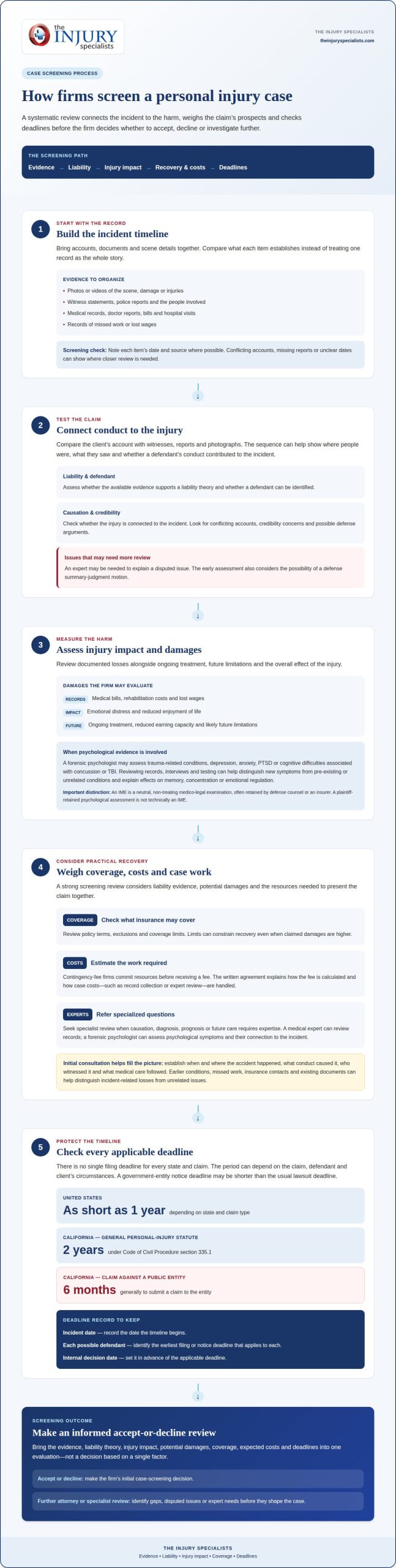
Statute-of-limitations checks and filing deadlines
There is no single personal-injury filing deadline for every state and claim. In the United States, the deadline may be as short as one year from the injury, depending on the state and claim type. California’s general personal-injury statute of limitations is two years under Code of Civil Procedure section 335.1. For a California claim against a public entity, a claim generally must be submitted to the entity within six months, according to the California Legislature.
Because deadlines vary by state, reviewing them is a screening priority, not an administrative afterthought. The applicable period may depend on the claim, defendant, and client’s circumstances. A claim involving a government entity may have a shorter notice deadline than the usual lawsuit deadline. The firm should identify every possible defendant and track the earliest filing or notice deadline that applies to each.
A practical deadline record includes the incident date, each defendant’s earliest deadline, and an internal decision date set in advance. For example, if a collision involves a private driver and a public entity, the firm tracks each distinct deadline rather than relying on a single calendar entry. Early tracking gives attorneys time to assess the claim and decide what action is needed.
Paralegals help maintain deadline calendars and organize supporting materials, including medical records and reports. They can gather records and flag approaching dates, but they cannot give legal advice or make strategic legal decisions. Attorneys use the timeline to determine which deadline applies and how it affects the claim. Uncertainty about a defendant’s identity or status should be escalated promptly for legal review.
Missing a filing or notice deadline can prevent a claim from moving forward. Accurate dates also help firms prioritize investigation and preserve time to evaluate liability and damages. State rules differ, so a deadline from one state should never be applied automatically to an injury claim arising in another.
Deadlines vary by state and claim type, and some may be only one year. California generally allows two years for personal-injury claims, while claims against public entities generally require a claim submission within six months.
Screening criteria for personal injury cases
A useful screen tests whether the evidence supports liability, the injury is documented, and the claim has a realistic path forward. Firms weigh these factors together because a clear injury alone does not show that a defendant caused it. A consistent approach to how to screen potential personal injury cases helps reviewers identify questions that need further investigation.
Start with negligence: did a party owe a duty of care, breach it, and directly cause harm? Then assess the injury’s severity and duration, possible damages, and whether multiple parties may share responsibility. In California, potential damages can include ongoing treatment, lost wages, emotional harm, and future injury-related problems. These factors help determine whether a personal injury claim merits further investigation, settlement discussions, or litigation.
An illustrative rubric can make reviews more consistent. It assigns each criterion a score from 0 to 2 points, then applies knockout criteria before totals. After a case clears those criteria, a score of 10 or more out of 14 indicates acceptance under the example rubric; 7 to 9 points calls for attorney review. A case that hits any knockout criterion is declined under that same model. The rubric is a framework, not a universal legal standard.
Before accepting a case, firms may ask a medical expert to review relevant records, particularly when expert testimony may be needed at trial. They also review policy terms, exclusions, and coverage limits, and consider whether a defense summary-judgment motion could challenge the claim. Partial fault may reduce compensation in some jurisdictions, so the client’s conduct belongs in the analysis. A documented screening rubric can show what supports each element, what remains disputed, and what further review could resolve.
To put a consistent screening framework into practice, take the next step.
The Injury Specialists
The Injury Specialists supports law firms and healthcare providers through referral programs, medical case management, and case management technology. When screening reveals a need for coordinated case processes or stronger professional connections, these resources can support the operational side of personal injury work. The Attorney Referral Program includes medical case management tailored to each firm’s distinct process, along with marketing and networking to grow referral partners.
Healthcare referral options include physician, chiropractic, physical therapy, and imaging center referrals. These services connect professional partners around injury-related cases, while firms remain responsible for their legal evaluations and decisions. Contact The Injury Specialists to discuss how its programs fit your firm’s case management and referral needs.
Make the Next Case Review More Consistent
A sound screening process leaves the firm with a clear record of what supports a claim, what remains unresolved, and who owns the next decision. Use that record to make handoffs more precise and improve how the team approaches future reviews. A consistent method for how to screen potential personal injury cases turns individual assessments into a process the firm can apply across its caseload.
The next step is operational: align case evaluation with the people and systems that support injury-related work. Clear coordination can help firms manage referral relationships and case processes alongside their legal review. The Injury Specialists works with law firms through its Attorney Referral Program and medical case management tailored to each firm’s distinct process.
Start a conversation with The Injury Specialists about your firm’s needs. A more coordinated process begins with a focused discussion.
Frequently Asked Questions
How Do You Build a Case Screening Scoring Rubric?
Build a rubric by defining what evidence supports each decision and how reviewers should record uncertainty. Separate disqualifying issues from factors to weigh, then leave room to note missing information and follow-up needs. For example, an unclear witness account might prompt further investigation rather than an automatic decline. Review the rubric periodically so attorneys apply its criteria consistently.
How Do You Check the Statute of Limitations and Conflicts at Screening?
Run deadline and conflict checks as separate intake controls. Record the incident date and relevant parties, then identify the possible claim and defendant before setting calendar reminders for each applicable deadline. Separately, screen names against existing and former clients before collecting detailed confidential information. ABA Model Rule 1.18 addresses information shared by prospective clients and circumstances where it can disqualify a firm from representing an opposing party.
How Should a Firm Decline a Personal Injury Case?
A firm should communicate its decision clearly and promptly, without implying that another firm will accept the matter. Explain the decision at an appropriate level, such as an evidentiary gap or conflict, and clarify whether the firm has agreed to represent the person. If timing may matter, do not suggest that the person can wait. The decision notice should not be mistaken for legal advice about deadlines.
What Are the Most Common Reasons PI Firms Decline Cases?
Firms may decline a case when the available facts do not support a clear liability theory, the injury’s connection to the incident is difficult to establish, or the likely recovery does not justify the work required. Conflicting accounts without independent support, for example, can weaken a claim. A conflict check, a serious deadline concern, limited available coverage, or extensive expert needs may also affect the decision.
What Criteria Do PI Firms Use to Evaluate a Case?
Firms consider whether the evidence supports a claim, whether the injury and its effects are documented, and whether potential defendants and coverage can be identified. They also assess unresolved issues, such as conflicting witness accounts or pre-existing conditions that complicate causation. A case requiring specialized medical or psychological analysis may need expert review before the firm can assess its strengths and weaknesses.
What factors determine whether a personal injury case is worth pursuing?
A case’s prospects depend on the overall picture, not one headline factor. The firm considers evidence quality, liability, injury-related losses, available coverage, time remaining, and the resources needed to develop the claim. For instance, substantial documented losses may still present a difficult case if causation is disputed and expert analysis is essential. The key question is whether the evidence and practical path forward support continued work.

Leave A Comment
You must be logged in to post a comment.