

The managing attorney should define the firm’s case criteria with input from the person leading intake. Clear rules help staff understand how to qualify personal injury leads while keeping decisions aligned with the firm’s preferred cases and licensed jurisdictions.
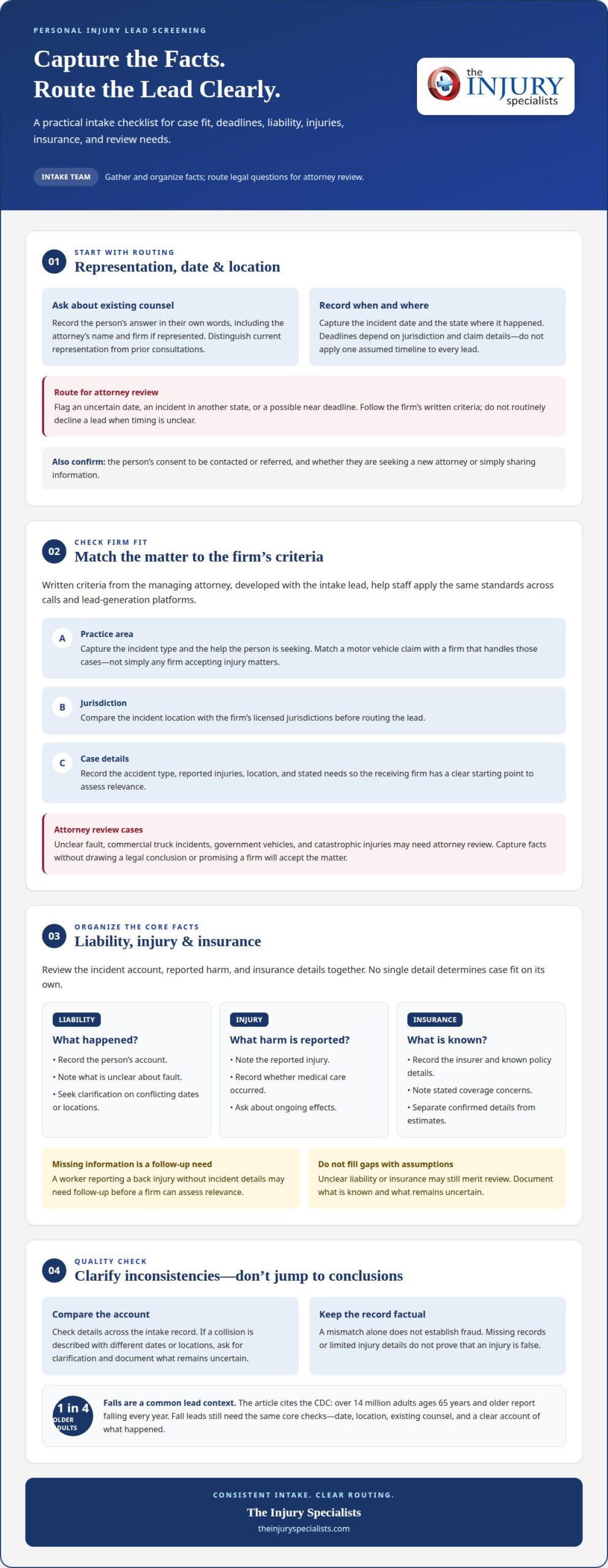
Effective screening goes beyond a quick review of the accident type. It also considers the applicable deadline, existing legal representation, case fit, liability, reported injuries, available insurance, and the person’s consent to be contacted or referred.
This guide explains how to assess these factors and when a lead needs attorney review rather than a routine decision. You’ll learn to identify deadline concerns, distinguish a potential case from a poor firm fit, and match each lead with a law firm equipped to evaluate it.
Key Takeaways
- Set written case criteria with input from the managing attorney and intake lead, including the firm’s practice areas and licensed jurisdictions.
- Screen for deadlines and existing counsel early, and route time-sensitive or unclear cases for attorney review.
- Assess case fit by organizing the facts about liability, injuries, medical care, and available insurance.
- Look for inconsistent details or missing consent before matching a lead with a law firm.
Existing attorney and statute-of-limitations checks
Start with two intake questions: Has an attorney agreed to represent you, and when did the accident happen? Record the person’s answer in their own words, including the attorney’s name and firm if they are represented. A vehicle collision, fall, or other injury may already be under review elsewhere. That status affects whether the lead can be referred for a new attorney relationship.
Next, record the incident date and the state where it occurred. Deadlines depend on jurisdiction and claim details, so intake should not apply one assumed timeline to every lead. The managing attorney’s written criteria should identify cases that need immediate review. If the date is uncertain, the incident happened in another state, or the deadline may be near, flag the lead for attorney review instead of routinely declining it.
Falls are the leading cause of injury for adults ages 65 years and older. According to the Centers for Disease Control and Prevention, over 14 million, or 1 in 4 older adults, report falling every year. A fall lead still needs the same core intake checks: incident date, location, existing counsel, and a clear account of what happened.
- Already represented: Record whether an attorney-client relationship exists and whether the person is seeking a new attorney or simply sharing information.
- No attorney yet: Note any prior consultations, but distinguish them from current representation.
- Date or location unclear: Preserve the uncertainty in the intake record and route it for review.
- Possible deadline concern: Escalate promptly under the firm’s criteria rather than relying on a general rule.
These checks support consistent decisions across intake staff and lead-generation platforms. They also help distinguish a referral opportunity from a matter that needs attorney direction first. A practical approach to how to qualify personal injury leads treats deadline screening as an early routing decision, not a final legal conclusion. Staff gather and organize facts; the attorney evaluates what they mean for the matter.
Identifying and matching potential clients with law firms
A useful referral connects a person’s stated needs with a law firm’s actual practice focus. Intake should capture the incident type, location, reported injuries, and help the person is seeking. These details distinguish a motor vehicle accident from a workplace injury or trucking collision and give the receiving firm a clear starting point for evaluating fit.
The managing attorney should set written criteria with input from the person leading intake. Criteria can define preferred case types, accepted jurisdictions, and details that require attorney review. Clear rules help staff apply the same standards across calls and lead-generation platforms. They also prevent a broad label such as “personal injury” from driving a referral without enough context.
- Practice area: Match a motor vehicle claim with a firm that handles those cases, not simply any firm accepting injury matters.
- Jurisdiction: Compare the incident location with the firm’s licensed jurisdictions before routing the lead.
- Case details: Record the accident type and the person’s stated needs so the firm can assess relevance.
- Review path: Send unclear fault, commercial truck, government vehicle, or catastrophic injury cases to an attorney for review.
For example, a lead involving a commercial truck may need a different review path from a routine vehicle collision. A workplace injury may also fall outside a firm’s preferred case mix, even when it involves physical harm. Intake should capture the facts without drawing a legal conclusion or promising that a firm will accept the matter.
Lead matching works best when the referral carries organized, relevant information rather than a category alone. A concise record lets the firm assess whether the case type, location, and circumstances align with its criteria. An attorney referral program can support connections between potential clients and firms using firm-specific processes.
Liability, injury, and insurance screening
Review the incident account, reported harm, and insurance details together. None determines case fit on its own. Lead costs and conversion rates vary by source, targeting, and qualification criteria, so compare channels using the same definition of a qualified lead.
Fraudulent and Low-Quality Lead Red Flags
A fraudulent or low-quality lead contains false, inconsistent, incomplete, or irrelevant information that prevents meaningful case review. Inaccurate details can distort decisions about liability, injuries, and referral fit.
Compare the person’s account across the intake record. If a vehicle collision is described with different locations or conflicting dates, seek clarification rather than drawing an immediate conclusion about liability. Record what the person says, what remains unclear, and which details need attorney review. A mismatch alone does not establish fraud.
Assess injury information with similar care. Note the reported injury, whether medical care occurred, and whether the person describes ongoing effects. For example, a worker who reports a back injury but provides no incident details may need follow-up before a firm can assess relevance. Missing records or limited details do not prove that an injury is false.
For insurance screening, record the insurer and policy information the person knows, along with any stated coverage concerns. Separate confirmed details from estimates. A personal injury lead with unclear liability or insurance may still merit review. Document the gap instead of filling it with assumptions.
Screening Leads Across Contact Channels
Phone, web form, and chat screening collect the same core facts in different formats. A consistent intake framework helps law firms assess each personal injury lead without letting the contact channel determine its quality.
On a phone call, ask focused questions about the accident, injuries, treatment, potential witnesses, and known insurance. Follow up when the account leaves a gap. A web form should request concise descriptions of the incident and harm, with blank or contradictory answers flagged for follow-up. Chat prompts should capture the same points clearly.
Across all channels, record the person’s account without turning it into a legal finding. The lawyer evaluates negligence and liability using the available facts. For example, if a worker reports a fall at a job site, intake can record what happened, the reported injury, and any known coverage. The firm can then decide whether the matter fits its criteria and what further review it needs.
What are red flags for fraudulent or low-quality personal injury leads?
A red flag is an inconsistency or missing detail that prevents reliable review, not proof of fraud. For example, a caller may give different accident locations during intake, or a web form may contain no usable contact details. Treat each signal as a reason to clarify and document, not as a final judgment.
Compare the incident account, contact information, and reported injury for internal consistency. A vehicle crash described with conflicting dates, or a name that changes between a form and follow-up call, needs careful review. Duplicate submissions can also be accidental, so ask whether the person intended to make multiple inquiries before labeling the lead invalid.
- Unreachable contact: Log attempted contact and distinguish a wrong number from a missed call.
- Conflicting details: Note which facts differ, such as the accident location or injury description.
- Generic account: Ask for a specific incident description instead of accepting a vague claim without context.
- Unclear consent: Confirm the person agreed to the contact or referral before sharing their information.
Low quality can also mean poor firm fit rather than fabricated information. A genuine injury lead may involve a case type outside the law firm’s practice areas or a location outside its licensed jurisdictions. Record that mismatch separately from suspected fraud. This distinction helps intake teams determine whether a lead needs clarification, attorney review, or a different routing decision.
Apply the same written criteria to phone calls, forms, chat, and lead-generation platforms. For each flagged submission, preserve the original answers, record follow-up attempts, and note the reason for the final routing decision. If several leads from one source have the same missing details, review that pattern against the firm’s criteria before changing intake rules. One incomplete form does not establish a source-wide problem.
Keep screening consistent and evidence-based. Strengthen your lead referral process with clear criteria and documented review steps.
The Injury Specialists
The Injury Specialists connects personal injury firms and professionals through referral services, medical case management, and networking support. For firms refining lead qualification, the Attorney Referral Program can align referrals and case management with the firm’s distinct process.
When a lead’s next step involves coordinating professional connections, the broader referral network can support that workflow. Physician, chiropractic, physical therapy, and imaging center referrals serve related needs across the injury care ecosystem. Marketing and networking also help firms and healthcare providers build referral relationships.
These services support professional connections and case coordination. They do not replace a law firm’s case evaluation or provide legal representation. To discuss your firm’s referral and case management needs, contact The Injury Specialists.
Turn Intake Insights Into Better Decisions
Qualification becomes a working system when each decision informs the next. Use intake outcomes to refine written criteria, clarify routing rules, and identify where staff need more guidance. Review declined-lead reasons monthly to see whether incoming inquiries align with the firm’s priorities. Track qualified-lead, consultation-booked, consultation-show, and signed rates each week to spot changes across the intake process.
These measures help teams distinguish a change in lead fit from a breakdown in follow-up or handoff. They also give managing attorneys and intake leads a shared basis for updating criteria. Knowing how to qualify personal injury leads is an ongoing operational discipline, not a one-time form or script. Keep the process clear, review patterns, and make focused adjustments as the firm’s needs evolve.
Contact The Injury Specialists to discuss building stronger referral connections. A consistent process can support a more confident next step for your firm.
Frequently Asked Questions
Who should write the case criteria?
The managing attorney should set the criteria with practical input from the person leading intake. This pairing connects legal priorities with details staff can reliably capture. For example, criteria can explain how to classify a rideshare collision or route an incident involving several potentially responsible parties. Keep the rules clear enough to apply consistently, and specify which unusual situations need attorney review.
What makes a personal injury lead qualified for a law firm?
A lead is qualified when its known facts align with the firm’s case types, jurisdiction, and intake requirements. For example, a person describing a workplace injury may fit a firm that handles workplace cases but not one focused elsewhere. Qualification is an intake decision, not a prediction of the case outcome. Record unanswered questions separately so missing details are not mistaken for a definite mismatch.
What questions should intake staff ask personal injury prospects?
Ask questions that establish what happened, what the person needs, and the appropriate next review. Start with what happened and where, then ask what injuries the person reports and what care they have received. Clarify whether another attorney is involved, what follow-up the person wants, and how they agreed to be contacted. If answers conflict, ask for clarification and preserve the original account.
How should intake assess liability, causation, and damages?
Intake should organize facts, not decide legal responsibility or calculate damages. Record the actions each person reportedly took, the sequence of events, and any witnesses or available photographs. Then capture the injury the person connects to the incident, treatment details, and reported effects on daily activities. For example, mark a disputed account of an intersection collision as disputed and route it for lawyer review.
What information and documents should be collected from a personal injury lead?
Record the person’s contact details, incident date and location, a brief event description, reported injuries, and known insurance information. Ask whether supporting materials are available, such as photographs, an incident report, witness details, or medical records. These items can help a firm understand the lead’s account. Note what has been provided and what remains unavailable without making every document a condition of intake.
How should intake evaluate injury severity, medical treatment, and case value?
Document the reported injury, care received, treatment timeline, and effects the person describes, such as difficulty performing regular tasks. An intake record can distinguish an emergency visit from ongoing appointments without ranking medical severity. Do not assign a dollar value based on a brief call. The attorney can assess the documented harm alongside liability evidence and available insurance information.

Leave A Comment
You must be logged in to post a comment.