

More marketing activity doesn’t automatically produce more signed cases. To understand how to attract more personal injury clients, firms need to connect the right acquisition channels with responsive intake, clear case qualification, and consistent follow-up.
Unpredictable leads make growth difficult to plan, while inquiries outside a firm’s focus can absorb valuable time. Even a strong opportunity can be lost when the response is slow or the next step is unclear. Sustainable growth depends on a system that moves prospects from discovery to a timely, informed conversation.
This 2026 framework explains how to choose channels that match your firm’s capacity and case focus, improve response and follow-up, and measure performance through outcomes such as qualified inquiries and signed cases. It also covers how professional referral relationships can complement digital marketing. Use it to identify what’s working, address weak points, and build a more predictable client-acquisition process.
Key Takeaways
- Learn how to attract more personal injury clients by building a system that values case fit, intake capacity, and signed engagements, not inquiry volume alone.
- Compare search, paid advertising, reputation-building, community education, and professional referrals to prioritize channels that fit your firm.
- Use a consistent intake process to assign inquiry ownership, capture lead sources, and guide qualified prospects toward a clear next step.
- Track response time, qualification, consultation attendance, and signed engagements together to identify where the process can improve.
- See how coordinated referral relationships and case-management support can complement marketing and align communication with firm workflows.
How to Attract More Personal Injury Clients by Building a Reliable Growth System
Growth is not simply a matter of generating more calls. A firm needs a clear path that helps the right prospective clients find it, make contact, understand what happens next, and move through a consistent consultation process. Build that path around the firm’s case focus and its capacity to respond and follow up.
A personal injury client-acquisition system is the coordinated process that moves prospective clients from awareness to qualified inquiry, consultation, and signed engagement. It connects marketing with intake and follow-up so each stage supports the next. The goal is a repeatable process, not a promise of a particular number of cases or outcomes.
What does client acquisition mean for a personal injury law firm?
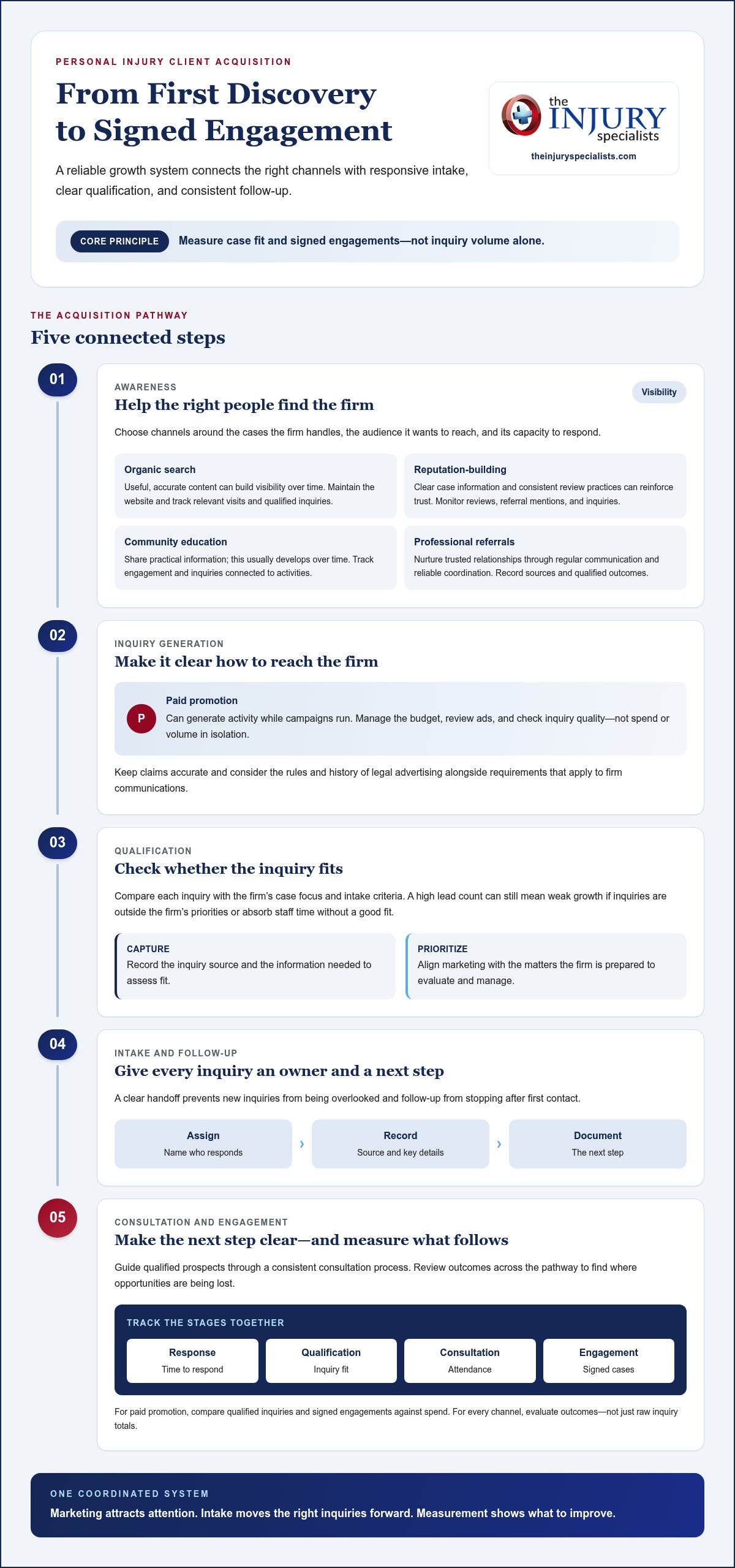
Client acquisition has several distinct stages. Visibility puts the firm in front of potential clients through search, reputation, education, or professional relationships. Inquiry generation gives interested people a way to reach the firm. Qualification helps determine whether an inquiry aligns with the firm’s focus and intake criteria. Consultation and engagement follow when the firm and prospective client decide to proceed.
Each stage takes time and resources. A firm focused on particular case types may not benefit from inquiries outside that focus, especially when staff capacity is limited. Plan marketing around the matters the firm is prepared to evaluate and the resources available to manage incoming inquiries. Consistent processes support sustainable growth, but they can’t guarantee case outcomes.
Why can a high lead count still produce weak growth?
Raw inquiry totals don’t show whether prospects fit the firm, receive a timely response, attend a consultation, or sign an engagement. A campaign can generate activity while consuming staff time on inquiries that don’t match the firm’s priorities. Track each stage separately to see where opportunities are being lost.
Unclear ownership creates another gap. If no one is responsible for a new inquiry, a response may be delayed or follow-up may stop after the first contact. Set a clear handoff: record the source, assign an owner, and document the next step. When making marketing decisions, consider the rules and history of legal advertising alongside the requirements that apply to the firm’s communications.
For a practical growth system, coordinate three elements:
- Marketing: Choose channels based on case focus, audience, and the firm’s capacity to handle inquiries.
- Intake: Establish who responds, what information is captured, and how qualified inquiries move forward.
- Measurement: Review source, qualification, consultation, and engagement data together to guide improvements.
This integrated approach is the foundation for how to attract more personal injury clients consistently. Next, choose channels that fit the firm’s goals and operating capacity.
Which Personal Injury Client-Attraction Channels Fit Your Firm?
No single channel suits every firm. Choose based on the cases you handle, the team available to manage inquiries, and the outcomes you can track. A useful rule is to select channels based on case focus, internal capacity, and measurable outcomes.
| Channel | Audience | Time horizon | Operating effort | Measurement and suitable firm conditions |
|---|---|---|---|---|
| Organic search | People researching an injury or looking for legal help | Builds over time | Ongoing content and website maintenance | Track relevant visits and qualified inquiries. Suits firms able to publish useful, accurate information consistently. |
| Paid promotion | People actively searching or engaging with targeted ads | Can generate activity while campaigns run | Budget management, ad review, and inquiry-quality checks | Measure qualified inquiries and signed engagements against spend. Suits firms with budget controls and an intake process ready to respond. |
| Reputation-building | Prospects comparing firms and seeking trust signals | Ongoing | Consistent review practices and clear case information | Monitor reviews, referral mentions, and inquiries. Suits firms prepared to maintain accurate, professional public information. |
| Community education | People seeking practical information before choosing counsel | Usually develops over time | Planning and delivering useful educational content | Track engagement and inquiries connected to activities. Suits firms with expertise to share and capacity to participate consistently. |
| Professional referrals | People connected to trusted professional relationships | Relationship-led and ongoing | Regular communication and reliable coordination | Record referral sources and qualified outcomes. Suits firms able to nurture relationships and manage appropriate referrals. |
How do search, paid promotion, and reputation-building differ?
Educational search content can answer common questions and build visibility over time, but rankings aren’t guaranteed. Paid promotion can put a firm in front of an audience while a campaign runs, but spend alone doesn’t prove value. Review the quality and fit of inquiries, not just their volume. Reviews and clear case information can reinforce trust as prospects compare firms. Keep marketing claims accurate, and consult the FTC’s guidance on truthful advertising standards.
When can professional referrals strengthen client acquisition?
Referrals can complement digital channels when relationships are built on consistent communication and dependable coordination. In appropriate cases, connections among legal and medical professionals can help create a more organized path for the people involved. Referral relationships still need clear ownership and source tracking, so firms can understand which connections lead to qualified inquiries. Learn how personal injury referral networks work and how attorney referral and networking support can fit into a broader growth plan.
The best channel mix is one your team can sustain and evaluate. That’s the practical foundation for how to attract more personal injury clients without relying on a single tactic.
How to Turn Personal Injury Inquiries Into Qualified Consultations
A consistent intake process helps a firm handle inquiries deliberately, rather than letting promising contacts stall between first contact and a clear next step. It should make three things visible: who owns the inquiry, whether it fits the firm’s stated focus, and what follow-up is due.
What should a personal injury intake process include?
Start with a concise record of the prospective client’s contact details, how they found the firm, basic incident information, and preferred response method. Use a screening checklist that reflects the firm’s practice focus. The checklist supports routing and prioritization; it isn’t a substitute for legal evaluation or a conclusion about the merits of a matter.
Assign each inquiry to a named team member and record the next action. A practical sequence looks like this:
- Log: Capture the source and essential contact and incident details.
- Screen: Apply the firm’s consistent, internally defined criteria.
- Route: Send the inquiry to the appropriate team member for review.
- Follow through: Document the contact attempt, outcome, and agreed next step.
Keep requests focused on information needed for intake, and handle sensitive details through the firm’s established processes. Clear, accurate communications also support trust. For additional perspective on ethical marketing for lawyers, consult the Pennsylvania Bar Institute’s guidance.
How can firms improve response and follow-up?
Set internal expectations for acknowledging new inquiries and making subsequent contact, then track whether the process is followed. The target should reflect staffing and inquiry volume, not an unsupported promise of immediate availability. Use professional messages that explain the next step without implying that the firm has accepted a matter or reached a legal conclusion.
Define a follow-up cadence, assign responsibility for each attempt, and record the result. If a prospect doesn’t respond or proceed, mark the outcome and the reason when known. Review those records for operational patterns, such as missed handoffs or unclear messages, rather than guessing why someone chose not to continue.
When a firm’s workflow includes coordination with medical professionals, connected processes can help organize communication around appropriate referrals. Law firm medical referral programs can support that workflow. The Injury Specialists provides medical case management and case-management technology that can complement a firm’s distinct processes. These tools support coordination; they don’t replace the firm’s own intake decisions or legal work.
To strengthen the operational side of your intake and referral workflow, learn about case-management and referral support. A clear process helps turn an inquiry into an informed next step, making intake a practical part of how to attract more personal injury clients.
How to Measure Client-Acquisition Performance and Improve It
Measurement connects marketing activity to the work that follows. A channel may generate inquiries, but that alone doesn’t show whether those inquiries fit the firm, receive timely attention, or become signed engagements. Use consistent definitions and review the full path before shifting resources.
Which personal injury marketing metrics should firms track?
Agree on what each stage means, then record it consistently in the firm’s chosen system. For example, define an inquiry as a new contact, a qualified inquiry as one that meets the firm’s internal screening criteria, and a scheduled consultation as a confirmed appointment. Track attended consultations and signed engagements as separate outcomes.
For each inquiry, capture its source and the timing of the first response. Review:
- Inquiry source: Which channel or referral relationship generated the contact?
- Response time: How long passed before the firm responded?
- Qualification: How many inquiries matched the firm’s stated focus?
- Consultation attendance: How many scheduled consultations took place?
- Engagements: How many resulted in a signed engagement?
Compare these measures by channel and case fit over a period that gives the firm enough consistent information to identify patterns. No single metric proves profitability. A high inquiry count, for instance, may look strong until the firm considers qualification, staff effort, and signed engagements. Avoid relying on generic benchmarks or assuming past performance guarantees future returns.
How should firms use results to refine their strategy?
Look for the point where activity drops off. If a channel brings in suitable inquiries but responses are often delayed, address intake capacity before increasing promotion. Missed-call records, response timing, and incomplete follow-up can reveal process gaps. If inquiries rarely match the firm’s focus, review the channel’s targeting and messaging.
Protect confidentiality while reviewing performance. Limit access to sensitive inquiry information, use aggregate reporting where possible, and avoid putting identifying details into marketing dashboards that don’t need them. Then assess channel results alongside the firm’s ability to handle additional inquiries. Scaling a productive source without enough intake capacity can strain the process rather than improve it.
Advertising and referral practices also need review against the professional rules that apply in each jurisdiction. Have qualified compliance guidance assess marketing claims, referral arrangements, and the firm’s processes. This keeps growth decisions grounded in performance data and responsible practice.
For firms connecting measurement with case-management workflows, explore case-management technology and referral support. A disciplined review cycle turns performance data into practical decisions about how to attract more personal injury clients.
How a Connected Referral and Case-Management Network Supports Firm Growth
Referral relationships can complement search, reputation-building, and other marketing channels. Their value comes from professional connection and coordination, not from replacing a firm’s own business development, legal judgment, or client service. For firms considering how to attract more personal injury clients, a connected network can be one part of a broader system that links appropriate referrals with organized intake and follow-through.
What can an integrated professional network contribute?
Personal injury matters may involve communication among a law firm and medical professionals such as physicians, chiropractors, physical therapists, and imaging centers. A coordinated network can help organize those professional connections, while medical case management can support communication and documentation in line with a firm’s workflow. Each professional remains responsible for their own role. A network doesn’t replace the firm’s decisions or the services provided by medical professionals.
The Injury Specialists connects injury victims with medical and legal professionals through a national referral network. Its case-management technology supports case management, marketing, and professional networking. These services can complement a firm’s existing processes, but they don’t guarantee inquiries, engagements, or case outcomes. Explore personal injury case-management technology to understand how it can support firm operations.
How can a law firm evaluate its next growth step?
Start with a defined need. If the firm wants to strengthen professional relationships, assess its referral communication and follow-through. If coordination is creating friction, review how information and next steps move through the firm’s workflow. If existing processes are difficult to manage, consider whether case-management technology can support a more organized approach.
Match any new support to the firm’s case focus, internal capacity, and ability to measure progress. Track referral sources and subsequent inquiry outcomes using the same consistent definitions applied to other channels. This keeps professional networking connected to the firm’s broader acquisition system rather than treating referrals as an unmeasured exception.
The Injury Specialists’ attorney referral program can be integrated with a firm’s distinct processes, alongside medical case management and referral-network support. The program can strengthen professional connections within a firm’s growth plan. A coordinated approach keeps relationships, intake, and case-management needs aligned without relying on any single source of new business.
Build a Growth System Your Firm Can Sustain
Attracting the right clients takes more than a single campaign. A reliable approach aligns channel choices with your firm’s case focus, gives each inquiry a clear path through intake, and measures progress beyond raw lead counts. Consistent response and follow-up help protect the value of opportunities created by marketing and professional relationships.
That’s the foundation of how to attract more personal injury clients: coordinate marketing, intake, measurement, and trusted referrals so each part supports the next. The Injury Specialists connects legal and medical professionals through a national referral network. Its attorney referral support can align with a firm’s distinct processes, while its technology supports case management, marketing, and networking.
Explore The Injury Specialists’ attorney referral and case-management network to see how these resources can complement your firm’s growth strategy. Choose a practical next step, strengthen the system around it, and keep refining your approach as you learn what works for your team.
Frequently Asked Questions
How can a personal injury law firm attract more clients?
A personal injury firm can attract more clients by combining relevant educational content, reputation-building, professional referral relationships, and consistent inquiry handling. To decide how to attract more personal injury clients, track where inquiries originate and whether they fit the firm’s case focus. Review those results alongside response and follow-up performance and the team’s capacity. No channel guarantees signed cases, so refine the mix using firm-specific data and applicable advertising rules.
What is the most effective marketing strategy for a personal injury law firm?
There isn’t one strategy that works best for every firm. The right mix depends on practice focus, audience, resources, and the team’s ability to respond to inquiries. Organic search, paid promotion, reputation-building, and professional referrals each require different levels of effort and time. Compare them using consistent measures, including qualified inquiries, consultation attendance, and signed engagements. Don’t choose a channel based only on reach or raw lead counts.
How can personal injury firms get more referrals?
Build professional relationships through clear communication, dependable coordination, and a defined process for appropriate referrals. Identify the case types and professional connections that align with the firm’s focus, then maintain regular, professional follow-up. Record referral sources and review outcomes without promising a particular number of cases. Referral and advertising practices may be subject to professional rules, so review the requirements that apply to your jurisdiction and program structure before making changes.
Can SEO help a personal injury law firm attract clients?
Yes. Search visibility can help prospective clients find useful information about a firm and its practice areas. Building it typically requires relevant content, technically sound pages, and ongoing attention to what users need. Results aren’t immediate or guaranteed, so evaluate content performance by whether it contributes to qualified inquiries, not rankings alone. Keep marketing claims accurate and review the advertising requirements that apply to your firm’s practice and communications.
How should a personal injury law firm handle new leads?
Use a consistent intake workflow with clear inquiry ownership, timely responses, documented contact attempts, and screening criteria set by the firm. Record each inquiry’s source and next step so the team can identify delays or missed follow-up. Keep communication professional and accessible, and protect confidential information through the firm’s established processes. Review patterns regularly, but don’t treat lead volume alone as proof of case quality or future results.
What metrics should a personal injury law firm track for marketing?
Track inquiry source, response time, qualified inquiries, scheduled and attended consultations, and signed engagements. Define each measure consistently so performance can be compared across channels and over time. Review results alongside case fit and staff capacity; a single metric won’t show the full picture. Use the firm’s own historical data to guide decisions rather than treating industry averages as guaranteed targets, and seek appropriate compliance guidance for marketing and referral practices.
Are referral programs allowed for personal injury law firms?
Requirements depend on the jurisdiction, the professionals involved, and how a referral program is structured. Firms shouldn’t assume one national rule applies to every arrangement. Before launching or changing a program, review the relevant professional conduct and advertising requirements with qualified compliance counsel. Keep communications accurate, document processes appropriately, and avoid language that suggests guaranteed case outcomes or improper influence. A careful review can help firms build referral relationships responsibly.

Leave A Comment
You must be logged in to post a comment.