

A directory can produce a list of physicians, but it can’t show which one fits the medical questions in a specific injury case. Understanding how attorneys find medical experts starts with defining those questions, then matching the needed specialty and experience to the facts, records, and litigation needs.
Credentials alone aren’t enough. Attorneys also need to assess an expert’s case experience, objectivity, ability to explain opinions clearly, and availability to meet deadlines. This article outlines a repeatable process for identifying the right expertise, evaluating qualifications and case fit, and organizing records and communication before engagement. It also explains how coordinated relationships across medical and legal professionals, supported by case management workflows and technology, can complement an attorney’s search without replacing case-specific evaluation.
Key Takeaways
- How attorneys find medical experts is a case-fit workflow: define the disputed medical issue before searching for a specialist.
- Compare potential experts on relevant experience, objectivity, communication, availability, and conflicts, not credentials alone.
- Set a clear engagement scope that connects the requested analysis to organized records and case deadlines.
- Use a consistent process to identify candidates, assess suitability, and document the engagement.
- Medical-legal networks and case management tools can support discovery and law-firm coordination, while independent screening remains essential.
How Attorneys Find Medical Experts Starts With the Case Question
Start with the issue, not a directory. A medical expert witness is a qualified professional who applies specialized knowledge to explain or analyze a disputed medical question. The Expert witness overview offers a general introduction to this role. For attorneys, the practical question is which medical issue needs analysis and what expertise can address it. That distinction makes how attorneys find medical experts a case-fit process, not a search for the most impressive profile.
Expert selection helps counsel assess evidence and prepare a case. It doesn’t guarantee that an opinion will be admissible, that an expert will testify, or that a case will reach a particular outcome. Those issues depend on the facts, applicable rules, and the court’s decisions.
Separate treatment needs from expert-witness needs
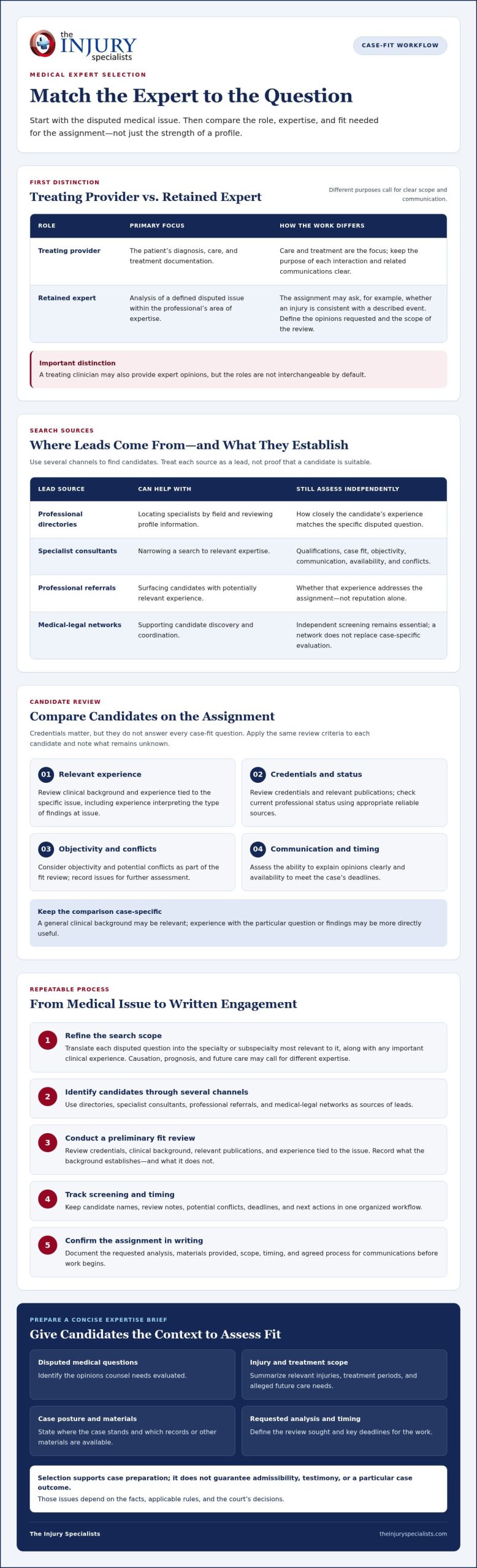
Treating providers focus on the patient’s diagnosis, care, and treatment documentation. A retained expert is asked to analyze a defined issue within their area of expertise, such as whether an injury is consistent with a described event. A treating clinician may also provide expert opinions, but the roles aren’t interchangeable by default. Keep the purpose of each interaction, the opinions requested, and related communications clear, consistent with applicable rules and case strategy.
Translate disputed issues into an expertise brief
Before searching names or specialties, list the questions the case actually raises. For example, a dispute about whether a reported nerve injury is supported by examination findings may call for different expertise from a dispute over the interpretation of imaging. The diagnosis alone doesn’t identify the right expert. The disputed question does.
Build a concise brief that gives prospective experts enough context to assess the assignment without burying the question in an unstructured record set. Include:
- Disputed medical questions: Identify the opinions counsel needs evaluated.
- Injury and treatment scope: Summarize the relevant injuries, treatment periods, and any alleged future care needs.
- Case posture and materials: State where the case stands and which records or other materials are available.
- Requested analysis and timing: Define the review sought and key deadlines for the work.
This brief narrows the search to relevant expertise and gives candidates a clear basis for assessing fit. It also creates a practical handoff for the next stage: reviewing qualifications, objectivity, and ability to address the specific issues.
A Step-by-Step Process for Finding the Right Medical Expert
A structured search turns the case question into a manageable sourcing and screening process. It also creates a record of why a candidate was considered, what was reviewed, and how the engagement moved forward. That discipline is central to how attorneys find medical experts whose experience matches the assignment.
Build a focused search from the medical issue
Search by the clinical discipline and specific experience related to the disputed question, not just the injury label. An opinion about causation may call for different expertise than an opinion about prognosis or future care. When a case raises several distinct questions, determine whether one specialist can address them or whether separate expertise is needed.
- 1. Refine the search scope. Translate each question into the specialty or subspecialty most relevant to it, along with any important clinical experience.
- 2. Identify candidates through several channels. Professional directories can help locate specialists by field and review profile information. Specialist consultants may help narrow a search; trusted professional referrals can surface candidates with relevant experience; established medical-legal networks can support discovery and coordination. Treat each as a source of leads, not proof of suitability.
- 3. Conduct a preliminary fit review. Review credentials, clinical background, relevant publications, and experience tied to the issue. Check current professional status using appropriate reliable sources. Record what each candidate’s background establishes and what it doesn’t.
- 4. Track screening and timing. Keep candidate names, review notes, potential conflicts, deadlines, and next actions in one organized workflow. This makes comparisons clearer and helps prevent follow-up from falling through the cracks.
- 5. Confirm the assignment in writing. Before work begins, document the requested analysis, materials provided, scope, timing, and agreed process for communications. Keep the engagement aligned with the case needs and applicable requirements.
Move from candidate names to a preliminary fit review
A profile can show credentials without showing how closely a person’s experience matches the case question. Compare candidates against the same criteria, then identify gaps for further review. For example, a specialist’s general clinical background may be relevant, while experience interpreting the particular type of findings at issue may be more directly useful. Focus the assessment on the assignment rather than reputation alone.
Coordinated relationships across medical and legal professionals can support the search and its surrounding workflow, while independent screening remains essential. Harvard Medicine Magazine’s How Medical Experts Interact With the Law offers additional context on how the professions intersect. The Injury Specialists’ attorney referral program provides law-firm workflow support through medical case management tailored to firm processes.
How to Assess an Expert’s Qualifications, Objectivity, and Case Fit
A long credential list can establish a professional’s background, but it doesn’t prove that person is right for a particular assignment. A directory profile may omit the details that matter most: experience with the disputed issue, ability to explain the analysis, and time to complete the work. A consistent comparison helps attorneys assess candidates against case needs instead of relying on titles or reputation alone. This is a key step in how attorneys find medical experts who can provide relevant, well-supported analysis.
Use a consistent qualification and fit checklist
Review each candidate using the same criteria. Consider training and board certification when relevant to the specialty and question, then assess current practice, focused experience, and familiarity with the issues. Record why a candidate fits or falls short. This creates a clear basis for comparison and helps identify what still needs verification before engagement.
| Assessment area | What to evaluate |
|---|---|
| Specialty fit | Does the candidate’s discipline and subspecialty align with the medical question? |
| Relevant experience | Has the candidate worked with similar conditions, findings, or clinical issues? |
| Communication | Can the expert explain the reasoning clearly and distinguish documented facts from assumptions? |
| Availability | Can the candidate meet the review, reporting, deposition, or trial schedule involved? |
| Potential conflicts | Are there prior relationships or other circumstances that may affect independence or require further review? |
Screen for independence, conflicts, and communication
Credentials and experience matter, but so does objectivity. Ask about relevant prior relationships and review litigation history, prior opinions, and other potential conflicts through appropriate screening. The goal isn’t to find someone who promises a favorable conclusion. It’s to determine whether the expert can apply a defensible method to the available facts, explain limitations, and support an independent opinion.
Communication is part of fit. A useful expert should be able to describe the basis for an opinion in clear terms and identify which conclusions depend on assumptions or incomplete information. Note any concerns and address them before relying on the analysis.
Finally, verify the rules that govern the case. Disclosure, discovery, and admissibility requirements can vary by jurisdiction and proceeding. Counsel should confirm the controlling standards and evaluate whether the proposed opinions and methods meet them. Careful screening strengthens case preparation, but it can’t guarantee admissibility, testimony, or an outcome.
How Attorneys Coordinate Records, Review, and Expert Engagement
A well-matched expert can only assess the materials and questions presented. Clear records, a defined scope, and a realistic timeline help turn the initial selection into a focused review. Coordination connects how attorneys find medical experts with the analysis the case requires.
Prepare a usable record set and review scope
Organize medical records chronologically, using consistent file names and a contents list so the expert can locate key documents. Flag missing records, duplicates, and unclear entries rather than silently excluding them. A chronology can identify treatment dates, providers, tests, and major events, while helping counsel and the expert spot gaps that may need follow-up.
Include a concise, neutral case summary. Separate documented facts from disputed claims, and avoid presenting an argument as established medical history. In writing, define the question, requested analysis, materials supplied, deliverables, schedule, and communication process. Send records through secure channels and limit access to appropriate participants. This structure supports an efficient review without steering the expert toward a predetermined conclusion.
Keep expert work aligned with case milestones
Track each handoff and deadline in one workflow. Log record delivery, review progress, anticipated written work product, disclosure dates, deposition scheduling, and trial milestones. Build in time to address questions about incomplete records or clarify the scope before a deadline becomes urgent.
Maintain appropriate records of communications and coordinate with counsel on discovery, privilege, and disclosure requirements that apply to the case. If the expert may be deposed or testify, preparation should focus on the methods, materials, assumptions, and reasoning behind the opinions. Clear explanations help counsel identify issues to address; they don’t guarantee admissibility or a particular result.
Consistent tracking can also support broader law-firm operations. The Injury Specialists’ medical case management for attorneys is designed around a firm’s distinct processes, while case management technology can support coordination across professional workflows. These tools complement counsel’s case-specific decisions and expert engagement. For additional context, attorneys can explore guidance on medical case management for attorneys and personal injury case management technology.
Explore attorney workflow support through The Injury Specialists’ referral program and case management resources.
How Medical-Legal Networks Support a More Coordinated Search
A medical-legal network can broaden an attorney’s professional connections and help organize the work surrounding an injury case. It’s one channel in the search process, not a shortcut to selecting an expert. A network connection doesn’t establish that a professional is qualified for a specific opinion, free of conflicts, available, or suitable to testify. Attorneys still need to assess each candidate independently against the case issues and applicable requirements.
Where a professional network fits in the expert-search workflow
Networks can support discovery by connecting legal and medical professionals and helping firms coordinate case-related processes. Those relationships may complement an attorney’s search for relevant expertise, but they don’t guarantee access to an expert or determine whether a particular candidate fits. Keep the steps distinct: define the disputed issue, identify possible candidates, assess credentials and conflicts, and decide whether the person’s expertise matches the assignment.
Medical case coordination serves a different function from expert-witness work. Case management can support organized communication and firm workflows; it doesn’t provide an expert opinion, legal advice, or direct legal representation. The attorney remains responsible for the case-specific evaluation and engagement decisions.
Next steps for law firms seeking coordinated support
A repeatable process makes network connections more useful. First, define the medical question and the expertise it calls for. Then identify possible candidates through appropriate channels, screen their qualifications and independence, and coordinate any engagement around the records, deadlines, and requested work. Keep a record of who is responsible for each step and how updates should move between the firm and relevant professionals.
Document the firm’s own processes, including how records are collected and shared, who manages communications, what approvals are needed, and how key dates are tracked. Consistent procedures make handoffs clearer and help a firm coordinate medical and legal workflows without treating a network as a substitute for independent review.
The Injury Specialists connects law firms, medical providers, and injury victims through a national personal injury referral network. Its attorney referral program includes medical case management tailored to law-firm processes, providing operational support rather than a guaranteed source of expert witnesses or testimony. Firms seeking a more coordinated approach can explore The Injury Specialists’ attorney network and case-management support.
Build a More Coordinated Expert-Search Process
Effective expert selection starts with a precise medical question, then moves through focused candidate screening and organized engagement. Credentials matter, but so do case-specific experience, objectivity, clear communication, and the ability to work within the case timeline. A careful process helps attorneys make informed decisions without assuming that any expert or network can guarantee admissibility or a favorable outcome.
Coordination matters after the search, too. A well-organized record set, a defined review scope, and clear responsibility for deadlines can help keep expert work aligned with the case. The Injury Specialists connects law firms and medical providers through a national personal injury referral network. Its attorney referral program includes medical case management tailored to law-firm processes, with technology supporting case management, marketing, and professional networking.
Use these steps to make how attorneys find medical experts a repeatable, case-focused workflow. Explore The Injury Specialists’ attorney network and case-management support to see how coordinated operational resources can complement your firm’s processes. A clear approach helps your team move forward with greater confidence and control.
Frequently Asked Questions
How do attorneys find a medical expert witness?
Attorneys start by defining the medical questions in dispute, then identify the specialty and experience needed to address them. They can discover candidates through expert directories, specialist consultants, professional referrals, or medical-legal networks. As part of how attorneys find medical experts, they assess each candidate’s relevant qualifications, experience, potential conflicts, availability, and communication. Before engagement, they also clarify the requested work, records to review, deadlines, and applicable case requirements.
Can a treating doctor serve as a medical expert witness?
A treating doctor may sometimes provide expert opinions, depending on the case, the opinions requested, and applicable procedural rules. Treating physicians primarily focus on diagnosis, care, and documenting treatment. A retained expert is engaged to analyze defined issues. If a treating provider may also offer expert testimony, attorneys should clarify the role, review potential conflicts, and verify disclosure obligations and other jurisdiction-specific requirements before relying on that testimony.
What qualifications should attorneys look for in a medical expert?
The right qualifications depend on the disputed medical issue, so specialty fit matters more than an impressive list of credentials. Review education, current professional status, relevant clinical experience, and familiarity with the specific questions. Also consider whether the expert can explain the basis and limits of their opinions clearly. Screen for potential conflicts, and verify applicable evidentiary and disclosure requirements before engagement. A credential or board certification alone doesn’t establish case suitability.
How do attorneys evaluate whether a medical expert is credible?
Attorneys assess credibility by examining relevant expertise, the reasoning behind an opinion, and how accurately the expert accounts for the available record. Review professional background, relevant experience, publications, prior testimony where appropriate, and potential conflicts. Evaluate whether the expert can explain assumptions and limitations consistently. No profile or credential list proves credibility by itself. Counsel should also apply the procedural and evidentiary standards that govern the specific case and jurisdiction.
How much does a medical expert witness cost?
Medical expert fees vary based on specialty, requested work, record volume, case complexity, and time required for review, reporting, deposition, or trial. Attorneys can clarify the anticipated scope before discussing engagement terms, including possible follow-up work and timing needs. A general estimate may not reflect the terms of a particular assignment. Confirm the proposed scope and terms directly for the engagement, and plan for work that may change as case needs develop.
What records should attorneys send to a medical expert?
Send records relevant to the defined medical questions, organized for efficient review. Depending on the case, these may include treatment records, diagnostic materials, reports, and a chronology of care. Identify missing, duplicate, or disputed information, and distinguish documented facts from assumptions in any case summary. Agree on the review scope and use appropriate secure handling. Counsel should follow confidentiality, discovery, and privilege requirements that apply to the materials and case.
When should an attorney consult a medical expert in an injury case?
The right time depends on the medical issues, available records, case posture, and procedural deadlines. Early consultation may help counsel understand medical questions or evaluate records; later engagement may focus on written analysis, deposition, or trial preparation. Define the purpose before sharing materials and provide a clear scope. Counsel should also check applicable confidentiality, disclosure, and expert-designation requirements, since the rules and timing can vary by jurisdiction and case.

Leave A Comment
You must be logged in to post a comment.