

Strong legal work depends on more than legal expertise. Law firm operations management connects staffing, budgets, technology, and client workflows so the firm’s day-to-day processes support its legal work. An administrative review helps identify where those processes need clearer ownership or better coordination.
That coordination matters because gaps between people, systems, and procedures can slow work and complicate resource management. A practical operations approach examines how matters move through the firm, how staff and technology are used, and whether budgets support the firm’s priorities.
This article explains what legal operations management covers and how it applies to a law firm. You’ll learn how an operations review can assess workflows, staffing, vendors, technology, and facilities, then prioritize improvements by potential impact and ease of implementation.
Staffing decisions, financial planning, technology choices, and client-facing processes all influence one another. Reviewing them together helps firm leaders identify practical ways to improve efficiency and provide clients with a more consistent experience.
Key Takeaways
- See how compliance, vendor oversight, and clear procedures help legal work move through consistent processes.
- Understand what an administrative review can reveal about support staffing, delegated tasks, and operational bottlenecks.
- Connect staffing decisions, financial planning, and technology choices to the firm’s workload and priorities.
- Clarify how operational responsibilities fit together, and where referral and case management support can strengthen client workflows.
What is Legal Operations Management?
Legal operations coordinates the people, processes, vendors, and systems that support a law firm’s legal work. Its scope can include compliance processes, project management, financial tracking, and client matters from intake through completion.
Procedure Documentation and Review
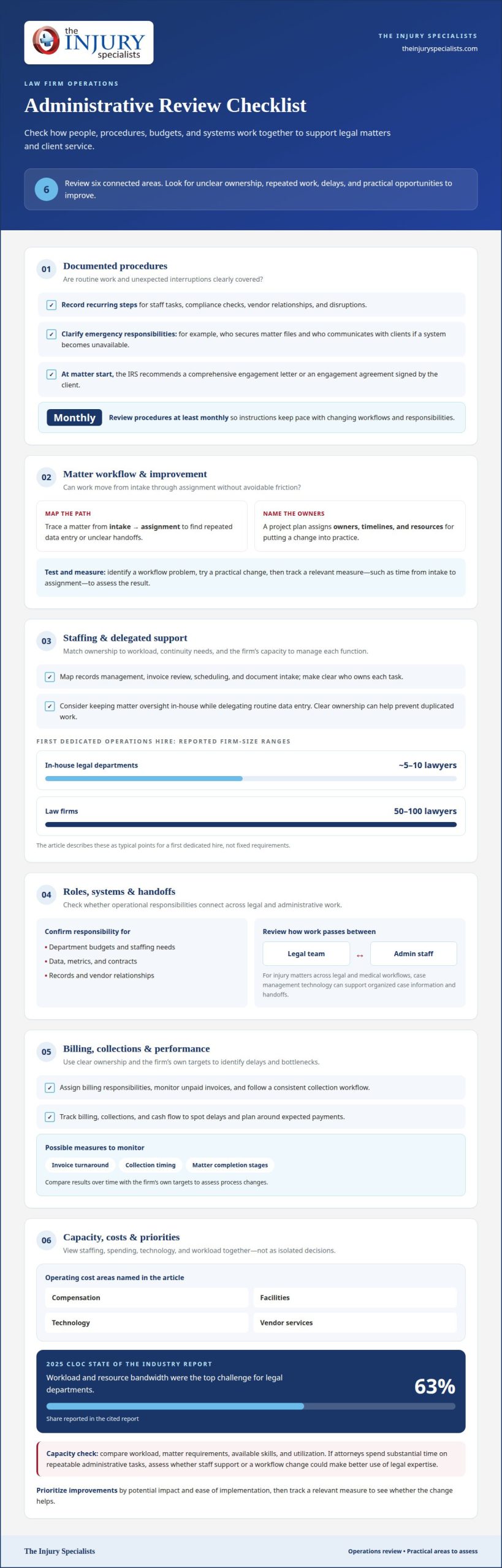
Documented procedures set out how staff handle recurring tasks, compliance checks, vendor relationships, and unexpected disruptions. For example, an emergency plan can identify who secures matter files and who communicates with clients if a system becomes unavailable. Clear steps reduce uncertainty during routine work and interruptions. At the start of a client matter, the Internal Revenue Service recommends using a comprehensive engagement letter or an engagement agreement signed by the client. Review procedures at least monthly to keep instructions current as workflows and responsibilities change.
Process Improvement and Project Management
Process improvement starts by identifying a workflow problem, testing a practical change, and reviewing the results. Project management assigns owners, timelines, and resources. For example, a department can map a matter’s path from intake to assignment to identify repeated data entry or unclear handoffs. A project plan gives staff a shared sequence for implementing and evaluating changes. Track a relevant measure, such as the time from intake to assignment, to assess whether the revised workflow is more efficient.
Operations Across Firm Sizes
Operational needs depend on a firm’s staffing structure, matter volume, and administrative capacity. A solo practice may centralize scheduling, billing, and file procedures with one person; a small firm may divide these tasks among legal and administrative staff. A larger firm may need dedicated operations coordination across departments, vendors, and practice groups. The core tasks remain similar, but ownership and coordination become more distributed as the firm grows.
Financial and Performance Measures
Financial operations track billing, collections, and cash flow, helping leaders spot delays and plan around expected payments. Firms can strengthen these processes by assigning clear billing responsibilities, monitoring unpaid invoices, and following a consistent collection workflow. Key performance indicators (KPIs) turn goals into measures, such as invoice turnaround, collection timing, or matter completion stages. Compare results over time with the firm’s own targets to find bottlenecks and assess process changes.
What administrative functions does an operations review cover?
An operations review examines how a legal department assigns work, uses support staff, and coordinates vendors. It connects staffing decisions with document flow, budgets, and client service.
In-House and Delegated Support
In-house operations hiring assigns ongoing coordination to a dedicated employee; delegated support covers defined tasks without creating that role. The right option depends on workload, continuity needs, and the firm’s ability to manage each function. In-house legal departments commonly make a first dedicated operations hire when they have roughly five to 10 lawyers. Law firms typically make their first dedicated hire at 50 to 100 lawyers.
Hiring and Outsourcing Tasks
Hiring or outsourcing can assign administrative work to people with the skills and capacity to complete it. An operations review can map tasks such as records management, invoice review, scheduling, and document intake, then clarify who owns each one. A firm might keep matter oversight in-house while delegating routine data entry. Clear ownership helps prevent duplicated work and gives managers a practical basis for assessing support needs.
Operations Roles and Responsibilities
Operations roles coordinate the systems that help lawyers and support staff move work through the firm. A review can clarify who manages the department budget, staffing needs, data and metrics, contracts, records, and vendor relationships. It can also examine how work passes between the legal team and administrative staff. For firms coordinating injury matters across legal and medical workflows, case management technology can support organized case information and handoffs.
Staffing, Compensation, and Utilization
Firms manage staffing by matching workloads and matter requirements with available skills, then assigning clear responsibility. Compensation should reflect each role’s scope, while utilization reviews compare attorney capacity with assigned work. Managers can review workload distribution, administrative demands, and matter progress together. If attorneys spend substantial time on repeatable administrative tasks, the firm can assess whether staff support or a workflow change would make better use of legal expertise.
Staffing, budgeting, and technology
Staffing, budgets, and technology shape how a firm assigns legal work and supports counsel. Together, these functions affect capacity, spending control, and client service.
Operating Costs and Profit Margins
Operating costs are the resources a firm uses to deliver legal work and maintain its business. Common categories include compensation, facilities, technology, and vendor services. Profit margins depend on revenue, staffing mix, matter workload, collection performance, and overhead, so firms assess these factors together rather than relying on a single benchmark. The 2025 CLOC State of the Industry Report says workload and resource bandwidth were the top challenge for 63% of legal departments. That pressure makes strategic budget planning central to managing capacity.
Software choices also affect operating costs. Practice management, e-billing, document management, and contract tools serve different purposes. Connect each purchase to a defined need, such as tracking matter status or reviewing invoices, then assess actual use and value.
Staffing and Budgeting
Staffing and budgeting align people and funding with the firm’s workload. A budget can separate personnel, technology, vendor, and training needs, then compare planned spending with actual use. In 2025, 87% of general counsel increased legal operations budgets, with those increases averaging 11%. This signals greater attention to operational capacity, but each firm’s resource decisions depend on its own priorities and workload.
To guide staffing decisions, leaders can map recurring tasks to roles and identify where lawyers spend time on administrative work. Budget owners can use this picture to assess whether the firm needs additional support, updated processes, or better use of existing tools. Revisit forecast assumptions when matter volume or staffing changes.
E-commerce functions can also support client billing workflows. Map invoice delivery, payment processing, and reconciliation as separate steps, then identify where staff enter or transfer data. A legal team can evaluate whether its existing technology supports these tasks before adding another system. Adoption matters as much as purchase: assign an owner, train users, and track whether the tool supports the intended work.
What are the key roles and responsibilities in law firm operations?
Law firm operations work best when each function has a clear owner and escalation path. A managing partner can set priorities, while an operations lead coordinates staffing, finance, technology, and administrative processes across the firm.
The managing partner or executive committee connects operational decisions to firm strategy. Leaders can set priorities, assign an accountable owner, and review progress at regular management meetings. A firm administrator or chief operating officer can then translate those priorities into schedules, budgets, facilities, and staff coordination. This division keeps strategic decisions with firm leadership and gives daily execution a clear point of responsibility.
A legal operations manager supports the legal team with data, project coordination, vendor oversight, and process analysis. The role can track matter intake, monitor records management, coordinate contract processes, and report on workload trends. Finance staff manage forecasting and billing information; human resources handles recruitment and personnel processes; technology staff maintain systems and support users. In a smaller firm, one person may cover several functions, so documenting ownership helps prevent tasks from falling between roles.
Attorneys remain responsible for legal judgment and oversight of delegated work. ABA Model Rule 5.3 requires attorneys to supervise and review non-lawyer personnel and their work as necessary. For example, a lawyer assigning document preparation should define the task, provide relevant matter context, and review the work appropriately. Operations staff can coordinate assignments and track completion, but they do not replace attorney supervision or legal decision-making.
Practice group leaders connect matter-level needs with firmwide operations. They can flag capacity gaps, clarify handoffs between lawyers and support staff, and share recurring workflow issues with the operations lead. A monthly review of open tasks, staffing assignments, and process measures helps leaders spot coordination problems early. Firms managing injury-related workflows can explore case management technology to support organized coordination across cases.
The Injury Specialists: Attorney Referral Program, medical case management based on firms distinct process, marketing and networking to grow referral partners.
The Injury Specialists supports law firms seeking to develop referral relationships and coordinate medical case management around their distinct processes. Its Attorney Referral Program combines medical case management with marketing and networking to help firms grow referral partnerships. This may suit firms looking to coordinate referral relationships alongside their existing matter workflows.
For firms building connections across medical and legal services, The Injury Specialists offers Physician Referral Services, Chiropractic and Physical Therapy Referrals, and Imaging Center Referrals. These services support referral connections, with case management aligned to the firm’s process. The right fit depends on the operational need, such as developing referral partners or coordinating case-related workflows.
Contact The Injury Specialists to discuss referral and case management support for your firm.
Turn Operational Priorities Into Your Next Move
Strong law firm operations management takes ongoing attention, not a one-time project. Choose an operational priority that can improve how your firm works with clients and professional partners. Assign a clear owner, define a practical measure of progress, and set a review point. This keeps the next change focused and helps firm leaders decide what to improve next.
For firms looking to build referral relationships within personal injury workflows, The Injury Specialists can explain how its attorney referral and medical case management support can align with the firm’s distinct process. A focused conversation can help determine whether this support matches the firm’s operational priorities.
Discuss your firm’s next step with The Injury Specialists and move forward with a clear operational focus.
Frequently Asked Questions
How can operational improvements affect law firm profitability?
Operational improvements can support profitability by reducing avoidable effort and helping the firm use its capacity effectively. For example, a clearer invoice review process can reduce corrections and help staff send accurate bills promptly. Leaders can also compare revenue and expenses by practice group to understand how resources are used. These measures can reveal where process changes may support stronger financial performance, without guaranteeing a particular result.
What is the right support staff ratio for a law firm?
A commonly cited planning range for well-run small and midsize firms is roughly one support staff member per one to two lawyers. Treat this as a reference point, not a fixed staffing formula. Practice areas, matter complexity, administrative workload, and technology automation all affect the support a firm needs. For example, a firm handling document-heavy matters may need different staff coverage than one with simpler workflows.
What does law firm operations management include?
Law firm operations management covers the business functions that help a firm deliver legal services, including staffing, financial planning, technology, vendor oversight, records, and workflow coordination. It can also include licensing administration, performance reporting, and knowledge management. For example, an operations review may clarify who tracks renewal dates, maintains shared templates, or reports on matter progress. The scope should reflect the firm’s structure and priorities.
What ethical and professional conduct rules affect law firm operations?
Professional conduct rules shape how firms supervise staff, handle client information, and manage entrusted funds. ABA Model Rule 1.15 governs trust accounting, so firms need clear processes for recording and reviewing trust transactions. ABA Model Rule 5.3 addresses attorneys’ supervision of non-lawyer personnel and their work as necessary. Operational procedures should support these responsibilities through defined roles, secure document handling, and appropriate review.
What are the risks of outsourcing law firm administrative functions?
Outsourcing can create risks when task ownership, information access, or quality expectations are unclear. A vendor’s schedules or systems may complicate handoffs and delay matter updates. Firms can reduce friction by defining the task, limiting access to necessary information, setting review points, and naming an internal owner. These controls help maintain continuity and keep responsibility clear.

Leave A Comment
You must be logged in to post a comment.