

Faster responses matter, but speed alone won’t create a consistent PI client experience. Improving the PI client experience starts with mapping the client journey, personalizing communication, responding promptly at important moments, and using client feedback to find friction. Together, these steps make responsiveness part of a repeatable process.
Clients want clear updates and a reliable sense of what happens next. When communication feels generic or questions go unanswered, the experience can feel disjointed. A defined approach helps teams make each interaction more relevant and keep the process moving.
This article explains how to map key points in the client journey, tailor communications to individual needs, and use technology to support timely responses. It also covers CSAT, CES, and NPS as ways to assess feedback and identify opportunities to improve. The result is a practical framework for strengthening client communication and making changes based on what clients actually experience.
Key Takeaways
- Map each stage of the client journey to spot delays, unclear handoffs, and moments that need a timely update.
- Personalize communication around each client’s needs, preferences, and place in the process.
- Use technology to streamline routine responses while keeping a clear path for more complex client questions.
- Track satisfaction, effort, and willingness to recommend to identify where communication can improve.
1. Customer journey mapping
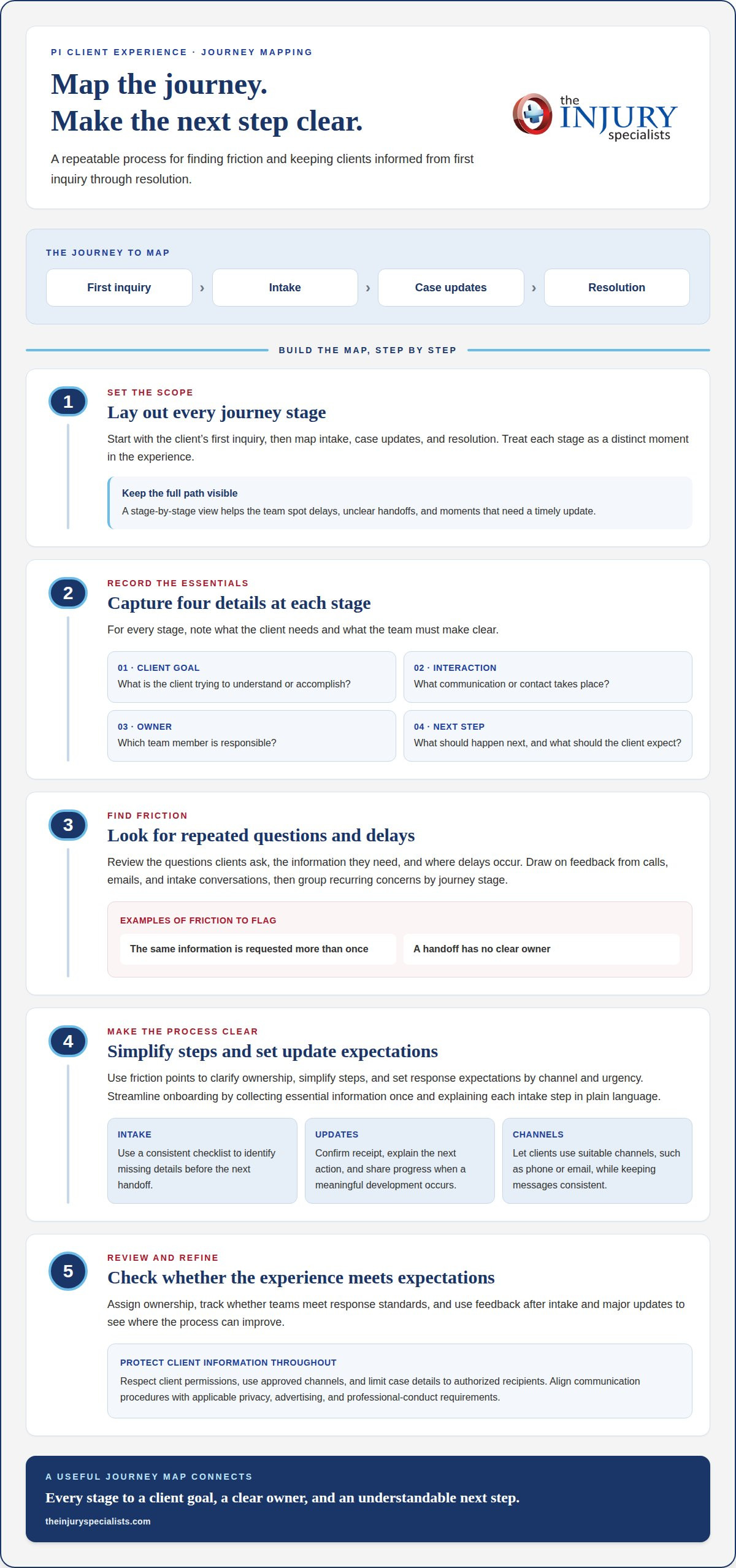
Map the PI client journey from first inquiry through intake, case updates, and resolution. At each stage, record the client’s goal, the interaction, the responsible team member, and the next expected step. For example, intake mapping can reveal repeated requests for the same information or a handoff with no clear owner. Use those friction points to clarify ownership, simplify steps, and set response expectations by channel and urgency.
Understand client needs by reviewing the questions they ask, the information they need, and where delays occur. Review feedback from calls, emails, and intake conversations, then group recurring concerns by journey stage. PI communications should protect confidential case information, respect client permissions, and follow applicable privacy, advertising, and professional-conduct requirements. Use approved channels and limit case details to authorized recipients. Align communication procedures with the rules that apply to the firm’s work and jurisdiction.
Streamline onboarding by collecting essential information once, explaining each intake step in plain language, and directing clients to the right contact for follow-up. A consistent checklist can help staff identify missing details before the next handoff. The cost of improving client experience depends on the project and is determined after a quote request; staffing, technology, workflow changes, and training shape the investment. Firms can start by identifying the intake bottleneck that creates the most repeated work.
Keep clients informed with a defined update process: confirm receipt, explain the next action, and share progress when a meaningful development occurs. An omnichannel approach lets clients use suitable channels, such as phone or email, while keeping the message consistent across interactions. Set response standards that match urgency, assign ownership, and track whether teams meet those standards. Speed, convenience, knowledgeable help, and friendly service are key drivers of positive customer experience. Feedback after intake and major updates can show whether the process meets expectations and supports loyalty.
2. Personalization
Personalization makes each interaction relevant to the client’s situation, not just their name. Accenture research found that 81% of consumers want brands to understand them better and know when to approach them. For a PI firm, that means matching communication to the client’s stage, questions, and preferred channel. Someone newly completing intake may need a clear explanation of next steps. A client awaiting a case update may need a concise status message instead.
Use journey mapping to connect client needs with specific actions. At intake, ask how the client prefers to receive routine updates and record that preference where the team can use it. When a client raises a concern by phone, staff can acknowledge it in the conversation and provide a written recap if appropriate. The goal is consistent, useful communication across channels, not repeated messages or unnecessary contact.
Personalizing the experience also means adapting the detail and timing of information. A client unfamiliar with legal processes may benefit from plain-language explanations of terms and milestones. A client who already understands the process may prefer brief updates focused on what changed and what happens next. Use feedback and prior interactions to refine those choices. Keep sensitive details limited to appropriate communications and recipients.
Make personalization operational with a simple workflow: record communication preferences, note unanswered questions, and tailor the next interaction to those details. Review feedback for patterns, such as clients asking for more frequent progress messages or clearer explanations. Then implement a focused change and assess whether it reduces confusion. These steps can improve customer experience without making each interaction feel scripted. Explore personalized client communication as one way to strengthen the journey from first contact onward.
3. Technology for faster response times
Technology can shorten the gap between a client’s question and a useful response. Start by identifying repeat requests, such as confirming receipt of documents or explaining the next intake step. Create approved response templates for routine questions, then assign a team member to review messages that need case-specific judgment. This gives staff a consistent starting point without making every response sound identical.
A shared case management platform can bring messages, task ownership, and case notes into one workflow. For example, when a client submits a document, the system can make the task visible to the staff member responsible for reviewing it. Clear ownership reduces the chance that an inquiry stays in an unmonitored inbox. Set internal response expectations by urgency, and use task reminders to flag overdue follow-ups.
AI-powered chatbots can be available 24/7 to answer routine questions, direct clients to the right process, or capture a message. They should not imply that a case-specific issue has been reviewed when it has not. A useful design gives clients a clear route to a person for sensitive questions, unusual circumstances, or requests that require professional judgment. That distinction helps an organization improve customer access while keeping answers appropriate.
Build technology workflows around actual client needs, not just a platform’s feature list. First, decide which inquiries can receive an automated acknowledgment. Next, define which topics require staff review and who owns each handoff. Then test the process with examples such as a missed callback request or an urgent case update. Review response records and client feedback to identify delays, confusing automated messages, or repeated transfers. Technology helps when it makes the next action clear, aligns with client expectations, and supports accurate responses across communication channels.
4. CSAT, CES, and NPS metrics
CSAT, CES, and NPS measure different aspects of a PI client relationship. CSAT captures satisfaction with a specific interaction, such as an intake call or case update. CES measures how easy clients found a task, such as submitting documents or getting an answer. NPS asks how likely a client would be to recommend the firm to a friend. Together, these measures offer more useful insight than a single general rating.
Choose the moment and question carefully. After an intake call, ask clients to rate their satisfaction and identify what could have been clearer. After a document submission, ask how easy the process felt. Use NPS at an appropriate relationship touchpoint, rather than treating it as a score for one staff interaction. Keep each survey short, and explain how responses will inform service improvements.
Leading PI firms can compare client experience by using the same questions, timing, and response scales across comparable stages. Review themes in public reviews, such as communication clarity or responsiveness, alongside direct feedback. Avoid treating star ratings alone as a reliable ranking: review volume, client circumstances, and timing can differ. Internally, compare trends across teams or journey stages to identify specific pain points.
Use survey software or a consistent tracking sheet to group responses by interaction type and date. Review comments alongside scores; a low CES after intake may point to confusing forms, while strong CSAT after a call may reflect clear explanations. BankUnited recorded a 104% increase in net promoter score and customer satisfaction after its customer-service transformation, illustrating how measurement can accompany operational change. Also, 90% of customers who are highly satisfied with a brand say they are highly likely to return. Treat that finding as context, not a promise of future outcomes.
Turn feedback into action: identify a recurring issue, assign an owner, implement a change, and review later responses. For a more structured approach, explore an Attorney Referral Program that includes medical case management based on a firm’s distinct process.
The Injury Specialists
The Injury Specialists connects personal injury firms and healthcare providers through referral programs and professional networking. For firms seeking stronger coordination across the client journey, its Attorney Referral Program includes medical case management based on the firm’s distinct process, alongside marketing and networking to grow referral partners.
Healthcare providers can use Physician Referral Services, Chiropractic and Physical Therapy Referrals, and Imaging Center Referrals to support connections across the personal injury ecosystem. Case Management Technology provides digital platform access for case handling. These services can help firms and providers organize referral management as they refine their broader client experience.
Contact The Injury Specialists to discuss how its programs may align with your organization’s referral and case management needs.
Make the Next Improvement Count
A better client experience takes shape through consistent operational choices. Choose one friction point that affects how clients receive updates or move through the process, then make it a priority for the team. Clear ownership turns that priority into a working practice, while regular review helps keep it aligned with client needs as workflows change.
Improving the PI client experience is an ongoing commitment, not a one-time project. The next step is connecting your firm’s communication goals with the referral and case-management processes that support them. The Injury Specialists connects firms and healthcare providers through personal injury referral management and digital case-handling tools, helping organizations build professional relationships suited to their operations.
Build from the process you have, identify where coordination can improve, and bring the right partners into the conversation. Contact The Injury Specialists today to discuss your organization’s needs and next steps.
Frequently Asked Questions
How can PI firms measure client satisfaction and experience?
Review CSAT, CES, and NPS trends alongside client comments, rather than treating a single score as the full picture. Compare results by case stage, communication channel, or team to locate recurring friction. For example, repeated complaints after document requests may signal a confusing process. Assign someone to review feedback, record the action taken, and check later responses for changes.
What are best practices for improving communication with PI clients?
Give clients a clear way to identify their case contact and explain what information that person can provide. If staff need time to answer, acknowledge the request and say when the client can expect an update, without promising a case outcome. For sensitive messages, confirm the recipient and use approved communication channels. These habits make improving the PI client experience a matter of dependable, transparent practice.
What technology can improve the PI client experience?
Tools that centralize case notes and client interactions can help staff review previous questions before responding. A searchable record also reduces unnecessary requests for information clients have already provided. Firms can assess whether their software supports clear task ownership, secure handling of case details, and useful reporting. Technology should make staff coordination easier while leaving nuanced or sensitive issues to appropriate human review.
What are common client complaints about PI services, and how can firms address them?
Firms should watch for feedback about delayed updates, unclear explanations, repeated information requests, or difficulty reaching the right person. Treat each complaint as a signal to examine the relevant handoff or communication step, not as an isolated problem. For example, if clients report uncertainty after submitting paperwork, clarify what happens next and who will follow up.
What steps can a PI firm take to build a client-experience improvement plan?
Start by selecting one client journey stage that needs attention, then document the problem using feedback and staff observations. Set a practical process change, assign an owner, and choose a measure that can show whether the change helps. Share the updated workflow with everyone involved, collect new feedback, and refine the plan if the same obstacle continues to appear.

Leave A Comment
You must be logged in to post a comment.