

A case can lose clarity well before settlement or court. Personal injury medical case management uses a checklist to bring medical records, treatment updates, bills, insurance payments, and write-offs into one organized view. This helps a legal team track what has arrived, what is still outstanding, and how medical expenses relate to the claim.
When care involves several providers, paperwork and payment details can quickly become difficult to follow. A consistent checklist makes these moving parts easier to monitor without assuming every billed amount is recoverable. This article explains what to track across treatment and billing, why checklists matter, and how organized documentation supports settlement preparation or court proceedings. It also covers how medical case management can coordinate records, provider communication, and case information as treatment progresses.
Key Takeaways
- Organize treatment records, provider updates, and case communications so the injury timeline is easier to follow.
- Use recurring checklist reviews to spot missing documents, treatment gaps, and stalled follow-ups earlier.
- Track billed charges alongside insurance payments, adjustments, and remaining balances; billed amounts alone don’t establish recoverable expenses.
- Bring medical records and billing details together before settlement preparation or court proceedings to clarify what supports the claim.
Medical documentation for settlement negotiations or court
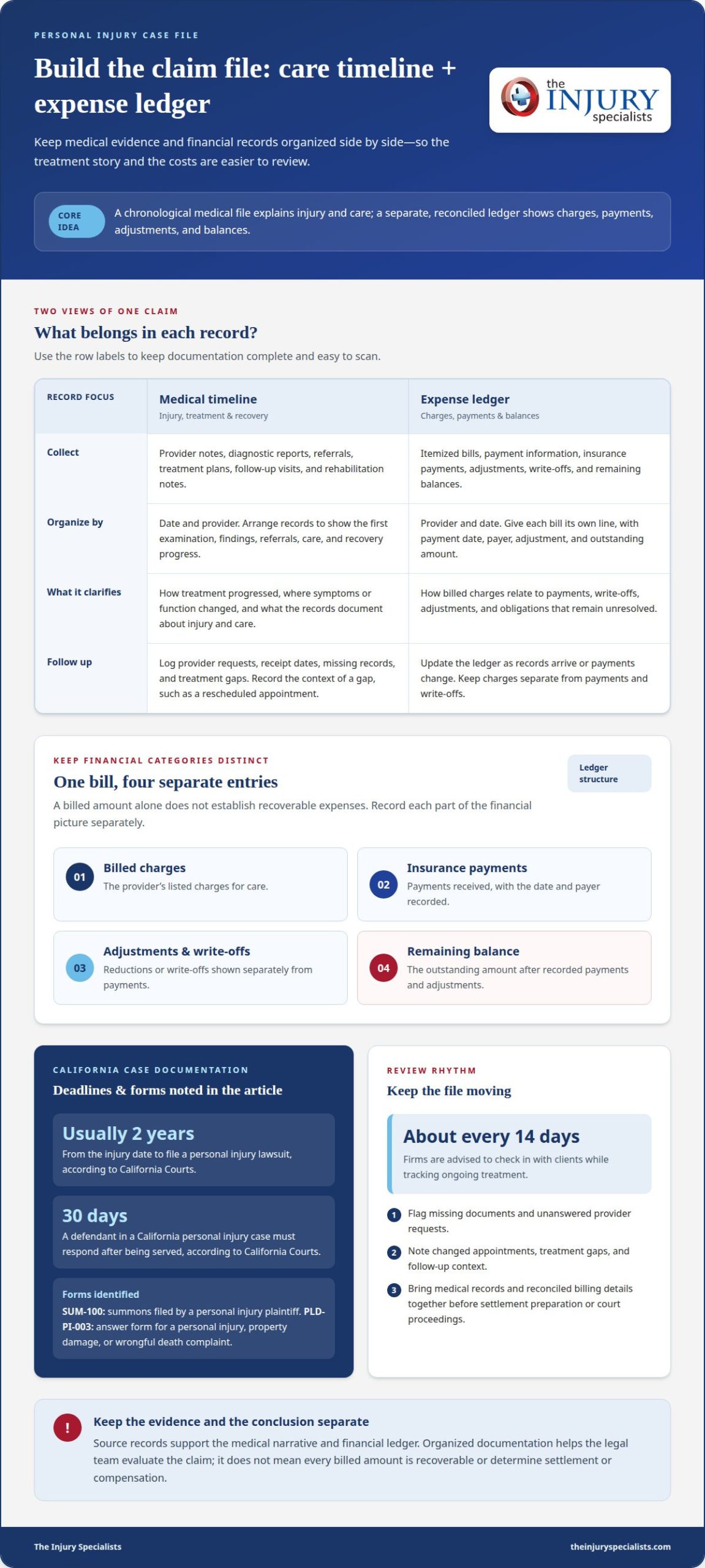
Medical documentation connects the injury, treatment, and financial effects of a claim. A chronological file can show the first examination, diagnostic findings, referrals, treatment plan, follow-up visits, and recovery progress. For example, place an imaging report alongside the provider’s assessment and later rehabilitation notes. This sequence helps explain how treatment progressed and where symptoms or function changed.
Build the record around dated, identifiable documents. Include provider notes, diagnostic reports, itemized bills, payment information, and communications about outstanding records. A medical narrative can summarize the patient’s history, examination, diagnosis, and treatment, while source records support those details. Record treatment gaps and document their context, such as a rescheduled appointment. This gives the plaintiff’s legal team a clearer basis for evaluating the claim and preparing evidence.
California deadlines and court forms also shape case documentation. California Courts states that an injured person usually has 2 years from the date of the injury to file a personal injury lawsuit. In California, a defendant in a personal injury case must respond within 30 days of being served, according to California Courts. A personal injury plaintiff must file a summons using form SUM-100, according to the Judicial Council of California. California personal injury defendants can use form PLD-PI-003 to answer a personal injury, property damage, or wrongful death complaint, according to the Judicial Council of California.
For demand preparation, organize records by provider and date, then reconcile each bill with insurance payments, adjustments, and balances. A demand package may include medical and billing records, photographs, lost-earnings documentation, and a claim summary. This allows the legal team to review documented treatment and expenses before presenting a settlement request to insurers. Keep billed charges separate from payments and write-offs, since each represents a different part of the financial record.
During settlement negotiations, update the file as records arrive or payments change. A concise settlement ledger can list charges, payments, write-offs, and unresolved balances in separate columns. This gives the team a clear view of documented expenses and outstanding obligations, while medical records explain the injury and care. Organized evidence supports a reasoned discussion of compensation without assuming every billed amount is recoverable.
Why use a personal injury case management checklist?
A checklist brings care coordination, record follow-up, and communication tasks into one workflow. Personal injury medical case management uses this structure to keep important case updates visible.
Collecting and Documenting Medical Records
Medical record collection tracks provider notes, diagnostic results, and billing documents from request to receipt. Each record can contribute different evidence about the accident, treatment, or recovery. When choosing a medical case manager, assess relevant experience, role boundaries, record-handling practices, and communication methods. A nurse case manager has a nursing role; medical case manager is a broader term, and duties and credentials vary. Log provider requests, receipt dates, and missing items.
Privacy, Timing, and Claim Effects
Privacy and consent practices guide how case-related health information is shared. Use appropriate authorization for record access, limit sharing to relevant participants, and document what was sent. Case management can be useful when care involves several providers, referrals, or rehabilitation, or when updates are difficult to coordinate. Personal injury medical case management can help legal teams review records and assess a claim, but it does not determine settlement or compensation.
Communication Challenges and Insurer Risks
Communication problems arise when provider updates, client reports, and case files don’t match. A checklist can flag unanswered requests, changed appointments, and missing updates. An insurance company case manager works within the insurer’s process, so clarify the manager’s role and information-sharing boundaries. This helps the patient understand who receives updates and why. Diagnostic results and therapy notes can document different aspects of injury severity and recovery, giving the legal team context for evaluating the claim.
For firms refining coordination workflows, structured case coordination can be a relevant next step.
Medical records can document injury type and severity, the course of treatment, and improvements or setbacks in recovery. Diagnostic tests, physical therapy notes, and other treatment records can show how an injury affects daily life. X-rays, MRIs, and surgical records may provide evidence about the injury and a person’s physical condition.
Personal injury case management checklists can help reduce human error, case stagnation, last-minute documentation scrambles, and financial surprises at settlement. Personal injury case managers can help coordinate communication among patients, healthcare providers, and legal teams. Firms are advised to check in with clients about every 14 days while tracking ongoing treatment.
Medical bills, insurance payments, and write-offs
Separate each provider’s billed charges from insurance payments, adjustments, write-offs, and the patient’s remaining balance. A ledger, for example, can give each bill its own line and record the payment date, payer, adjustment, and outstanding amount. This makes financial progress visible and gives the attorney a clearer basis for reviewing claimed damages.
An insurance company’s request to work with its case manager is different from a requirement to do so. Applicable policy terms and any signed authorization define cooperation duties and the information the case manager may access. Keep the patient informed about the manager’s role, planned communications, and documents being shared.
Who pays for medical case management depends on who arranged the service and the engagement terms. Identify the responsible party, covered work, and any amount assigned to the patient or claim. Keep this arrangement separate from medical bills and insurance write-offs, so the settlement review does not confuse case-management charges with treatment expenses.
Coverage records help explain how each charge was handled. In California, the medical-expense analysis may depend on whether health insurance paid bills, whether amounts were written off, whether the patient remains responsible, and whether treatment occurred outside an available insurance plan. The fact that treatment was provided does not by itself establish that it was reasonably necessary, and necessary care does not automatically make its charged amount reasonable.
Before preparing a demand, reconcile provider statements with insurer explanations and payment records. Flag duplicate charges, unexplained adjustments, missing bills, and balances that need further documentation. Then give the attorney a current summary of billed amounts, payments, write-offs, and patient responsibility. This helps the attorney assess documented expenses and communicate clearly with insurers during negotiations. Updated figures also support informed settlement discussions while preserving the distinction between billed charges and amounts that may be recoverable as damages.
Personal injury case management checklists
A structured checklist connects intake, medical care, documentation, and settlement preparation. In personal injury cases, clear task ownership helps teams track recovery and identify delays before they affect case progress.
Organizing Case Tasks
A case checklist assigns each task, status, and next action to a responsible team member. This matters because a missed records request or untracked lien can delay later review.
At intake, record incident details, identify the statute-of-limitations date, and complete signed retainers and records-release authorizations. Log each provider, request date, records received, and outstanding bill. During treatment, note appointments, referrals, reported gaps, and changes in the patient’s ability to work or manage daily activities. A 30/60/90-day audit cadence can review current records, calendared deadlines, and outstanding lien statements. Assigning a person and follow-up date to each open task makes ownership visible.
Tracking Post-Accident Care Steps
The post-accident process tracks care and documentation from initial attention through settlement preparation. A consistent sequence matters because each stage creates information needed for the next review.
- Arrange prompt medical attention and record the initial reported symptoms and findings.
- Identify treating providers, coordinate referrals, and document appointments and care-plan changes.
- Request and log medical records and bills as treatment progresses, noting gaps or missing items.
- Track rehabilitation progress, setbacks, and effects on the patient’s function and ability to work.
- Review records, bills, liens, and settlement documents before preparing the case for resolution.
At each review, compare provider updates with the case timeline. For example, record the date and documented explanation when a missed therapy visit is followed by a new treatment plan. This helps the team present a coherent account of care and show what the evidence establishes, without treating the checklist itself as proof.
Use a consistent workflow to coordinate medical case management across providers and legal teams. Explore coordinated case management for a structured approach to referral and case workflows.
The Injury Specialists
The Injury Specialists connects medical and legal professionals through referral programs and medical case management. For providers coordinating injury-related care, Physician Referral Services and medical case management support referral relationships and case coordination. Chiropractic and Physical Therapy Referrals, along with Imaging Center Referrals, connect relevant provider categories within the network.
Law firms can use the Attorney Referral Program, which includes medical case management tailored to each firm’s distinct process, along with marketing and networking to grow referral partners. This can be a practical next step when a firm or provider needs structured coordination and professional connections around personal injury cases. The Injury Specialists supports these professional workflows, rather than providing legal representation or medical treatment.
Contact The Injury Specialists to discuss your firm’s or practice’s case management and referral needs.
Make case coordination part of the workflow
A checklist works best when it becomes part of the team’s regular case process. Assign ownership, keep status updates visible, and use each review to identify unresolved handoffs. This makes personal injury medical case management an operational routine that can adapt as treatment, documentation, and case needs change.
For providers and firms, The Injury Specialists supports coordination through Physician Referral Services, medical case management, Chiropractic and Physical Therapy Referrals, and an Attorney Referral Program tailored to each firm’s distinct process. Marketing and networking support referral relationships. These services can connect professional workflows as teams build a consistent approach to injury-related cases.
Set a clear next step for your organization, whether that means strengthening referral relationships or aligning case coordination with your firm’s process. Connect with The Injury Specialists to discuss the approach that fits your work. A well-defined workflow gives your team a practical foundation for moving forward.
Frequently Asked Questions
What is medical case management in a personal injury case?
Medical case management coordinates injury-related care and case information across the people involved. For example, after a patient moves from imaging to rehabilitation, case management can help align updates and records across providers. It supports organized communication and continuity, while treating professionals provide care and the legal team makes legal decisions.
What does a personal injury medical case manager do?
A medical case manager coordinates information and communication related to care and the injury claim. For example, when a provider changes a treatment plan, the manager can help route relevant updates to appropriate participants and keep case information current. The manager facilitates coordination, but does not replace the patient’s healthcare providers or the attorney’s legal work.
