

Continuity of care is built into the handoff, not assumed. Ensuring continuity of care for PI clients means coordinating transitions, keeping documentation clear and current, introducing incoming team members through warm handovers, and maintaining regular communication. These steps help everyone involved understand the care plan and the next action.
Personal injury care can involve multiple professionals and changing needs. When a transition leaves important details unclear, it can disrupt the plan and undermine a client’s confidence. Coordinated communication helps care move forward while giving clients a clear understanding of what to expect.
This article explains how to structure provider transitions, what case notes should capture, and how warm handovers and ongoing updates can support trust. You’ll also find practical ways to spot gaps early, clarify responsibilities, and make transitions easier for clients and care teams to manage.
Key Takeaways
- Map each transition before it happens, with clear next steps, assigned responsibilities, and follow-up plans.
- Keep case notes current so incoming team members can quickly understand the client’s needs and ongoing plan.
- Use a warm handover to introduce the incoming case manager and preserve a sense of continuity.
- Set a regular communication rhythm to share updates, address concerns, and keep clients involved in decisions.
- Track missed appointments and changes in engagement so the team can respond early and reduce care gaps.
1. Care transitions and coordination among clinicians
Personal injury care can cross several clinical settings and involve multiple professionals. Medicare patients have reported receiving care from five or more physicians within a year. For some patients with one condition, as many as 50 interactions may occur over three months. A transition plan helps each clinician see the next step, the responsible person, and information needed to continue care.
Start with a shared assessment of current needs, scheduled services, and outstanding recommendations. With appropriate patient permissions and secure processes, participating providers can use a shared case file to coordinate relevant updates. Record the care plan, referral status, upcoming appointments, and the person responsible for follow-up. This gives physicians a consistent reference instead of relying on separate messages or the client’s memory.
Physician collaboration works best when clinicians share relevant information promptly and stay engaged in referrals. The referring physician can clarify a recommendation or discuss an alternative if the receiving provider identifies a mismatch. For example, if a client’s needs change and the current provider’s clinical focus is no longer appropriate, the care coordinator can help arrange a better-fitting referral. Provider communication should support informed decisions, not duplicate or contradict instructions.
HIPAA allows providers to share protected health information for treatment, care coordination, and continuity of care without patient authorization. Teams should still share only relevant information through appropriate channels and explain the transition to the client. Clear communication helps clients understand which professionals are involved and what information will support the next stage of care.
Missed appointments and delayed treatment can interrupt the care plan, postpone clinical follow-up, and leave changes in a client’s condition unaddressed. Track missed visits, contact the client, and document the outcome and next action. Before discharge, coordinators should ensure follow-up appointments are scheduled with the primary care provider and needed specialists. Hospitals can also follow up within 72 hours of discharge to identify early problems at home.
Who pays for ongoing medical care while a personal injury claim is pending depends on available coverage and the billing arrangement. The client and care team should identify the payer for each service and clarify how outstanding balances will be handled. A pending claim alone does not determine who pays.
As health needs evolve, update the assessment and transition plan instead of relying on an outdated referral. Name the next provider, outline their role, confirm the appointment, and assign follow-up. Ensuring continuity of care for PI clients means connecting these steps across clinicians, agencies, and care settings.
2. Case documentation and warm handovers during staff changes
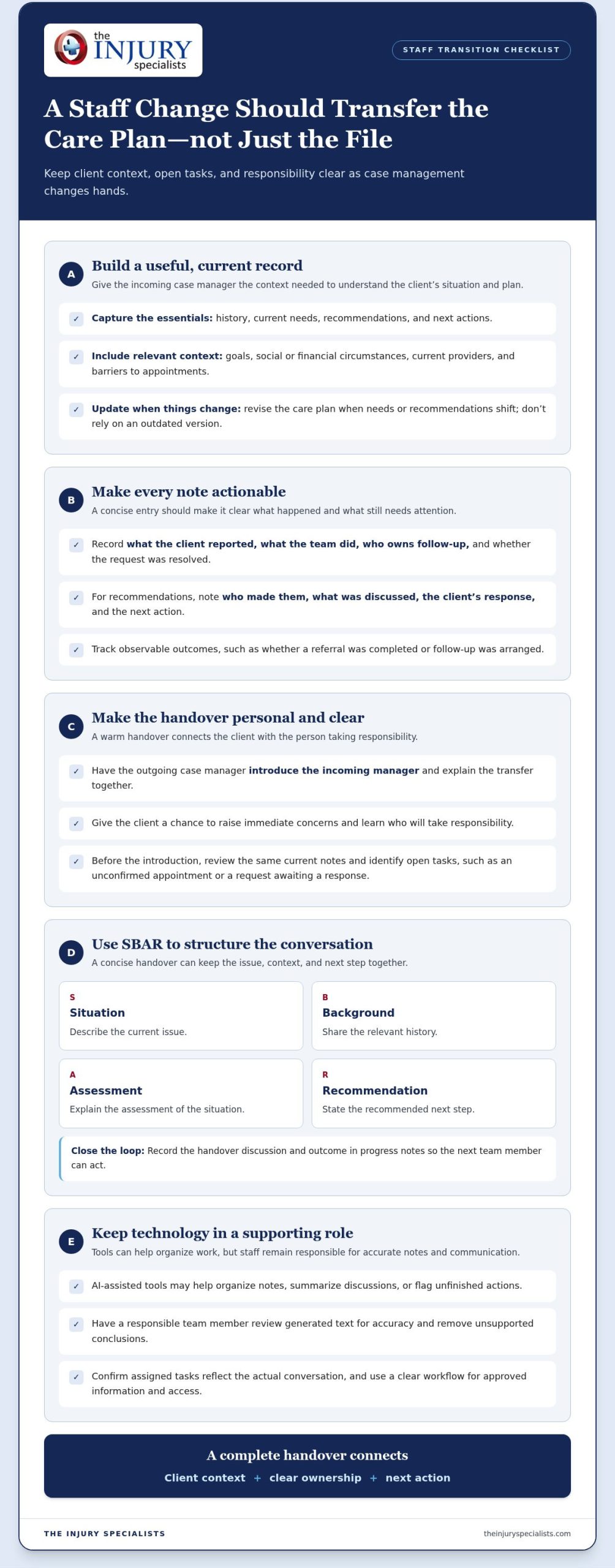
A staff change should transfer the client’s working care plan, not just a case file. Keep notes current so an incoming case manager understands the client’s history, needs, recommendations, and next actions. For example, a concise entry can state what the client reported, what the team did, who owns follow-up, and whether the request was resolved.
Use a consistent structure for routine documentation, then tailor each care plan to the individual. A template can prompt staff to capture goals, relevant social or financial circumstances, current providers, and barriers to appointments. The assessment gives the team context; the individualized plan turns that context into practical actions. Update it when needs or recommendations change, rather than letting an old version guide new decisions.
For a staff transition, arrange a warm handover. The outgoing case manager introduces the incoming manager to the client and explains the transfer together. This gives the client a chance to raise immediate concerns and learn who will take responsibility. Before the introduction, both managers should review the same current notes and identify open tasks, such as an unconfirmed appointment or a request awaiting a response.
SBAR provides a concise structure for the conversation: Situation, Background, Assessment, and Recommendation. The outgoing manager can describe the current issue, relevant history, assessment, and recommended next step. For instance, if a client reports a new obstacle to attending care, the handover should capture the concern and the agreed follow-up. Record the discussion and outcome in progress notes so the next team member can act.
AI-assisted documentation and task tools may help organize notes, summarize discussions, or flag unfinished actions. They should support staff, not replace clinical judgment or communication with the client. Have a responsible team member review generated text for accuracy, remove unsupported conclusions, and confirm that assigned tasks reflect the actual conversation. A clear workflow also specifies where approved information can be entered and who may access it.
Document clinical recommendations with enough context to make later decisions understandable. Record who made the recommendation, what was discussed with the client, the client’s response, and the next action. If a higher level of care or an additional service is discussed, include it in progress notes. Then track observable outcomes, such as whether a referral was completed or follow-up was arranged.
Case management technology can help teams keep case notes, care plans, and tasks organized in one workflow. Use case management technology to support consistent documentation and clear task ownership. The process still depends on accurate entries, timely updates, and a warm introduction when the person responsible for the case changes.
3. Trust and regular communication between case managers and clients
Set a communication rhythm at the start of care. The case manager can agree with the client on preferred contact methods, update frequency, and the best person to reach when plans change. A brief progress check can confirm whether an appointment happened, instructions were understood, or a new barrier needs attention. Regular updates make responsibilities clear and give clients a practical way to raise concerns.
Clients can help avoid treatment gaps by keeping a current appointment list, notifying the care team about cancellations, and sharing new instructions from clinicians. They should also report barriers such as transportation, mobility, language, or scheduling needs. The case manager can coordinate next steps with the relevant provider and record who will follow up. If a client misses an appointment, prompt outreach can clarify the reason and support re-engagement.
Provider communication needs structure, too. SBAR, meaning Situation, Background, Assessment, and Recommendation, helps clinicians share essential context without burying the next action in lengthy notes. A team huddle can review client updates, flag care concerns, and assign follow-up. For example, the group can identify a pending referral, name the person responsible for contacting the receiving office, and document the result.
Caregivers and community agencies may also have information that affects a smooth transition. With appropriate information-sharing practices, the case manager can coordinate practical support with a caregiver and connect the client with relevant transportation, housing, or family resources. Advance care planning can record the client’s preferences and support needs, helping the team communicate those priorities when health circumstances change. Keep the client involved in decisions and explain each action in clear, accessible language.
Clients looking for providers who accept liens or letters of protection can ask their attorney or case coordinator about referral options. Before scheduling, clarify directly with the provider whether that payment arrangement is accepted and what documentation the office needs. The provider’s billing process and the client’s case arrangements determine whether the option is suitable.
Language access matters, too. A client with limited English proficiency may benefit from an interpreter or translated materials to understand instructions and choices. Record the preferred communication method and any accommodation needed. When clients understand the plan, they can participate more effectively and alert the team when something changes.
Use a simple follow-up loop: share the update, name the responsible person, agree on the next action, and record the outcome. This keeps provider communication efficient and gives the client a consistent point of contact. Regular progress checks can also help the team spot disengagement early and reconnect before an unresolved concern causes a larger interruption.
4. Definition and benefits of continuity of care
Continuity of care means healthcare remains coordinated and consistent as a person’s needs, providers, or care setting change. For a personal injury client, the goal is a connected experience, not simply a sequence of appointments. The next clinician should understand relevant history, current priorities, and the plan already underway. That context helps teams avoid treating each transition as a fresh start.
A multidisciplinary review in the BMJ identified three types of continuity across disciplines: relational, informational, and management continuity. Relational continuity means a consistent connection with a clinician or care team. Informational continuity carries important details between providers. Management continuity keeps the care approach aligned as responsibilities shift. Consider a client moving from a hospital to outpatient care: all three types matter for a coherent transition.
These forms of continuity support practical goals. A consistent relationship can help clients raise concerns and stay engaged. Shared information can help a new clinician interpret earlier recommendations. Coordinated management connects decisions across providers and settings. Research published as far back as 2018 found an association between higher continuity rates and reduced all-cause mortality. A study across nine countries reported an 81.8% reduction in mortality among patients receiving continuity with the same medical provider. These findings describe associations, not a guaranteed outcome for an individual.
Continuity also gives teams a clearer way to assess progress. Set a goal with the client, identify the next clinical action, and decide how the team will review the result. For example, after a specialist visit, the care team can record the recommendation and check whether it fits the client’s overall plan. This makes follow-through visible and supports informed participation.
Discharge is a key test of coordination. Before a client leaves one setting, identify the next provider, the follow-up plan, and any support needed to carry it out. A scheduled appointment and clear instructions help connect the current episode of care with the next one. If the plan changes, update relevant team members so the client does not receive conflicting guidance.
Poor continuity of care costs the United States billions of dollars each year. For individuals, fragmented care can also mean repeated explanations, unclear next steps, or recommendations that are difficult to reconcile. A practical review can reveal these gaps: check whether the client knows the next action, each provider has the necessary context, and someone owns follow-up. These checks turn continuity from an aspiration into an everyday practice.
5. Care continuity, client trust, and satisfaction
Clients judge care by more than individual appointments. They also notice whether providers share information, explain changes, and follow through on agreed actions. Looking at the full client experience helps teams identify where trust can weaken. For example, repeated requests to explain the same injury may signal that records are not reaching the next provider.
Trust grows through predictable, respectful communication. Tell clients who will contact them, what the next step involves, and how to report a change. Then close the loop by sharing the outcome. If a referral is delayed, explain its status and record who owns the follow-up. Clear expectations reduce confusion without promising a particular clinical result.
Fragmented care can affect health outcomes as well as confidence. A 2023 systematic review identified a significant association between fragmented care and adverse outcomes of chronic illnesses. That finding supports practical strategies: keep records accessible to authorized care teams, involve clients in decisions, and review whether transitions match current needs. Ask clients to explain the next step in their own words, then clarify any misunderstanding.
Research also raises questions about unnecessary procedures and continuity. An analysis of 1.2 million Medicare patients examined unnecessary medical procedures and continuity of care. In a study of Medicare patients in the United States, 14% received at least one unnecessary medical procedure. These findings do not establish that any single handoff causes an unnecessary procedure. They do reinforce the value of sharing relevant records and coordinating recommendations before care proceeds.
Insurance arrangements can affect continuity through coverage limits, provider networks, authorization steps, and billing coordination. Record each plan’s requirements and who handles approvals, so administrative questions don’t interrupt clinically recommended care. Keep insurance discussions separate from clinical decisions, and clarify the next administrative action with the responsible person.
Client satisfaction improves when the care process is understandable and responsive. Use progress checks to learn whether instructions were clear, appointments were manageable, and the client knows whom to contact. If transportation or mobility creates a barrier, identify accessible resources and update the plan. Each response should lead to a named next step, not an open-ended promise.
Teams can review continuity with a simple check: confirm the client’s priorities, identify the next provider, verify that relevant records are available, and assign follow-up. Revisit the plan when symptoms, recommendations, or circumstances change. This approach connects trust to observable actions and gives clients a clearer role in their care. Consistent follow-through is a practical measure of a dependable relationship.
The Injury Specialists: Physician Referral Services, medical case management, marketing and networking to increase referral partners.
The Injury Specialists supports personal injury care coordination through medical case management and referral programs. Healthcare providers and law firms can turn to these offerings when they need structured connections across care and case workflows. Physician, chiropractic, and physical therapy referrals can help connect clients with appropriate providers, while the Attorney Referral Program includes case management based on a firm’s distinct process. Marketing and networking support referral-partner growth, and imaging center referrals can connect clients with imaging services. These offerings complement the coordination practices described above; they do not replace clinical decisions or direct legal representation. To discuss referral and case management needs, visit The Injury Specialists.
Build a stronger handoff process
A durable approach to ensuring continuity of care for PI clients starts by making coordination part of everyday case workflows. Set clear ownership for follow-up, keep communication pathways practical, and review where transitions most often stall. Then use those insights to strengthen relationships among the people supporting each case.
For organizations managing personal injury referrals, the next step is to connect care coordination with a process that fits their needs. The Injury Specialists offers medical case management and referral services to support connections between legal and healthcare professionals. A conversation can help identify how these services may align with your workflow and referral goals.
Contact The Injury Specialists to discuss your organization’s coordination needs. With clear ownership and purposeful collaboration, teams can create a more consistent experience for clients and build confidence at every transition.
Frequently Asked Questions
How do you provide and ensure continuity of care?
Make each change in care traceable from the client’s perspective. For example, after a specialist changes a recommendation, update the current plan, identify which existing appointments are affected, and communicate the revised sequence to the client. Resolve conflicting instructions before treating them as a shared plan. A brief review after a transition can show whether the client understands the change and knows who handles follow-up.
What are the best practices for promoting continuity of care?
Use one current care plan as the working reference, with a clear update date and named owner. When staff provide coverage, give the covering team access to active tasks and recent decisions, not just background records. Review the plan when a provider changes, a recommendation is revised, or the client reports a new barrier. This change-triggered approach keeps information useful instead of letting routine reviews miss important developments.
What is the difference between continuity of care and continuum of care?
Continuity of care describes how connected and consistent a person’s care remains across providers, visits, or settings. A continuum of care describes the range or progression of services available, such as care moving from a hospital setting to outpatient support. A client may move along a continuum while experiencing poor continuity if providers lack shared context. The terms are related, but describe different aspects of care delivery.
What is the primary goal of continuity of care?
The primary goal is to keep care coherent as responsibilities or circumstances change, while aligning decisions with the client’s needs and preferences. For example, when a client sees a new specialist, relevant history should help that clinician understand prior decisions and avoid unnecessary repetition. The team can assess progress by checking whether the client understands the plan, receives coordinated recommendations, and can take the next step.
What practical strategies can agencies use to improve continuity?
Agencies can create an exception queue for cases with unresolved referrals, conflicting instructions, or repeated missed visits. Assign a staff member to review each exception, record the next action, and close the item when resolved. Periodically reviewing a sample of completed cases can reveal recurring handoff failures, such as missing appointment outcomes. Use those findings to adjust templates, training, or team workflows instead of adding documentation that does not address the underlying problem.
What are best practices for ensuring continuity of care for personal injury clients?
Connect the care timeline to the client’s reported functional changes and evolving needs. For example, after a client reports difficulty completing a daily activity, record the concern accurately and route it to the appropriate treating professional for clinical assessment. Keep the client’s account distinct from clinical findings, and don’t present assumptions as diagnoses. This separation helps professionals interpret records and make decisions based on appropriate information.
How should providers coordinate referrals and share records for personal injury clients?
Include the referral reason, relevant clinical context, records requested, and intended receiving professional. HIPAA allows providers to share protected health information for treatment, care coordination, and continuity of care without patient authorization. Use secure channels and share information relevant to the purpose. If the receiving office identifies a missing record or unclear referral detail, direct that issue to the responsible sender and document its resolution.
What technology and care plans help track treatment and follow-up for personal injury clients?
Choose tools that let authorized team members see current tasks, referral status, appointment outcomes, and the latest care-plan version. A useful task should identify an owner and completion status, rather than display only a reminder. For example, a referral tracker can distinguish “sent” from “appointment completed.” Technology should organize information and support follow-through, while clinicians remain responsible for interpreting records and making clinical decisions.

Leave A Comment
You must be logged in to post a comment.