

Medical expertise alone does not establish credibility; it must be supported by sound judgment and trustworthy conduct. Establishing credibility with medical experts means demonstrating relevant competence, integrity, empathy, and the ability to build a respectful, psychologically safe professional relationship.
Medical professionals reasonably assess more than confidence or polished communication. They look for expertise grounded in appropriate training and experience, clear reasoning, and respect for the people affected by medical decisions. Strong communication helps, but it cannot replace those foundations.
This article explains how competence, integrity, empathy, psychological safety, and relevant medical expertise shape professional credibility. It also explores how credentials, clinical evidence, and fair attention to bias influence whether an expert’s views are taken seriously in medical and legal settings.
Key Takeaways
- Show competence through relevant knowledge and sound judgment, not confidence or polished communication alone.
- Build professional trust by listening carefully, responding with empathy, and creating room for candid discussion.
- Connect medical opinions to the specific expertise and reasoning needed to explain the issue at hand.
- Assess credentials, experience, and professional reputation in relation to the expert’s role and specialty.
- Use clinical evidence thoughtfully: consider study quality, potential bias, and how well findings apply to the question.
Competence, integrity, and caring
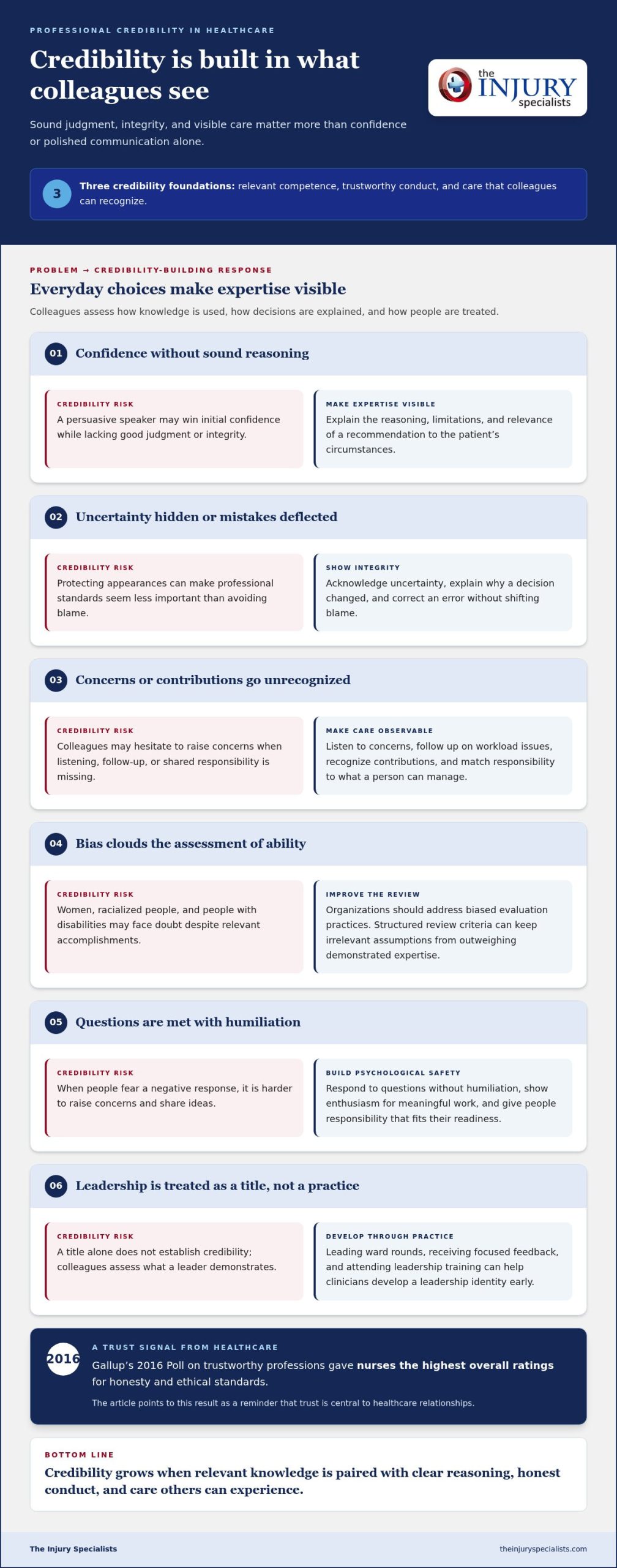
Credibility depends on what colleagues observe, not simply on a leader’s title. In healthcare, people assess whether a leader demonstrates competence and merits trust. Relevant education and clinical judgment contribute, but neither guarantees confidence. A medical leader must connect knowledge to decisions colleagues can understand and evaluate.
Communication matters, but it cannot replace sound leadership. A persuasive speaker may win initial confidence while lacking good judgment or integrity. For example, a leader who recommends a treatment confidently should also explain the reasoning, limitations, and relevance to the patient’s circumstances. Clear communication makes expertise visible; it does not make weak expertise credible.
Integrity is evident in specific choices. A leader can acknowledge uncertainty, explain why a decision changed, and correct an error without shifting blame. These actions show that professional standards matter more than appearances. In a team discussion, crediting the colleague who identified a missed concern demonstrates that honest contributions are valued.
Caring also has to be visible to colleagues. A medical leader demonstrates it by listening to concerns, following up on workload issues, and recognizing how much responsibility each person can manage. Gallup’s 2016 Poll on trustworthy professions gave nurses the highest overall ratings for honesty and ethical standards. That result underlines why trust is central to healthcare relationships.
Credibility judgments can reflect prejudice rather than ability. Women, racialized people, and people with disabilities may face doubt despite relevant accomplishments. Organizations must address biased evaluation practices instead of placing the full burden on individuals targeted by discrimination. Structured review criteria, for instance, can prevent irrelevant assumptions from outweighing demonstrated expertise.
A psychologically safe team makes it easier to raise concerns and share ideas. Leaders foster that environment by responding to questions without humiliation, showing enthusiasm for meaningful work, and matching responsibility to a person’s readiness. Leading ward rounds, receiving focused feedback, and attending leadership training can help clinicians develop a leadership identity early.
Hazelton and MacDonald discuss credibility as a medical leadership issue in the Canadian Journal of Physician Leadership, volume 7, number 3, pages 101-107. Their topic reinforces a practical point: establishing credibility with medical experts requires visible competence, trustworthy conduct, and care others can recognize. These qualities contribute when colleagues experience them in everyday decisions, not merely when a leader describes them.
Empathy and relationship-building
Empathy helps medical professionals understand how a decision affects the person receiving care. It does not require agreeing with every request or opinion. A clinician can acknowledge a patient’s fear, explain the available information, and still offer a medically grounded recommendation. That balance keeps the discussion respectful without weakening professional judgment.
How a clinician responds to disagreement can shape trust. When parents raise vaccine concerns, anger instead of information may reduce their trust and contribute to an antivaccine stance. A more constructive response starts by listening, clarifying the concern, and explaining the evidence in language the family can understand. This treats the conversation as a relationship, not a contest.
Medical experts also build stronger working relationships by making their reasoning accessible. In a malpractice matter, an expert may need to explain a diagnosis, treatment choice, or outcome to people without medical training. Plain language, definitions of unfamiliar terms, and connections between conclusions and records help others follow the opinion. Clarity should make the reasoning understandable, not oversimplify it.
Respectful collaboration matters when professionals interpret complex facts differently. A treating clinician and an expert reviewing a case, for example, may focus on different records or questions. Each can identify the evidence supporting an opinion, listen to the other perspective, and distinguish established facts from interpretation. This keeps the discussion focused on the medical issue rather than personal disagreement.
Empathy can also strengthen testimony by helping an expert remain composed under pressure. In a legal setting, opposing counsel may challenge the credibility and reliability of an expert’s testimony. Direct answers, careful explanations, and a respectful tone help keep the exchange focused on the evidence. The expert should acknowledge the question before explaining the medical basis for an answer.
Building professional relationships depends on consistent, practical habits. Follow through on agreed communication, prepare relevant records before a discussion, and explain what information supports an opinion. If new evidence changes the analysis, describe what changed and why. These actions respect colleagues’ time and help preserve trust through difficult conversations.
Empathy does not replace competence or evidence. It helps medical experts exchange information, understand concerns, and explain conclusions without dismissing the people involved. In patient care, case review, or testimony, that combination supports clearer communication and more constructive professional relationships.
Communicating information clearly while keeping the person’s circumstances in view matters in personal injury cases. Medical experts can clarify the causal relationship between an accident and resulting injuries. They may also provide functional capacity evaluations to assess a patient’s ability to perform work-related tasks in personal injury or disability cases. These explanations connect medical judgments to practical questions while keeping individual circumstances in view.
Credibility and trust also depend on the environment around a conversation. Organizations should address bias as part of credibility-building rather than placing the full responsibility on individuals targeted by discrimination. Leaders can build trust and motivation by creating a safe environment, showing enthusiasm, and understanding how much responsibility an individual can manage. These conditions support respectful exchange.
Establishing credibility through medical expertise
Medical expertise strengthens an opinion when relevant knowledge supports clear, evidence-based reasoning. In malpractice and injury matters, expert witnesses connect clinical facts to the questions a case must resolve.
In the United States, interactions with medical experts should protect independent, evidence-based opinions. Eligibility requirements vary by state, while transparent communication helps readers assess an expert’s reasoning and credibility.
Ethical Rules for Expert Interactions
Ethical interaction means providing an expert with accurate information and allowing an independent medical assessment. Pressure to reach a preferred conclusion can undermine confidence in the opinion. Share relevant records, state the question clearly, and do not ask an expert to alter conclusions for strategic convenience. In a malpractice review, the analysis should consider information available to the medical professional at the time.
No single eligibility rule applies identically across every state. Requirements often include a current healthcare-provider license or certification, relevant experience, and spending most of one’s time practicing medicine and treating patients. These criteria matter because an expert’s field and experience should fit the medical issue under review. A specialist’s credentials alone do not establish that every opinion falls within that specialty.
Credentials and Relevant Experience
Relevant credentials show that an expert has training connected to the subject under review. Board certification in the relevant medical specialty is identified as the minimum credential for a medical expert witness. Attorneys also consider qualifications, prior testimonial experience, and professional reputation. These details help readers judge whether the expert can explain the applicable medicine clearly and reliably.
Medical expertise can clarify causation, standard of care, or the consequences of an injury. In a malpractice matter, an expert assesses whether a healthcare professional departed from the standard expected in that field. The analysis should use the information available when the decision occurred, not hindsight alone. This ties the opinion to the clinical circumstances being evaluated.
Credible testimony translates specialized knowledge for judges and jurors without medical training. An expert can define unfamiliar terms, explain a diagnosis, and connect test results to the reasoning behind an opinion. For example, testimony about a test that was not performed can explain how the omission contributed to a misdiagnosis or delayed diagnosis. Specific links between records and conclusions make complex reasoning easier to assess.
Several expert witnesses may examine a case from different medical perspectives. One may address diagnosis, while another explains rehabilitation needs or long-term effects. Their opinions are most useful when each expert stays within relevant expertise and explains the evidence supporting each conclusion. Persuasive delivery cannot compensate for a weak factual foundation.
Credibility can suffer when an opinion exceeds the expert’s specialty, ignores relevant records, or relies on unsupported assumptions. Cross-examination may challenge qualifications, reasoning, or consistency. Bias can also distort credibility judgments, so evaluation should focus on relevant expertise and evidence rather than irrelevant personal characteristics. These safeguards help distinguish a well-grounded medical opinion from confidence without adequate support.
What credentials and experience do medical experts look for?
Medical professionals often use relevant training and professional role as cues when assessing health-related opinions. A cardiologist’s credentials, for example, carry the most weight when the question concerns cardiovascular care. The same title may be less relevant to a matter centered on rehabilitation. Match expertise to the specific issue, not simply to a respected job title.
For medical expert witnesses, board certification in the relevant specialty is identified as the minimum credential. That credential signals specialty training, but it does not answer every question about an expert’s fit. A review should also consider whether the expert’s clinical background aligns with the treatment, diagnosis, or outcome being examined. Specialty relevance makes credentials meaningful to the issue.
Experience matters when it connects directly to the medical question. An expert evaluating a diagnostic decision should have relevant knowledge of the diagnostic process, not just a broad healthcare background. In malpractice cases, the opinion must address the standard of care in the professional’s field. A close match between the expert’s practice and the issue makes the reasoning easier to assess.
State eligibility requirements for medical expert witnesses vary. They often include a current healthcare-provider license or certification, relevant experience, and spending most of one’s time practicing medicine and treating patients. Those factors help distinguish active clinical knowledge from credentials held without current patient-care experience. The exact criteria matter in the state connected to the case.
Attorneys assess more than degrees when selecting an expert witness. Qualifications, prior testimonial experience, and reputation in the field all contribute. Testimony experience can show whether an expert can explain medical reasoning clearly under questioning. It does not, by itself, prove that an opinion is reliable. The foundation remains the expert’s relevant knowledge and supporting evidence.
A practical assessment connects each credential to a case question. First, identify the specialty needed to address the medical issue. Then compare the expert’s training, current license or certification, clinical experience, and professional work with that issue. Finally, consider whether prior testimony and reputation support clear, credible communication. This focused approach helps avoid choosing an expert based on impressive credentials alone.
For example, a case involving a disputed diagnosis may call for expertise in that diagnostic specialty. A rehabilitation question may require experience evaluating recovery and long-term function. When several medical issues arise, separate experts may explain different aspects. The goal is a direct fit between each expert’s qualifications and the opinion required, keeping the analysis grounded in relevant medical experience.
How important are peer-reviewed publications and clinical evidence for credibility?
Peer-reviewed publications and clinical evidence can support an expert’s reasoning, but neither proves an opinion is correct. Credibility depends on how well the evidence fits the medical question. A study about one patient group, treatment method, or outcome may not apply directly to another. Experts strengthen their analysis by explaining both the evidence and its limitations.
Randomized controlled trials compare treatment and control arms to help determine whether outcomes can be attributed to an intervention. Blinding participants and researchers can reduce the influence of placebo effects and clinicians’ expectations. These design features matter, but a trial can still be poorly conducted, fraudulent, or built around unsuitable endpoints, populations, or treatment versions.
Vertebroplasty illustrates why evidence needs careful interpretation. The procedure injects bone cement into a fractured vertebral body to treat pain after an acute osteoporotic fracture. It became a standard treatment after positive clinical, retrospective, and nonrandomized results circulated. In 2009, two randomized controlled trials found vertebroplasty no better than placebo. Researchers disputing those results argued the treatment works best for patients whose pain has lasted less than six weeks.
The AMA Journal of Ethics examined the issue in volume 19, issue 2, pages 176-182. Its discussion underscores a key distinction: publication and adoption do not settle whether a treatment works for a particular patient or clinical question. An expert should explain how a study’s design, patient population, and measured outcomes relate to the opinion being offered.
Evidence also has limitations beyond trial design. Funding mechanisms, conflicts of interest, and publication bias can shape which results receive attention. A careful review considers who funded a study, what outcomes researchers measured, and whether other findings support or challenge its conclusions. These factors do not automatically invalidate research; they provide context for assessing its weight.
When evaluating an expert’s use of research, look for a clear connection between published evidence and the case-specific facts. A credible explanation identifies the study’s relevant population, intervention, comparison, and outcomes. It also distinguishes established findings from interpretation. For example, an expert discussing vertebroplasty should explain why trial findings apply, or do not apply, to the patient’s condition and timing.
Peer review is one form of scrutiny, not a substitute for sound analysis. Strong medical opinions show how evidence supports a conclusion, address credible contrary findings, and avoid presenting a single study as definitive. That disciplined approach lets readers assess the reasoning behind an expert’s view instead of relying on publication status or confident delivery alone.
The Injury Specialists: Physician Referral Services, medical case management, marketing and networking to increase referral partners.
The Injury Specialists supports healthcare providers and legal professionals seeking stronger referral relationships and organized case coordination. Its Physician Referral Services combine medical case management with marketing and networking to help grow referral partnerships. These offerings are relevant when a practice wants to build professional connections alongside its case-management process.
For law firms, the Attorney Referral Program includes medical case management based on each firm’s distinct process, along with marketing and networking to grow referral partnerships. Chiropractic and Physical Therapy Referrals and Imaging Center Referrals support connections across related areas of care. These services facilitate professional referrals; they do not replace independent medical opinions or expert evaluation.
To discuss referral services or case management for your professional needs, contact The Injury Specialists.
Put Professional Trust Into Practice
Trust grows through consistent professional decisions. The next step is to make those decisions easier to sustain across your work. Identify where stronger connections, clearer coordination, or more reliable referral relationships would support your professional goals. Then focus on a process that can move those priorities forward.
For healthcare providers and legal professionals, establishing credibility with medical experts also depends on the quality of working relationships around each case. The Injury Specialists supports that work through physician referral services, medical case management, and networking to grow referral partnerships. Its referral programs connect relevant professionals while keeping your organization’s needs in view.
Choose a practical next step: define the connection or coordination challenge you want to address, then discuss how a referral or case-management approach may fit. A focused conversation can clarify the path forward without replacing independent medical judgment or professional expertise.
Connect with The Injury Specialists to explore a professional next step. Keep building relationships grounded in sound expertise, clear communication, and trust.
Frequently Asked Questions
Is This Accepted in the Medical Community?
Yes, medical expert testimony is used in malpractice lawsuits, personal injury claims, disability disputes, workers’ compensation cases, and insurance claims. Its credibility depends on whether the expert’s relevant qualifications and reasoning support the opinion. For example, an expert discussing a treatment decision should connect medical records to the clinical question, rather than rely on a title alone. Clear, evidence-based explanations help others evaluate the opinion.
What does establishing credibility with medical experts mean?
It means earning professional confidence through reliable judgment and relevant medical understanding. In practice, a clinician proposing a new care pathway should explain its purpose, identify the patient group it serves, and distinguish established findings from expectations. Colleagues can then assess the proposal on its merits. Credibility is not automatic because someone holds a senior role; it develops as others see expertise applied consistently.
How can healthcare professionals build credibility with medical experts?
Prepare a focused question and organize the information needed to address it. Before a case conference, for example, separate the timeline, test results, and treatment decisions so participants can follow the issue. Identify which details come from the record and which are your interpretation. If a colleague identifies a gap, address it directly and update the discussion with relevant information. This makes collaboration more precise.
How can healthcare companies establish credibility with medical experts?
Healthcare companies can build confidence by making their processes clear and clinically relevant. A referral organization, for example, should explain how professional connections are coordinated and how case information moves between participants. Consistent documentation and clear communication help medical experts understand their role and the context for a referral. Organizations can also use feedback from participating professionals to identify workflow gaps and improve coordination without overstating clinical outcomes.

Leave A Comment
You must be logged in to post a comment.