

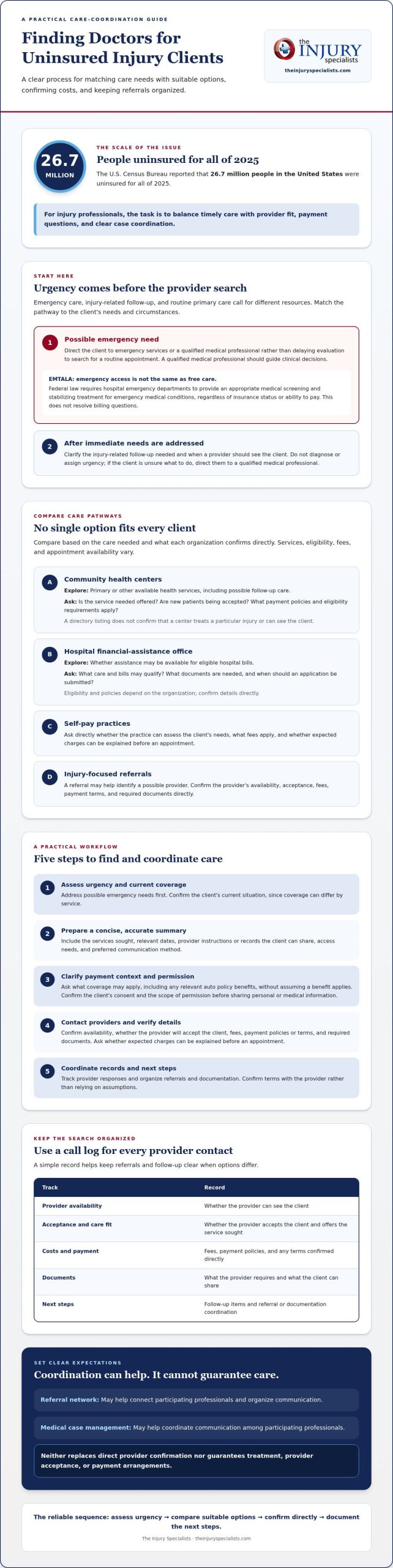
The U.S. Census Bureau reported that 26.7 million people in the United States were uninsured for all of 2025. For injury professionals, finding doctors for uninsured clients means balancing timely care with provider fit, payment questions, and clear case coordination. A referral can help identify a possible provider, but it doesn’t guarantee the provider will accept the client or agree to particular payment terms.
It’s understandable to be unsure where to start. Emergency care, injury-related follow-up, and routine primary care call for different resources, and disconnected records or referrals can complicate coordination. This guide outlines a practical process: assess urgency and the client’s circumstances, identify suitable care options, ask providers about fees and financial assistance, and coordinate referrals and documentation. It also explains how medical case management and referral networks may help organize communication among participating professionals, without replacing provider confirmation or guaranteeing care or payment arrangements.
Key Takeaways
- Distinguish urgent symptoms from planned follow-up first, then match the care pathway to the client’s needs and circumstances.
- Compare community health centers, hospital financial-assistance offices, self-pay practices, and injury-focused referrals rather than assuming one option fits every client.
- When finding doctors for uninsured clients, confirm provider acceptance, fees, payment terms, and required documents directly before arranging care.
- Use a call log to track provider availability, costs, documents, and next steps so referrals and follow-up stay organized.
- A referral network and medical case management may help coordinate participating professionals, but neither guarantees treatment, acceptance, or payment arrangements.
Finding Doctors for Uninsured Clients Starts With Urgency and Care Needs
Start with urgency, not a provider directory. If the client may need emergency care, direct them to emergency services or a qualified medical professional rather than delaying evaluation to search for a routine appointment. An uninsured client is someone without active health coverage for the specific care being considered. Coverage can differ by service, so confirm the client’s current situation before narrowing the search.
Federal law requires hospital emergency departments to provide an appropriate medical screening and stabilizing treatment for emergency medical conditions, regardless of a patient’s insurance status or ability to pay. The Emergency Medical Treatment and Active Labor Act (EMTALA) concerns emergency access. It doesn’t mean the care is free or resolve billing questions. Emergency evaluation and billing are separate from arranging follow-up care. A qualified medical professional should guide clinical decisions.
Separate emergency needs from non-emergency appointments
Don’t let the search for a routine appointment delay emergency evaluation when symptoms warrant it. Once immediate needs have been addressed, clarify what injury-related follow-up the client needs and when a provider should see them. Avoid diagnosing or assigning a level of urgency yourself. If the client is unsure what to do, direct them to a qualified medical professional for guidance.
Gather the details providers need before a search
Prepare a concise, accurate summary before contacting providers. This helps office staff assess whether their services may fit and explain their intake process, while reducing repeated calls.
- Care needs: Record the injury-related services being sought, relevant dates, and any existing provider instructions or records the client can share.
- Access needs: Note mobility or transportation considerations and preferred ways to communicate, such as phone or email.
- Payment context: Ask what coverage may apply, including any relevant auto policy benefits, and whether the client has funds or assistance options to discuss. Don’t assume a benefit applies or that a provider accepts a particular arrangement.
- Permission to share: Confirm the client’s consent and the scope of permission before disclosing personal or medical information to a provider.
When finding doctors for uninsured clients, verify availability, fees, required documents, and payment policies directly with each provider. Ask whether the office can explain expected charges before an appointment and what information it needs to assess the client’s circumstances. Policies vary, so record the answers and confirm any terms with the provider rather than relying on assumptions.
A referral may connect a client with a participating medical professional, but a referral is not a guarantee of treatment, provider acceptance, or payment terms. Confirm each detail directly before arranging the next step.
Compare Care Pathways for Uninsured Injury Clients
Once immediate needs are addressed, compare options based on the type of care needed, the client’s circumstances, and what each organization confirms directly. No single pathway fits every injury. Services, eligibility, fees, and appointment availability vary by organization. For a broader look at how professional referral networks can connect injury-related care, see this guide to physician referral services for personal injury.
| Care setting | Likely purpose | Questions to ask | Availability caveats |
|---|---|---|---|
| Community health centers | Explore primary or other available health services, including possible follow-up care. | Do you offer the service needed? Are you accepting new patients? What payment policies and eligibility requirements apply? | Services and appointment openings differ by center. A directory listing doesn’t confirm that a center treats a particular injury or can see the client. |
| Hospital financial-assistance office | Ask about assistance for eligible hospital bills and how to apply. | What care and bills may qualify? What documents are needed, and when should the application be submitted? | Policies and eligibility are organization-specific. For emergency-care protections, consult the Centers for Medicare & Medicaid Services’ overview of your rights under federal law. Emergency access and financial assistance are separate questions. |
| Self-pay practice | Arrange outpatient care with a practice that may see patients paying directly. | Do you accept uninsured patients? Can you provide written fee information and explain payment expectations before the appointment? | Acceptance, services, fees, and scheduling depend on the individual practice. |
| Injury-focused provider referral | Identify a potentially appropriate physician, chiropractic, physical therapy, or imaging provider for injury-related needs. | Does the provider’s scope fit the referral? Is an appointment available, and what payment terms, if any, will the provider consider? | Confirm clinical fit, acceptance, availability, and terms directly. A referral does not create a lien or establish a financial arrangement. |
Check community resources and provider terms
HRSA health centers are a resource to investigate, not a guaranteed match for every injury or service. Ask each center about its offerings, new-patient availability, payment policies, and eligibility. The 211 service may also be a starting point for finding community resources. Check that listings are current and contact each organization to confirm details.
For self-pay practices, request written fee information and clarify what the estimate covers. For an injury-focused referral, verify the provider’s clinical fit and payment terms before arranging an appointment. Referral coordination can help connect professionals, but it doesn’t establish a lien, guarantee acceptance, or determine how care will be paid. The Injury Specialists’ physician referral and medical case management services may support professional coordination. Providers must confirm care and terms directly.
Address the Main Concern: Will a Doctor See an Uninsured Client?
Sometimes. Some providers see uninsured patients, but acceptance, available services, appointment timing, fees, and payment terms vary. A community health center may be worth contacting about affordable care, while a self-pay practice may provide fee information before an appointment. Hospital financial assistance may help with eligible hospital bills, but it doesn’t necessarily arrange follow-up care. An injury-focused referral may help identify a provider whose services fit the injury, but it doesn’t guarantee acceptance or a particular payment arrangement.
When finding doctors for uninsured clients, treat each option as a lead to verify, not as a confirmed appointment or funding source. A referral doesn’t mean a provider accepts a lien, deferred payment, or any specific source of payment. Only the provider can confirm current availability and the terms it will consider.
Questions to ask before scheduling
Contact the practice directly and ask clear, specific questions. Request written details where possible so the client can review the terms before agreeing to care.
- Do you accept patients without health insurance, and can you provide the service being sought?
- What fees may apply, and can you provide a written estimate and explain your billing policies?
- Do you offer financial assistance, and what eligibility rules or documents apply?
- Are any payment arrangements available? What approval process and documentation do you require?
- Is there an appointment available within the timeframe the treating clinician recommends?
Healthcare.gov offers information on finding a community health center. The listing is a starting point, not confirmation that a particular center offers the required service, has an opening, or fits the client’s circumstances. Verify those details with the center.
Keep clinical decisions separate from payment
The treating clinician determines appropriate care based on the patient’s needs. A legal case’s potential value doesn’t establish medical necessity, determine what care a clinician recommends, or require a provider to accept a patient. Keep clinical discussions focused on health needs and payment discussions focused on provider policies that have been confirmed.
Rules and provider policies concerning medical liens can vary. Don’t assume a lien is available or accepted. Confirm any proposed arrangement directly with the provider and seek qualified legal review of state-dependent lien questions. A referral can support a connection, but it isn’t a substitute for those confirmations.
Use a Step-by-Step Workflow to Find and Coordinate Care
A repeatable process helps professionals move from a care need to a verified referral while keeping communication organized. When finding doctors for uninsured clients, use these steps and record each decision so the next person involved can see what’s confirmed and what still needs follow-up.
- Assess urgency. If the client may need emergency attention, prioritize emergency services or qualified clinical guidance. Don’t delay urgent evaluation to complete a routine provider search.
- Define the care need. Record the services being sought, relevant injury and treatment dates, known referral requirements, and practical access needs. Don’t diagnose. Confirm clinical questions with qualified professionals.
- Identify possible providers. Search appropriate practices or use personal injury referral networks as one possible way to identify participating professionals. A network can support a coordinated search, but it doesn’t confirm provider acceptance.
- Verify fit and terms. Confirm specialty, appointment access, accessibility needs, and whether a referral or records are required. Ask the provider whether it can address the described care need, accepts uninsured patients, and will explain fees and payment policies.
- Coordinate next steps. With the client’s consent, share relevant records through approved, secure channels. Confirm who will schedule, who will follow up, and how changes to the care plan will be communicated.
Keep a concise call log
Record each contact while the details are fresh. Note the provider or office name, contact date, person reached, response, and planned follow-up. A simple log can include:
- Availability: Appointment openings and any scheduling conditions.
- Fees and policies: Information provided by the office, including whether estimates or payment terms were supplied in writing.
- Required documents: Referral, records, forms, or other items the provider says it needs.
- Next action: Who will send information, call back, schedule, or confirm the appointment, and by when.
Protect sensitive information throughout the process. Obtain consent before sharing records, limit disclosures to information relevant to the referral, and use approved secure communication channels. Note what was sent, to whom, and when.
Pre-settlement funding is a separate option to investigate, not a guaranteed way to pay for care. Eligibility and terms require direct confirmation. Funding doesn’t replace provider verification or establish a payment arrangement. Learn more about pre-settlement funding for injury victims as a distinct consideration. For professional support connecting referrals and case workflows, explore medical case management and referral coordination.
When a Personal Injury Referral Network Can Support Uninsured Clients
A professional referral network may help identify participating providers and organize connections for injury-related care. Depending on the client’s needs and provider availability, referrals may involve physicians, chiropractors, physical therapists, or imaging centers. This can give legal and medical professionals a structured way to explore options when finding doctors for uninsured clients, while keeping provider fit and the client’s circumstances central.
Coordination has clear limits. A network can facilitate a referral and help organize communication, but it doesn’t provide medical treatment or legal representation. The treating provider independently decides what care is appropriate and confirms whether they’ll accept the client, offer an appointment, or discuss particular payment terms. A referral does not guarantee treatment, coverage, an outcome, or a settlement result.
What coordinated referral support can and cannot do
Case management can support workflows by helping organize referrals, records, communication, and follow-up among participating professionals. It can help clarify who needs information and what coordination remains. It cannot replace the treating clinician’s judgment or confirm a provider’s acceptance on the provider’s behalf. Verify network participation, provider availability, and any eligibility criteria before making a referral, then confirm the provider’s terms directly with the office.
Evaluate a network before making a referral
Review the process, not just the provider list. Ask how the network handles provider coverage, referral intake, case-management scope, and communication among professionals. Confirm how it obtains consent, handles documentation and sensitive information, and tracks follow-up. Establish who will contact the provider, who will communicate updates to the client, and how changes or unanswered questions will be handled.
For professional readers, explore The Injury Specialists for information about its referral network, medical case management, and coordination technology. These services facilitate connections and workflows. The provider remains responsible for confirming clinical fit, availability, and any financial terms.
Use a practical sequence: assess the client’s care needs, confirm permission to share relevant information, and determine whether network support fits the referral and coordination requirements. Then verify the next step with the provider and document what has been confirmed. This keeps the process organized without treating a referral as a promise of care or payment.
Move From Provider Search to Coordinated Follow-Up
Effective care coordination starts with the client’s needs. Address urgency first, compare suitable care pathways, then confirm availability, fees, and payment terms directly with each provider. A referral can connect professionals, but it doesn’t guarantee treatment or a financial arrangement.
For professionals finding doctors for uninsured clients, a clear record of consent, provider conversations, and follow-up responsibilities helps keep the process organized. The Injury Specialists connects injury victims with medical and legal professionals through a national network. Its medical case management and referral coordination support professional workflows. The company facilitates connections; providers make their own decisions about care and acceptance.
Explore The Injury Specialists’ professional referral network to learn how its referral and case-management services may fit your coordination needs. A structured search and clear provider confirmation can help you move to the next step with greater confidence.
Frequently Asked Questions
Can an uninsured person see a doctor after an injury?
Yes, some doctors and clinics see patients without health insurance, but each provider sets its own acceptance, scheduling, and payment policies. For an emergency medical condition, a hospital emergency department must provide screening and stabilizing treatment regardless of insurance status or ability to pay. That doesn’t mean the care is free or guarantee access to later appointments. For follow-up, contact providers directly to confirm services, availability, and payment expectations.
How can I find a doctor who accepts uninsured patients?
Call practices that match the care needed and ask whether they accept uninsured patients, offer the relevant service, and have appointments available. Request written fee information and ask about financial assistance or payment options. Community health centers and hospital financial-assistance offices may also be worth contacting, depending on the situation. Finding doctors for uninsured clients means confirming each provider’s current policies directly rather than relying on a directory listing or referral alone.
Do community health centers treat injury-related conditions?
Some community health centers may provide services relevant to an injury, but offerings vary by center, and a listing doesn’t confirm that a particular injury can be treated there. Contact the center to describe the type of care being sought without asking staff to diagnose the condition. Confirm available services, new-patient appointments, fees, and eligibility requirements. If the client needs urgent evaluation, don’t wait for a routine center appointment. Seek appropriate emergency or clinical guidance.
Will a doctor treat a personal injury patient on a lien?
Possibly, but don’t assume a doctor accepts liens or deferred payment. Provider policies and applicable rules can vary, and a referral doesn’t establish a lien or financial arrangement. Ask the provider directly whether it considers the proposed terms, what documents or approvals it requires, and how charges are handled. For state-dependent legal questions about a lien, seek qualified legal review before relying on an arrangement.
What should I ask a provider before scheduling an uninsured client?
Ask whether the practice accepts uninsured patients, provides the service needed, and has appointment availability. Request written fee estimates and billing policies, and ask about financial assistance or payment arrangements, including any required documents or approvals. Confirm referral requirements, records needed, and accessibility accommodations. Record who supplied the information and when. The provider should confirm current availability and terms directly, so distinguish confirmed details from anything still awaiting follow-up.
Can 211 help someone find medical care without insurance?
211 may be a starting point for locating community health resources, assistance programs, or other services. Listings and referral options can vary, so confirm that any suggested organization is currently operating and offers the service the client needs. Contact the provider directly to ask about eligibility, availability, fees, and uninsured-patient policies. A directory referral can point the search in a useful direction, but it doesn’t guarantee an appointment or qualify someone for assistance.
Does a referral network guarantee that a doctor will accept a client?
No. A referral network may help identify and coordinate connections with participating medical professionals, but it can’t guarantee that a provider will accept a particular client, offer an appointment, or agree to specific payment terms. The provider makes those decisions independently. The Injury Specialists facilitates connections through its referral services and supports professional workflows with medical case management. It doesn’t provide direct treatment or guarantee care, coverage, or an outcome.

Leave A Comment
You must be logged in to post a comment.