

Pre-settlement funding belongs in a documented case workflow, not in a settlement conversation as a promise. A consistent approach to pre-settlement funding for personal injury lawyers can help firms respond when clients ask about financial support while a claim is pending, without implying that funding is guaranteed or that a case will succeed.
Funding terms and repayment expectations can be difficult to explain, and uncoordinated requests can create extra administrative work. Clear communication helps clients understand that a provider’s funding decision is separate from the firm’s assessment of the claim and any eventual settlement. A defined process also gives staff a reliable way to handle inquiries without overstating the firm’s role or a provider relationship.
This article explains how firms can assess funding inquiries, discuss agreement terms and potential effects on a client’s net recovery, and coordinate referrals while keeping case workflows organized. It also covers questions to ask about funding agreements, alternatives clients may consider, and when a funding facilitator or referral process may fit the firm’s operations.
Key Takeaways
- Keep funding distinct from settlements, legal fees, medical treatment, and law firm operating capital so clients understand what they’re considering.
- For pre-settlement funding for personal injury lawyers, use a consistent process to receive, document, and route client inquiries without predicting approval or recovery.
- Compare provider agreements by reviewing fee disclosures, repayment language, communication practices, and complaint-handling procedures.
- Read the agreement rather than relying on labels such as “non-recourse,” since terms and processes can vary by provider.
- Coordinate funding referrals as one part of a connected support workflow, while clearly explaining what facilitators do and don’t provide.
Pre-Settlement Funding for Personal Injury Lawyers: Define the Client Need
Pre-settlement funding is potential financial support a plaintiff may seek while a personal injury claim is unresolved, subject to a provider’s review, agreement terms, and applicable law. It’s a client-focused arrangement, not a settlement payment or a loan to the law firm. The term legal financing is often used for this category, but a label alone doesn’t explain how a particular agreement works.
For firms handling pre-settlement funding inquiries, a clear definition sets expectations early. Funding isn’t a legal fee, medical treatment, payment for litigation expenses, or firm operating capital. It also isn’t guaranteed income for a client or a promise that a case will succeed. Availability, costs, and repayment conditions depend on the provider’s agreement and the rules that apply to the transaction.
Why clients may ask about funding before a case resolves
A claim can remain open while a client’s ordinary expenses continue. That timing gap may prompt someone to ask about financial options before a settlement or judgment. The inquiry signals a financial concern, not a legal conclusion: a client’s need for support doesn’t establish liability, predict the claim’s value, or determine whether a provider will approve an application. Eligibility and terms vary, so avoid suggesting that every client or case will qualify.
What funding is, and is not, for a law firm
Keep client funding separate from firm financing, case-cost arrangements, and attorney fee agreements. A provider may review case information as part of its process, but that doesn’t make the advance law firm capital or change the firm’s assessment of the claim. Explain the distinction in neutral language, and don’t connect a potential advance to a predicted recovery.
Before a client considers an agreement, explain that the provider decides whether to offer funding and that repayment depends on the contract and applicable law. Don’t characterize approval, timing, or a particular case outcome as certain. Clients seeking a plain-language overview can also consult Pre-Settlement Funding for Injury Victims: 2026 Guide. Use it as a companion resource, and direct questions about the case or agreement to the appropriate professionals.
How Pre-Settlement Funding Works in a Personal Injury Case
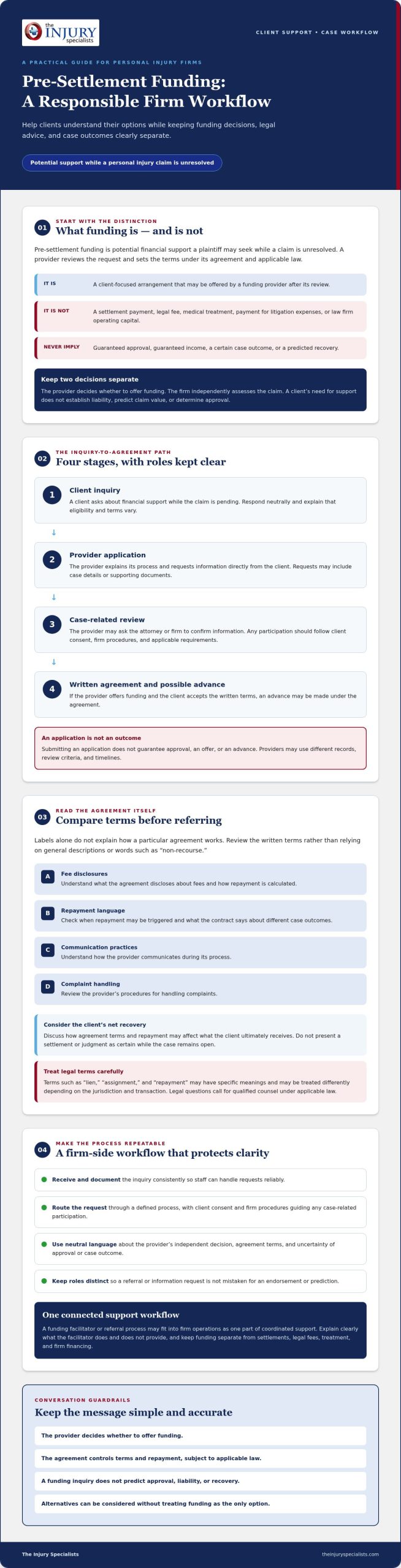
The process usually moves through several stages, but providers set their own application requirements and review methods. A defined sequence helps the firm coordinate requests without implying that an application will be approved or money will be advanced.
The typical funding inquiry and review sequence
- Client inquiry: The client asks about funding and receives neutral information about how to contact a provider.
- Provider application: The provider explains its process and requests information directly from the client. This may include case details or supporting documents.
- Case-related review: The provider may ask the attorney or firm to confirm information. Any participation should follow client consent, firm procedures, and applicable requirements.
- Agreement and possible advance: If the provider offers funding and the client accepts the written terms, an advance may be made under the agreement.
Details vary. Providers may request different records or confirmations, and their review criteria and timing aren’t universal. Submitting an application doesn’t guarantee approval, an offer, or an advance. For pre-settlement funding for personal injury lawyers, keeping the client, firm, and provider roles distinct helps prevent a referral or information request from sounding like an endorsement or prediction.
Repayment terms and case resolution
Review the actual agreement rather than relying on general descriptions of how funding works. Check the fees, how repayment is calculated, when repayment may be triggered, and what the contract says about different case outcomes. A settlement or judgment may resolve a claim, but neither should be presented as certain while the case remains open.
Terms such as “lien,” “assignment,” and “repayment” can have specific meanings in an agreement and may be treated differently depending on the jurisdiction and transaction. Don’t assume a label defines the client’s obligations or the firm’s role. Have qualified counsel review legal questions under applicable law, and confirm provider-specific requirements before responding to requests.
Attorneys should also consider the professional-conduct issues raised by client funding arrangements. Annuity.org’s discussion of pre-settlement funding references the American Bar Association’s Commission on Ethics. Firms can use it as a starting point, then verify relevant guidance for their jurisdiction. For firms assessing how funding coordination may fit within a broader professional network, The Injury Specialists’ coordination capabilities offer a relevant point of reference. The company facilitates funding services; it isn’t presented as the direct lender.
Compare Funding Options, Terms, and Alternatives Before Referring
A referral should follow a careful comparison, not become the default recommendation. For pre-settlement funding for personal injury lawyers, the firm can help clients understand what to examine without making unsupported claims about which provider or option is best. Review the written agreement and the provider’s process, and check applicable requirements with qualified advisers.
Questions lawyers can use to review funding agreements
Use the same checklist when comparing providers. Look for clear terms and a practical explanation of how the agreement works.
- Charges: How are charges calculated? Does the provider offer examples or payoff illustrations showing how the amount could change over time?
- Repayment: What events trigger repayment, and how does the agreement address different case outcomes?
- Disputes: Does the contract explain how disagreements are handled and whom the client can contact with concerns?
- Information: What case or personal information is requested, how is it used, and what does the provider say about handling client information?
- Communication: Are questions answered clearly? Does the provider explain the process without suggesting approval is assured?
“Non-recourse” is a description, not a substitute for reading the contract. Don’t assume the label guarantees the same result across agreements. Check the specific repayment terms and how they apply under different outcomes.
Funding versus other ways to address a temporary cash gap
Funding is one possible option, not the right fit for every client. Depending on individual circumstances, a client might first review budgeting options, existing benefits, or other available resources. They may also discuss payment timing with qualified advisers. Each alternative has its own conditions and implications, so don’t present a general option as a recommendation for a particular person.
A brief comparison can organize the conversation without ranking options in the abstract:
| Option | What to clarify |
|---|---|
| Pre-settlement funding | Provider terms, charges, repayment triggers, and applicable rules |
| Budgeting or existing benefits | Eligibility, limitations, and how the option fits the client’s circumstances |
| Payment-timing discussion | Whether the relevant organization can explain available arrangements |
| Advice from qualified advisers | Which financial or legal questions need individual review |
For a client-facing overview, direct readers to How Pre-Settlement Cash Advances Work. The goal is an informed choice, not pressure to apply. Keep the discussion neutral and encourage clients to review the actual terms with appropriate advisers before agreeing.
Build a Responsible Law Firm Workflow for Funding Inquiries
A consistent workflow helps staff respond to funding questions without turning a client’s financial inquiry into a prediction about the case. For pre-settlement funding for personal injury lawyers, define who receives requests, who may communicate with a provider, and how the firm records consent and follow-up. Apply the process consistently while allowing for jurisdiction-specific review.
A repeatable intake and communication checklist
When a client raises the topic, record the request and clarify what they want the firm to do. Before sharing case information, confirm the client’s permission and the scope of that permission under firm procedures. A practical workflow can include these steps:
- Record the inquiry: Note the date, the client’s request, and any questions requiring follow-up.
- Clarify the firm’s role: Explain whether the firm can provide information or communicate with a provider. Don’t present the firm as the funding decision-maker.
- Confirm consent: Document what information the client authorizes the firm to share and with whom, following applicable rules and firm policy.
- Route and track: Assign the inquiry to the appropriate staff member. Record provider contacts, information requests, responses, and next steps.
- Close the loop: Tell the client what has and hasn’t been done, without implying that an application will be approved.
Use neutral wording. For example: “We can confirm case information you authorize us to share, but the provider makes its own decision. That decision doesn’t determine our evaluation of your claim.” Avoid recommending agreement terms the firm hasn’t independently reviewed.
Risk controls for attorney-client relationships
Keep case assessment separate from funding discussions. Staff shouldn’t guarantee approval, an advance, settlement timing, or claim value. Clear boundaries help prevent a client from mistaking administrative assistance for an endorsement or assurance about the case.
Before adopting a workflow, ask qualified counsel to review applicable state-specific legal and professional obligations, including confidentiality, consent, potential conflicts, and communications with providers. Document the review and update procedures when the firm’s guidance changes. For broader workflow context, consult Personal Injury Case Management Technology: The 2026 Strategic Guide alongside your internal policies.
To explore how a professional network and case-management technology may support organized coordination, review The Injury Specialists’ network and coordination capabilities. The Injury Specialists facilitates pre-settlement funding services and connects injury victims with legal and medical professionals. It doesn’t provide legal representation or make case-outcome guarantees.
Coordinate Funding Through a Connected Personal Injury Support Network
Funding coordination can sit alongside a firm’s broader case-management work, but it should remain a distinct track. Legal decisions, medical referrals, treatment decisions, and settlement evaluation each have separate purposes and responsible parties. A clear workflow keeps those roles visible, so a funding inquiry isn’t mistaken for a medical referral or interpreted as an assessment of the claim.
Where funding coordination fits into case operations
Use separate documentation and handoffs for each process. For example, record a client’s funding inquiry in the appropriate workflow, while medical referrals and treatment-related communications follow the firm’s established procedures. Note who owns each next step, what the client has authorized, and whether a response is pending. This structure helps staff track activity without confusing a provider introduction with approval, treatment, or a legal recommendation.
Firms reviewing medical referral processes may also find context in The Comprehensive Guide to Law Firm Medical Referral Programs in 2026. Keep the referral pathway distinct from funding coordination, even when both operate within the same case-management system.
Evaluate a network or facilitation partner
Before adding a partner to the workflow, clarify its role and boundaries. Ask how it makes introductions, what information it may request, how it communicates with the firm and client, and what happens after a referral. Confirm which technology and case-management support are available, and distinguish documented capabilities from assumptions. A network connection can support coordination, but it doesn’t guarantee access to a particular provider, funding approval, medical treatment, or a legal result.
The Injury Specialists facilitates pre-settlement funding services and connects injury victims, medical providers, and law firms through a national referral network and case-management platform. It is a facilitator, not a law firm, medical provider, or confirmed direct lender. For firms considering pre-settlement funding for personal injury lawyers, a practical next step is to map current handoffs, identify where inquiries create administrative friction, and assess whether network coordination fits the firm’s process. Explore The Injury Specialists’ professional network and coordination capabilities as part of that review, and confirm the scope of any service or provider relationship directly.
Make Funding Coordination Part of a Clearer Case Workflow
Responsible pre-settlement funding for personal injury lawyers starts with clear client communication, careful review of provider terms, and a consistent process for managing inquiries. Keep funding discussions separate from case valuation, settlement expectations, and medical decisions. Confirm consent before sharing information, and have qualified counsel review jurisdiction-specific questions.
A structured workflow helps staff route requests, document communications, and explain the firm’s role without suggesting approval or a particular case outcome. When evaluating a referral or coordination partner, confirm how it handles introductions, describes its services, and supports case-management needs.
The Injury Specialists facilitates pre-settlement funding services and connects injury victims with medical and legal professionals through a national network. It is a facilitator, not a law firm or confirmed direct lender. Explore The Injury Specialists’ professional network to assess whether its coordination capabilities fit your firm’s workflow. With clear boundaries and practical processes in place, your team can handle funding inquiries with confidence while keeping client understanding at the center.
Frequently Asked Questions
What is pre-settlement funding for personal injury lawyers?
Pre-settlement funding for personal injury lawyers refers to financial support a client may seek from a funding provider while a personal injury claim is pending. It’s intended for the client, not the law firm, and it isn’t a settlement, legal fee, or medical treatment. The provider sets its own application process and agreement terms. Attorneys can clarify their role, but shouldn’t present funding as guaranteed or as a prediction of the claim’s outcome.
Can a personal injury lawyer help a client apply for pre-settlement funding?
A lawyer may help with parts of the process, depending on the client’s consent, the firm’s procedures, and applicable professional requirements. For example, a provider may ask the firm to confirm case information. Before sharing anything, clarify what the client authorizes and document the request. The provider, not the attorney, evaluates the application and decides whether to make an offer. The firm should explain this distinction and avoid promising approval.
How does pre-settlement funding work for a personal injury case?
Generally, a client contacts a provider and submits an application with the requested information. The provider may review case details and seek confirmation from the attorney. If it makes an offer, the client can review the proposed agreement and decide whether to accept it. An advance may follow an accepted agreement, but approval, required documents, review criteria, and timing vary. Applying alone doesn’t guarantee an offer or payment.
Is pre-settlement funding the same as a settlement advance from a law firm?
No. Pre-settlement funding is typically sought by a client through a funding provider, while a settlement advance from a law firm would involve a different source and arrangement. Don’t assume they have the same terms, repayment conditions, or legal treatment. A firm should identify who is providing funds, explain its role accurately, and avoid describing a provider’s potential advance as a settlement payment or firm financing.
Does pre-settlement funding have to be repaid if a client loses a case?
Repayment after an unsuccessful case depends on the signed agreement and applicable law. Some arrangements are described as non-recourse, but that label shouldn’t replace careful review of the actual terms or be treated as a universal guarantee. Clients should check what the contract says about different case outcomes, repayment triggers, and any exceptions. Attorneys should avoid giving a blanket assurance and direct jurisdiction-specific questions to qualified counsel.
Can a lawyer recommend a pre-settlement funding provider?
A lawyer can establish a process for responding to a client’s request and may provide neutral information or a referral, subject to applicable professional rules and firm procedures. Before recommending a provider, consider whether the firm has reviewed the provider’s role, communications, and agreement terms, and whether potential conflicts or client interests require further review. Make clear that a referral doesn’t guarantee funding, endorse every contract term, or predict the case result.
What should attorneys review in a pre-settlement funding agreement?
Attorneys should examine how charges are calculated, whether payoff examples are clear, and what events trigger repayment. Review terms addressing different case outcomes, dispute procedures, and any lien or assignment language. Confirm what information the provider requests and how the agreement describes its use. Because contract language and legal treatment can vary, don’t rely on marketing labels alone. Have qualified counsel review jurisdiction-specific issues before advising a client about legal effect.
Is pre-settlement funding available in every state?
No. Availability and the rules governing funding can differ by state, and provider processes may also vary. A provider’s general service information doesn’t establish that a particular client or case is eligible. Before discussing options, verify current availability and relevant state requirements with the provider and qualified legal counsel. Avoid promising access based on a client’s location or claim type, and make sure the client reviews the specific agreement before deciding.

Leave A Comment
You must be logged in to post a comment.