

Medical liens shouldn’t be viewed as administrative hurdles that threaten your settlement; they are strategic variables that dictate the ultimate profitability of your personal injury practice. For many firms, unexpected liens appearing at the time of settlement erode client trust and damage professional relationships with medical providers. This attorney guide to medical liens offers a definitive framework to regain control over your recovery process and maximize the net value of every case.
We understand that tracking multiple providers and navigating complex payment delays is a significant drain on your firm’s resources. You need a system that ensures provider compliance while protecting your client’s bottom line. This guide provides the tools to streamline your lien management, ensuring you never miss a 2026 CMS reporting threshold or a state-specific deadline. We will examine how to leverage integrated case management technology and professional referral networks to increase your firm’s efficiency, strengthen your medical partnerships, and secure higher net recoveries for your clients.
Key Takeaways
- Identify the critical differences between statutory and contractual liens to determine which claims carry legal priority and which are open to negotiation.
- Protect your firm from personal liability by mastering the ethical obligations required to satisfy perfected liens before settlement distribution.
- Use the negotiation strategies in this attorney guide to medical liens, including the “Rule of Thirds” and “Made Whole Doctrine,” to maximize client net recovery.
- Replace inefficient manual tracking with integrated case management technology to gain real-time visibility into outstanding balances and missing records.
- Scale your practice by leveraging a national referral network of providers who understand the specific logistical and financial requirements of personal injury litigation.
Understanding Medical Liens in Personal Injury Litigation
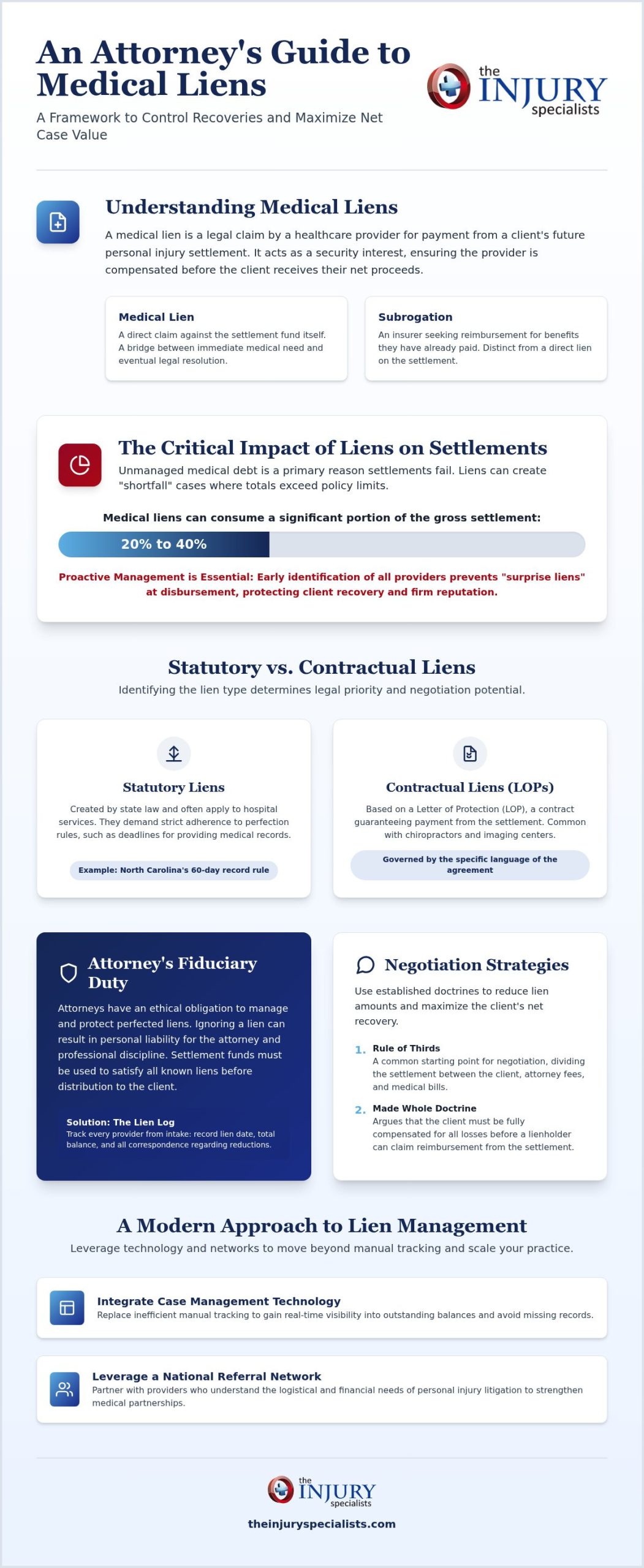
A medical lien is a legal claim filed by a healthcare provider to secure payment for services from a client’s future personal injury settlement. It functions as a security interest, ensuring that the provider is compensated before the client receives their net proceeds. To understand the broader legal context of these claims, it is helpful to first define What is a Lien? In the personal injury sector, these financial obligations act as a bridge between immediate medical necessity and eventual legal resolution. This section of our attorney guide to medical liens explores the fundamental structures that govern these claims and how they dictate case value.
Attorneys frequently use a Letter of Protection (LOP) to establish a contractual lien. This document is a legally binding guarantee that the provider will be paid from the settlement in exchange for treating the client on credit. This arrangement is distinct from subrogation claims made by insurance carriers. While subrogation involves an insurer seeking reimbursement for benefits they have already paid, a medical lien is a direct claim against the settlement fund itself. Understanding this distinction is vital for accurate case accounting and effective negotiation.
Statutory vs. Contractual Liens
Statutory liens are created by state law and usually apply to hospital services. These liens require strict adherence to perfection rules. For example, in North Carolina, providers must produce requested medical records within 60 days or risk having their lien waived. Failure to meet these technical statutory requirements can invalidate the provider’s claim. Contractual liens, which are common with chiropractors and imaging centers, rely on the specific language of the LOP. For an example of a practice that integrates specialized treatments with these legal requirements, you can visit Chiropractic Natural Care Center. Leading firms prefer working with providers who operate on a lien basis because it facilitates client care without exhausting the client’s immediate cash flow, keeping the litigation process moving forward.
The Impact of Liens on Settlement Calculations
Unmanaged medical debt is one of the primary reasons settlements fail during the final stages of a case. Data suggests that medical liens can consume 20% to 40% of a gross personal injury settlement before any attorney fees are deducted. Early identification of every treating provider is the only way to prevent “surprise liens” from appearing at the time of disbursement. When lien totals are too high relative to the available insurance policy limits, it creates a “shortfall” case that is difficult to resolve. Proactive management ensures that the client’s net recovery remains high enough to justify the settlement, protecting the firm’s reputation and the client’s financial interests.
The Attorney’s Duty: Managing and Protecting Medical Liens
Attorneys carry a fiduciary responsibility to manage settlement funds with precision. This duty extends beyond the client to include medical providers who have perfected their security interests. Ignoring a perfected lien is not merely an administrative oversight; it is a breach of ethical obligations that can result in personal liability for the attorney. When a firm receives settlement funds, it must satisfy all known liens before distributing the net proceeds to the client. This attorney guide to medical liens emphasizes that proactive management is the only way to safeguard the firm from post-settlement litigation and professional discipline.
Effective lien management requires a structured “Lien Log” that tracks every provider from the moment of intake. This log should record the date the lien was received, the total balance, and any correspondence regarding reductions. Coordinating with medical case management ensures that the treatment plan aligns with the legal strategy. If you are struggling with the complexities of Negotiating Medical Liens, establishing a clear internal workflow is the first step toward resolution. Managing these obligations efficiently allows your firm to maintain its focus on litigation rather than logistical disputes.
Establishing the Lien Process at Intake
The foundation of a high-value case is laid during the initial client interview. Your team must identify every potential lienholder, including emergency rooms, diagnostic centers, and follow-up specialists. Standardizing your Letter of Protection (LOP) template ensures that all contractual obligations are uniform and defensible. Verifying provider credentials and their billing practices early prevents complications during the settlement phase. Firms that utilize an Attorney Referral Program can often integrate these intake steps into a broader, more efficient medical-legal workflow.
Maintaining Documentation and Communication
Reliable documentation is the best defense against unexpected claims. Utilizing physician referral services for personal injury allows your firm to partner with providers who understand the necessity of timely billing and record production. Conduct quarterly audits of all medical records and updated billing statements to ensure your settlement demand reflects the actual treatment costs. In cases where the settlement is insufficient to cover all obligations, you may need to apply the “Common Fund Doctrine.” This principle allows the firm to reduce lien amounts by a pro-rata share of attorney fees and litigation costs, ensuring the client still receives a fair recovery. For firms looking to automate these manual tasks, implementing Case Management Technology can eliminate administrative bloat and improve accuracy.
Strategies for Negotiating Medical Lien Reductions
Negotiation is the most critical phase for maximizing a client’s net recovery. While previous sections of this attorney guide to medical liens focused on identification and tracking, this section outlines the tactical maneuvers required to lower outstanding balances. Effective negotiation relies on a combination of legal doctrines and professional leverage. By presenting a data-driven case for reduction, firms can satisfy providers while protecting the client’s financial interests. Skilled negotiation frequently reduces provider liens by 30% to 50% off the billed amount, significantly impacting the final disbursement.
The “Rule of Thirds” remains a standard benchmark in personal injury settlements. This practice suggests an equitable split between attorney fees, medical providers, and the client’s net recovery. When a settlement is insufficient to maintain this balance, attorneys should invoke the “Made Whole Doctrine.” This principle, applicable in many jurisdictions, argues that a lienholder shouldn’t be reimbursed until the injured party is fully compensated for their losses. Applying this doctrine is especially effective against private insurance subrogation claims, which can often be reduced by 20% to 40% through persistent advocacy.
ERISA liens present a more complex challenge due to federal preemption and strict plan language. These plans often contain “first priority” and “right of recovery” clauses that bypass traditional state-level protections. In the first three months of 2026, the industry saw nearly 70 proposed class-action lawsuits under ERISA, a sharp increase from previous years. This surge in litigation, combined with a 95% success rate for class certification in 2025, underscores the need for a rigorous analysis of ERISA plan documents. Attorneys must verify if the plan is self-funded and check for “pecuniary-only” investment factors introduced in recent 2026 federal legislation before conceding to a full reimbursement demand.
The Art of the Compromise Request
Success in reduction starts with transparency. Submit a formal compromise request that includes a comprehensive “Settlement Sheet.” This document should clearly outline the gross settlement, litigation costs, attorney fees, and the proposed distribution to all lienholders. By showing providers the client’s actual net recovery, you demonstrate the necessity of the reduction. If a billing dispute is particularly complex, involving a medical legal consultant can provide the expert analysis needed to challenge inflated “usual and customary” rates.
Managing Provider Relationships During Negotiation
Aggressive negotiation shouldn’t come at the cost of your professional network. Frame reductions as a necessary step to close the current case and facilitate future referrals. Providers are more likely to accept a lower amount when they view your firm as a consistent source of high-quality cases. To ease the financial pressure on providers during long litigation cycles, many firms utilize Pre-Settlement Funding. This ensures that the logistical and financial needs of the provider are met without compromising the firm’s ability to negotiate a fair final lien reduction. Using a national referral network helps maintain consistent expectations across all medical-legal partnerships.
Leveraging Technology to Streamline Lien Resolution
Manual tracking is a significant liability in modern personal injury practice. Relying on fragmented spreadsheets or paper files leads to missed deadlines and inaccurate settlement demands. This attorney guide to medical liens advocates for a transition to integrated platforms that centralize all provider data into a single source of truth. By digitizing the workflow, firms gain immediate access to outstanding balances and treatment status without the need for constant, manual follow-up calls to medical billing departments.
Centralizing communication between the law firm and imaging centers or specialty clinics eliminates the information silos that traditionally delay cases. A dedicated medical-legal platform provides real-time visibility into the entire treatment lifecycle. This connectivity ensures that the legal team is notified via automated alerts the moment a bill is updated or a new record is available. For example, in jurisdictions like North Carolina where the 60-day rule for record production is critical, these alerts serve as a failsafe to preserve or challenge lien validity before settlement.
Features of High-Performance Case Management Software
High-performance systems include integrated document portals where Letters of Protection (LOPs) and final billing statements are stored securely. These platforms feature sophisticated calculation tools that provide an estimated net to the client based on current lien totals and litigation expenses. This allows attorneys to make informed settlement decisions mid-negotiation rather than waiting for a final accounting. Security is paramount; any digital solution must maintain strict HIPAA compliance to protect sensitive patient health information while facilitating seamless data exchange between legal and medical professionals.
Reducing Administrative Overhead
Specialized referral programs significantly reduce the time paralegals spend on medical coordination and document retrieval. By utilizing a pre-vetted network, the firm ensures that providers are already familiar with the necessary billing formats and legal requirements. This synergy eliminates “lost” liens that often surface after settlement funds have been disbursed, a situation that can lead to costly trust account disputes and damage to the firm’s reputation. Integrated technology prevents lien-related malpractice risks by providing a verifiable audit trail of all provider communications and payment obligations.
Optimize your firm’s workflow and eliminate administrative bloat with our proprietary Case Management Technology.
Scaling Your Firm with an Integrated Medical-Legal Network
Expanding a personal injury practice requires more than just high case volumes; it requires a scalable infrastructure for medical coordination. High-growth firms move beyond manual, one-off provider relationships to leverage the largest personal injury referral network in the United States. This “power-connector” approach allows attorneys to focus on litigation strategy while a professional ecosystem manages the logistical complexities of medical care and documentation. This final part of our attorney guide to medical liens explores how integrated networks drive consistent settlement results and firm expansion.
Aligning with providers who understand the legal lifecycle of a PI case is a strategic necessity. These partners recognize the importance of lien-friendly billing and the impact of medical documentation on case valuation. When medical case management is integrated into the firm’s distinct processes, client outcomes improve because treatment is coordinated and transparent. This synergy reduces the friction typically found in the settlement phase, ensuring that all parties are aligned on expectations from day one. By utilizing a centralized network, you replace the administrative burden of tracking multiple providers with a streamlined, reliable system.
Accessing Pre-Vetted Specialists Nationwide
A national network provides immediate access to pre-vetted specialists, including chiropractors, physical therapists, imaging centers, and surgeons who accept cases on a lien basis. This eliminates the time-consuming task of vetting individual providers for their billing compliance or record-keeping speed. A professional network manages the medical documentation for you, ensuring that every record is trial-ready and every bill is accurate. For firms focused on growth, this connectivity serves as a marketing and networking engine. It allows for rapid expansion into new geographic markets without the need for local medical outreach teams or long-term relationship building.
The Future of Personal Injury Case Management
The industry is transitioning from fragmented, localized care to a cohesive medical-legal ecosystem. This shift prioritizes logistical ease and financial stability for all stakeholders. Pre-Settlement Funding plays a vital role in this future by bridging the gap between treatment and resolution. It provides clients with financial support while the firm negotiates the best possible outcome, preventing premature settlements due to client financial pressure. By adopting a system that integrates referrals, technology, and funding, firms can move cases through the pipeline with unprecedented speed. Scale your firm’s referral network with The Injury Specialists today.
Take Control of Your Firm’s Settlement Recovery
Efficient lien management is the difference between a stalled case and a high-value settlement. By moving away from fragmented tracking and embracing integrated technology, your firm eliminates the administrative bloat that threatens net recovery. This attorney guide to medical liens has outlined the necessity of early identification, ethical fund management, and the tactical application of legal doctrines to secure favorable reductions. Implementing these strategies ensures that your firm remains a dominant leader in the personal injury sector while maintaining strong, reliable partnerships with medical providers.
You can now access a world-class technology platform and a national network of lien-friendly specialists to optimize your workflow. Integrated medical case management based on your firm’s distinct processes allows you to scale with confidence and precision. Streamline your case management and join the largest PI referral network today. Success in today’s legal landscape belongs to firms that prioritize professional synergy and logistical ease.
Frequently Asked Questions
What is a medical lien in a personal injury case?
A medical lien is a legal claim filed by a healthcare provider against a client’s future settlement to secure payment for services. It functions as a security interest, ensuring the provider receives compensation before the client receives their net proceeds. This attorney guide to medical liens clarifies that these claims can be either statutory, such as those filed by hospitals, or contractual, established through a Letter of Protection.
Is an attorney personally liable for a medical lien?
Attorneys can be held personally liable if they ignore a perfected medical lien during the distribution of settlement funds. Ethical obligations require that an attorney protect the interests of third parties who have a valid claim to the proceeds. If a lien is disputed, the attorney must hold the contested amount in a trust account until the matter is resolved to avoid professional discipline or civil litigation.
How much can an attorney typically reduce a medical lien?
Skilled negotiation frequently results in provider lien reductions of 30% to 50% off the total billed amount. For private health insurance subrogation claims, attorneys often secure reductions between 20% and 40%. These results depend on the available insurance coverage and the application of the “Rule of Thirds,” which balances the recovery between the client, the firm, and the medical providers.
What happens if a medical lien is not paid from a settlement?
Failure to pay a valid medical lien from a settlement can lead to lawsuits against the firm for breach of contract or violation of state statutes. Providers may pursue the attorney directly for the unpaid balance if the funds were disbursed to the client. Beyond financial liability, ignoring these obligations damages referral relationships and can result in formal complaints to the state bar.
What is the difference between a medical lien and subrogation?
A medical lien is a direct claim by a provider against the settlement, while subrogation is an insurance company’s right to reimbursement for benefits paid. Liens are often based on the full billed amount of the treatment. Subrogation claims are limited to the actual costs the insurer covered. Each requires different negotiation strategies, as subrogation is often more susceptible to the “Made Whole Doctrine” in specific jurisdictions.
Does a Letter of Protection (LOP) create a perfected lien?
A Letter of Protection creates a binding contractual lien but doesn’t necessarily “perfect” a lien in the statutory sense. Perfection usually involves filing specific notices with a court or county clerk as required by state law, typically for hospital liens. While an LOP is a powerful legal tool, attorneys must still verify if providers have met all statutory filing requirements to maintain their priority status.
Can a hospital file a lien if the patient has health insurance?
Hospitals often file liens even when a patient has health insurance to avoid the lower reimbursement rates mandated by insurance contracts. This practice allows the hospital to seek their full charges from the settlement proceeds. Some states have enacted legislation to limit this practice, so it’s critical to check local statutes regarding the priority of insurance versus statutory liens in your specific jurisdiction.
How does ERISA affect medical lien negotiations?
ERISA plans are governed by federal law, which often preempts state-level consumer protections like the “Made Whole Doctrine.” These liens are notoriously difficult to reduce because the plan language usually grants the insurer “first priority” for reimbursement. In 2026, new federal legislation regarding pecuniary factors and a surge in ERISA class-action litigation have made it even more vital to review the specific summary plan description before negotiating.
