

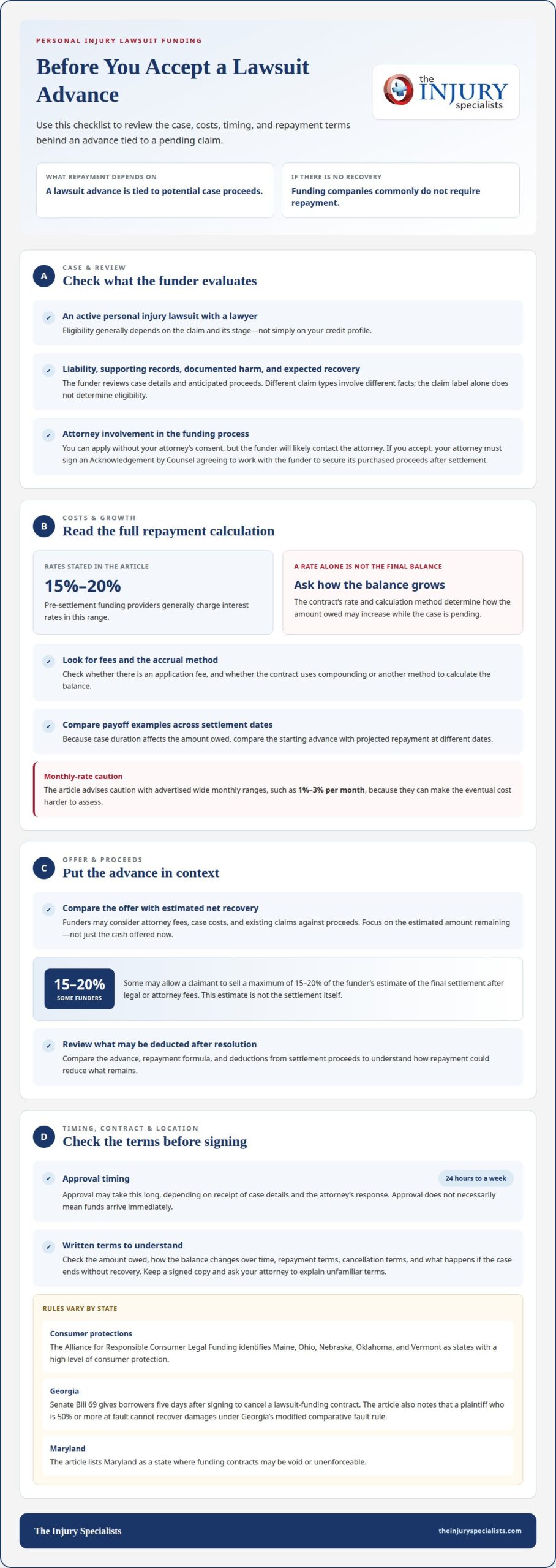
The key difference is what repayment depends on. Pre-settlement funding for personal injury cases is an advance tied to a pending claim, rather than a traditional loan that must be repaid regardless of the case outcome. If the case ends without a recovery, funding companies commonly do not require repayment.
It’s reasonable to want a clear picture of the terms before accepting an advance. This guide explains how lawsuit funding works, how it differs from a traditional loan, and what non-recourse repayment means if there is no recovery. It also covers what funders consider when reviewing a case and how an advance is repaid from any proceeds.
Key Takeaways
- Understand how a lawsuit advance is tied to a pending claim and what information may be reviewed during an application.
- Compare the repayment terms with a traditional loan, including how funding costs are disclosed in writing.
- Know how non-recourse funding generally works if a case ends without a recovery.
- Review the agreement carefully so you understand the repayment process and its effect on any proceeds from your case.
Are Personal Injury Lawsuit Advances the Same as Traditional Loans?
No. A lawsuit advance is tied to a legal claim, while a traditional loan creates repayment obligations separate from the case. In the United States, funding rules vary by state. The Alliance for Responsible Consumer Legal Funding identifies Maine, Ohio, Nebraska, Oklahoma, and Vermont as states with a high level of consumer protection. Georgia Senate Bill 69 gives borrowers five days after signing to cancel a lawsuit-funding contract.
That state variation matters before signing. Maryland is listed as a state where funding contracts may be void or unenforceable. In Georgia, a plaintiff who is 50% or more at fault cannot recover damages under the modified comparative fault rule. These examples show why location and the legal rules affecting an injury claim matter alongside the expected case outcome.
Eligibility depends on the claim and its stage, not simply on a person’s credit profile. Applicants generally need a personal injury lawsuit underway with a lawyer. A funding review may consider the incident, evidence of responsibility, documented harm, and expected recovery. A motor vehicle claim and a premises-related claim involve different facts, so the claim label alone does not determine eligibility.
Employment cases require particular care during review. A workplace dispute is not automatically a personal injury case. The claim’s legal basis, supporting evidence, and anticipated proceeds all affect whether it meets a funder’s criteria. The same principle applies to other injury claims: the decision centers on the lawsuit’s prospects and potential recovery, not a credit score.
Before accepting an advance, read the written agreement for the amount owed, how the balance changes over time, and the repayment terms. Approval may take 24 hours to a week, but speed does not replace a careful review. Ask your attorney to explain how the agreement interacts with your case and what happens if it is successful. Compare the written terms, not just a quoted rate or advertised timeline.
What Is Pre-Settlement Legal Funding?
Legal funding is an advance connected to a pending lawsuit, with repayment tied to case proceeds. For plaintiffs considering pre-settlement funding for personal injury cases, the application, attorney review, written costs, and contract terms shape the process.
Application and Attorney Review
Start by applying for a personal injury lawsuit that is already underway with an attorney. Funding companies review case details, including liability, supporting records, and expected recovery. You can apply without your attorney’s consent, but the funder will likely contact the attorney before approval. If you accept an advance, your attorney must sign an Acknowledgement by Counsel, agreeing to work with the funding company to secure its purchased proceeds after settlement.
Funding Costs and Fee Growth
Read the written agreement to see whether it charges an application fee and how it calculates repayment. Pre-settlement funding providers generally charge interest rates between 15% and 20%. The contract’s rate and calculation method determine how the balance may grow while a case is pending. Because the case duration affects the amount owed, compare the starting advance with the projected repayment at different settlement dates.
For pre-settlement funding for personal injury cases, the rate alone doesn’t show the final balance. Review any fees, compounding or other accrual method, and payoff examples before accepting. Be cautious of companies that advertise a wide monthly rate range, such as 1% to 3% per month, because it can make the eventual cost harder to assess.
Timelines, Contract Terms, and Risks
Funding companies may approve an application in 24 hours to a week. The timeline depends on receiving case details and the attorney’s response, so approval doesn’t necessarily mean funds arrive immediately. Before signing, compare the advance, repayment formula, and deductions from settlement proceeds. Review cancellation terms and what happens if the case ends without recovery.
Keep a signed copy and ask your attorney to explain unfamiliar terms. For practical guidance, explore funding application support.
Differences between lawsuit advances and traditional loans
A lawsuit advance is tied to potential case proceeds; personal loans and credit cards have their own repayment terms. The advance amount and fees depend on the funder’s assessment, the claim, and the written contract, rather than a standard amount for every plaintiff.
Advance Limits and Settlement Estimates
Funding companies assess expected recovery after considering attorney fees, case costs, and existing claims against proceeds. Some may allow a claimant to sell a maximum of 15-20% of the funder’s estimate of the final settlement after legal or attorney fees. That estimate is not the settlement itself. Compare the proposed advance with the net proceeds forecast, then review how repayment could reduce what remains after resolution.
Comparing Advances with Other Borrowing Options
A traditional personal loan or credit card creates repayment obligations independent of the lawsuit’s outcome. A litigation cash advance is generally structured around the claim, and funding companies commonly do not require repayment if the plaintiff loses. This distinction matters when comparing lawsuit funding with other borrowing, but the costs and contract terms still matter. Check whether the balance grows over time and how the agreement defines a successful recovery.
A settlement advance also differs from a loan approved mainly on creditworthiness. Plaintiffs generally do not need a good credit score to qualify for pre-settlement funding. Before deciding whether an advance suits your needs, review where repayment comes from and what deductions may be taken from the proceeds.
Advance Amounts, Fees, and Approval
There is no typical advance amount that applies to every case. The amount depends on the funder’s estimate of recoverable proceeds, expected legal fees, case costs, and existing obligations. Compare the offer with the estimated net recovery, rather than focusing only on the cash available now. This helps show how the advance may affect the settlement proceeds left over.
For an HMR Servicing agreement, review the written advance amount, fee calculation, and repayment terms together. Approval timing depends on the case review and supporting information. A clear contract should show how the balance changes and what may be owed after settlement. Do not treat fast approval or a large advance as proof that the terms suit your case.
Non-recourse protection if a case has no recovery
Non-recourse funding ties repayment to money recovered from the lawsuit. Funding companies commonly do not require repayment if the plaintiff loses. This differs from borrowing where payments remain due regardless of an accident claim’s outcome. Read the contract’s definitions of loss and recovery, including how it treats a settlement that leaves the plaintiff with no proceeds.
While a case is pending, an advance may help cover expenses such as medical bills or household costs. The funds are provided before resolution, with repayment assigned from a successful recovery under the agreement. The amount owed depends on the contract’s calculation and the time until resolution. Review how the balance could affect the net proceeds remaining after attorney fees, case costs, and other obligations.
A lawyer plays a practical role in confirming case details. The funding company will likely contact the attorney before approval to review the claim and expected proceeds. If the plaintiff accepts an advance, the attorney must sign an Acknowledgement by Counsel, agreeing to work with the funding company to secure its purchased proceeds after settlement. This step connects the funding agreement with the case’s settlement process.
If the case succeeds, repayment comes from the proceeds as set out in the signed agreement. If it ends without recovery, funding companies commonly do not require repayment, but the contract defines how that protection applies. Check whether it distinguishes a lost case from a settlement with little or no net proceeds. Also review what happens if the claim is withdrawn, dismissed, or otherwise resolved without payment.
Before accepting an advance, compare the repayment terms with your expected net recovery. Confirm the amount owed at different resolution points, how case expenses are treated, and how the funder must be notified about a settlement. Your credit score does not determine whether a case has recoverable proceeds. Review the terms with your lawyer before signing, and keep a complete copy of the agreement.
The Injury Specialists: Physician Referral Services, medical case management, marketing and networking to increase referral partners.
The Injury Specialists helps healthcare providers and law firms build referral connections and coordinate case management. For providers seeking patient referrals, its Physician Referral Services and Chiropractic and Physical Therapy Referrals support referral pathways. Imaging Center Referrals connect another part of the injury-care network.
Law firms can use the Attorney Referral Program, which includes medical case management based on each firm’s distinct process, as well as marketing and networking to grow referral partners. These services can help firms and providers organize professional connections around personal injury cases. They are not legal representation or medical treatment for an individual claim.
Contact The Injury Specialists to learn about referral services or case management.
Make the Next Step Deliberate
Before moving forward, consider how the funding decision fits into the broader plan for the claim. Clear communication among the injured person, legal team, and care providers helps keep expectations aligned as the case progresses. For firms and healthcare organizations, this includes considering how financial support fits alongside the professional relationships and case-management workflows involved in injury matters.
Treat the funding agreement as part of the plan for pre-settlement funding for personal injury cases, not simply as a source of immediate cash. Identify who will coordinate updates, how settlement information will be shared, and which professionals need to stay informed. These steps support an organized process while leaving legal decisions and medical care to the professionals responsible for them.
The Injury Specialists can help firms and providers strengthen referral and case-management connections around injury matters. Connect with The Injury Specialists to discuss support for your professional needs. A considered next step can keep your work focused and coordinated.
Frequently Asked Questions
Are pre-settlement funds loans?
Lawsuit funding is usually structured as an advance against a legal claim, rather than a conventional loan based on regular income or credit. This distinction matters because the contract links repayment to case proceeds. Before accepting an advance, check how the agreement defines recovery and whether the balance grows over time. The agreement, not the label “lawsuit loan,” explains the financial obligation.
Do I have to pay a deposit?
Whether an upfront deposit applies depends on the written offer. Do not assume that applying or receiving approval means a deposit is required or waived. Review the contract and payment instructions before authorizing a charge. Separate any upfront amount from the advance itself, and make sure you understand whether it is refundable or deducted from proceeds.
Do you need a good credit history or financial standing to apply?
A strong credit history generally is not required to qualify. Funding companies focus on the pending claim, including evidence of liability and expected recovery, rather than treating a credit score as the main measure. For example, prepare information that helps explain how the accident happened and what supports the injury claim. The case review remains central to the decision.
How Soon Can I Get Funding?
Application approval may take 24 hours to a week. The timing depends on how quickly the funding company receives case information and the attorney’s response. Approval and receipt of funds are separate steps, so ask what remains after a decision, such as completing the agreement or arranging payment. A quick review does not remove the need to read the terms carefully.
How much can I borrow?
The advance depends on the funder’s estimate of potential case proceeds, minus anticipated legal fees, case costs, and other claims. Some funding companies may allow a claimant to sell a maximum of 15-20% of the funder’s estimate of the final settlement after legal or attorney fees. Use the estimate to assess how an advance could affect your eventual net recovery.
How much can I get?
The amount available is based on the case assessment, not a standard figure for every claimant. A stronger estimate of recoverable proceeds may affect the offer, while expected fees, case expenses, and competing claims can reduce what remains. Compare the proposed advance with the projected net recovery. The Injury Specialists facilitates connections related to pre-settlement funding; it is not a medical funding company.

Leave A Comment
You must be logged in to post a comment.