

A channel’s lead count isn’t its return. To understand how to measure law firm marketing ROI, attribute new-client revenue to each channel, subtract that channel’s marketing costs, then divide the net return by those costs. Compare channels using consistent cost categories and reporting periods to make the results meaningful.
It’s easy to focus on clicks, calls, or consultations, but those measures show activity, not whether marketing is producing revenue. This article explains what counts as law firm marketing ROI, how to track leads through consultations and signed matters, and how to calculate revenue by channel. It also covers benchmarks, including why a useful target depends on attribution quality, case outcomes, and the full cost of a campaign. You’ll have a practical framework for comparing channels and deciding where to focus next.
Key Takeaways
- Track prospects from first contact through consultation and signed case to connect marketing activity with outcomes.
- Include the full cost of each channel when assessing performance, including campaign and management expenses.
- Use consistent attribution to compare SEO, paid advertising, social media, and business development on equal terms.
- Use ROI benchmarks as context, then weigh them against your firm’s goals, case mix, and marketing results over time.
What is a good marketing ROI for lawyers?
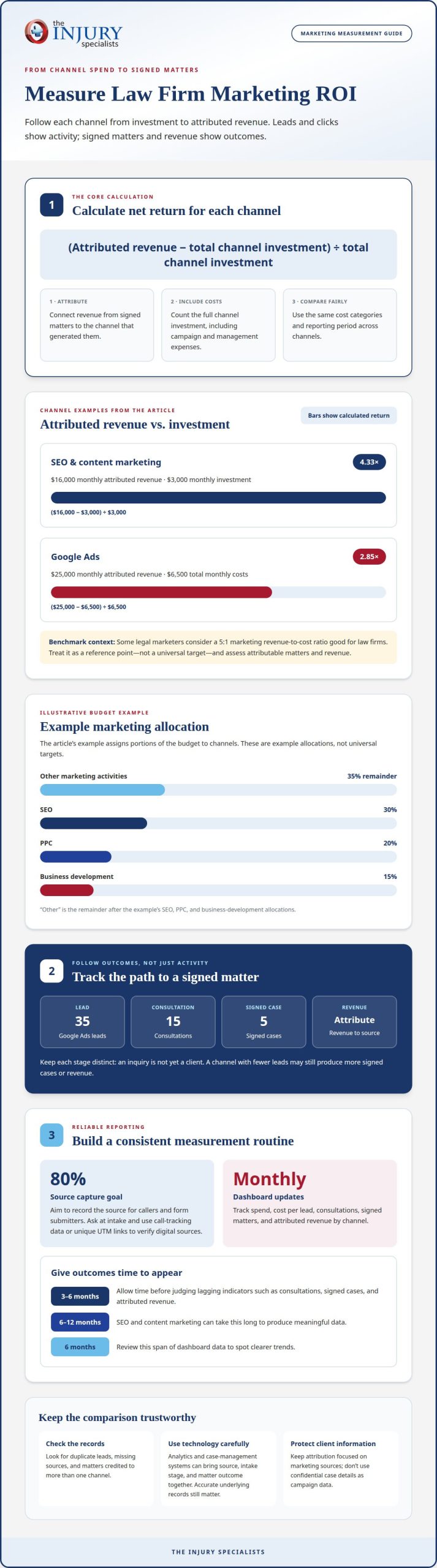
Some legal marketers consider a 5:1 marketing revenue-to-cost ratio good for law firms. Treat it as a reference point, then measure whether each channel generates attributable matters and revenue.
In the United States, professional conduct rules shape ethical advertising and how firms use client data for marketing tracking. Keep attribution focused on marketing sources, and don’t use confidential case details as campaign data.
-
Trace Leads Through the Signed Case
Connect each lead’s first contact to its consultation, signed case, and attributed revenue. This shows whether advertising produces matters, rather than only calls or website visits. For example, a Google Ads campaign with 35 leads, 15 consultations, and 5 signed cases gives the firm a clearer conversion path to assess. Keep each stage distinct so an inquiry isn’t counted as a client.
Track the same stages across channels and review where leads stop progressing. A channel with fewer leads may still produce more signed cases or revenue. Without tracking that path, firms can mistake activity for results and allocate spending based on incomplete evidence.
-
Record Lead Sources at Intake
Record the source of calls and form submissions, then link it to the lead record. Near the end of an intake call, ask callers how they heard about the firm and compare their answers with call-tracking data. For forms, use unique UTM tracking links on digital ads to preserve campaign sources.
Aim to capture source information for 80% of callers and form submitters. If intake staff can’t identify a source, call-tracking software can help verify it. Consistent source records let firms compare channels and connect leads to consultations, signed cases, and revenue.
-
Use Technology and AI for Tracking
Use a marketing analytics or case-management system to bring source, intake stage, and matter outcome into one reporting process. Track website traffic, social media engagement, leads, new matters, and attributed revenue. The 2025 Legal Trends Report states that 79% of legal professionals use AI in their firms; AI tools can support analysis, but attribution depends on accurate underlying records.
Before shifting ad spending, compare technology reports with intake and matter records. Look for duplicate leads, missing sources, and cases credited to more than one channel. A reliable performance view helps firms adjust campaigns based on evidence, not clicks alone.
What Counts as Law Firm Marketing ROI?
Use ROI to connect marketing investment with measurable business outcomes. Track results by channel, then use them to guide campaigns and resource allocation.
-
Identify Marketing Performance Metrics
For each channel, track spending, cost per lead, consultations, signed matters, and attributed revenue. Together, these metrics show whether campaigns generate qualified opportunities and business outcomes. Calculate cost per lead by dividing marketing spending by the number of new leads acquired during the month.
Compare channels over the same reporting period and with the same cost categories. Consistent comparisons help firms see whether legal marketing delivers results beyond surface-level engagement.
-
Assess the Time to See ROI
Separate early indicators, such as traffic and inquiries, from lagging indicators, including consultations, signed cases, and attributed revenue. Allow 3 to 6 months before judging those lagging indicators. SEO and content marketing can take 6 to 12 months to produce meaningful data, so a short review window can undervalue them.
Update the ROI dashboard monthly and review six months of data to spot clearer trends. This gives campaigns time to develop while keeping performance visible.
- Allocate budgets using channel results. First compare each channel’s attributed revenue and conversion performance with its spending. Then shift resources toward campaigns that support the firm’s goals, while retaining investment in channels that need a longer measurement window.
One budget example allocates 30% to SEO, 20% to PPC, and 15% to business development, with the remainder assigned to other marketing activities. These are example allocations, not universal targets. For firms growing referral relationships, an attorney referral program can be one business-development channel to include in the same measurement framework.
Calculating revenue by marketing channel
Attribute revenue to the channel that generated each signed matter, then compare its net return with its investment. A practical framework for how to measure law firm marketing ROI starts with consistent attribution and cost rules across Google Ads, SEO, and social media.
-
Calculate Client Acquisition Cost and Lifetime Value
Calculate client acquisition cost by dividing a channel’s acquisition spending by the number of new clients it generated. For lifetime value, total the revenue attributed to a client across the relationship, using recorded matters rather than projections. These measures show the investment required to acquire clients and the revenue they deliver over time.
Keep the measurement basis consistent. Don’t compare one channel’s ad spend alone with another channel’s ad and management costs combined. Track client outcomes separately from lead volume and engagement, which reflect earlier stages. This distinction makes acquisition metrics more useful for budget decisions.
-
Calculate ROI by Marketing Channel
Subtract a channel’s total investment from attributed revenue, then divide the net return by that investment. For example, SEO and content marketing generating $16,000 in monthly attributed revenue on a $3,000 monthly investment produces a 4.33x return. Include costs associated with the channel in the investment figure.
A Google Ads example attributes $25,000 in monthly revenue to $6,500 in total monthly costs, producing a 2.85x return. Compare channels over the same period, and don’t treat clicks or engagement as revenue. This calculation helps explain how to measure law firm marketing ROI at the channel level.
-
Calculate Overall Law Firm Marketing ROI
Add attributed revenue across channels and total their marketing investments, then apply the same net-return formula. This gives firms an overall view as well as channel-level results. If a prospect engages with multiple campaigns before signing, apply consistent attribution rules so the same revenue isn’t counted twice.
For a separate example, spending $2,000 on a campaign and earning $10,000 in new-client revenue yields 400% ROI after subtracting the investment. Review channel and overall metrics together. The combined view can reveal whether a strong total masks a weak channel or an attribution gap.
Law firm marketing ROI benchmarks
Use benchmarks to frame performance, not as automatic budget rules. A 3x to 5x return is described as solid performance for a law firm marketing channel, while results depend on attribution, practice areas, and campaign goals.
- Compare each channel with the same return measure. A 3x return and a 5x return can signal different performance, but conversion quality matters too. Check whether attributed revenue comes from signed matters and whether channel costs include relevant campaign expenses. Social media engagement can inform awareness goals, but it doesn’t replace revenue and conversion metrics when assessing financial return.
Choose benchmarks that match each channel’s purpose. A lead-generation campaign needs different indicators from a campaign designed to build awareness.
- Set marketing spending against firm revenue and stage of growth. One guideline for an established small law firm is allocating 6% to 12% of revenue to marketing. A new small firm in a highly competitive market may need to spend close to 16%.
An established small firm in a more competitive market may spend closer to 14% of revenue. Treat these figures as context, not fixed targets. Practice areas, competition, and the firm’s growth objectives shape the appropriate marketing strategy.
- Use revenue-to-cost ratios as another comparison point. Some legal marketers consider a 10:1 marketing revenue-to-cost ratio outstanding for law firms. That benchmark is more demanding than the 3x to 5x range described as solid channel performance, so don’t compare them as identical thresholds.
Review results consistently, then optimize campaigns where conversion or attributed revenue trails the firm’s goals. Referral channels can also form part of a growth strategy. Discuss referral-focused marketing as part of your benchmark review.
The Injury Specialists: Attorney Referral Program, medical case management based on firms distinct process, marketing and networking to grow referral partners.
The Injury Specialists helps law firms expand referral relationships and coordinate case management around each firm’s distinct process. Its Attorney Referral Program combines medical case management with marketing and networking to grow referral partners, making it a structured option when referral development is part of a firm’s growth strategy.
When assessing referral activity alongside other marketing channels, consistent tracking can help show how new relationships contribute to inquiries and matters. The Injury Specialists also provides Physician Referral Services, Chiropractic and Physical Therapy Referrals, and Imaging Center Referrals, connecting firms with relevant parts of the injury-care network.
Contact The Injury Specialists to discuss how referral development and case management can fit your firm’s approach.
Make Your Next Marketing Decision With Confidence
Turn your next ROI review into a planning decision. Identify which channels support the firm’s priorities, where attribution needs improvement, and what to change in the next campaign cycle. A practical approach to how to measure law firm marketing ROI should help your team make clearer decisions, not just produce another report.
Referral development can be part of that plan. The Injury Specialists offers an Attorney Referral Program, medical case management tailored to a firm’s distinct process, and marketing and networking to grow referral partners. Its Physician Referral Services include medical case management, marketing, and networking to increase referral partners, alongside Chiropractic and Physical Therapy Referrals.
If referral growth aligns with your firm’s next step, contact The Injury Specialists to discuss your goals. Keep refining your approach, and let each review inform a stronger, more focused marketing strategy.
Frequently Asked Questions
What is marketing ROI for law firms?
Marketing ROI measures the financial return associated with marketing investment against the resources spent to generate it. For law firms, distinguish revenue attributed to a campaign from profit remaining after relevant expenses. A channel may generate signed matters but perform differently once costs and case outcomes are considered. Define the outcome before comparing campaigns.
How do law firms calculate marketing ROI?
Subtract a channel’s total marketing costs from its attributed revenue, then divide the result by those costs. Multiply by 100 to express ROI as a percentage. For example, include applicable campaign expenses in the cost figure rather than counting media spend alone. Apply the same calculation and cost rules across channels so the comparison supports a consistent budget decision.
How do you attribute signed clients and revenue to law firm marketing channels?
Record each inquiry’s source when it enters intake, and retain that source as the lead advances to a signed matter. Set a consistent attribution rule for prospects who interact with several channels, such as recording both the first known source and the source immediately before contact. This preserves the lead journey and makes revenue assignments easier to explain.
What is a good marketing ROI or cost per lead for a law firm?
A useful ROI target depends on the firm’s expenses, case economics, and conversion from lead to signed client. Cost per lead is marketing spending divided by the number of leads acquired, but that figure alone can mislead. Compare leads by source and assess how many become suitable matters. A higher-cost source may still contribute more value if it generates stronger client outcomes.
How should law firms measure ROI for SEO, PPC, referrals, and social media?
Choose channel indicators that match each source’s role. For SEO, review organic inquiries and their progress; for PPC, connect ad campaigns to qualified contacts and signed matters. Record referral sources at intake, and assess social media against its intended outcome, such as engagement or inquiries. Separate early activity from later case results so channels with different timelines aren’t judged alike.
What CRM and call-tracking tools help measure law firm marketing ROI?
Choose tools that link a lead’s source to intake status, signed matters, and attributed revenue. A CRM can organize these records, while call tracking can help identify where phone inquiries originated. Useful reporting should reveal missing or conflicting source data and support consistent channel comparisons. Control access to sensitive client information and limit marketing reports to what staff need.

Leave A Comment
You must be logged in to post a comment.