

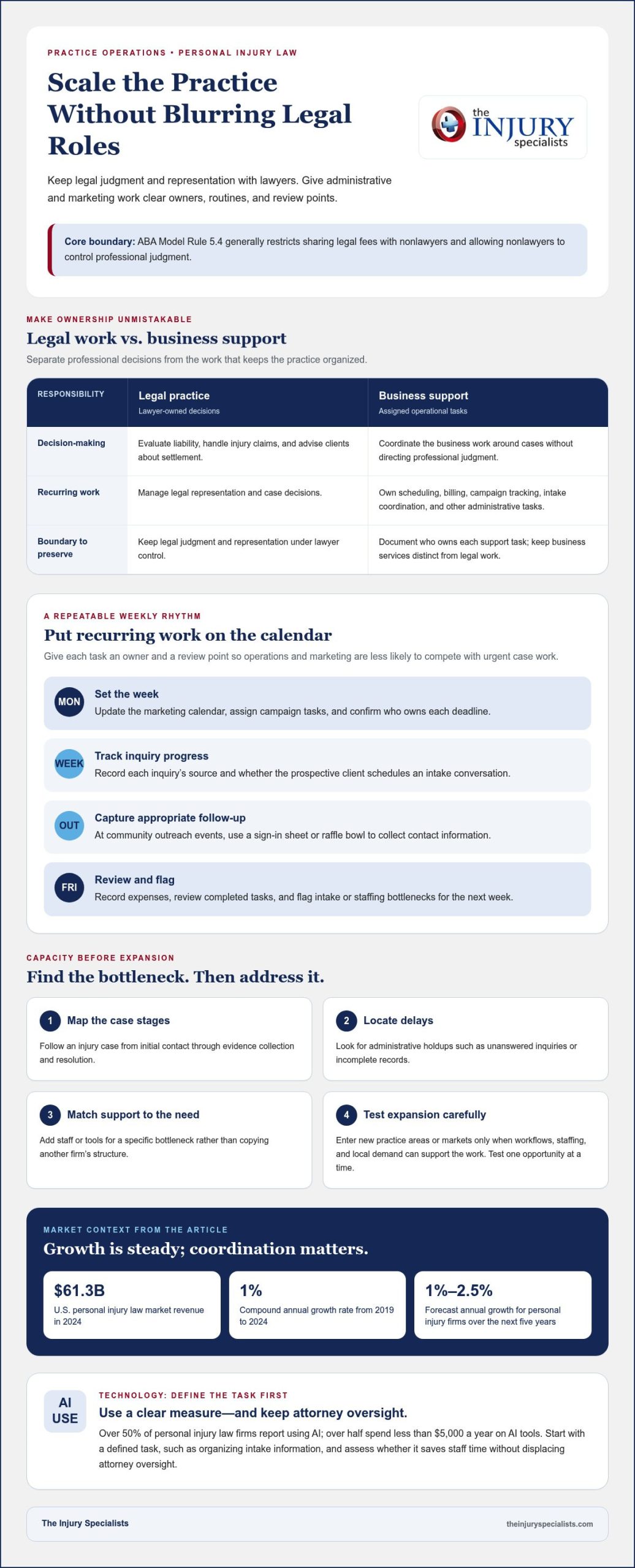
Growth should add capacity, not blur professional roles. Expanding a personal injury law practice works best when lawyers retain control over legal judgment and representation while administrative and marketing work supports the business separately. ABA Model Rule 5.4 generally restricts lawyers from sharing legal fees with nonlawyers and from allowing nonlawyers to control professional judgment.
More matters can bring heavier demands on intake, coordination, marketing, and operations. A clear division of responsibilities helps a firm scale these functions without confusing business support with legal services.
This article explains how to organize administrative and marketing work, establish a manageable growth routine, and keep legal practice distinct from nonlegal business services. It also explores how referral networks and case management technology can support a firm’s expansion while preserving that distinction.
Key Takeaways
- Separate legal judgment and representation from administrative and marketing support, then assign clear ownership for recurring work.
- Build a focused marketing routine around professional relationships, community connections, and a calendar your team can maintain.
- Improve intake by making each step clear, tracking follow-ups, and communicating consistently with prospective clients.
- Use referral networks and case management support to strengthen coordination as the practice grows, while keeping business services distinct from legal work.
Organizing administrative and marketing tasks
The U.S. personal injury law market generated $61.3 billion in revenue in 2024. From 2019 to 2024, the personal injury attorney market grew at a 1% compound annual growth rate. Analysts forecast 1% to 2.5% compound annual growth for personal injury firms over the next five years. This competitive market rewards firms that coordinate intake, staffing, and marketing rather than relying on growth alone.
Keep legal judgment distinct from business support. ABA Model Rule 5.4 generally restricts lawyers and law firms from sharing legal fees with nonlawyers and allowing nonlawyers to control professional judgment. Assign lawyers responsibility for legal work, including evaluating liability, handling an injury claim, and advising clients about settlement. Document who owns scheduling, billing, campaign tracking, and other administrative tasks.
Turn recurring work into a weekly operating rhythm. A practical schedule assigns each task an owner and a review point, so marketing and administration are less likely to compete with urgent case work.
- On Monday, update the marketing calendar, assign campaign tasks, and confirm which attorney or staff member owns each deadline.
- During the week, record inquiries by source and track whether each prospective client schedules an intake conversation.
- At community outreach events, use a sign-in sheet or raffle bowl to collect contact information for appropriate follow-up.
- On Friday, record expenses, review completed tasks, and flag intake or staffing bottlenecks for the next week.
Assess capacity before taking on more work. Map each stage of an injury case, from initial contact through evidence collection and resolution. Identify where administrative delays occur, such as unanswered inquiries or incomplete records. Add staff or tools to address a specific bottleneck rather than copying another firm’s structure. Marketing and staffing costs depend on the channels, workload, and responsibilities the firm chooses.
Should a personal injury firm enter new practice areas or geographic markets? Expand only when existing workflows, staffing, and local demand can support the added work. Test one opportunity at a time, then compare its qualified inquiries and operational demands with those of the current practice.
How can a firm measure growth, profitability, and marketing return? Track qualified leads, signed matters, case progress, collected revenue, and expenses by channel. Compare results over consistent review periods, accounting for the time between an inquiry, an injury claim, and a settlement.
Technology can support this review, but budget decisions need clear measures. Over 50% of personal injury law firms report using AI, while over half spend less than $5,000 a year on AI tools. Start with a defined task, such as organizing intake information, and assess whether the tool saves staff time without displacing attorney oversight. Keep the workflow and its cost visible as the practice grows.
Which marketing channels generate the most personal injury clients?
No single channel works best for every personal injury firm. Other attorneys can refer clients, while search visibility, educational content, and community connections can help prospective clients find a practice. When expanding a personal injury law practice, choose a mix that fits the firm’s location, case focus, capacity, and ability to follow up consistently.
Attorney referrals are built on direct professional relationships. A lawyer in another specialty may meet a client with an injury matter. Make the relationship useful by explaining the types of cases your firm handles and sharing updates when appropriate. For example, a firm focused on car accident claims can describe its experience with liability issues and insurance disputes. Keep referral relationships professional and centered on client needs.
Online channels help people find a firm while researching an injury claim. A useful website clearly explains the firm’s practice focus, location, and contact process. Educational pages can answer specific questions, such as what evidence may matter after a car accident or how an insurer evaluates a claim. Practical information gives potential clients a clear next step, unlike general marketing language.
Local visibility connects online research with a firm’s service area. Keep business details consistent across relevant directories, and create pages that address the communities the firm serves. A location-specific page should provide local context, not repeat identical copy with a different place name. This helps readers decide whether the attorney’s practice fits their needs.
- Attorney relationships: Build connections with lawyers whose practice areas complement personal injury work.
- Search content: Publish clear answers to questions about claims, insurance, and case steps.
- Local presence: Make the firm’s location and practice focus straightforward to find.
- Community engagement: Participate in relevant professional and local networks, then follow up with contacts appropriately.
Choose channels based on the quality of conversations they generate, not just inquiry volume. Consider whether contacts fit the firm’s case focus, whether staff can respond promptly, and whether inquiries lead to meaningful intake discussions. A channel that produces fewer but better-matched inquiries may be more useful than broad exposure without a clear path to contact. A disciplined approach to expanding a personal injury law practice weighs these results against the time required to manage each channel.
As the firm grows, relationship-based outreach can become difficult to coordinate across lawyers and staff. A structured attorney referral network can support professional connections and case coordination. Consider how attorney referral and networking support fits the firm’s growth approach.
How can a personal injury law firm improve lead conversion and client intake?
Conversion improves when every inquiry has a clear next step. A prospective client may be juggling medical appointments, insurance calls, and uncertainty about an injury claim. Keep the first interaction focused: identify the caller’s immediate concern, gather basic facts, and explain what happens next. A consistent process helps staff handle inquiries without making legal decisions outside their role.
Start with a defined intake process. Assign responsibility for receiving inquiries, recording contact details, arranging attorney review, and following up. Use a shared system to record the inquiry source, contact attempts, scheduled conversations, and outcome. For example, staff can flag an unanswered inquiry for follow-up and note whether the person spoke with an attorney. Make access and responsibilities clear so information reaches the right person.
- Respond clearly: Tell the caller who will follow up and what the next step involves.
- Capture consistently: Record the incident type, contact preferences, and relevant dates.
- Route promptly: Send potential matters to the appropriate attorney for review.
- Close the loop: Document whether the inquiry proceeded, needs follow-up, or was not a fit.
Communication matters beyond the first call. A reported 72% of legal clients want more transparent communication with their attorneys going forward. Set expectations about who will provide updates, how clients can ask questions, and what information the firm needs. A client portal or secure communication workflow can help organize documents and messages. Staff should explain the process in plain language, not promise a case result.
Measure each transition, not just the total number of inquiries. Compare how many contacts lead to an intake conversation, receive attorney review, and become clients. Review each stage by source and matter type. If a channel generates inquiries but few appropriate consultations, refine the message or intake questions. If consultations stall, examine scheduling, follow-up ownership, and whether clients understand the next step.
Technology can simplify these handoffs when it fits the firm’s process. Choose tools that centralize contact records, reminders, and case-related communications. Train staff to enter data consistently, then review incomplete records during routine team meetings. Attorneys should handle legal evaluation and advice; administrative workflows should support their work, not replace professional judgment.
Audit the intake process using a recent inquiry. Trace its path from first contact to attorney review, identify any missed handoff, and assign someone to address it. A repeatable intake workflow gives a growing firm a practical foundation for client communication and conversion.
The Injury Specialists: Physician Referral Services, medical case management, marketing and networking to increase referral partners.
The Injury Specialists supports personal injury firms seeking stronger referral connections and coordinated case management. Its Attorney Referral Program includes medical case management tailored to each firm’s distinct process, along with marketing and networking to grow referral partners. These services can support a firm’s business operations as it expands, while legal judgment and representation remain with its attorneys.
For firms developing healthcare connections, support includes Physician Referral Services, Chiropractic and Physical Therapy Referrals, and Imaging Center Referrals. Medical case management and referral coordination can help address operational needs around professional relationships without replacing the firm’s legal work.
When referral development or case coordination becomes a growth priority, contact The Injury Specialists to discuss its attorney referral and medical case management support.
Set a Clear Direction for Your Firm’s Next Stage
Growth is more manageable when each new initiative has an owner, a purpose, and a review point. Before expanding a personal injury law practice further, choose the operational gap to address first. Then define what progress would look like for your firm, such as smoother intake handoffs or stronger professional connections.
Keep the plan focused. Any new channel or process should fit the firm’s legal work, staff capacity, and commitment to clear professional boundaries. Review its impact with your team and adjust as priorities change. That keeps expansion deliberate instead of turning every opportunity into another competing task.
The Injury Specialists can be part of the next step when referral development and case coordination are priorities. Discuss your firm’s growth priorities with The Injury Specialists and identify a practical path forward. Build with purpose, preserve clear roles, and give your team a stronger foundation for sustainable growth.
Frequently Asked Questions
What are the best strategies for growing a personal injury law practice?
Prioritize a defined case focus, a reliable client experience, and relationships that support that focus. For example, a firm handling workplace injuries can develop useful educational resources for that audience and build professional connections relevant to those matters. Review case outcomes, inquiry quality, and workload together before widening the firm’s reach. This ties growth decisions to the practice’s strengths and available capacity.
How much does it cost to market a personal injury law firm?
There’s no universal marketing budget for a law firm. Spending depends on the channels, audience, creative work, and staff time involved. Paid search has different cost drivers from educational content or professional networking. Set a budget around a specific goal, such as qualified consultations, and track expenses and outcomes by channel. Adjust spending based on performance rather than copying another firm’s budget.
What staffing and technology are needed to expand a personal injury practice?
Match staffing and software to the work that currently slows the firm down. Intake coordinators can manage scheduling and records, while attorneys retain responsibility for legal analysis and client advice. Case management tools can organize documents, tasks, and communication; choose features that fit established workflows. Use any referral or case management platform only for legal and ethical purposes, and train staff to enter accurate information consistently.

Leave A Comment
You must be logged in to post a comment.