

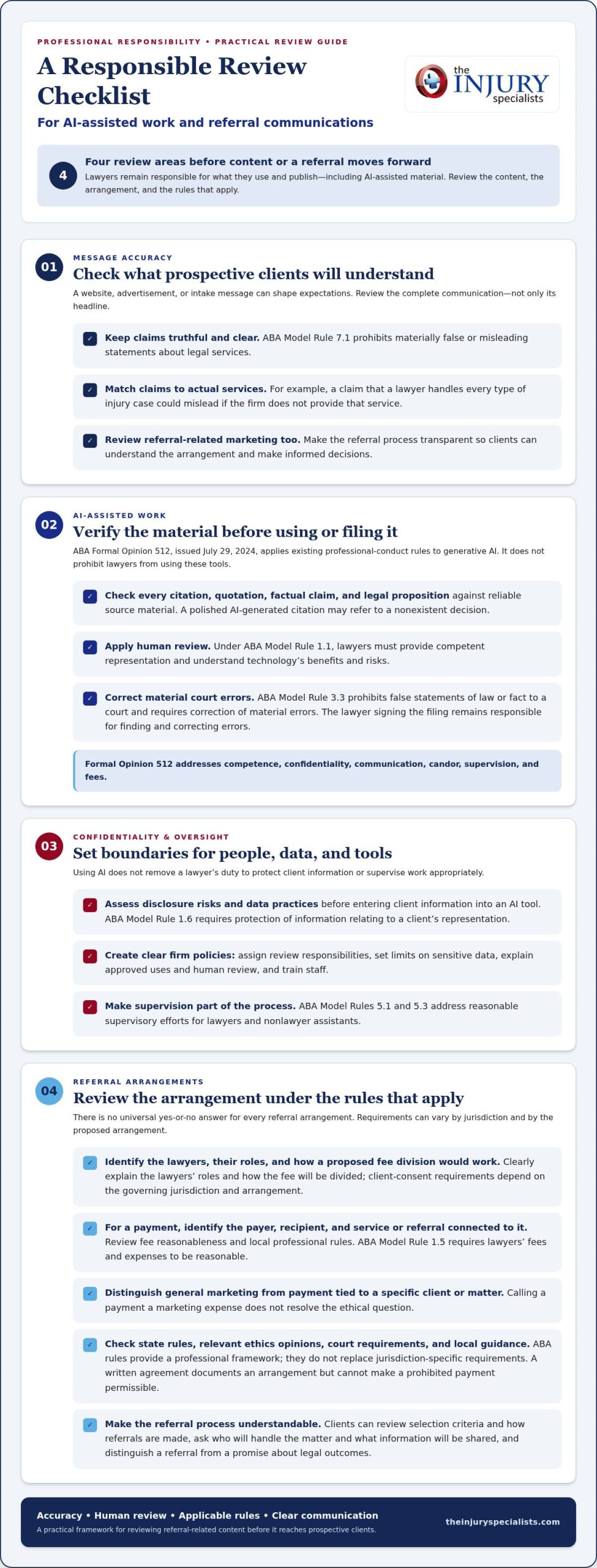
A referral can be professionally handled and still be undermined by misleading marketing. The ethical guidelines for attorney referrals include truthful communications about legal services: ABA Model Rule 7.1 prohibits materially false or misleading statements. Lawyers remain responsible for reviewing what their firms publish, including AI-assisted content.
That responsibility extends beyond the referral itself. A website, advertisement, or intake message can shape a prospective client’s expectations, so accuracy and human review matter at every stage. Clear oversight helps firms keep referral communications consistent with their professional obligations.
This article explains how lawyer responsibility, accuracy checks, and marketing content review fit together. It also covers the ABA’s Formal Opinion 512, issued July 29, 2024, and why using generative AI doesn’t remove a lawyer’s duty to assess its output. The result is a practical framework for evaluating referral-related content before it reaches prospective clients.
Key Takeaways
- Review AI-assisted legal work for accurate facts, citations, and claims before using or filing it.
- Assess referral arrangements under the professional-conduct rules that apply to the lawyers and jurisdictions involved.
- Keep attorney advertising truthful and clear, with careful review of referral-related marketing content.
- Make referral communications transparent so clients can understand the arrangement and make informed decisions.
Accuracy, human review, and lawyer responsibility
Artificial intelligence can help lawyers draft and organize legal work, but it doesn’t take responsibility for the result. The American Bar Association’s Formal Opinion 512, issued July 29, 2024, applies existing professional conduct rules to generative AI. It addresses competence, confidentiality, communication, candor, supervision, and fees. It doesn’t prohibit lawyers from using these tools.
Human review is essential before AI-assisted material is used in a filing. Under ABA Model Rule 1.1, lawyers must provide competent representation and understand technology’s benefits and risks. ABA Model Rule 3.3 also prohibits false statements of law or fact to a court and requires correction of material errors. A lawyer should check each citation, quotation, factual claim, and legal proposition against reliable source material.
For example, a polished AI-generated citation may refer to a nonexistent decision. The lawyer signing the filing remains responsible for finding and correcting that error. Clear firm policies can assign review responsibilities, set limits on sensitive data, and train staff. ABA Model Rules 5.1 and 5.3 address reasonable supervisory efforts for lawyers and nonlawyer assistants.
For fee-sharing between referring attorneys, client-consent requirements depend on the governing jurisdiction and proposed arrangement. Clearly explain the lawyers’ roles and how the fee will be divided, then follow the applicable professional conduct rules before making the referral.
Attorney referral rules vary by state because professional conduct rules, ethics opinions, court rules, and bar guidance differ. Lawyers should review the requirements that apply to their practice and referral arrangement, rather than assuming one state’s approach applies everywhere.
When assessing a referral service, clients can review its selection criteria, how referrals are made, and whether it clearly explains its role. A transparent process helps distinguish a referral from a promise about legal outcomes. Before proceeding, ask who will handle the matter and what information will be shared.
Confidentiality needs attention when lawyers use AI tools. ABA Model Rule 1.6 requires protection of information relating to a client’s representation. Before entering such information into an AI tool, lawyers should evaluate disclosure risks and the tool’s data practices. Policies should explain approved uses and human review, keeping accuracy and professional responsibility central.
Can attorneys receive referral fees or pay for client referrals under ABA rules?
There isn’t a universal yes-or-no answer for every referral arrangement. Ethical guidelines for attorney referrals depend on the arrangement and the jurisdiction’s professional conduct rules. ABA Model Rule 1.5 requires lawyers’ fees and expenses to be reasonable, but that requirement alone doesn’t establish whether a particular referral payment or fee division is allowed.
Before agreeing to share a fee, identify the lawyers involved, their respective roles, and how the proposed division would work. Then review the governing state rules and relevant ethics opinions. ABA rules provide a professional framework, but they do not replace jurisdiction-specific requirements. A written agreement can document the arrangement, but it cannot make a prohibited payment permissible.
Payments for client referrals require separate review. Describe what the payment covers, who receives it, and whether it depends on a particular client or matter. Calling a payment a marketing expense does not resolve the ethical question. The actual arrangement and the rules governing the lawyers determine the analysis.
For example, a firm considering compensation for a referral source should distinguish payment for general marketing from payment tied to a specific legal matter. That distinction helps frame the review, but does not determine whether the arrangement is permissible. Before proceeding, check the state’s professional conduct rules, bar ethics opinions, and applicable court requirements.
- Identify the payer and recipient.
- Describe the service or referral connected to payment.
- Review fee reasonableness and local professional rules.
- Document the arrangement and any required client communication.
For firms building referral relationships, applying ethical guidelines for attorney referrals also means keeping networking activity distinct from payments tied to a client or matter. Structured attorney referral networking can support clearer processes. Assess each arrangement under the rules that govern it.
Reciprocal referrals can raise concerns when they involve an impermissible fee division, payment tied to a specific client or matter, or unreasonable fees. The arrangement must also comply with applicable state rules and client-communication requirements. Describing a payment as marketing does not resolve the ethical issue.
What rules govern lawyer referral services and attorney advertising?
ABA Model Rule 7.1 governs lawyers’ communications about legal services. It prohibits materially false or misleading statements. Referral-related advertisements can shape a prospective client’s understanding, so review the full message, not just its headline. For example, a claim that a lawyer handles every type of injury case could mislead if the firm doesn’t provide that service. Ethical guidelines for attorney referrals include reviewing those claims accurately.
Review the rules that apply where the lawyer practices. State professional conduct rules, court rules, ethics opinions, and local bar guidance may add requirements or clarify how advertising rules apply. ABA Formal Opinion 512 addresses generative artificial intelligence, not every referral-service question, so it doesn’t replace local advertising review.
For AI-assisted marketing, assign a lawyer or designated reviewer to compare every public claim with the firm’s actual services and referral process. Check names, practice areas, descriptions of outcomes, and statements about relationships. Even a polished draft can contain a false claim or imply an endorsement the firm cannot support.
A useful review separates factual claims from promotional language. “We connect prospective clients with attorneys” describes a process. “We guarantee the best attorney” makes a sweeping claim that requires careful scrutiny. The distinction matters because Rule 7.1 focuses on whether a communication is materially false or misleading. Ethical guidelines for attorney referrals make that review part of responsible marketing.
- Identify each claim about legal services, experience, or referral handling.
- Check factual statements against current firm information and process records.
- Review the message under applicable state and local requirements.
- Recheck edits before publishing, especially changes to claims or disclaimers.
Keep the final advertisement with its review record. If the firm updates its practice areas or referral process, revisit related pages, social posts, and intake materials. A consistent review process helps lawyers catch outdated claims before prospective clients rely on them.
What disclosures must an attorney make when referring a client to another lawyer?
A referral should make clear who may handle the matter and what happens next. Explain the receiving lawyer’s identity, the reason for the referral, and whether the original lawyer will remain involved. Do not imply that the receiving lawyer has accepted the matter before they agree to do so.
ABA Model Rule 1.4(a)(2) requires lawyers to reasonably consult clients about the means for achieving their objectives. In a referral conversation, explain how the proposed handoff relates to those objectives. For example, describe whether the new lawyer would take over the case or provide help on a particular issue. Give the client room to discuss concerns and preferences.
If the referring and receiving lawyers will divide a fee, explain the arrangement plainly before the client decides. Identify which lawyers will work on the matter and how the proposed division relates to their roles. Fee-division and client-consent requirements depend on the jurisdiction and arrangement, so do not present one disclosure as universal.
A referral may also involve sharing case details. Tell the client what information will be shared with the other lawyer and why. Share only information relevant to evaluating or handling the matter, and follow applicable confidentiality rules. For example, clarify the purpose of the handoff with the client before sending case documents to the prospective lawyer.
Before making the introduction, explain these points in clear language:
- The receiving lawyer’s name and expected role.
- Whether the current lawyer will withdraw, stay involved, or coordinate the transition.
- Any proposed fee division or other financial relationship relevant to the referral.
- What case information will be shared and the next step for the client.
State rules and ethics opinions may impose different requirements. The referring lawyer should apply the rules governing the specific arrangement and document the client discussion. A concise written summary can help the client understand the referral, compare proposed next steps, and make an informed choice.
The Injury Specialists: Physician Referral Services, medical case management, marketing and networking to increase referral partners.
The Injury Specialists supports professional referral relationships through its Attorney Referral Program, medical case management based on each firm’s distinct processes, and marketing and networking to grow referral partnerships. These services can help firms develop connections while keeping their own referral procedures in view.
Healthcare professionals can also use Physician Referral Services, Chiropractic and Physical Therapy Referrals, and Imaging Center Referrals. The right connection depends on the professional relationship a firm aims to build and how it fits the firm’s workflow. For law firms, the Attorney Referral Program and related case management help align referral networking with the firm’s process.
Use these services as a professional networking resource, not as a substitute for a lawyer’s independent review of applicable ethics rules or referral disclosures. To discuss referral partnerships, contact The Injury Specialists.
Make Referral Integrity Part of Your Firm’s Workflow
Make ethical guidelines for attorney referrals a working standard, not a one-time review. Assign responsibility for referral communications, marketing updates, and client handoffs. When the firm changes its services or referral process, revisit materials describing those relationships. This helps keep internal practices and public messaging aligned as the firm grows.
Build a consistent process for making introductions and connecting prospective partners with your firm. The Injury Specialists can support firms developing referral relationships that fit their distinct processes. A focused conversation can help determine whether its Attorney Referral Program and related networking align with your firm’s goals.
Explore referral partnership opportunities with The Injury Specialists and take a practical next step toward a more coordinated network. Clear processes support confident professional relationships and help your firm move forward with purpose.
Frequently Asked Questions
What ABA Model Rules govern attorney referrals and recommendations?
ABA Model Rule 7.1 applies when lawyers communicate about legal services, including claims in referral-related advertising. A recommendation should not imply expertise, availability, or an outcome the lawyer cannot support. For example, an online directory description should accurately reflect the lawyer’s practice. Other requirements can depend on state and local rules, so lawyers should consider the jurisdiction and context of each communication.
What ethical duties apply when lawyers refer clients to other attorneys?
Lawyers should communicate clearly about the referral and protect information connected to the representation. ABA Model Rule 1.6 requires safeguarding client-related information, so a lawyer should consider what details are necessary before sharing a file with a prospective attorney. For example, an initial introduction may need only a brief matter description. The client’s objectives should guide the referral discussion and the information shared.
Can a referring attorney remain responsible for a referred client’s matter?
Yes, a referring attorney may remain involved by continuing to handle agreed tasks. A referral alone does not clarify who is responsible for ongoing work, so define each lawyer’s role with the client and receiving attorney. For example, specify who will track a court deadline, communicate case updates, and manage records during the transition. Clear boundaries help prevent gaps as responsibility changes.

Leave A Comment
You must be logged in to post a comment.