

The most controlled option isn’t always an entirely in-house team. In an in-house vs outsourced PI case management decision, a co-managed model can keep key decisions and firm-specific processes internal while bringing in outside case management support where capacity or specialized expertise is needed. The right structure depends on how much control, coverage, and flexibility your firm needs.
It’s understandable to weigh control and service quality against staffing demands and cost. Each model changes who manages workflows, how accountability is shared, and how readily support can adapt as caseloads shift. Outsourcing can add capacity, while in-house teams retain close knowledge of firm processes. Co-management aims to combine those strengths, but depends on clear ownership and communication.
This article compares in-house, outsourced, and co-managed PI case management across control, service quality, accountability, cost, and flexibility. You’ll see how each model works in practice and which factors can help your firm decide where internal oversight matters most and where external support could strengthen operations.
Key Takeaways
- Match the management model to the level of firm control and customization your case workflows require.
- Set clear communication and accountability expectations to reduce coordination gaps when outside support is involved.
- Compare the full demands of dedicated internal staffing with the flexibility of scaling external resources.
- Consider co-management when your firm wants to retain internal oversight while adding capacity or specialized support.
Control, customization, and customer experience
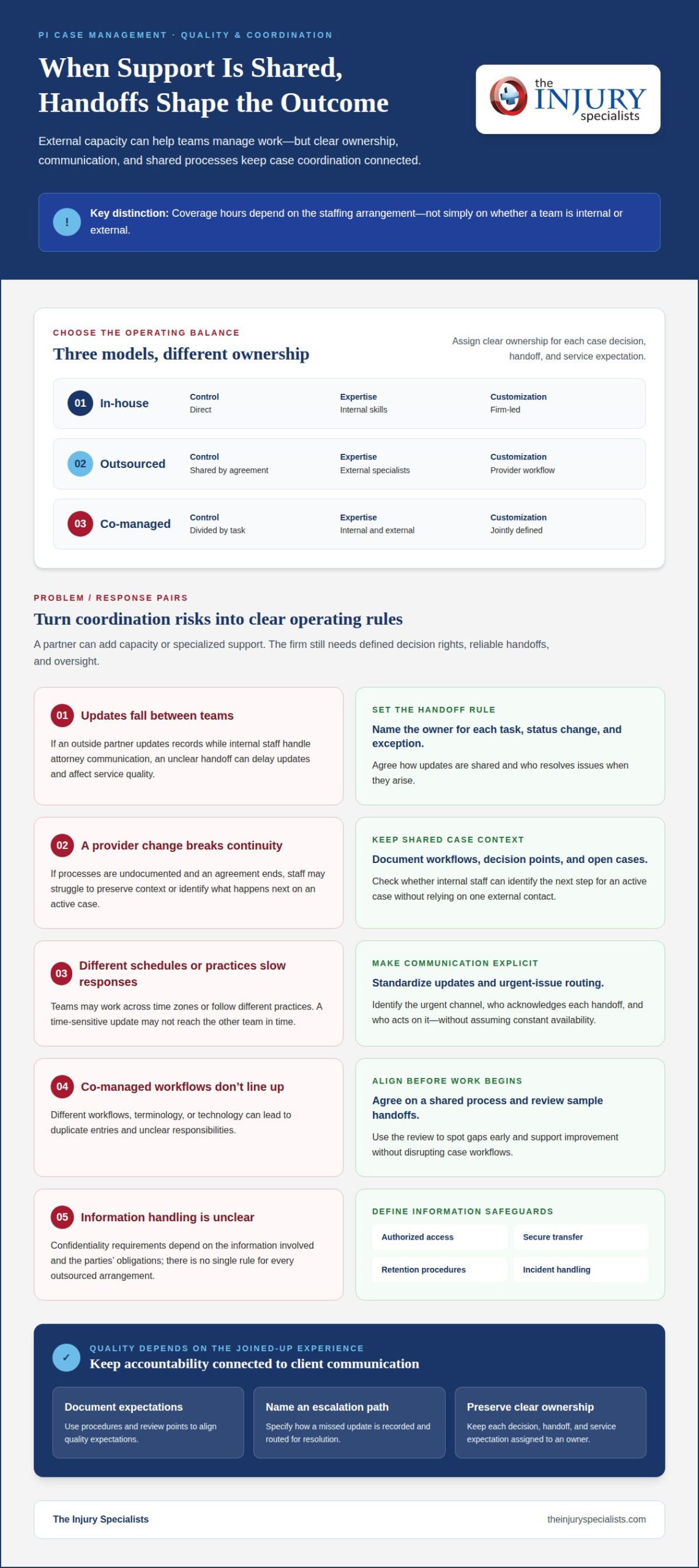
In-house teams keep workflows close to firm leadership, while outsourced and co-managed structures add external capacity. The right balance depends on who needs authority over decisions and how cases move between people.
In-House Control and Customization
An in-house team can adapt intake steps, communication preferences, and case updates to the firm’s established processes. Staff also build institutional knowledge by working with the same attorneys and workflows over time. The trade-off is limited access to specialized expertise when internal employees lack a particular skill. In-house control is especially useful when firm-specific judgment shapes daily case handling.
Coverage Hours and Service Quality
Coverage hours depend on the staffing arrangement, not simply on whether a team is internal or external. An in-house team can coordinate directly during scheduled hours, while outsourced support may bring together people with different roles and expertise. For example, a specialist can support a defined case-management task without replacing the firm’s internal decision-maker. Service quality depends on clear handoffs, consistent updates, and agreed workflows.
U.S. confidentiality rules depend on the information involved and the parties’ obligations. There is no single rule for every outsourced arrangement. Firms should establish procedures for confidentiality, authorized access, secure information transfer, retention, and incident handling.
Outsourced personal injury case management may coordinate case information, communication, referrals, and workflow support. The work varies by arrangement, so define responsibilities and decision-making authority before handoffs begin.
In-house management offers closer control and firm-specific knowledge, but depends on internal capacity and expertise. Outsourcing can add specialized support and flexibility, while making clear communication and oversight essential.
| Model | Control | Expertise and coverage | Customization |
|---|---|---|---|
| In-house | Direct | Internal skills | Firm-led |
| Outsourced | Shared by agreement | External specialists | Provider workflow |
| Co-managed | Divided by task | Internal and external | Jointly defined |
Choose a model that assigns clear ownership for each case decision, handoff, and service expectation.
Outsourcing quality, reputation, and communication risks
External support can expand capacity, but the firm still needs clear ownership of case decisions. For example, if an outsourced partner updates records while internal staff handle attorney communication, both teams need an agreed handoff. Otherwise, delayed updates can affect service quality and the firm’s reputation. Define who owns each task, how status changes are shared, and who resolves exceptions.
Provider dependency creates another risk. If a partner’s work falls short or an agreement ends, undocumented processes can make continuity difficult. Keeping shared records of workflows, decision points, and open cases helps preserve context during a transition. A practical test is whether internal staff can identify the next step for an active case without relying on one external contact.
Communication gaps can arise when teams work across time zones or follow different practices. An update sent at the end of one team’s day may not reach the other before a deadline-sensitive task. Set a standard format for updates, identify the channel for urgent issues, and establish who acknowledges and acts on each handoff. These steps support coordination without assuming constant availability.
Co-management brings its own integration risks. Internal and outsourced teams may use different workflows, terminology, or technology, leading to duplicate entries or unclear responsibilities. Agree on a shared process before work begins, then review sample handoffs together. This can reveal gaps early and support improvement without disrupting case workflows.
Reputation depends on the combined experience clients receive, not the provider arrangement behind it. Firms can align quality expectations through documented procedures, review points, and a named escalation path. For example, specify how staff record a missed update and route it for resolution. A clear case-management handoff process helps partners keep communication and accountability connected.
Dedicated internal resources and accountability
In-house PI case management assigns case coordination to employees within the firm. Tasks can include organizing intake information, tracking case progress, coordinating communication, and maintaining records. For example, an internal case manager can route a new file to the assigned attorney and record the next action in the firm’s system.
Dedicated staff build familiarity with the firm’s priorities and processes, supporting direct oversight. This structure also depends on internal capacity: staffing changes or rising caseloads can strain coverage. Accountability is clearer when each task has a named owner, such as one person responsible for tracking records and another for attorney updates.
Software integration affects how case information moves between teams. If a firm uses separate platforms for case records and accounting, staff may need to reconcile case status with expense or revenue entries. A defined process should identify which system holds the authoritative record, who updates it, and how exceptions are routed. This helps reduce duplicate entry and unclear handoffs.
Accounting workflows also need clear ownership. An internal accounting team can involve costs beyond salaries, including benefits, payroll taxes, software, training, turnover, and management time. These are accounting-team cost considerations, not a quoted price for PI case management. Outsourced accounting may add review layers, with one person’s work checked by another, while the firm retains oversight of case priorities.
Scalability depends on how readily responsibilities can shift as workloads change. Internal employees may handle routine coordination consistently, while outsourced support can be adjusted to match project needs. In a co-managed arrangement, the firm might retain case decisions and use external support for defined coordination tasks. The agreement should identify task owners, review points, escalation routes, and a process for transferring open work.
With the in-house model, accountability sits close to firm leadership, along with staffing demands and continuity risks. Outsourcing can expand available capabilities, but requires active coordination and clear performance expectations. The practical decision is which work must remain internal and which tasks can move to a documented external workflow.
Outsourcing cost efficiency and flexibility
Outsourcing can align support with workload rather than requiring full internal staffing. Compare the full operating model, including setup, oversight, and transition work.
Outsourcing Cost Efficiency
Outsourced support can reduce the need to recruit and retain permanent employees for temporary demand. It may also avoid building internal infrastructure for fluctuating work, such as case coordination during a period of increased intake. The trade-off is ongoing provider oversight. Weigh staff time, technology integration, and management responsibilities alongside the external service scope.
Flexibility matters when needs change. A firm can define a project period or specific tasks, then adjust the arrangement as priorities shift. This can free internal resources for strategic work, such as developing processes or managing complex case decisions. It still requires an internal owner for quality and handoffs.
Per-Case and Monthly Costs
Outsourced personal injury case-management pricing depends on the case and is provided after a quote request. Cost factors include scope of work, case volume, coordination requirements, staffing model, and technology or integration needs. A per-case structure ties charges to individual files, while a monthly structure may suit ongoing support. Compare what each arrangement includes.
Assess risk transfer through specific responsibilities rather than assuming it follows from outsourcing. For example, an agreement can define who handles routine updates, who reviews completed work, and how exceptions are escalated. The firm still needs to account for oversight and transition planning. Regulatory requirements may also affect workflows, so document responsibilities and procedures clearly.
For a practical comparison, estimate the internal staffing and infrastructure needed for the same scope, then compare them with external support and its oversight demands. A co-managed model can retain internal decision-making while adding outside capacity, balancing cost efficiency with operational control.
The Injury Specialists
The Injury Specialists helps law firms connect case management with the professional relationships that support personal injury workflows. Its services are relevant when your firm wants medical case management aligned with its distinct processes or support building referral relationships.
The offerings include an Attorney Referral Program with medical case management, marketing, and networking to grow referral partners. Physician Referral Services, Chiropractic and Physical Therapy Referrals, and Imaging Center Referrals support connections across the care network. The right model still depends on your firm’s priorities: which decisions remain internal, where added coordination helps, and how outside support fits existing processes.
For firms weighing internal control against outside support, The Injury Specialists offers case management and referral services as a practical next step. Contact The Injury Specialists to discuss how these offerings fit your firm’s approach.
Set Your Case Management Model in Motion
Use the in-house vs outsourced PI case management decision to define how work should move through your firm, not simply where tasks sit. Start with the outcomes your team needs from its operating model, then identify which responsibilities should remain under internal direction and where external support could fit. Clear ownership gives staff and partners a practical framework for coordinating work as priorities evolve.
The next step is to connect that operating choice with the relationships and processes that support your firm. The Injury Specialists works with law firms through medical case management tailored to each firm’s distinct process, alongside marketing and networking to grow referral partners. Physician Referral Services and Chiropractic and Physical Therapy Referrals can also support connections across the care network.
Discuss your firm’s priorities and case-management approach with Contact The Injury Specialists. A focused conversation can help you identify a practical path forward for your team and its professional relationships.
Frequently Asked Questions
What does a hybrid or co-managed model look like?
A hybrid model divides work between the firm’s internal team and an external case-management partner. For example, firm staff might retain responsibility for decisions and client communication, while the partner handles agreed coordination tasks. The arrangement works best when each task has a named owner, records are shared, and there is a clear process for escalating exceptions or transferring active work.
What should you evaluate before choosing a model?
Evaluate the work that needs support, the internal capabilities available, and how closely case workflows depend on firm-specific practices. Consider how each model handles workload changes, staff absences, software integration, and quality review. For example, a firm with established processes but limited coordination capacity may need a different structure from one building its workflows from the ground up.
What are the pros and cons of outsourcing PI case management?
Outsourcing can add capacity and specialized support without requiring the firm to hire for every workload increase. It can also create dependency, handoff, and communication risks if responsibilities or processes are unclear. For example, when a provider manages records but firm staff own updates, a defined transfer point helps prevent conflicting or incomplete case information.
How do law firms evaluate and choose a PI case management provider?
Start by mapping the tasks a provider would handle and the decisions the firm will retain. Then assess how the proposed workflow fits existing documentation, communication, and review practices. Use a sample case scenario to clarify handoffs, escalation routes, reporting, and continuity if assigned staff change. The goal is a written operating model with measurable responsibilities, not assumptions.
How does outsourcing affect client communication, case quality, and settlement outcomes?
Outsourcing changes who handles coordination, but the firm should retain a clear communication owner. Case quality depends on accurate records, timely handoffs, and consistent review. Outsourcing alone does not determine settlement outcomes, which depend on case-specific evidence, legal decisions, and other factors. For instance, a shared update process can help keep clients informed without implying a particular result.

Leave A Comment
You must be logged in to post a comment.