

The fastest way to start tracking treatment is to organize the records already available, rather than introduce a new system. Knowing how to track medical treatment for clients means bringing appointment history, treatment goals, and progress notes into one consistent view.
Existing records offer a practical starting point, but scattered dates and details can make it difficult to see what has happened and what needs follow-up. A professional can organize them around the client’s goals, attendance, treatment updates, and signs of progress.
This article covers the key fields to track, how appointment and treatment details fit together, and what progress tracking can show. You’ll learn how to work from existing records, document changes clearly, and recognize when a more connected case management approach may help.
Key Takeaways
- Existing records can provide a practical starting point for organizing appointment history and treatment details.
- Link each progress entry to its objective, date, staff member, and a concise account of what happened.
- Use baseline measures and scheduled reviews to make emerging changes easier to spot.
- Choose tracking tools around the records and workflows already in use, then assess whether they support clear, consistent follow-up.
Appointment history and session details
A useful appointment history shows the sequence of care, not just a list of dates. Organize existing records by appointment date, provider, location, and treatment type. Mark each visit as completed, canceled, missed, or rescheduled. For example, a physical therapy session and an imaging appointment belong on the same timeline, but each needs its own details. This structure helps clarify what happened before a treatment plan changed and what still needs follow-up.
For each session, capture the date, provider, purpose, attendance status, and relevant next step. Record a short summary from the source document, such as “reviewed lab results” or “follow-up after hospital stay,” without turning it into a new diagnosis. Keep the original record’s date and source visible so staff can trace details back to the document. California physicians may charge no more than 25 cents per page for copies of medical records, plus reasonable clerical costs, according to California Legislature.
For a virtual appointment, organize the visit link, scheduled time, patient’s location, and relevant records before the session. The clinician may use telemedicine to review lab results, adjust medication, check blood pressure or blood sugar, or follow up after a hospital stay. Practitioners must be licensed in the state where the patient is physically located during the visit. A remote visit cannot replace an in-person appointment that requires a hands-on exam, procedure, imaging, or in-office testing. For potentially life-threatening symptoms, telemedicine is not appropriate; call 911 or go to an emergency department.
Start referral tracking with a clear request record. Note who made the referral, the reason, the requested service, the receiving provider, and the request’s status. Link the referral to the appointment history once a visit is scheduled, then update it when records confirm completion or a change. For example, keep an imaging request separate from the appointment and the resulting record.
- Separate scheduled, completed, canceled, and missed visits.
- Connect each referral request to its appointment and source record.
Essential treatment plan tracking fields
A treatment plan tracker should link each clinical update to a goal, rather than collect disconnected notes. Each entry should include the related objective, date, staff member, and a brief description of what happened. For example, “attended group; practiced breathing strategy” connects an activity to a therapeutic objective more clearly than “doing better.”
Useful fields include the objective, target behavior, status, supporting record, and next review date. A trackable objective might ask a client to attend weekly group sessions for eight weeks. Another might measure attendance against a target of at least 80% over 60 days. The plan’s named owner and next review date clarify responsibility and help keep reviews visible. These elements also give professionals a practical framework for how to track medical treatment for clients using records already available.
HIPAA-related requirements depend on the organization’s role and the information it handles. Determine which requirements apply, then organize record access and handling to meet those obligations.
Record-retention periods vary by state, provider type, and record category. Apply the relevant retention schedule to each record type instead of treating every file the same way.
Consent documentation should state the agreed purpose, the information covered, and the intended recipients. Record the authorization and any limits before sharing treatment updates.
The cost of professional tracking depends on record volume, coordination scope, and workflow complexity. A quote request defines the work and its applicable price.
For medication, appointment, symptom, and outcome tracking, connect each item to its date and treatment objective. Document changes based on existing records and compare symptom scores with the client’s baseline. This structure helps clarify how to track medical treatment for clients while tying each update to its source.
Spreadsheets and paper files can lead to conflicting versions, missed updates, or access problems when multiple people handle records. Identify who owns the tracker and distinguish current information from outdated entries.
When sharing updates with a client or authorized caregiver, document who may receive them and use an approved channel. A medical case management workflow can help coordinate records and treatment updates alongside referrals.
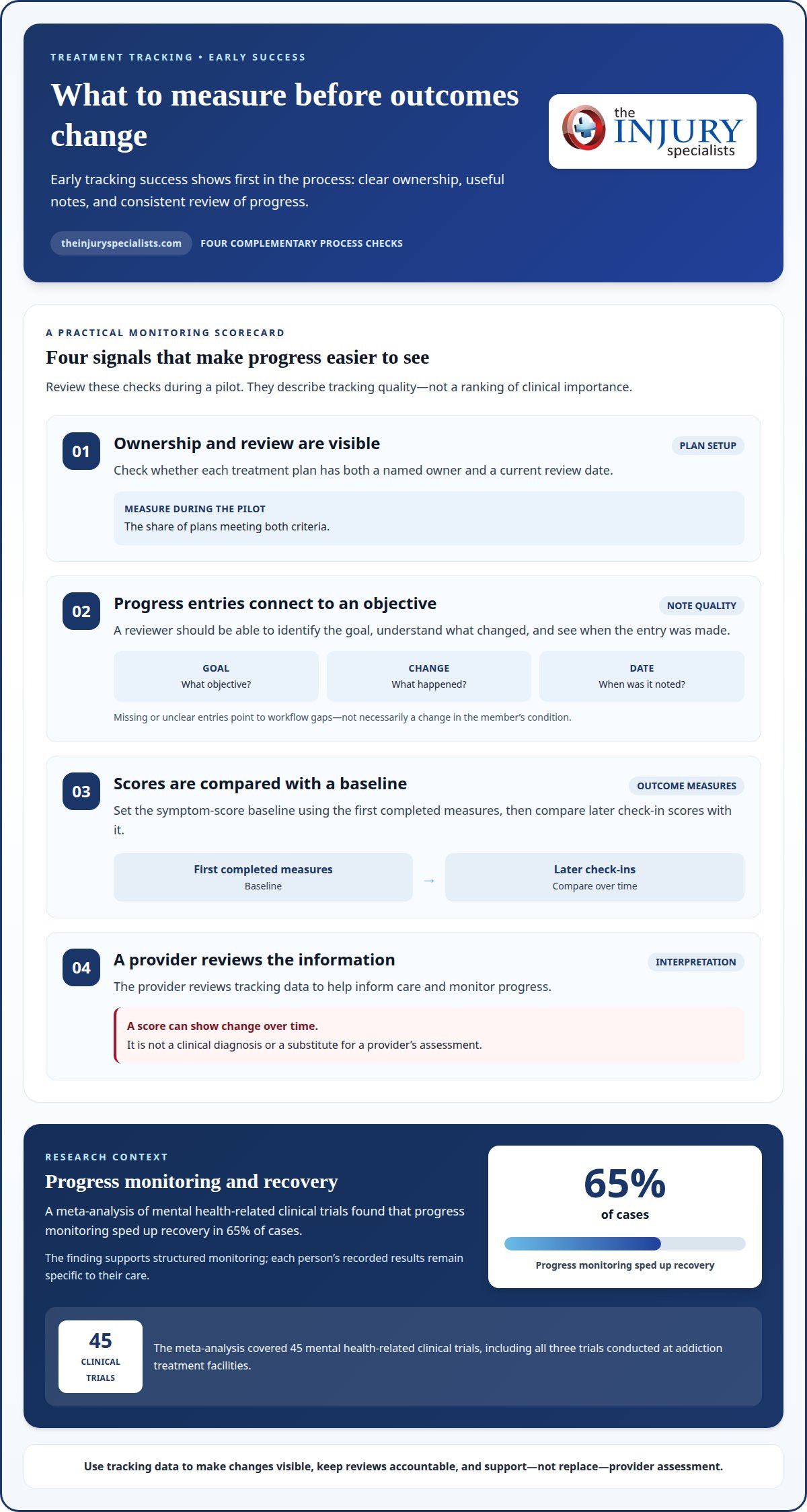
Measuring early tracking success
Early tracking success shows in the process before clinical outcomes change. Start by checking whether each treatment plan has a named owner and a current review date. During a pilot, measure how consistently plans meet both criteria. These checks show whether responsibilities and reviews are being recorded.
Next, check whether progress entries link to a specific objective and include useful details. A provider reviewing mental health progress data should be able to identify the goal, understand what changed, and see when the entry was made. For example, an attendance update is more useful when linked to the objective it measures. Missing or unclear entries point to workflow gaps, not necessarily a change in the member’s condition.
Outcome measures provide another perspective. Set a symptom-score baseline using the first completed measures, then compare later check-in scores with it. The provider reviews the data to help inform care and track progress. A score can show change over time, but it is not a clinical diagnosis or a substitute for a provider’s assessment.
Research offers a reason to monitor progress carefully. A meta-analysis of 45 mental health-related clinical trials found that progress monitoring sped up recovery in 65% of cases, including all three trials conducted at addiction treatment facilities. That finding supports structured monitoring, while each person’s recorded results remain specific to their care.
- Track the share of plans with a named owner and current review date.
- Review whether entries connect clearly to objectives and include meaningful updates.
- Compare follow-up symptom measures with each member’s baseline.
Set review points that fit the program’s workflow, and examine missed dates alongside incomplete records. If scores shift or appointments are missed, the provider can review the context before updating the plan. This helps the team assess tracking reliability and identify emerging progress.
Software for tracking medical treatments and outcomes
Professionals may use an electronic health record for clinical documentation and a case management platform to coordinate across providers. Choose based on whether staff need treatment notes, referral status, outcome measures, or a shared care timeline. Keep existing records traceable to their sources rather than copying them into disconnected files. Linking tracking entries to source documents helps staff understand where each update came from.
A small behavioral health program can pilot its process with a shared spreadsheet or simple no-code database through one full review cycle. This lets the team test its fields and workflow before moving to a specialized system. The pilot should reveal whether staff can find current information, update records consistently, and link each measure to its treatment objective. It can also show which details need a dedicated field rather than a note.
Compare software based on the work it supports, not the number of features it advertises. Assess whether it accommodates existing documents, assigned responsibilities, review dates, and outcome tracking. It should also make it easy to distinguish current updates from older entries. Clear permissions and a defined record-sharing process help align access with each person’s role.
- Electronic health records: Support clinical documentation within a healthcare setting.
- Case management platforms: Help coordinate treatment-related records and workflows across participants.
- Spreadsheets or no-code databases: Allow a small program to test its tracking process before expanding it.
During a pilot, review incomplete fields, duplicate entries, and delays between an event and its documentation. Then decide whether the current tool supports the workflow or a more connected case management system would be a better fit. The software should make records easier to interpret, not add steps staff cannot sustain.
Explore a coordinated case management approach to connect treatment tracking with professional workflows.
The Injury Specialists
The Injury Specialists connects medical and legal professionals through referral programs, medical case management, and case management technology. For teams tracking treatment across appointments, providers, and records, this coordinated support can help bring related workflows into clearer view.
Its services include Physician Referral Services, Chiropractic and Physical Therapy Referrals, Imaging Center Referrals, and an Attorney Referral Program with medical case management tailored to firms’ distinct processes. These services can help a practice or law firm coordinate referrals and cases alongside its existing records and tracking approach.
Contact The Injury Specialists to discuss how its referral and case management services may fit your professional workflow.
Move Toward More Connected Case Coordination
A clear process for how to track medical treatment for clients should support coordinated decisions, not create another disconnected workflow. Align record management with how professionals already handle referrals, communication, and case progress. This can help teams follow a consistent approach while leaving clinical decisions to the appropriate providers.
The Injury Specialists supports professional networks through referral services and medical case management, including workflows tailored to law firms. These connections can help organizations refine how treatment information moves across their professional relationships. The right approach depends on existing processes, the records involved, and the coordination the team needs.
Use your current workflow as the starting point for that conversation. Connect with The Injury Specialists to discuss how its services may fit your organization’s referral and case management needs. A more connected process can give your team a practical foundation for the work ahead.
Frequently Asked Questions
How can a professional start tracking medical treatment without requiring a new system?
Start by mapping existing record sources to the current workflow. For example, appointment summaries can stay in their source files while a tracking view records each document’s date and location. Then identify gaps, such as a referral with no linked visit, and assign follow-up to the appropriate role. This adds structure without replacing the system already in use.
What fields does a treatment plan need?
A treatment plan needs fields that connect goals to measurable activity and review decisions. Include the objective, the indicator used to assess it, the baseline when relevant, the responsible staff member, and the current status. Record supporting evidence and the next review date, too. For example, a goal involving appointment attendance should explain how attendance relates to the objective, rather than simply marking the plan “active.”
What information should be included in a client medical treatment tracking log?
A tracking log should record the event, date, status, and source document. It can distinguish an appointment that was requested from one that was scheduled or completed. For a medication update, record what the source document says and where the information came from. Note the next action and assigned role so another authorized team member can see what remains outstanding.
How do professionals create a medical treatment tracking system for clients step by step?
Start by defining what the tracking process needs to support, such as coordinating appointments or reviewing treatment outcomes. Map existing records, choose consistent fields, and assign responsibility for updates. Then test the workflow using current cases, identify missing or unclear entries, and refine the process. In the final review, check whether staff can trace a record from its source to the next action.
How can clients give consent for medical treatment tracking and data sharing?
Record the agreed purpose, information covered, intended recipients, and any limits. Document authorization before sharing treatment updates.
How to securely share medical treatment updates with clients and authorized caregivers?
Document who is authorized to receive updates and share them through an approved channel. Use clear permissions to align access with each person’s role.

Leave A Comment
You must be logged in to post a comment.