

A settlement doesn’t automatically mean you keep the full amount. Medical liens generally must be paid before you receive your share, but you can review and negotiate a lien that includes inaccurate, duplicate, or unrelated charges. Knowing how to negotiate a medical lien starts with understanding what the claim covers and how it affects your settlement.
It’s reasonable to want a clear accounting before funds are paid out. A lien may come from a healthcare provider, insurer, Medicare, or Medicaid, and the rules and negotiation options depend on who holds it. Your attorney can review the claim, raise supported disputes, and negotiate an appropriate reduction.
This guide explains what a medical lien means, what happens when your case settles, and practical steps for approaching negotiations. You’ll also learn when an attorney’s help can move the process forward and protect your share of the settlement.
Key Takeaways
- Identify who holds the lien and what part of your settlement it may affect before distribution begins.
- Review itemized charges and payment records to spot errors, duplicate billing, or treatment unrelated to the injury.
- Build a negotiation around the settlement amount, documented disputes, and the lienholder’s claim, then get any agreed reduction in writing.
- Bring in an attorney when lien rules or government program claims make repayment and negotiation more complex.
What happens to a medical lien when a case settles?
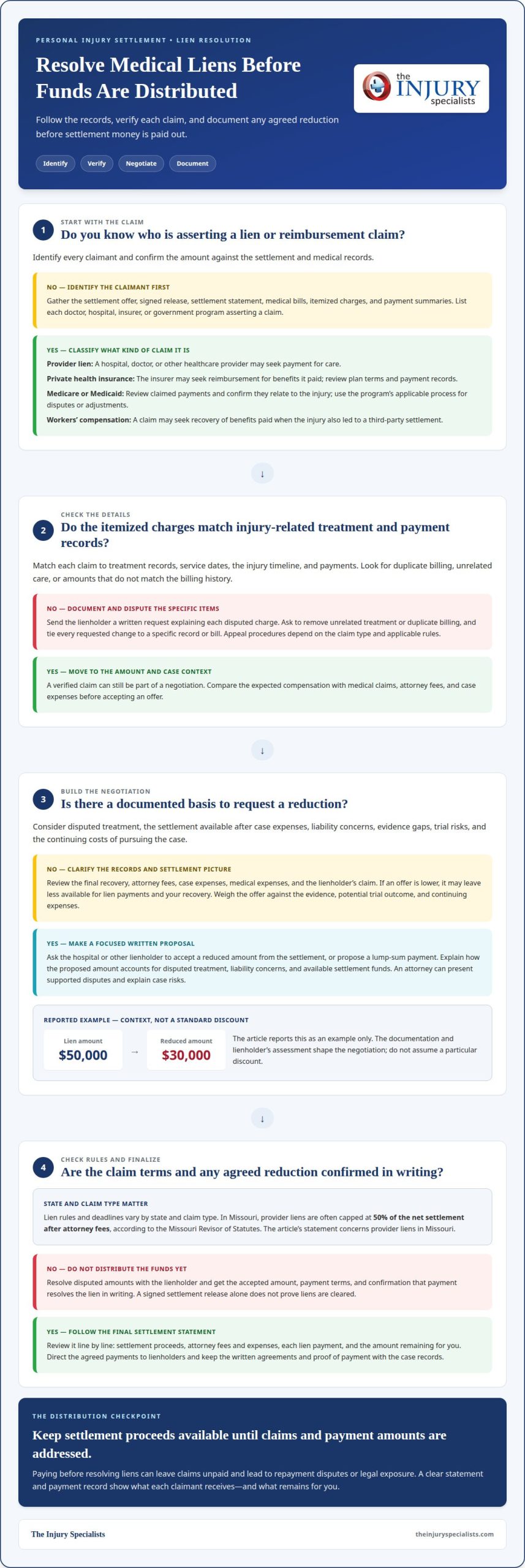
A settlement does not automatically clear a medical lien. Before distributing compensation, identify each lienholder, verify the legal claim, and account for agreed payments in the settlement statement.
Distributing funds before resolving liens can leave claims unpaid and lead to repayment disputes or legal exposure. Keep the settlement proceeds available until the claims and payment amounts are addressed.
Gather Medical and Settlement Records
Gather the settlement offer, signed release, settlement statement, medical bills, itemized charges, and payment summaries. These records show the recovery amount, case expenses, and medical expenses connected to the injury. Match each lienholder’s claim to treatment records and payments, and flag duplicate charges, unrelated care, or amounts that don’t match the billing history.
- Identify each claim. List every doctor, hospital, insurer, or government program asserting a lien, then confirm the claimant and amount against the records.
- Assess the settlement. Before accepting an offer, compare the expected compensation with medical claims, attorney fees, and case expenses. A lower offer may leave less available for lien payments and your recovery.
- Weigh trial risk. Compare the offered settlement with the case’s evidence, potential trial outcome, and continuing expenses. The decision should account for both the possibility of a different result and the costs of pursuing it.
Resolve Liens Before Distributing Settlement Funds
Review the final settlement statement line by line. It should show the settlement proceeds, attorney fees and expenses, each lien payment, and the amount remaining for you. In Missouri, provider liens are often capped at 50% of the net settlement after attorney fees, according to the Missouri Revisor of Statutes.
Resolve disputed amounts with the lienholder and document any agreed reduction before paying. Don’t treat a signed settlement release as proof that liens are cleared. Once settlement funds arrive, use the statement to direct the agreed amounts to lienholders and keep records of payments. This creates a clear account of what each claim receives and what remains for you.
Your Settlement Is Finalized, Now What About Medical Liens?
You can challenge a medical lien by disputing inaccurate, excessive, or unrelated charges and supporting your position with records. Send the lienholder a written request; appeal procedures depend on the claim type and applicable rules.
Request Reductions Based on Treatment Relatedness
Separate treatment related to the injury from care that appears unrelated. Compare itemized charges with medical records, service dates, and the injury timeline. Ask the lienholder to remove unrelated treatment or duplicate billing, and explain each disputed item in a focused letter. To understand how to negotiate a medical lien, tie every requested change to a specific record or charge.
- Explain case risk and liability. Ask your attorney to describe disputed fault, evidence gaps, and trial risks in the reduction request. The lienholder can assess the claim in light of the recovery and settlement, rather than treating the original lien amount as separate from the case.
- Propose a supported reduction. Base the request on documented disputes, available settlement money, and case risks. A reported example reduced a $50,000 lien to $30,000. Use examples as context, not as a standard discount. The strength of the documentation and the lienholder’s assessment shape the negotiation.
Negotiate a Reduction or Lump-Sum Settlement
Ask the hospital or other lienholder to accept a reduced amount from the settlement, or propose a lump-sum payment to resolve the claim. Explain how your offer accounts for disputed treatment, liability concerns, and the recovery available after case expenses. When deciding how to negotiate a medical lien, consider the claim’s documentation and available settlement funds rather than assuming a particular discount.
- Get the agreement in writing. Confirm the accepted amount, payment terms, and that payment resolves the lien. Keep the written agreement with the personal injury case records rather than relying on a verbal conversation.
- Distribute funds after terms are settled. Give the final amount to the person preparing the settlement statement. Match payment to the written agreement, then retain proof that the lienholder received it.
What is a medical lien in personal injury?
A medical lien is a legal claim against personal injury recovery for treatment costs. State law and the claim type determine how a provider, insurer, or government program can seek payment. Deadlines and lien rules vary by state, so identify the relevant state and lienholder before responding.
For Medicare or Medicaid claims, review the claimed payments and confirm they relate to the injury. Address disputed charges and request any available adjustment through the program’s applicable process before distributing settlement funds.
- Identify each claim and its holder. A hospital, doctor, or other healthcare provider may assert a provider lien for unpaid care. A private health insurer may instead bring a subrogation claim, seeking reimbursement for benefits it paid. Medicare and Medicaid claims involve government program payments. A workers’ compensation claim may seek recovery of benefits paid for an injury that also generated a third-party settlement.
- Separate provider liens from insurance claims. Ask whether the demand comes from the treating hospital or from an insurer that paid medical expenses. For a private health insurance claim, review the plan terms and payment records; the plan language can affect whether reimbursement is owed.
- Check the rules for the state and claim type. There is no single deadline or rule for every medical lien. In Oregon, ORS 87.555 caps a hospital lien at one-third of the total settlement. Oregon recovery calculations also consider the total settlement, attorney fees, and medical bills paid.
- Address Oregon provider demands with records. Match each hospital or provider charge to treatment connected to the injury. Compare billed services with payment records and the settlement details, then raise specific disputes with the lienholder.
- Handle Medicare and Medicaid claims separately. Review the program’s claimed payments, identify charges unrelated to the injury, and submit supporting records with any dispute or adjustment request. Keep the program’s claim and response with the settlement file, since these claims follow their own procedures.
Attorney assistance with lien negotiations
- Ask your personal injury attorney to map every claim. After an accident, a lawyer can identify provider liens, health insurance reimbursement claims, and government program demands. Each claim may follow different terms and procedures. A clear list helps the attorney track who is requesting payment, what charges are included, and which records support the demand.
- Have the attorney assess the settlement picture. The lawyer can compare the lien amount with the recovery, case expenses, disputed liability, and evidence of injury-related treatment. That context matters when the settlement leaves limited funds for both lienholders and you. It also helps frame a specific request instead of accepting the opening demand as final.
- Coordinate the negotiation with the case record. An attorney can organize treatment records, payment histories, and settlement details, then explain disputed charges in a written request. For example, a charge outside the accident-related treatment timeline may warrant closer review. The request should identify the item, explain the dispute, and state the reduction sought.
- Confirm terms before funds move. Ask the attorney to secure a written agreement identifying the accepted amount and any payment conditions. The settlement statement should reflect that agreement before distribution. Keep the agreement and payment proof with the case file so the lienholder’s claim and the amount paid remain documented.
- Discuss complex claims and remaining exposure. Medicare, Medicaid, and private health insurance claims may involve different repayment procedures. An attorney can coordinate responses and explain how unresolved demands affect the settlement distribution. Properly accounting for liens matters: an attorney may face malpractice liability if settlement liens are not handled correctly.
- Connect legal and medical case coordination. Law firms seeking a structured way to coordinate referrals and case management can explore the Attorney Referral Program. It supports firms’ distinct processes, marketing, and networking to grow referral partners, without replacing the legal advice a personal injury attorney provides.
The Injury Specialists
The Injury Specialists connects personal injury professionals through referral programs and medical case management. For attorneys and healthcare providers managing the broader coordination needs of an injury case, these services support connected workflows. The company’s programs include physician, chiropractic, physical therapy, and imaging referrals, as well as networking to grow referral relationships.
These services complement, but do not replace, legal advice about lien rights, repayment obligations, or settlement negotiations. A personal injury attorney is the right professional to assess a specific lien and advise on negotiation strategy. The Injury Specialists supports the professional connections and case-management processes surrounding injury cases.
Contact The Injury Specialists to discuss how its referral and case-management programs may fit your needs.
Build a More Coordinated Path Forward
Use the next stage of your personal injury case to strengthen coordination between legal and medical partners. A clear process for handling records, communication, and referrals can support smoother case management alongside lien negotiations. For attorneys and healthcare professionals, connected physician, chiropractic, and physical therapy referral pathways can help align the services involved in injury cases.
Understanding how to negotiate a medical lien gives you a clearer basis for discussing disputed charges and settlement terms with your attorney. The Injury Specialists supports professional connections through referral services, medical case management, and networking to grow referral partnerships. These resources complement legal advice rather than replace it.
Explore professional referral and case-management support to identify a practical next step for your organization. With the right coordination in place, you can keep attention on the decisions that move each case forward.
Frequently Asked Questions
How Long Does the Negotiation Process Take?
Simple negotiations with hospitals or private providers may take a few weeks to a couple of months. Settlement payout involving private providers can generally take a few weeks after you sign the release. Medicare or Medicaid repayment can take months; resolving a Medicaid lien may take 2-4 months, and missing documents can extend the process. Send complete records promptly to reduce avoidable delays.
When Should I Get an Attorney Involved to Negotiate My Medical Liens?
Involve an attorney early, especially before accepting an offer or authorizing settlement distribution. Different jurisdictions have specific rules for hospital liens, while insurance reimbursement and government program claims may follow varying procedures. An attorney can identify the claim type, assess its effect on the proposed settlement, and coordinate written objections or reduction requests. Early review can also uncover competing claims before funds are allocated.
What Is a Medical Lien, and How Does It Affect a Personal Injury Settlement?
A medical lien is a legal claim seeking payment from personal injury settlement funds for care connected to an injury. It can reduce the amount left for you after settlement expenses and lien payments. A letter of protection is different: it is an agreement between an attorney and provider to defer payment until settlement, while a lien is a claim for payment from the recovery.
Who Can Place a Medical Lien on a Settlement in the United States?
Potential claimants include hospitals, doctors, chiropractors, surgery centers, health insurers, Medicare, and Medicaid. A medical lien company may also acquire a provider’s lien and seek payment after settlement. Workers’ compensation claims can involve reimbursement demands for benefits paid. The name on a demand matters: identify whether it is a provider claim, insurer reimbursement claim, government program claim, or another type before discussing the amount.
How Do I Verify the Validity and Amount of a Medical Lien?
Compare the lien notice with itemized bills, treatment records, and payment summaries. Confirm that the patient, provider, dates of service, and billed care match the personal injury case. Look for duplicate charges, payments already credited, and treatment that appears unrelated to the accident. If a charge does not match the records, list the specific item and supporting document so the lienholder can address the discrepancy.
How Can I Negotiate a Medical Lien With a Hospital or Medical Provider?
Send the hospital or provider a written request identifying the disputed charges and the reduction you seek. Support it with itemized statements, treatment records, and a clear explanation of any unrelated care or duplicate billing. You can also propose a lump-sum payment to resolve the claim. Ask for the agreed amount and payment terms in writing before distributing settlement funds.

Leave A Comment
You must be logged in to post a comment.