

More charting doesn’t always mean safer care; clear, timely notes matter more. The most important medical documentation mistakes to avoid include missing details, outdated copied text, unclear medication entries, and records that don’t reflect what happened or how a patient responded.
Workload can make accurate charting harder. Busy shifts, interruptions, and documentation fatigue may delay notes or leave important context unclear, even when clinicians know what good records should include. Effective documentation is factual, complete, organized, and recorded close to the care provided, so the next person can follow the patient’s condition and the decisions made.
This article explains which charting errors can create safety risks and how to make clinical notes clearer and more reliable. It also looks at how training, EHR habits, and workload affect documentation quality, with practical ways healthcare teams can support accurate records without treating charting as an afterthought.
Key Takeaways
- If a medication record is incomplete, clarify the details with the patient, pharmacy, or previous nurse rather than assuming a dose was given.
- Make notes factual, specific, timely, and organized so the care team can understand what happened and why.
- Use consistent charting practices and terminology, and review copied or auto-filled details for accuracy.
- Reduce documentation fatigue by prioritizing essential charting and building protected time for records into the workflow.
1. Which documentation errors compromise patient safety the most?
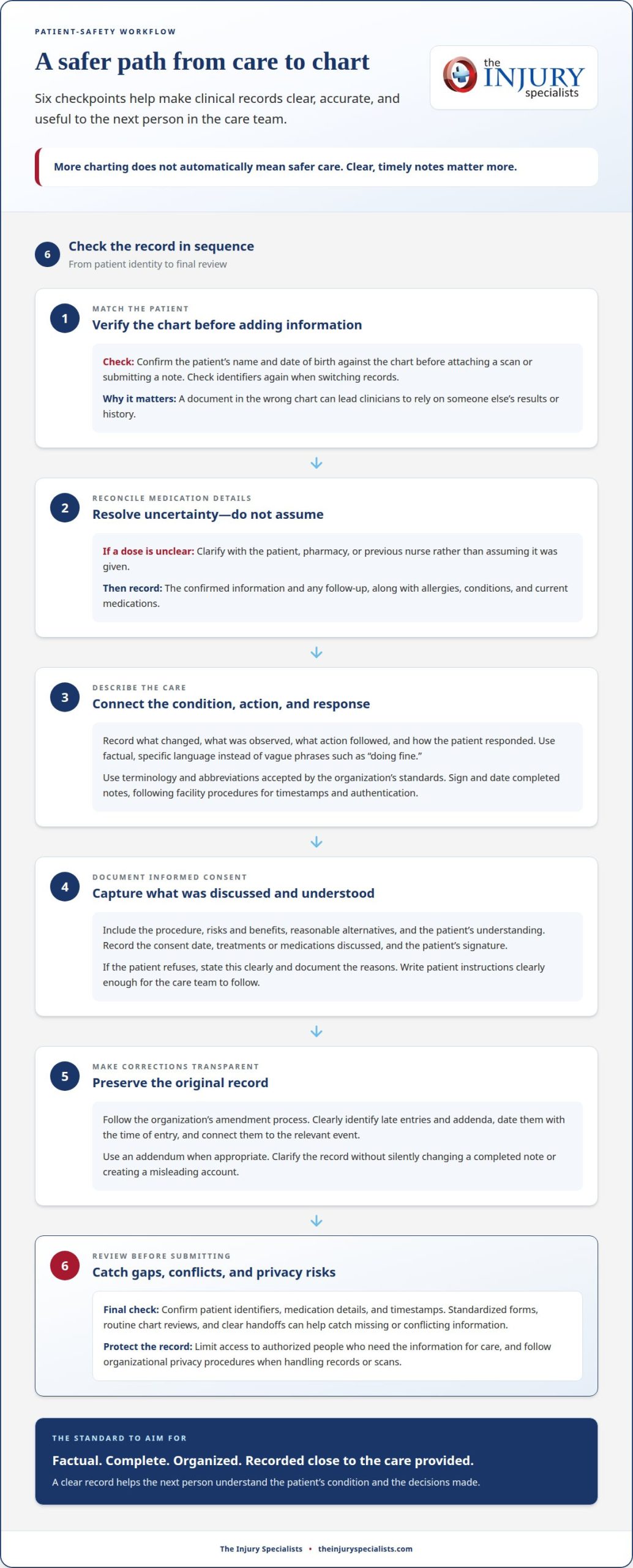
Medication gaps can turn uncertainty into a patient safety risk. If a chart doesn’t show whether a dose was given, don’t assume. Clarify with the patient, pharmacy, or previous nurse, then document the confirmed information and any follow-up. Record allergies, conditions, and current medications so clinicians can consider them during treatment. A missing allergy or unclear dose can affect decisions across the care team.
Wrong-chart errors create a separate hazard. A scan uploaded to another patient’s record may lead clinicians to rely on someone else’s results or history. Before attaching a document or submitting a note, verify the patient’s name and date of birth against the chart. Check identifiers again when switching records. These consistent steps can help prevent documentation errors from becoming treatment errors or increasing liability.
Correct a record through the healthcare organization’s amendment process, using a clearly identified addendum when appropriate. A correction should clarify the entry, not create a misleading account. Follow facility procedures when documenting the change.
HIPAA and state privacy rules govern how patient information is handled. Specific requirements depend on the applicable rules and setting. Limit access to authorized people who need the information for care, and follow organizational privacy procedures when handling records or scans.
Informed-consent notes can be incomplete if they omit what was discussed or whether the patient understood. According to the Joint Commission, consent documentation should address the procedure, risks and benefits, reasonable alternatives, and the patient’s understanding. Record the consent date, treatments or medications discussed, and the patient’s signature. If the patient refuses, state this clearly and document the reasons. Record patient instructions clearly enough for the care team to follow.
Prevent errors with a consistent review before submitting notes: confirm patient identifiers, medication details, and timestamps. Use standardized forms, routine chart reviews, and clear handoffs to catch missing or conflicting information. These practical controls make the medical documentation mistakes to avoid easier to spot before they affect patient care.
2. Characteristics of effective clinical documentation
Accurate clinical notes connect a patient’s condition, decisions, treatment, and outcomes. A useful entry states what changed, what the clinician observed, what action followed, and how the patient responded. For example, “pain improved” provides less context than a description of the reported change and response after treatment. Specific details help the next clinician understand the record without guessing.
Clear language matters. Replace vague phrases such as “doing fine” with observable findings or the patient’s reported symptoms. Use terms and abbreviations accepted by the organization’s standards, and organize each entry by date and clinical event. Shared medical records work best when clinicians can distinguish current findings from older information and identify missing context.
Clinician signatures and dates establish who made an entry and when. Sign and date each completed note, following facility procedures for timestamps and authentication. Scribes and clinical documentation specialists can support the workflow, but the record still needs accurate clinical details and appropriate clinician review. Templates may help organize information, but copied text must reflect the patient’s current condition and plan.
Clearly identify late entries and addenda, date them with the time of entry, and tie them to the relevant event. Preserve the original documentation and follow the organization’s correction process instead of silently changing a completed note.
Inaccurate or incomplete medical records can confuse treatment decisions, contribute to missed follow-up, and make it harder to explain the reasoning behind care. They may also create reimbursement difficulties or increase exposure to liability claims if the record does not support the services provided.
For organizations coordinating care across providers, consistent documentation workflows help keep clinical information organized. Medical case management can support coordination across a firm’s distinct process.
3. Staff training in charting and medical terminology
Electronic health records (EHRs) require more than basic typing skills. In one study, 90% of new or novice nurses reported workplace EHR training, compared with 75% of nurse managers. Yet over 60% of nurse managers said new nurses needed more than two months to become proficient. Training should therefore include hands-on practice with the actual records, templates, and workflows staff use.
Terminology needs equal attention. Teach team members to use approved terms and abbreviations consistently, and explain what each means. Use abbreviations only when their meaning is clear to everyone involved in the patient’s care. Staff should follow facility rules for permitted abbreviations rather than rely on memory or informal shorthand. Clear writing also reduces the risks created by rushed handwriting or misunderstood entries.
Training should cover common EHR failure points: copy-and-paste errors, auto-populated fields, missing information, and text expanders that insert outdated details. Ask staff to review generated text against the current assessment before saving. A 2012 study found gaps in 13 of 28 knowledge and skill areas considered critical to effective EMR/EHR use, showing why one-time onboarding may not address every workflow need.
Effective programs pair instruction with feedback. Use sample charts to practice documenting assessments, treatment decisions, and outcomes, then review entries for accuracy and completeness. If recurring errors point to confusing screens or templates, EHR redesign can reduce unnecessary fields and make key information easier to enter. Training and system improvements should work together rather than placing the burden entirely on individual clinicians.
For telehealth, record the visit’s clinical details and relevant communications in the patient’s chart. If speech recognition or AI tools draft text, review and correct it before it becomes part of the record.
Regular refreshers help staff apply documentation standards as workflows change. A focused review of a charting scenario, such as documenting a medication change, can connect terminology, EHR steps, and sound clinical judgment while reducing avoidable errors that may complicate care or malpractice claims.
4. Documentation fatigue and workload management
Documentation fatigue often builds when charting competes with patient care, interruptions, and handoffs. Under pressure, staff may postpone notes, rush through fields, or leave details incomplete. That creates extra work: a clinician returning to a chart must reconstruct what happened before recording accurate information. Electronic health records can support consistent workflows, but they don’t remove workload or replace careful review.
Start with scheduling. In a Sermo physician-community poll, dedicated documentation time slots received 32% of the vote as a suggested way to prevent errors. Protected time can help clinicians complete notes while events remain clear. Teams can also identify predictable charting windows, such as after rounds, while keeping urgent patient needs ahead of routine documentation.
Next, separate essential clinical details from repetitive administrative work. Use approved templates to capture relevant assessments, actions, and outcomes, then check each entry for patient-specific accuracy. Time-saving scribe tools may reduce typing, but the responsible clinician still needs to review the record for missing or incorrect information. Auto-filled text and copied material can add noise if nobody checks whether they reflect the current visit.
Workload management also depends on how teams distribute tasks. Supervisors can review where charting delays occur, whether handoffs create duplicate work, and which fields are often incomplete. For example, if staff repeatedly search multiple screens for the same health records, workflow redesign may make the right information easier to find. Keep procedures aligned with facility and regulatory standards, and give staff a clear process for late entries.
The practical takeaway is to build charting into the workday, rather than treating it as an invisible task after care ends. Prioritize time-sensitive entries, reduce avoidable duplication, and use audits to find recurring bottlenecks. Teams coordinating documentation across case workflows can explore case management technology as part of a more organized process.
The Injury Specialists
The Injury Specialists helps healthcare providers and law firms coordinate injury-related referrals and case management. When clear records need to support collaboration across a care network, its physician referral services, medical case management, and referral-partner marketing and networking can help connect professionals involved in the process. The Attorney Referral Program includes medical case management tailored to each firm’s distinct process, along with marketing and networking to grow referral partners.
These services complement strong documentation practices; they don’t replace clinical charting, staff training, or an organization’s recordkeeping procedures. They are suited to providers and firms seeking structured connections and case coordination across referral relationships. For help with referral coordination and medical case management, contact The Injury Specialists.
Make Clear Charting Part of the Workflow
Reliable documentation depends on more than individual attention. It takes a workflow with clear expectations, usable systems, and room for clinical teams to complete records alongside patient care. A practical next step is to identify where medical documentation mistakes to avoid are most likely to occur in your process, then focus improvement efforts there. Patterns in delayed entries, recurring corrections, or handoff gaps can show where teams need clearer procedures or better support.
Keep the goal practical: make accurate records easier to produce and easier for the next person to use. Align documentation practices across the people and organizations involved in injury-related care while preserving each provider’s clinical responsibilities.
For support connecting with referral partners and coordinating case management, contact The Injury Specialists. A more consistent documentation process is a practical step toward clearer coordination and stronger continuity of care.
Frequently Asked Questions
What does good documentation look like?
Good documentation lets another authorized clinician understand the clinical story and decide what needs attention next. A note should distinguish what the patient reported from what the clinician observed, then connect those details to the working assessment. For example, “patient reports dizziness after standing” is clearer than “dizzy” because it preserves timing and context for later review.
Which documentation errors compromise patient safety the most?
The highest-risk errors are those that can distort a decision before another clinician has a chance to clarify the record. An unrecorded abnormal test result, a medication entry attached to the wrong patient, or an outdated copied plan can each send care down the wrong path. Risk increases during handoffs, when the next team relies on the chart rather than the original conversation.
Why Do You Need Accurate Clinical Documentation?
Accurate clinical documentation helps clinicians understand how a patient’s care has progressed and why a decision was made. For example, a later provider can interpret a test result more effectively when the record connects it to the symptoms and assessment from that visit. Clear records also help teams explain the sequence of care if a claim or complaint later requires review.
What are the most common medical documentation mistakes clinicians should avoid?
Common errors include carrying forward outdated text, using vague descriptions, leaving key fields incomplete, and failing to record a meaningful change. A note that says “follow-up needed” without specifying what requires follow-up can leave the next team uncertain. Review each entry for patient-specific details, and remove template language that doesn’t describe the current encounter.
What information must be included in a complete medical record note?
A complete note should include information relevant to the encounter, such as the patient’s identifying details, reason for the visit, relevant history, findings, assessment, and plan. Add pertinent test results, medications, allergies, and follow-up details when they inform care. The exact format depends on the healthcare organization’s documentation standards and the type of encounter.
How should clinicians document symptoms, findings, diagnoses, and treatment plans accurately?
Keep each part distinct: record symptoms as the patient describes them, findings as observed or measured, and diagnoses as the clinical assessment. Then make the plan specific enough to show the next action, such as ordering a test or arranging follow-up. If a diagnosis remains uncertain, describe the assessment accurately rather than presenting a possibility as established fact.

Leave A Comment
You must be logged in to post a comment.