

Case volume alone does not show whether a personal injury practice is performing well. Measuring success in a personal injury practice means tracking financial performance alongside case outcomes, intake follow-up, client experience, and progress toward firm goals. Together, these measures show where the practice is advancing and where its processes may need attention.
Revenue and profitability matter, but they are only part of the picture. This guide covers financial, operational, and client-focused measures that support clear goals, including how quickly the team follows up with prospective clients. Weekly reports can surface bottlenecks, while monthly reports help leaders assess broader trends. Use these measures to build a practical view of performance and make informed adjustments as results emerge.
Key Takeaways
- Assess profitability alongside revenue, expenses, and case performance to see which parts of the practice are driving results.
- Turn broader ambitions into measurable goals, then track milestones that show whether the practice is moving in the right direction.
- Measure intake follow-up time and conversion by lead source to spot where prospective clients may be getting lost.
- Use weekly reports to identify case-stage bottlenecks and monthly reports to review wider performance trends.
1. Financial performance and profitability
Revenue alone gives an incomplete picture of financial performance. Track profit, operating expenses, and case outcomes together. Personal injury firms often measure productivity through cases resolved and fees generated. Compare results across practice areas, attorneys, and clients to identify differences in performance. Expense tracking can also reveal overspending or investments that may need attention.
Contingency-fee matters need metrics that reflect when revenue arrives. Personal injury firms often receive fees when a case resolves, so monthly revenue can shift with case timing. Track the average fee per client, fee growth among top clients, and collection rates. Realization rates can help firms assess how fees relate to time spent on a matter. Write-off and write-down rates can help firms monitor fee reductions.
State-specific fee limits and court rules can affect how firms calculate, record, and compare fees. Separate results by jurisdiction and use the applicable rules when setting fee assumptions. This keeps comparisons meaningful rather than blending matters governed by different requirements.
There is no single typical case value or attorney fee that applies to every U.S. personal injury firm. Case values depend on each matter’s circumstances, while attorney fees depend on the fee arrangement and recovery. Track your firm’s own average fee per client and results by case type instead of relying on a broad market average.
For sustainable growth, assess profitability alongside market share and reputation, not headcount alone. Review billing records and accounts receivable to identify matter-specific issues. Then use the findings to decide whether to adjust expenses, invest in technology, or strengthen client service. These financial measures create a more useful baseline for measuring success in a personal injury practice.
2. Reasons to set goals for a personal injury practice
A five-year vision gives a law firm direction for staffing, client service, and growth. Specific goals turn that direction into choices leaders can track. For example, a firm seeking more matters can set monthly quotas and review whether new cases meet its target. Goals also help teams spot when rising volume strains case handling or client satisfaction.
Make each goal measurable and realistic. A personal injury practice could target 25% more cases in the first half of the year than the previous year. Other examples include increasing website traffic by 30% within the year or social media engagement by 20% within the year. Break each target into monthly milestones, assign responsibility, and review progress against the same baseline.
Use key performance indicators (KPIs) to connect firm performance with those targets. Track leads and retained clients by marketing source to measure conversion. Compare settlements and verdicts separately, then consider case type, resolution path, and time to resolve. A combined average can hide differences between cases settled through negotiation and those decided at trial.
When reporting advertising and case results, keep claims factual, contextual, and free of promises about future outcomes. Follow the professional rules that apply in the relevant jurisdiction, and avoid presenting one result as typical of every case. This gives prospective clients clearer information and keeps performance reporting focused on verifiable facts.
Measure client satisfaction through post-case surveys, feedback, and referral trends. A firm might set a goal of 90% client satisfaction using post-case surveys, then compare scores across teams or case stages. Track referral sources alongside new matters to see which relationships produce retained clients. Referral partnerships can also be tracked as a distinct growth strategy.
There is no single case cycle time that fits every personal injury matter. Track intake-to-resolution time by case type and resolution path, since medical treatment, records, negotiation, and litigation can affect the timeline. Compare similar cases to identify delays without treating a faster resolution as the only measure of quality.
Measure attorney productivity by cases handled, matters resolved, and time spent on case work. For case managers, track open caseloads, stage progression, and overdue tasks. Reviewing these metrics together helps leaders distinguish workload pressure from process bottlenecks and set goals that support productivity and client satisfaction.
3. Intake lead follow-up time
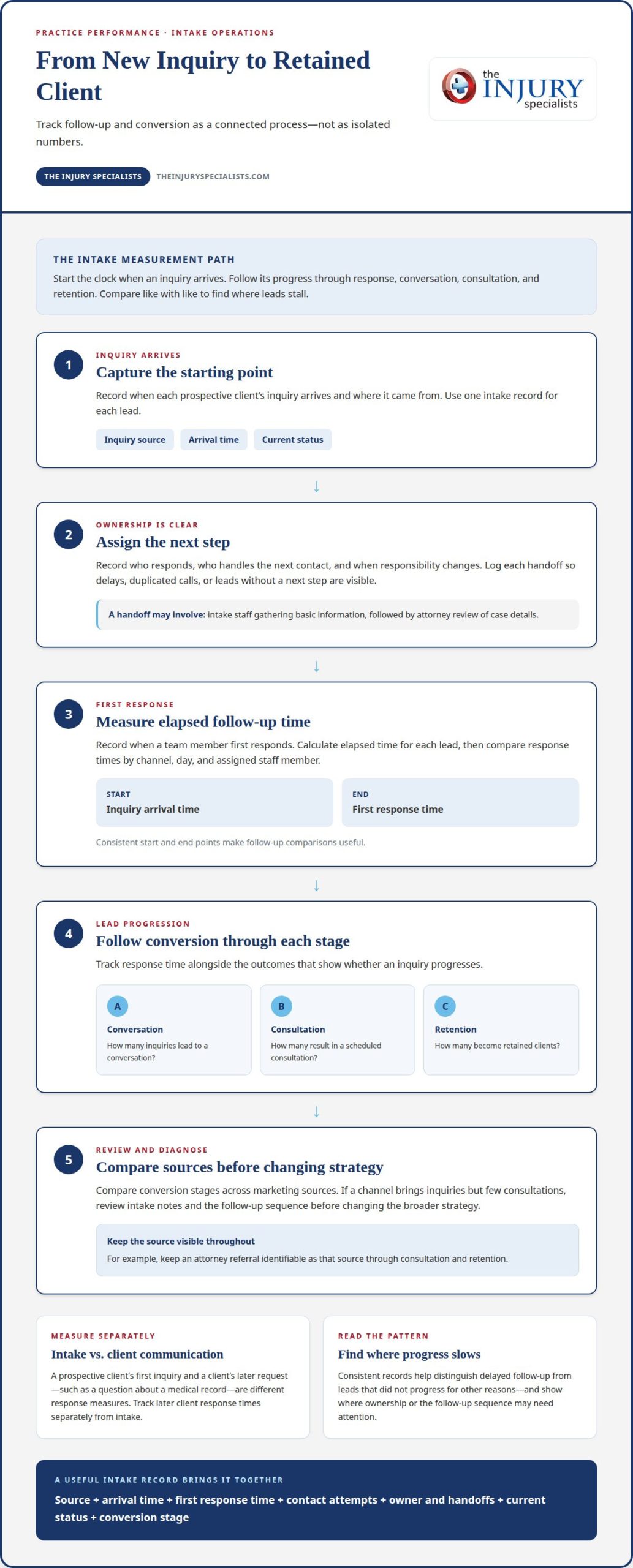
New client inquiries offer an early measure of intake performance. Prompt responses can affect conversion and the likelihood of securing new cases. Establish consistent start and end points by recording when each inquiry arrives and when a team member first responds. Calculate elapsed time for every lead, then compare results by channel, day, and assigned staff member.
Use one intake record for each prospective client. Include the inquiry source, arrival time, first response time, contact attempts, and current status. For example, keep a lead from an attorney referral identifiable as that source through consultation and retention. Consistent fields help law firms distinguish delayed follow-up from leads that did not progress for other reasons.
Track response time alongside conversion. Measure how many inquiries lead to a conversation, how many result in a scheduled consultation, and how many become retained clients. Compare these stages across marketing sources. If one channel produces inquiries but few consultations, review intake notes and the follow-up sequence before changing the broader strategy.
Assign clear ownership to each new lead. The intake process should show who responds, who handles the next contact, and when responsibility changes. An attorney may need to review case details, while intake staff gather basic information. Recording each handoff helps identify delays, duplicated calls, or inquiries left without a next step.
Review communication timing alongside case progression. Once a lead becomes a client, track later response times separately from intake. A prospective client’s first inquiry and a client’s request about a medical record, for example, belong to different stages. Keeping these measures distinct makes the intake metric useful instead of blending it with ongoing case communications.
Set a follow-up standard that fits the firm’s capacity, then review results consistently. Compare response times with conversion patterns and note where coverage gaps occur. If inquiries wait during a particular shift, adjust lead assignment or intake coverage. This creates a practical feedback loop: record the contact, assess the outcome, and refine the process.
4. Weekly and monthly KPI reports
Use weekly reports to examine case stages that may create bottlenecks. List matters by stage, age, assigned lawyer, and next action. If a report shows several cases waiting for medical records, managers can review ownership and follow-up. Track exceptions as well as totals, so each meeting ends with a specific decision.
Review other case phases monthly to see broader trends. Compare new matters opened, cases closed, client growth rate, and average earnings per client. Add average time to settlement and case cycle time to show how cases move through the process. These measures connect case management activity with revenue patterns without treating one month’s results as the full picture.
Keep a concise set of KPIs for client development and productivity. Compare potential-client conversion by marketing source, then review total billable hours and unbilled days. Track staff time on cases alongside progression through key stages. If the firm uses automation or outsourcing, compare time on desk and lifecycle measures before and after implementation.
Include client feedback in the monthly review. Net Promoter Score measures satisfaction and willingness to recommend the firm. Review it alongside client satisfaction measures and referrals, then look for patterns by case stage. Pairing these signals with closed cases helps leaders assess service and outcomes together.
Make each report actionable. Assign an owner and next step to every flagged bottleneck, then revisit it in the following weekly review. Monthly, compare results with firm goals and adjust strategies when a trend persists. Consistent definitions matter: a “new matter” or “case closed” should mean the same thing in each reporting period. A case management system can organize these measures and support reliable review. Improve your case reporting workflow with a process that connects case activity to performance decisions.
The Injury Specialists
The Injury Specialists supports personal injury practices with referral relationships and case management coordination. When performance reviews reveal gaps in referral development or case coordination, its programs can support the systems behind those measures.
Services include physician, chiropractic, physical therapy, and imaging center referrals, as well as an Attorney Referral Program. Medical case management is tailored to a firm’s distinct process, while marketing and networking support efforts to grow referral partners. These services help practices build professional connections and organize case-related workflows, giving leaders more structure as they pursue their goals.
For a closer look at how these services could fit your practice, contact The Injury Specialists.
Turn performance insight into your next move
Use your latest performance review to choose an operational priority, assign an owner, and define what progress will look like. That might mean improving how teams handle incoming opportunities or strengthening professional relationships that support steady case flow. Connect the insight to a decision, then revisit that decision as new results emerge.
Measuring success in a personal injury practice is not about collecting more numbers. It is about using relevant measures to guide action, support consistent processes, and keep firm priorities visible. As your practice evolves, reassess whether each metric still helps leaders make better decisions.
The Injury Specialists can support firms seeking stronger referral relationships and coordinated case management. Contact The Injury Specialists to discuss a practical next step for your practice.
Frequently Asked Questions
What Key Benchmarks Does My Personal Injury Firm Need to Track?
Track a balanced set of financial, intake, case progression, and client measures. A useful dashboard can group each metric by case type or lead source so firm-wide averages do not hide weaker segments. For example, compare inquiries from different channels with the matters they produce. Keep definitions consistent across reporting periods, then use changes from your own baseline to prioritize review.
What KPIs measure success in a personal injury law practice?
Useful KPIs include profit margin, client acquisition cost, intake conversion, average time to settlement, case cycle time, and client satisfaction. Choose measures that connect directly to a firm goal. If the goal is to retain more cases, for example, pair signed matters with lead-source conversion. If the goal is smoother case progression, examine stage delays alongside resolution times.
How do personal injury firms calculate case conversion and settlement rates?
Calculate case conversion by dividing retained clients by the number of qualified prospective clients in the same group and period, then multiplying by 100. Calculate settlement rate by dividing settled cases by the defined group of resolved cases, then multiplying by 100. State whether the denominator includes only closed matters or another cohort, and keep that definition unchanged when comparing results.
How should a PI firm measure revenue, profit margin, and cost per signed case?
Use consistent accounting periods and revenue-recognition rules. Profit margin is net profit divided by revenue, multiplied by 100. To measure cost per signed case, divide sales and marketing spend by the number of signed cases attributed to those efforts. For example, align a campaign’s spend with its resulting signed matters, rather than dividing by every inquiry received.

Leave A Comment
You must be logged in to post a comment.