
A clear injury record connects the incident, symptoms, treatment, and recovery in a consistent timeline. Knowing how to document client injuries effectively means recording what happened, tracking symptoms and changes, preserving medical records and expense documentation, and sharing relevant updates with care providers and case contacts. Each entry should be factual, dated, and easy to follow.
Consistent documentation keeps care information organized and gives professionals a clearer view of how an injury progresses. This guide explains what to record, how to organize photos and records, and how to keep documentation current as treatment continues. It also covers practical ways to share relevant information with medical providers and case contacts, so key details remain connected throughout the process.
Key Takeaways
- Build a dated record that connects the incident, symptoms, treatment, and recovery in a clear timeline.
- Keep medical documents, expense records, and injury images organized so important details are easy to retrieve.
- Use consistent, factual updates to support continuity of care and keep medical providers and case contacts aligned.
- Understand how referral services and medical case management can help connect healthcare and legal professionals when coordination is needed.
Organizing records for insurance negotiations and court
Create one dated file that connects the incident, care, and expenses for claim review. Store it in a password-protected location, limit access, and avoid public links.
Preserve Medical Records, Prescriptions, and Bills
Request and save copies of emergency reports, diagnostic test results, treatment plans, progress notes, prescriptions, and physical therapy or rehabilitation records. Keep hospital and provider bills with receipts for medications, treatment, and related expenses. Check that each document identifies the provider, service date, and amount charged. Organize files by date so you can match records and costs to the treatment they describe.
Update Records as Care or Condition Changes
Add each appointment, test, prescription, or rehabilitation visit to the record as care continues. Note changes in symptoms or treatment, and retain updated plans and provider progress notes. Keep the file private by limiting access to people involved in care or the claim. Avoid sharing medical details through public links or unrelated group messages. A current, access-controlled file supports continuity while limiting unnecessary exposure of records.
- Create a chronological index with the incident date, each treatment date, and the related document. For example, place a diagnostic report beside the appointment and plan that followed it.
- Save original digital files and legible copies of paper records in clearly named folders. Use labels such as “pharmacy,” “imaging,” and “rehabilitation” to retrieve evidence quickly.
- After each new service, add its record and receipt, then review the timeline for missing dates or documents. Keep copies together when treatment plans or costs change.
These records can also document the economic impact of an injury. Keep medical reports, prescriptions, and bills alongside receipts for medical treatment, medications, and related expenses. Include hospital and doctor bills, diagnostic test costs, prescription expenses, physical therapy and rehabilitation fees, and necessary medical equipment costs. For a personal injury case, request copies of medical records, test results, and bills for your own files. After a slip-and-fall accident, save all injury-related medical records and bills. Continue adding treatments and changes in condition, including after filing a personal injury lawsuit, so the record stays current.
Client-centered documentation and continuity of care
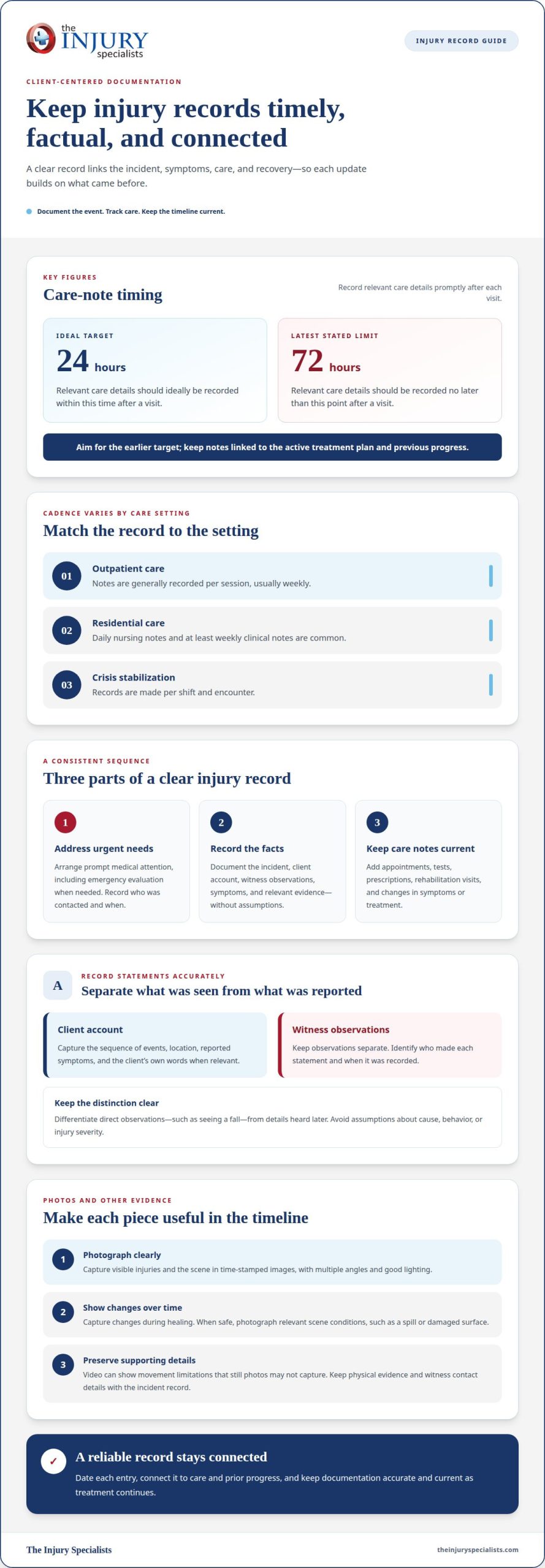
Use a consistent sequence after an injury: address urgent needs, record the facts, and keep care notes current. Make each entry factual, dated, and consistent with the procedures for the care setting.
- Arrange prompt medical attention, including an emergency evaluation when needed. Notify responsible management, document the incident, and preserve the scene when it is safe. Record who was contacted and when. U.S. documentation requirements depend on the care setting and applicable rules, so keep entries accurate and connected to the care provided.
-
Complete Care Documentation on Time
Document each visit promptly, linking the note to the active treatment plan and previous progress. Relevant care details should ideally be recorded within 24 hours of a visit and no later than 72 hours. Outpatient notes are generally recorded per session, usually weekly. Residential care commonly includes daily nursing notes and at least weekly clinical notes; crisis stabilization records are made per shift and encounter.
-
Record Witness Statements and Client Descriptions
Record the client’s account and witness observations as separate statements. Include the sequence of events, location, reported symptoms, and the speaker’s own words when relevant. Identify who made each statement and when it was recorded. Distinguish direct observations, such as seeing a fall, from details heard later. Avoid assumptions about cause, behavior, or injury severity.
-
Collect Photos and Other Evidence
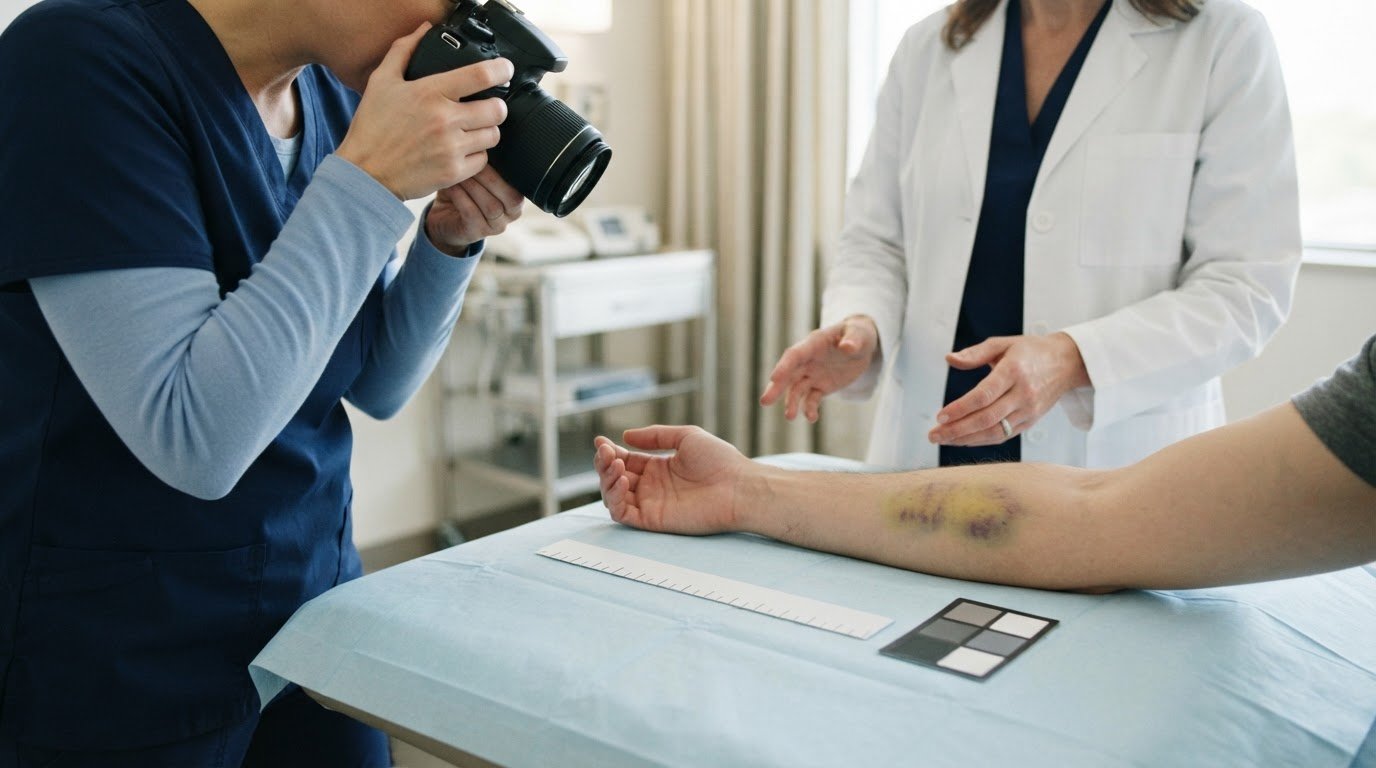
Photograph visible injuries and the scene in clear, time-stamped images, using multiple angles and good lighting. Capture changes during healing. When it is safe, photograph relevant scene conditions, such as a spill or damaged surface. Video can show movement limitations, such as difficulty walking, that still photos may not capture. Keep physical evidence and witness contact details with the incident record.
- For teams coordinating provider communication across cases, medical case management support can help connect care updates with ongoing coordination.
For a personal injury case, follow the doctors’ treatment plans and attend follow-up appointments. Emergency room reports document urgent care, initial diagnoses, and emergency treatments, helping connect an incident to injuries. The Joint Commission requires individualized, patient-centered documentation linked to the active plan of care. Ongoing medical evaluations can document the persistence or progression of chronic injuries or long-term disabilities. Behavioral health clinicians should document notes soon after a session to support accuracy and completeness. CARF emphasizes person-centered language and documentation of the individual’s goals in their own words.
Medical-provider conversations and case communications
Use provider updates to connect symptoms, evaluation, treatment, and expenses in a clear claim timeline. Keep communications factual, and tie each update to a dated event or record.
- Arrange a medical evaluation after an injury, even when symptoms seem limited. Tell the provider when and how the accident occurred, which areas hurt, and how symptoms affect daily activities. Describe changes since the incident without guessing at a diagnosis. The provider’s findings and treatment plan can document the injury and its progress.
- Prepare concise questions for each conversation with a provider. Ask what the evaluation found, what treatment is planned, and what changes you should report. Record the provider’s answers, the date, and any follow-up instructions. Share relevant updates with authorized case contacts so they understand treatment progress, without treating informal summaries as substitutes for medical records.
- Track each injury-related expense in a dated log. Include provider bills, diagnostic testing, prescriptions, physical therapy, medical equipment, appointment travel, and injury-related lost wages. Match each entry to a receipt, invoice, or other supporting document. This organized record helps distinguish treatment expenses from unrelated costs when assessing economic damages and compensation.
- Connect medical documentation to the accident with a consistent timeline. Emergency reports can record initial diagnoses and care; later evaluations can show ongoing symptoms or changes. Physician diagnoses provide medical opinions about the injury and its short- or long-term effects. Keep communications accurate, and don’t present a personal interpretation as a provider’s conclusion.
- Account for state differences when organizing a claim. Documentation practices can vary by care setting and applicable state rules. In California, pure comparative negligence allows an injured person to recover damages when partially at fault, with compensation reduced by that person’s share of fault. California also allows healthcare providers to place liens on personal injury settlements to secure payment for medical services.
What information should be included when documenting a client injury?
Use a consistent incident record to connect the event, reported symptoms, observations, and follow-up. Keep descriptions precise, dated, and clearly attributed to their source.
- Record the incident date, time, location, and sequence of events. Describe the activity or condition involved, such as a wet floor near an entrance. Training should teach staff how to document client injuries effectively by separating direct observations from details reported by the client or others. Identify the person making the record and note when the entry was made.
- Record the client’s description in their own words when relevant. Note affected areas, reported symptoms, and when each symptom began. Include specific examples, such as difficulty standing or pain while walking, rather than unsupported labels like “severe.” Record changes as the client describes them, without turning a report into a diagnosis.
- Describe visible injuries in neutral, observable terms. Note the location, appearance, and any changes seen during later checks. Avoid assumptions about diagnosis, cause, or recovery. For example, write “swelling visible near the left ankle,” not “fracture,” unless a medical provider documented that diagnosis.
- Take clear, time-stamped photographs from multiple angles and in good lighting. Photograph visible injuries again during healing to record changes. When relevant and safe, capture the scene and the condition involved. Preserve original image files and connect each image to its date and subject.
- Collect witness names and contact information, then record each statement separately. Note when it was given and distinguish firsthand observations from details heard later. A written procedure can show staff how to document client injuries effectively when witness accounts differ: identify each source, preserve distinct accounts, and avoid presenting an unverified conclusion as fact.
- Keep entries factual and clearly attributed. Use direct quotes for significant client descriptions, identify staff observations, and associate related photographs or witness statements with the same incident record. If details conflict, record each account and its source rather than silently choosing one version.
The Injury Specialists
The Injury Specialists helps healthcare and legal professionals coordinate around injury cases through referral programs and medical case management. When organized records need to support communication across a care network, these services can help connect providers and case contacts. Physician Referral Services, Chiropractic and Physical Therapy Referrals, and Imaging Center Referrals support connections to relevant care professionals. The Attorney Referral Program includes medical case management based on each firm’s distinct process, along with marketing and networking to grow referral partners. These offerings support coordination and referrals, not direct medical treatment or legal representation. For professional referral or case-management needs, contact The Injury Specialists to discuss the next step.
Make Clear Documentation Part of the Workflow
A strong record is more than a file assembled for a claim. It is a working tool that helps teams coordinate decisions, preserve context, and maintain continuity as a case develops. Put a clear process in place: assign responsibility for updates, use consistent documentation practices, and share relevant information with the appropriate care and case contacts.
Knowing how to document client injuries effectively can strengthen those handoffs while keeping the focus on accurate, client-centered records. The next step is connecting the people and processes involved in injury care. The Injury Specialists supports professional referral networks and medical case management for healthcare and legal partners. Contact The Injury Specialists to discuss coordination needs and referral support. A reliable workflow starts with clear records and grows through purposeful collaboration.
Frequently Asked Questions
How soon must a client injury be documented and reported?
Document the injury and report it promptly under the procedures for the care setting. Relevant care details should ideally be documented within 24 hours of a visit and no later than 72 hours. Operational incident reporting may follow a separate process. Record when the report was made, who received it, and any follow-up action still pending.
What forms or templates are used for client injury reports?
Use the incident-report form or documentation system established for the organization and care setting. If a form allows free-text notes, use them to clarify the sequence of events without leaving required fields incomplete. Include a way to track notifications, assigned follow-up, and completion status. For example, note whether a supervisor still needs to review an unresolved safety concern.
What documentation mistakes can create legal or safety risks?
Common risks include backdating an entry, deleting an earlier account without preserving the correction, and recording guesses as facts. For example, changing “client reported dizziness” to “client fell because of dizziness” adds an unsupported conclusion. Keep corrections traceable, distinguish reports from observations, and avoid sharing records through broad, unsecured channels. These practices help maintain a reliable record for later review.
