

The strongest pain evidence often includes details that a chart does not capture. A consistent approach to documenting pain and suffering for clients combines their own reports with observable physical or behavioral cues, changes to everyday activities, and treatment records. Start at intake and continue through follow-up so the demand can connect the injury to its day-to-day effects.
Medical records matter, but they may not show how pain disrupts sleep, work, movement, or time with family. A clear process helps firms capture these effects consistently without treating a single pain score or observation as the whole story.
This article explains which cues and daily-life impacts to record, when to begin, and how to organize evidence in a demand. It also covers how client reports, observations, and medical documentation can support a coherent account of an injury’s impact.
Key Takeaways
- Capture physical limits, emotional effects, and changes to work or routine, not only reported pain intensity.
- Begin recording symptoms and daily-life effects early, then keep entries consistent and factual.
- Use observable cues alongside the person’s own account, and document the context rather than drawing conclusions from behavior alone.
- Organize demand evidence to connect reported symptoms and daily impacts with treatment, examination findings, and the injury.
- Review relevant medical records for symptom reports, diagnoses, treatment, referrals, and follow-up pain assessments.
Daily-life impacts that medical records may omit
A treatment note can record symptoms without showing what a client could no longer do at home, work, or during therapy. Documenting pain and suffering for clients means connecting reported symptoms to specific effects on daily life.
Recording Symptoms and Daily Effects
Daily-effect records describe how symptoms change a client’s activities, routine, and ability to function. They matter because medical records may focus on examination findings and treatment while leaving ordinary disruptions unclear.
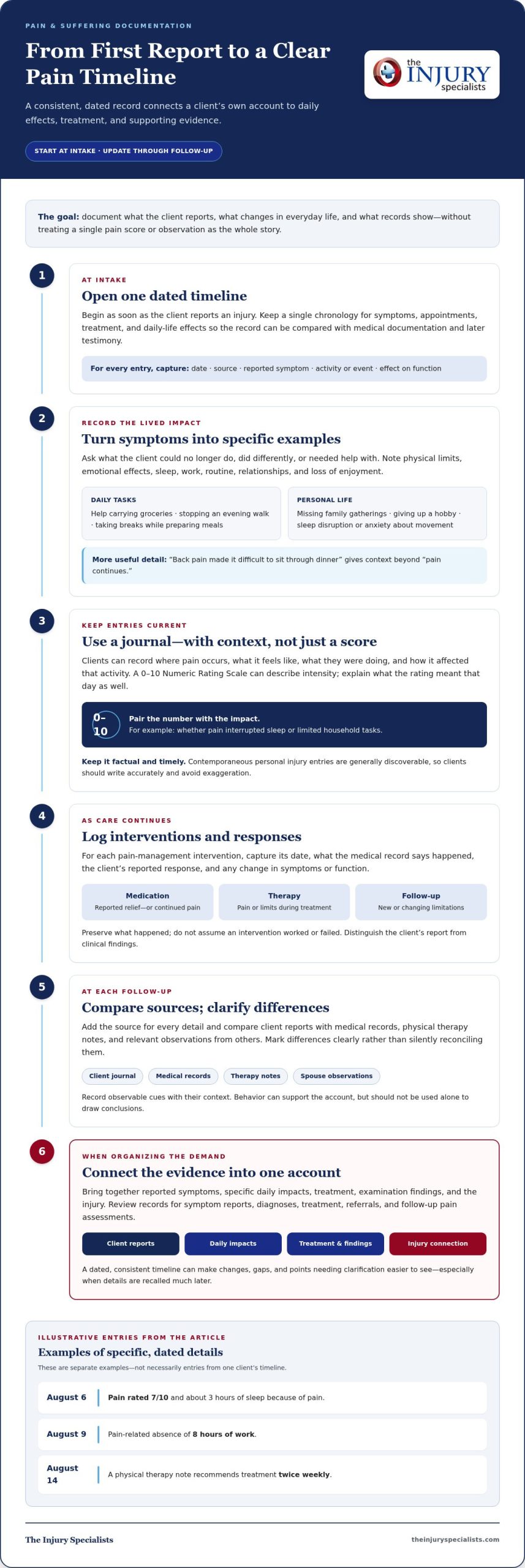
Use a consistent intake and follow-up process to capture physical limits, emotional effects, loss of enjoyment, and work impact. Ask for specific examples, such as needing help to carry groceries or stopping an evening walk because pain worsened. An illustrative timeline records a client missing 8 hours of work because of pain on August 9. That entry connects a symptom to a concrete consequence.
Record the date, activity, symptom, and effect in the client’s own words. For example, “Back pain made it difficult to sit through dinner” gives more context than “pain continues.”
Maintaining a Pain and Suffering Journal
A pain and suffering journal is a dated record of symptoms, emotional state, appointments, and changes to normal activities. Regular entries give clients a structured way to capture details that might otherwise fade from memory.
Clients can note where pain occurs, what it feels like, what they were doing, and how the symptom affected that activity. A Numeric Rating Scale uses numbers from 0 to 10 to describe pain intensity, but the entry should also explain what the rating meant that day. For example, a client might describe how pain interrupted sleep or limited household tasks.
Keep entries factual and timely. A client’s journal, physical therapy notes, and a spouse’s observations can corroborate one another. Contemporaneous personal injury entries are generally discoverable, so clients should write accurately and avoid exaggeration.
Pain-and-suffering damages differ by state because there is no nationwide cap. Applicable limits on non-economic damages vary by state and claim type, and some caps apply to medical malpractice claims rather than all personal injury claims.
Functional Impact and Daily Limitations
Functional-impact records explain which tasks a client can no longer perform, or performs differently, because of symptoms. They help show how an injury affects independence beyond a pain score.
Describe the task, the limitation, and any assistance or adjustment required. For example, note whether a client stopped driving, needs help dressing, or takes breaks while preparing meals. An August 14 physical therapy note recommends treatment twice weekly, providing a treatment detail to compare with the client’s account of ongoing limitations.
Expert witnesses can explain how medical findings and treatment relate to reported symptoms and functional limits. Their analysis can clarify the significance of documented restrictions without replacing the client’s own account.
Emotional Distress and Loss of Enjoyment
Attorneys document emotional distress and loss of enjoyment by recording specific changes in mood, relationships, sleep, and activities after an injury. These details distinguish a general statement of distress from examples tied to daily life.
Ask clients to describe activities they stopped or changed, such as missing family gatherings or giving up a regular hobby. Record when the change began, how often it occurs, and the client’s explanation. If pain affects sleep or creates anxiety about movement, capture the client’s description and connect it to relevant treatment records.
When emotional symptoms are significant, psychiatric-care records can support an account of distress. A consistent timeline of client statements, observed changes, and treatment makes the effects easier to understand alongside physical limitations.
When Should You Start Documenting Pain and Suffering?
Start at intake, then update the record as symptoms, treatment, and daily effects change. Early entries give the client and legal team a dated account to compare with medical records and later testimony.
Start Early and Build One Timeline
Open a timeline as soon as the client reports an injury, then add dated entries from follow-up conversations, appointments, and records. A single chronology makes it easier to see how reported pain, diagnosis, treatment, and daily effects relate.
For example, an illustrative timeline records pain rated 7/10 and about 3 hours of sleep because of pain on August 6. Add the source for each entry, such as a client journal, a medical record, or a therapy note. Mark differences between sources clearly instead of silently reconciling them. A visual timeline can help identify gaps, changes, and points that need clarification.
Record Interventions and Their Effects
Document each pain-management intervention alongside the client’s response. Include the date, the intervention described in the medical record, the reported effect, and any change in function or symptoms.
For example, note whether a client reports relief after medication, continued pain during therapy, or a new limitation after an appointment. The purpose is to preserve what happened, not to conclude that an intervention worked or failed. Compare client reports with provider notes so the timeline distinguishes personal observations from clinical findings.
Prepare for Depositions With Contemporaneous Records
A personal injury deposition may take place a year or more after a crash, so dated entries can help clients recall details accurately. The federal rules of evidence provide hearsay exceptions for statements about then-existing physical conditions, including pain, and records made while a matter was fresh in the witness’s memory. A witness may also use a writing to refresh memory while testifying.
These principles do not make every journal entry admissible. They do show why dates, clear wording, and consistent recordkeeping matter. Before a deposition, compare the client’s timeline with treatment records and identify any differences that need an accurate explanation.
Deadlines and Documentation Mistakes
Filing deadlines depend on the state and claim, and the event that starts the deadline can depend on the circumstances. Begin documenting promptly, but do not assume ongoing treatment or a journal changes the filing deadline.
Common mistakes include backdating entries, guessing at dates, exaggerating symptoms, and copying medical language the client wouldn’t naturally use. Record corrections transparently, separate what the client reported from what a provider observed, and avoid leaving long gaps unexplained. Firms refining their case documentation workflows can use consistent intake and follow-up practices to keep these records organized.
How Do You Write Pain and Suffering Into a Demand?
Build the demand around evidence connecting the injury to treatment and actual harm. Organize medical records and firsthand documentation into a clear account rather than relying on a pain label alone.
Medical Records of Injury and Treatment
Medical records document symptoms, examination findings, diagnoses, injury severity, treatment, and referrals. Together, these details help explain how a reported injury was assessed and managed.
In the demand, connect each relevant record to the client’s account. A hospital examination may document findings, while later therapy notes describe treatment and progress. Explain how the records support the claimed injury and its effects, without presenting a diagnosis as proof of every daily limitation. Distinguish clinical observations from the client’s own reports.
To obtain compensation, an injured person must prove that another party’s negligent actions caused the injury and actual harm. State that connection clearly: identify the event, the resulting injury, and the documented consequences. Do not treat a timeline alone as proof of causation.
There is no nationwide cap on pain and suffering damages in the United States; applicable limits on non-economic damages vary by state and claim type. A demand explains the documented severity, duration, treatment, and personal effects behind its requested amount. These factors help support a valuation rather than a single nationwide calculation formula.
Timestamped Journals, Messages, and Photographs
Timestamped journals, messages, and photographs preserve dated examples of symptoms and their effects. They can add context to medical records by showing what happened between appointments.
Arrange each item by date and identify who created it. A journal entry might describe pain interfering with sleep, while a message to a family member records that the client needed help with a household task. An injury photograph can show visible changes over time, but cannot establish pain by itself. Pair images with dates and relevant treatment records.
Social media posts can hurt a claim if an image or caption appears inconsistent with reported limitations. A post showing a client at an event, for example, may leave out rest breaks or pain afterward. Preserve the context and discuss the post with counsel rather than altering or deleting it.
Documenting Invisible Injuries
Invisible injuries require records that explain symptoms and effects even when photographs show no visible change. Consistent reports, clinical notes, and treatment records can help make those effects understandable.
For symptoms such as ongoing pain or emotional distress, connect the client’s account to appointments, diagnoses, referrals, and functional changes. If a client reports difficulty concentrating at work, describe the specific task affected and when the problem occurs. For significant mental or emotional symptoms, psychiatric-care records can support a compensation claim.
Keep the demand precise: cite the relevant record, summarize what it establishes, then explain the client’s reported harm. This structure distinguishes medical evidence from personal experience while showing how both relate to the injury.
Behavioral and physical pain cues
Pain documentation should combine a person’s report with specific observed behavior and physical changes. Use the same approach at each encounter, noting what was observed, when it occurred, and how the client described it.
Start With the Client’s Own Report
Patient self-report is considered the gold standard for pain assessment, so record the person’s words and the scale used. The Numeric Rating Scale lets a person rate pain from 0 to 10. Record the score with context, such as whether pain increased while walking or affected sleep, rather than presenting a number alone.
Some clients may communicate pain through behavior or facial expression instead of a clear verbal report. The Wong-Baker FACES scale can support pain-intensity assessment for cognitively intact adults, with scores ranging from 0 to 5. Document the selected score and the client’s explanation. A scale captures reported intensity, while written notes preserve what the client says the pain prevents them from doing.
Describe Observable Cues Precisely
Behavioral observations can add context when a client has difficulty describing symptoms. The Behavioral Pain Scale scores three behavioral categories on a 1-to-4 scale, and a cumulative score above 3 may indicate pain is present. Record the observed behavior and the assessment context instead of converting a single action into a diagnosis.
PAINAD assesses breathing, negative vocalization, facial expression, body language, and consolability, using a score from 0 to 10. For example, note a change in facial expression during movement and whether the client reports pain at that moment. A consistent written description lets later reviewers compare encounters without treating any cue as conclusive by itself.
Connect Cues to Function and Follow-Up
Record physical and behavioral cues alongside an activity, intervention, or examination. If a client pauses during a task, document the task, the pause, and the client’s explanation. If the client reports reduced strength or difficulty gripping an object, preserve those words and note any related examination finding separately.
At follow-up, compare the current pain report with earlier documentation and the client’s stated comfort-function goal. Reassess after an intervention and record the response, including continued symptoms or an observable change. This creates a traceable sequence: the client’s report, the recorded cue, the action taken, and the follow-up finding.
Keep emotional observations distinct from physical findings. If a client appears distressed, describe the observed behavior and record the client’s own account rather than inferring a cause. Consistent descriptions across encounters make the evidence easier to interpret and preserve the distinction between what the client reported and what another person observed.
What medical records help prove pain and suffering?
Medical records help establish reported symptoms, examination findings, diagnoses, injury severity, treatment, and referrals. Review them as a connected account: an emergency visit may document initial complaints, while later records show follow-up and response to care.
Build a Treatment Record Sequence
Start with records from the hospital or clinic that first evaluated the injury. Then gather follow-up notes from physicians, specialists, physical therapy, and other relevant treatment providers. Each record adds context, such as a reported symptom, examination finding, diagnosis, treatment recommendation, or referral.
Arrange records by date and identify the provider and visit type. For example, compare an initial complaint with a later examination and therapy assessment. Note changes in symptoms or function without rewriting clinical findings as conclusions. This sequence helps a reviewer see what was reported, what clinicians observed, and how treatment developed.
Check Pain Assessments and Follow-Up
A useful pain assessment records the client’s pain score, the rating scale used, and follow-up information. Those details make separate assessments easier to interpret, especially when the client’s reported intensity changes during treatment.
Compare the score with the surrounding note. A rating without context may not explain whether pain affected movement, sleep, or a treatment activity. Follow-up entries can show what happened after an intervention, including whether the client reported relief or continued symptoms. Preserve the provider’s wording and distinguish it from the client’s separate account.
Include Records Addressing Emotional Symptoms
Physical treatment records may not capture every emotional effect. If accident-related pain and suffering causes significant mental or emotional symptoms, psychiatric-care records can support a compensation claim.
Include relevant evaluations, reported symptoms, diagnoses, and treatment notes in the same chronology as physical care. For example, connect a documented emotional concern with the date it was reported and any resulting care. Do not interpret a provider’s note beyond what it says. The record can support the documented concern, while the client’s own account explains its effect on daily life.
Review for Gaps and Clear Attribution
Before using records in a demand, check that dates, providers, and visit types align. Flag a missing follow-up note or a difference between a client report and an examination finding. Present discrepancies accurately rather than omitting them or resolving them through assumption.
Keep a source label beside each detail: client report, clinician observation, diagnosis, or treatment recommendation. Nurses should document the pain score, scale used, and follow-up information. This separation helps the demand present medical evidence precisely and connect it to the client’s account without overstating either.
For firms coordinating provider records and case workflows, strengthen medical case management to support a more organized review of treatment documentation.
The Injury Specialists: Physician Referral Services, medical case management, marketing and networking to increase referral partners.
The Injury Specialists supports firms and healthcare providers coordinating injury-related care and case processes. Use its Physician Referral Services or medical case management when a case requires organized connections between legal and medical professionals. Its Attorney Referral Program provides medical case management tailored to a firm’s distinct process, alongside marketing and networking to grow referral partners.
For practices seeking chiropractic or physical therapy connections, The Injury Specialists’ referral services support that workflow. Imaging center referrals are also available. These services complement careful documentation by helping professionals coordinate around the medical care and records relevant to an injury claim.
To discuss referral services or case management, visit The Injury Specialists.
Build a Stronger Process for Future Cases
Each completed demand can help refine how your team captures client experience in future cases. Review where information was clear, where details were difficult to retrieve, and which follow-up prompts produced useful context. Then update intake and case-review practices so documenting pain and suffering for clients remains consistent throughout a claim.
Make the process practical for the people using it. Assign responsibility for updating records, set a regular review point, and keep client reports distinct from medical observations. A clear workflow supports continuity when files move between team members and helps prepare a coherent record for the next stage of case development.
For support connecting legal and medical professionals through referral services and case management, contact The Injury Specialists. A focused process gives your team a stronger foundation for the work ahead.
Frequently Asked Questions
How Do Firms Capture This Evidence Consistently?
Firms capture evidence consistently by using shared prompts, clear ownership, and routine file reviews. For example, an intake template can ask about current activities, changed routines, and symptoms affecting work. A follow-up checklist can prompt staff to record updates after appointments or client calls. During file review, check for missing dates, unclear sources, and unexplained changes. A consistent process helps different team members document cases in a similar format.
What About Invisible Injuries?
Invisible injuries can be documented through the client’s descriptions, relevant clinical evaluations, and changes in everyday function. For example, a client may describe difficulty concentrating through a work meeting or discomfort during a familiar activity. Record the specific situation and the client’s explanation rather than relying on a broad label. Treatment notes may add context, while the client’s account shows how symptoms affect activities outside the clinical setting.
What Evidence Proves Pain and Suffering?
No single item proves every aspect of pain and suffering; evidence is strongest when different records support a consistent account. A provider’s examination may document findings, while a client’s dated account describes a missed activity. A family member’s observation can add another perspective. Keep each source identifiable and explain what it supports. For example, distinguish a clinician’s observation from a client’s report of pain during a routine task.
Why Is Functional Impact the Evidence That Matters Most?
Functional impact makes the consequences of an injury concrete by showing what changed in a person’s routine. A pain rating describes intensity, but an example such as needing to stop while preparing a meal illustrates a practical limitation. This context helps connect symptoms to real activities. It should not replace medical evidence or the client’s own description; it adds detail about how the injury affects daily decisions and independence.
What Evidence Documents Pain and Suffering in a Personal Injury Claim?
Useful evidence can include medical records, treatment notes, pain assessments, dated client entries, and accounts from people who observed changes. Each item has a different role: a diagnosis identifies a clinical finding, while a client entry may describe a disrupted routine. Organize the materials so dates and sources are clear. For instance, compare an appointment record with the client’s description of symptoms around that visit.
How Should Clients Keep a Pain and Suffering Journal?
Clients should keep entries brief, dated, and specific to what they experienced that day. They can note the activity, symptom, effect, and any relevant appointment or medication. Instead of writing “bad day,” for example, describe which task became difficult and what happened. Use personal language, correct mistakes transparently, and avoid guessing at details later. A journal should reflect the client’s actual experience, not language written to strengthen a claim.

Leave A Comment
You must be logged in to post a comment.