

A campaign that generates clicks but does not show where referrals come from is difficult to evaluate. Effective diagnostic imaging marketing to law firms pairs targeted ads on platforms such as Facebook or LinkedIn with focused landing pages, then tracks referral sources, organic website traffic, advertising conversions, and changes in referring physicians.
That measurement matters. Law firms need clear, relevant information about imaging services, while imaging practices need to understand which outreach connects them with professional referral partners. A focused campaign makes those connections easier to see without relying on broad, untargeted promotion.
This article explains how to target advertising to law firms and evaluate campaign performance using practical metrics. It also covers imaging services commonly relevant to injury cases, rules that can affect referral marketing, and ways a structured referral network can support ongoing professional relationships.
Key Takeaways
- Track referral sources alongside website traffic, ad conversions, and changes in referring physicians to see which campaign activities are reaching professional partners.
- Use targeted ads and dedicated landing pages to make imaging services relevant to law firms, then measure what happens after people engage.
- Build outreach around clear service information and consistent professional relationships, rather than relying on advertising alone.
- Understand how MRI and CT can help visualize soft-tissue and skeletal injuries, and communicate service details clearly to legal audiences.
- Keep compliance in view: federal referral rules and state requirements can affect how imaging services are promoted.
Marketing campaign metrics
To compare an imaging center with a hospital-based service, document each option’s imaging modalities, scheduling process, location, and communication workflow. Apply the same criteria to both so law firms can assess practical differences without relying on broad claims of superiority.
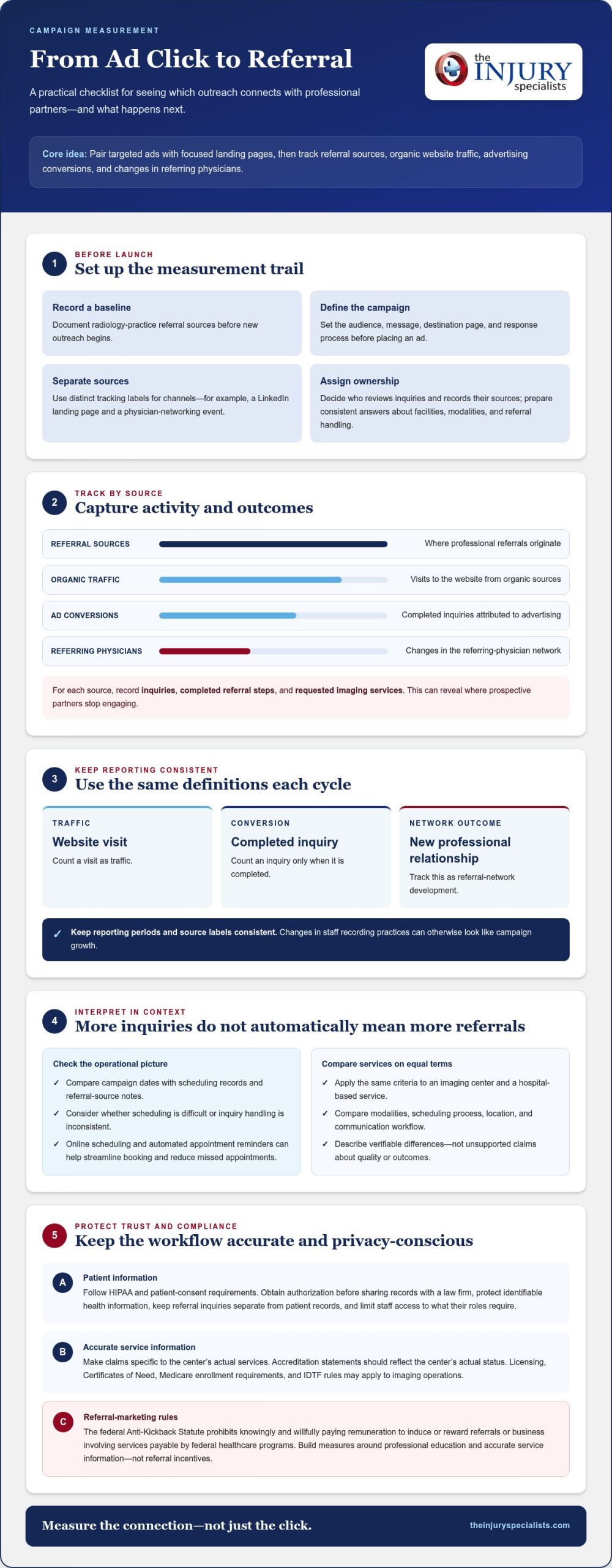
Start with a baseline: record the sources of radiology-practice referrals before launching new outreach. Then track referral sources alongside organic website traffic, advertising conversions, and changes in referring physicians. These measures show whether outreach is reaching healthcare professionals and creating connections, rather than merely generating visits.
Separate campaign activity by source. For example, use different tracking labels for a LinkedIn landing page and a physician-networking event. Record inquiries, completed referral steps, and requested imaging services for each source. This helps practice leaders compare channels and identify where prospective partners stop engaging.
Use a simple reporting cycle with consistent definitions. Count a website visit as traffic, a completed inquiry as a conversion, and a new professional relationship as a referral-network development outcome. Keep the reporting period and source labels consistent. Otherwise, changes in how staff record referrals can look like campaign growth.
Review results in their operational context. More inquiries may not mean more referrals if scheduling is difficult or staff handle inquiries inconsistently. Compare campaign dates with scheduling records and referral-source notes. Online scheduling software and automated appointment reminders can help streamline booking and reduce missed appointments.
When comparing hospital-based services, evaluate the details that matter to a law firm’s workflow: available modalities, appointment access, location, and how referral questions are handled. An imaging center may offer a focused service mix, while a hospital may provide a broader healthcare setting. Present verifiable differences, not unsupported claims about quality or outcomes.
HIPAA and patient consent should guide referral and records workflows. Protect identifiable health information during attorney referrals, and obtain authorization before sharing records with a law firm. Keep referral inquiries separate from patient records, and limit staff access to the information needed for their roles.
Local requirements can affect what a campaign may accurately claim. Licensing, Certificates of Need, Medicare enrollment requirements, and IDTF rules may apply to imaging operations. Accreditation statements should reflect the center’s actual status. Medicare supervision and patient-notification requirements can also shape service descriptions and workflows.
Assess campaign strengths, weaknesses, opportunities, and threats annually. Pair that review with a marketing plan that includes a mission statement, implementation deadlines, and staff accountability. The U.S. Department of Health and Human Services Office of Inspector General explains that the Anti-Kickback Statute prohibits knowingly and willfully paying remuneration to induce or reward referrals or business involving services payable by federal healthcare programs. Build campaign measures around professional education and accurate service information, not referral incentives.
Targeted advertising
Diagnostic imaging marketing to law firms works best when campaigns give legal professionals clear, relevant information. Define the audience, message, destination page, and response process before placing an advertisement.
Marketing to Personal Injury Law Firms
Focus on what personal injury attorneys need to understand: available imaging services, referral steps, facility location, and how inquiries are handled. Keep claims specific to the center’s services. For example, an ad can lead to a landing page explaining how to inquire and where to direct process questions.
Facebook and LinkedIn can carry targeted ads to those pages. Match each ad to a specific audience and purpose rather than sending every visitor to a general homepage. A page for law firm counsel can explain referral procedures, while physician-facing information can focus on professional coordination.
Law Firm Outreach Planning
Start by identifying the firms and roles the campaign aims to reach, such as personal injury attorneys or intake teams. Set one clear objective, such as encouraging visits to a page about imaging services. Then choose a platform, prepare audience-specific copy, and make the landing page’s next step easy to understand.
Before launch, assign responsibility for reviewing inquiries and recording their sources. Prepare answers to common questions about facilities, modalities, and referral handling. A diagnostic imaging marketing to law firms campaign needs a consistent staff process for responding and gathering useful audience feedback.
Separate campaigns by audience and purpose. An attorney-focused post might explain referral procedures, while content for healthcare partners could describe coordination with physicians and imaging centers. Distinct messages help each group find relevant information without suggesting that legal professionals make clinical decisions.
Make every landing page match its ad. If an advertisement mentions MRI and CT, the destination should explain those services, the inquiry route, and the information a firm needs to start a conversation. Avoid broad claims such as “best care.” Describe the center’s actual services and workflow instead.
Keep creative professional and easy to scan. Use a clear headline, a brief explanation, and one action, such as viewing the referral process. A campaign can test different headlines or page layouts. Change one element at a time to make results easier to interpret.
Review engagement alongside the inquiries it generates. Record the platform and message behind each inquiry, whether it came from an attorney or another professional, and what information was requested. These details show whether the campaign reaches its intended audience or needs a clearer message.
Use feedback to refine later outreach. If counsel repeatedly asks about referral steps, make those steps more prominent. If physicians need different details, prepare separate content for them. For support with professional referral outreach, explore law firm outreach planning.
How can diagnostic imaging centers market services to personal injury law firms?
Build outreach around the information personal injury firms need to understand imaging services and referral logistics. An imaging center can combine professional networking, useful educational content, and clear service information so attorneys can assess whether its capabilities fit their workflow.
Begin with a defined audience. Separate personal injury attorneys from physician and healthcare-facility contacts because each group needs different information. A law firm page might explain how to inquire and what service details are available. A physician-facing resource can focus on professional coordination.
Use a practical outreach sequence:
- Map the audience. Identify relevant firms and the roles involved, such as attorneys, intake staff, or office administrators.
- Prepare useful materials. Create a concise service overview covering imaging modalities, referral steps, location, and inquiry handling.
- Make a professional introduction. Share the overview through direct outreach or a networking conversation, then invite questions about the center’s process.
- Follow up with relevant information. If a firm asks about MRI or CT, provide clear details about those services rather than sending unrelated material.
Education can support this process. For example, a short article or infographic can explain how MRI and CT provide detailed views of soft-tissue and skeletal injury, as RadiologyInfo.org describes. Keep the material informative, and do not suggest that an imaging center determines legal claims or directs medical decisions.
Use a professional website as the destination for outreach. Organize pages by service, make them load quickly, and ensure they work on mobile devices. A lawyer reviewing a message between meetings should be able to find the inquiry process without searching through unrelated pages.
Social media can extend the same message. A radiology practice might publish an educational infographic, a brief explanation of imaging services, or behind-the-scenes information about its facility. Keep patient testimonials and other patient-related content consistent with privacy requirements, and do not include identifiable details without proper authorization.
Consistency matters across channels. If a LinkedIn post describes a referral process, the linked page and staff response should explain that same process. Record which firms receive outreach and what questions they ask. Repeated questions can reveal where materials need clearer explanations.
Professional networking can build connections beyond a single campaign. Relationships with physicians and healthcare facilities can complement law firm outreach by creating a broader referral network. Keep the focus on accurate service information and professional relationships, not referral incentives.
Make follow-up useful rather than repetitive. After an introductory conversation, send the specific material requested, such as a service overview or process explanation. Relevant follow-up helps each firm understand the center’s imaging services.
What imaging services do law firms most often need for injury cases?
MRI and CT are central to imaging discussions in injury cases because they provide detailed views of soft-tissue and skeletal injury, according to RadiologyInfo.org. Law firms need accurate information about an imaging center’s services. Explain the modalities and referral steps without implying that attorneys choose tests or interpret findings.
The appropriate imaging service depends on the patient’s clinical needs and the treating professional’s assessment. An attorney may need to know which services a center provides, but marketing should not present a modality as suitable for every injury. For example, a service page can describe MRI and CT availability while directing clinical questions through the appropriate care process.
- MRI: RadiologyInfo.org identifies MRI as a way to visualize soft-tissue and skeletal injury. Center materials can describe MRI as a service without predicting a particular finding.
- CT: CT also provides detailed visualization of soft-tissue and skeletal injury, according to RadiologyInfo.org. Explain how to ask about this service and its referral process.
- X-rays: Diagnostic radiologists use X-rays to help diagnose structural or disease-related changes. A center can list this modality and explain its role in the available imaging services.
- Ultrasound: Ultrasound is another diagnostic imaging modality. Include it in service information when the center provides it, with clear descriptions rather than broad injury-related promises.
Organize service details so law firm staff can scan them quickly. A modality page can state which imaging services are offered, how to submit an inquiry, and how the center handles referral communications. Separate information about MRI, CT, X-rays, and ultrasound so readers can find relevant details without assuming every modality serves the same purpose.
Keep descriptions factual. Explain, for example, that MRI and CT can provide detailed visualization of soft-tissue and skeletal injury, without claiming either scan will identify a specific condition in every case. Arizona Advanced Imaging describes examples such as herniated discs, torn ligaments, and brain trauma in its discussion of MRI, but individual imaging and interpretation remain clinical matters.
Clear distinctions help prevent confusion between legal and clinical roles. Law firms can learn what a center offers and how referrals are handled. Clinical professionals assess patient needs and interpret imaging. Marketing materials should support that division by describing services, access steps, and communication channels without steering diagnostic decisions.
Use consistent service names across the center’s website, outreach materials, and referral documents. If a law firm sees “MRI” in an advertisement, the linked page should provide MRI-specific information. This makes it easier for legal staff to identify relevant services and understand the next administrative step.
What rules govern marketing diagnostic imaging services to law firms in the United States?
Marketing imaging services to law firms means communicating clearly without treating referrals as promotional rewards. Federal rules, state requirements, and operational standards can affect what a center says and how it handles professional relationships. Build a review into campaign planning before publishing advertisements, referral materials, or partnership proposals.
The U.S. Department of Health and Human Services Office of Inspector General explains that the federal Anti-Kickback Statute prohibits knowingly and willfully paying remuneration to induce or reward patient referrals or business involving services payable by federal healthcare programs. Keep outreach focused on service information and professional education, not payments or other benefits intended to generate referrals.
The Stark Law is another consideration for diagnostic imaging providers and leasing entities. It addresses certain physician referrals involving financial relationships, and its rules include restrictions on enticements offered to referring physicians. Review proposed arrangements and marketing language for financial relationships or referral incentives before putting them into practice.
State statutes and regulations may add requirements. The relevant rules depend on where the imaging facility operates and which services it provides. California, for example, has specific provisions concerning technical components of CT, PET, and MRI services. A campaign used across state lines should not assume one state’s requirements apply everywhere.
Privacy matters in outreach and follow-up. HIPAA is a compliance consideration for diagnostic imaging providers and leasing entities. Keep patient information out of marketing materials unless its use is properly authorized, and separate general law firm inquiries from information tied to an individual’s care.
Operational rules can also shape accurate advertising. Medicare enrollment requirements, IDTF enrollment rules, and Medicare supervision requirements may affect how a facility describes its services. Certificates of Need and licensure can also apply to imaging providers. Claims about accreditation or operational status should match the facility’s actual circumstances.
Use a practical review process before launch. Identify the states and imaging services covered, compare campaign descriptions with actual operations, and review any financial arrangements connected with referrals. Route patient-related content and records through appropriate privacy procedures. This draws a clearer boundary between marketing information and clinical or patient-specific communications.
For example, an advertisement can describe available imaging services and explain how attorneys can make a general inquiry. It should not promise a particular diagnosis, imply a guaranteed outcome, or offer a reward for referrals. Clear boundaries keep messaging accurate and professional outreach focused.
Develop referral outreach around accurate service information and compliant professional relationships. Explore imaging center referral support for help building connections with referral partners.
The Injury Specialists: Physician Referral Services, medical case management, marketing and networking to increase referral partners.
The Injury Specialists supports imaging centers in building referral relationships through Imaging Center Referrals, marketing, and networking. This can help a center strengthen connections with law firms and healthcare professionals beyond individual advertising campaigns.
For law firms, the Attorney Referral Program includes medical case management tailored to each firm’s distinct process, alongside marketing and networking to grow referral partners. Physician Referral Services and medical case management can also support broader professional referral development. These offerings complement campaign planning by helping organizations build structured relationships across injury-related care networks.
Contact The Injury Specialists to discuss referral support aligned with your organization’s professional relationship goals.
Turn Campaign Insight Into Stronger Partnerships
Make campaign learning part of a broader relationship strategy. Use questions from law firms to shape future outreach, refine professional materials, and identify opportunities to develop imaging-center relationships. A disciplined approach to diagnostic imaging marketing to law firms gives your team a practical basis for continuing those conversations.
The Injury Specialists supports referral-partner development through Physician Referral Services, medical case management, marketing, and networking. Its Attorney Referral Program includes medical case management tailored to each firm’s distinct process, while Chiropractic and Physical Therapy Referrals can support connections across related professional networks. These services can help organizations build a more connected referral strategy around their needs.
Choose a next step that fits your organization’s priorities and partnership goals. Connect with The Injury Specialists to explore referral support and move your professional outreach forward with a clearer plan.
Frequently Asked Questions
Diagnostic Imaging Arrangements Questions?
Document the arrangement’s purpose, service scope, referral workflow, record handling, and responsibilities. For example, an agreement between an imaging facility and a professional partner should distinguish marketing coordination from clinical decisions and patient-specific records. Identify who handles scheduling inquiries and what authorization supports any record release. Review financial terms and applicable state requirements before implementation, as federal and state rules may affect the arrangement’s structure.
What are effective ways to build referral relationships with attorneys?
Make collaboration useful beyond the initial introduction. Designate a contact for process questions, prepare clear explanations of administrative steps, and invite feedback about recurring communication gaps. If a firm’s staff often needs clarification about submitting an inquiry, for example, create a concise process guide and update it when workflows change. Consistent, accurate follow-through gives attorneys a practical basis for maintaining a professional relationship.
Are referral fees or fee-splitting arrangements between imaging centers and law firms legal?
There is no blanket answer: legality depends on the arrangement and applicable federal and state requirements. The federal Anti-Kickback Statute prohibits knowingly and willfully paying remuneration to induce or reward referrals or business involving services payable by federal healthcare programs, according to the U.S. Department of Health and Human Services Office of Inspector General. State statutes may also apply. Do not assume that labeling a payment a marketing fee makes it permissible.

Leave A Comment
You must be logged in to post a comment.