

Medical records can shape how a personal injury claim is understood and evaluated. Medical case management for attorneys brings records, treatment updates, professional input, and insurance communications into a clearer view of the case. This organized picture helps legal teams assess how the reported injury, care, and claim strategy connect.
A complete file matters, but so does the context around it. Records document diagnoses, treatment, and costs, while ongoing monitoring can surface gaps or changes that affect case planning. Medical professionals can clarify complex details, and consistent insurance communication keeps claim developments in view.
This article explains how case management works inside a personal injury law firm and how medical information can support case strategy and compensation claims. It covers organizing records, integrating medical insights, coordinating with professionals, and monitoring treatment and insurance communications. The aim is a practical framework for turning scattered case information into a structured, reviewable record.
Key Takeaways
- Organize records, bills, and treatment summaries so the legal team can locate key evidence and assess how it relates to the claim.
- Put medical opinions in the context of the case, weigh differing interpretations, and prepare for opposing arguments.
- Bring medical professionals into complex cases early and prioritize expertise, experience, and clear communication.
- Track treatment developments and document insurance communications to keep case decisions grounded in current information.
1. Using records to establish causation, fault, and compensation
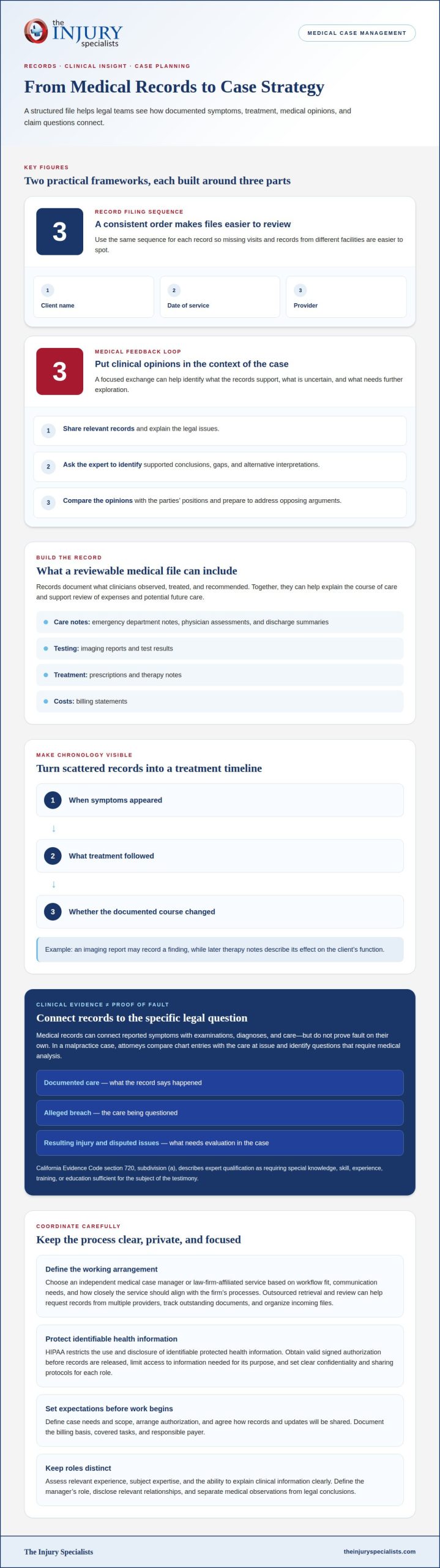
Medical records document what clinicians observed, treated, and recommended after an injury. They can connect reported symptoms with examinations, diagnoses, and care, but do not prove fault on their own. In a malpractice lawsuit, attorneys compare chart entries with the care at issue and identify questions that require medical analysis.
Relevant documents may include emergency department notes, physician assessments, imaging reports, test results, prescriptions, therapy notes, discharge summaries, and billing statements. For example, an imaging report may record a finding, while later therapy notes describe its effect on the client’s function. Together, these records help explain treatment needs and support review of medical expenses and potential future care.
Use a consistent filing sequence: client name, date of service, then provider. This makes it easier to spot a missing visit or compare records from different facilities. A timeline can then show when symptoms appeared, what treatment followed, and whether the documented course changed.
According to California Legislature, California Evidence Code section 720, subdivision (a), describes expert qualification as requiring special knowledge, skill, experience, training, or education sufficient for the subject of the testimony. Outsourced retrieval and review can help request records from multiple providers, track outstanding documents, and organize incoming files for legal analysis.
Attorneys can choose between an independent medical case manager and a law-firm-affiliated service by weighing workflow fit, communication needs, and how closely the service should align with the firm’s processes. The right arrangement supports access to records while keeping legal decisions with the attorney.
HIPAA restricts the use and disclosure of identifiable protected health information. Clinicians should obtain valid signed authorization before releasing records in response to a request, and case workflows should limit access to information needed for the intended purpose.
Hiring a medical case manager involves defining case needs, setting the scope of work, arranging valid authorization, and establishing how records and updates will be shared. The firm can then review the organized materials and decide what needs further medical or legal analysis.
To find services in a state, attorneys can use state-specific legal and medical professional networks, then assess whether a service’s process fits the firm’s workflow. Compare its approach to record coordination, review, and communication.
2. Integrating medical insights into case strategy
Medical insights are useful when attorneys connect clinical findings to specific legal questions. In a medical malpractice case, compare the documented care with the alleged breach, resulting injury, and disputed issues. A clinician’s explanation can help counsel assess what the records support and what remains uncertain.
Build a feedback loop with medical experts. First, share relevant records and explain the legal issues. Next, ask the expert to identify supported conclusions, gaps, and alternative interpretations. Then compare those opinions with the parties’ positions and prepare to address opposing arguments. For example, a witness may interpret a test result differently from the treating clinician, changing which questions counsel needs to explore.
Medical case managers handling identifiable health information must account for privacy requirements. HIPAA restricts the use and disclosure of identifiable protected health information, and healthcare providers’ business associates must meet HHS privacy and security standards. Set clear access, confidentiality, and information-sharing protocols for each role.
Document fees and payment responsibility before work begins. The written agreement should identify the billing basis, covered tasks, and responsible payer, so the firm and service provider have clear expectations.
Assess a medical case manager’s experience, subject expertise, and ability to explain clinical information to nonmedical audiences. Ask how the person will help with record interpretation and communication. Treat certifications as supporting credentials, not substitutes for relevant experience and clear explanations.
Attorney direction can create conflicts if a manager feels pressure to favor a desired case theory. Define the manager’s role, disclose relevant relationships, and separate medical observations from legal conclusions. For a process aligned with a firm’s distinct workflow, explore firm-specific medical case management.
3. Collaboration with medical professionals
Bring medical professionals into complex claims early, while the legal team is defining disputed issues. Early input helps identify which records need interpretation and whether additional expertise can clarify the patient’s condition. For example, a specialist can explain how a test result relates to a reported limitation. That perspective helps counsel identify the medical questions that matter to the claim.
Keep each consultation focused. Provide the relevant timeline, identify the question requiring clinical insight, and request an explanation in plain language. A useful discussion might address whether treatment notes describe consistent symptoms or different findings over time. The professional explains the medical evidence; attorneys use that information to shape legal arguments.
Match the professional’s background to the issue. A complex imaging question calls for experience interpreting imaging, while a rehabilitation question may require insight into functional progress. Evaluate expertise, relevant experience, and the ability to communicate with nonmedical audiences. When interpretations conflict, clarify what each opinion relies on before deciding how it informs the strategy.
Set a clear handoff between legal and clinical teams. Identify who will provide records, who will frame questions, and how the medical professional will share observations. In a high-volume file, a concise case summary can direct attention to key events without replacing the full record. This structure helps teams distinguish documentation errors from differences in timing or clinical perspective.
Medical input can also inform settlement analysis by clarifying treatment needs, functional effects, and unresolved issues. Ask professionals to explain what the evidence supports, rather than decide the legal value of a claim. If a clinician may serve as a witness, identify technical terms that need plain explanations. Clear communication keeps the patient’s medical experience distinct from legal conclusions and helps counsel present evidence accurately.
4. Insurance communication and treatment monitoring
Consistent insurance documentation gives the legal team a traceable record of claim activity. Log each call, email, and claim status update with the date, participants, topic, and any stated next step. For example, an adjuster’s request for a treatment record should be logged with the date it arrived and the firm’s response. This helps teams track open issues and prepare accurate updates.
Treatment monitoring adds context to those communications. Record appointments, new recommendations, completed care, and changes the client reports. If a therapy note describes improved movement while a later visit records continuing limitations, preserve both entries and their dates. The sequence helps attorneys understand the course of treatment without treating a single update as the full medical picture.
Connect each treatment update to relevant insurance activity. A new diagnostic result may prompt a request for supporting documents, while a treatment recommendation may raise questions about future care. Keep the underlying record with the communication log so the team can distinguish documented facts from an adjuster’s position or an unresolved question.
Before settlement discussions, review the timeline for gaps, outstanding records, and changes in care. Compare the insurer’s stated position on liability with documented events and medical information. In a malpractice claim, for example, the file may need to show how the alleged conduct relates to the injury. If settlement does not resolve the dispute, the same organized history can support litigation preparation.
A reliable workflow assigns responsibility for each update, records follow-up actions, and routes new documents to the case file. This keeps attorneys, case staff, and medical professionals aligned as treatment evolves. To coordinate attorney-focused medical case management around your firm’s process, connect with the Attorney Referral Program.
The Injury Specialists: Attorney Referral Program, medical case management based on firms distinct process, marketing and networking to grow referral partners.
The Injury Specialists supports law firms seeking medical case management aligned with their distinct processes. Its Attorney Referral Program integrates case management with marketing and networking to help firms grow referral partnerships. This can suit firms looking for a more coordinated way to connect case workflows with professional relationships.
For firms building broader referral networks, support also includes Physician Referral Services, Chiropractic and Physical Therapy Referrals, and Imaging Center Referrals. These offerings connect with different parts of the medical referral ecosystem, while the firm’s own process remains central to case management.
If your firm wants to strengthen referral relationships or align medical case management with its workflow, contact The Injury Specialists to discuss the Attorney Referral Program.
Build a Case Workflow That Scales
The next step is to turn your firm’s approach into a consistent operating framework. Define how medical information enters a file, who reviews it, how updates reach the legal team, and which decisions require attorney oversight. A shared process can help staff handle cases consistently while leaving room for case-specific judgment.
Use that framework to identify where coordination needs support, such as managing professional relationships or aligning case management with your firm’s distinct process. This gives your team a practical basis for deciding whether additional medical case management for attorneys fits its workflow and growth priorities.
The Injury Specialists can discuss how its Attorney Referral Program and related professional networking support law firms. Contact The Injury Specialists to explore a path that fits your firm’s needs. A clearly defined process puts your team in a stronger position to move forward with focus.
Frequently Asked Questions
How Does Case Management Work Inside a Personal Injury Law Firm?
It gives each case a defined workflow from intake through resolution. After conflict checks, the firm opens a file, assigns responsibility for tasks, and tracks procedural dates alongside client communications. For example, staff may coordinate document production for discovery while attorneys prepare deposition questions. If negotiations do not resolve the dispute, the team shifts to litigation preparation and manages the case under court deadlines.
What Does Case Management Mean in Legal Terms?
Legal case management is the organized handling of a matter’s information, tasks, communications, and procedural milestones. In a lawsuit, it can include preparing for a case management conference, coordinating discovery, tracking motions, and scheduling depositions. A case management order may set deadlines and procedural rules. The process helps the legal team understand what must happen next and who is responsible for each task.
What does medical case management for attorneys involve?
It coordinates medical information and case-related communication so attorneys can evaluate how healthcare evidence fits the legal issues. A case manager may organize incoming provider documents, note changes in treatment status, and route questions to the appropriate professional. The role supports the legal team’s review; it does not replace the attorney’s legal judgment or the clinician’s responsibility for medical care.
What services do medical case managers provide to personal injury attorneys?
Services can include coordinating medical records and referrals, organizing case information, and supporting communication between legal and medical professionals. Depending on the firm’s needs, medical provider referrals may involve physicians, chiropractors, physical therapists, or imaging centers. Case management technology can help organize information across those relationships. The attorney remains responsible for legal strategy, while healthcare providers make clinical decisions and deliver treatment.
How are medical case management fees billed, and who pays them?
Document the billing basis, covered tasks, and responsible payer in a written agreement before work begins.

Leave A Comment
You must be logged in to post a comment.